


 by Tom Gurney
Tom Gurney BSc (Hons) is an art history expert with over 20 years experience
Published on June 19, 2020 / Updated on October 14, 2023
Email: tomgurney1@gmail.com / Phone: +44 7429 011000
Landscape with a Group of Trees and a Mule: Introduction
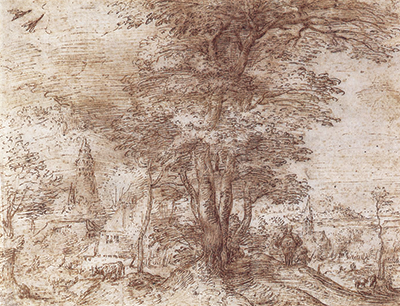
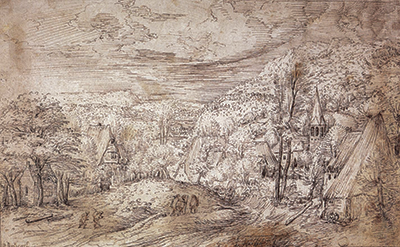
A cluster of trees divides two views in Pieter Bruegel the Elder’s Landscape with a Group of Trees and a Mule. At the left, roofs gather around a pointed tower. At the right, a man leads a mule into a valley where another church stands. The 2001 exhibition catalogue gives the unsigned drawing a date of about 1554 and records it in a private collection. The Phoebus Foundation now identifies the sheet as part of its collection in Antwerp, under the title Village with a Group of Trees and a Mule. The drawing has appeared under both titles, and the four trees and small descending party identify the same composition [1] [2] [4].
This work across Bruegel’s career
Tower of Babel
1563The Harvesters
1565Peasant Wedding
1568Children's Games
1560Triumph of Death
1562–1563Landscape with a Group of Trees and a Mule
This artworkContents
- Introduction
- A View on Either Side of the Trees
- The Mule and the Near Ground
- The Speed of the Pen
- Date and Collection History
- Annotated Details
A View on Either Side of the Trees
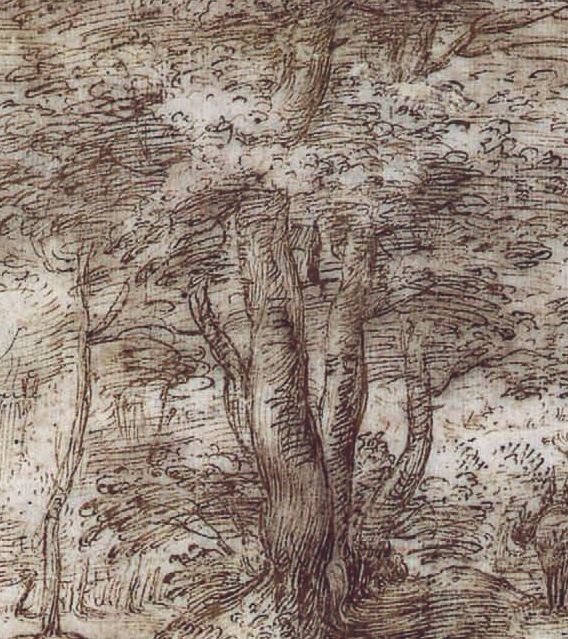
Begin at the base of the central trunks. Their lines converge where the ground rises, then separate again above the bank. A narrower trunk to the left has more space around it and makes it easier to see how the cluster stands in depth. Darker strokes gather in the larger trunks and in patches of foliage. Branches extend to the right and left, where they interrupt the lighter areas of sky. The trees are wide enough to divide the sheet into two views while allowing the rooflines and hills to remain visible on both sides.
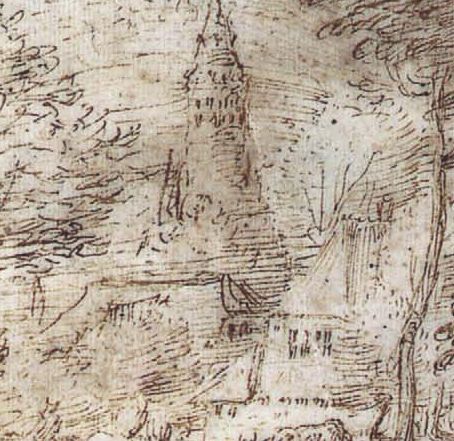
The left view opens past an angled roof towards a tall tower. Bruegel uses relatively long strokes for the roof and short ones to suggest openings at different heights on the tower. Its outline registers quickly even where it is crossed by other pen marks. Compare the roof with the irregular forms of the neighbouring trees. Each built surface gives the eye a short straight edge to follow. The structures can be recognised from discontinuous lines because the foliage is organised differently around them [1].
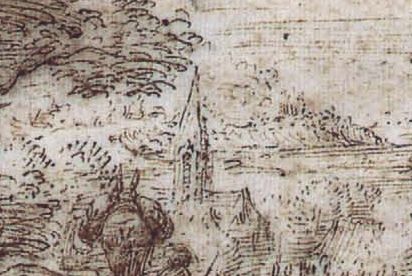
The view to the right has a different scale. A small steeple stands below and beyond the nearest branch. Much of the ground around it can be seen at once, even though individual buildings are only briefly described. The distant horizontal lines give the viewer room to move past the church towards the right edge. This opening is narrower than the full expanse of the trees, but it appears to continue much farther back. The two views therefore do different work. The left makes the village tangible through roofs and walls, and the right extends the route into lower country.
Annotated Details from Landscape with a Group of Trees and a Mule
Look around the central tree group to find the village and the descent into the valley.
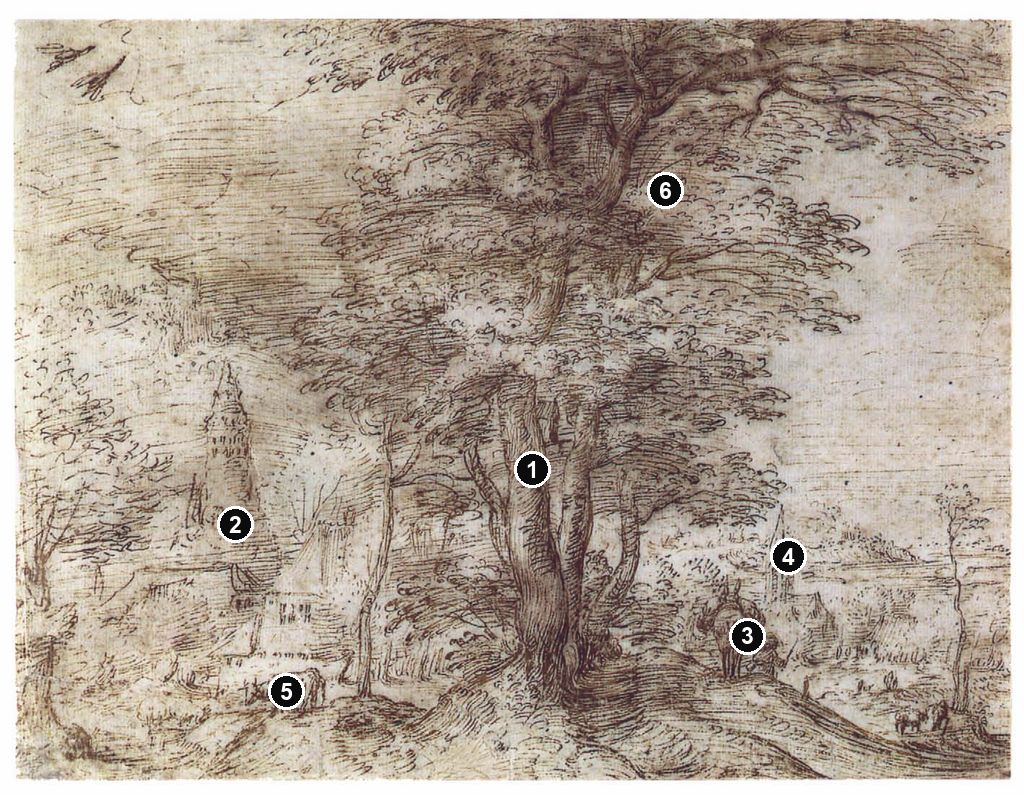
Details from LANDSCAPE WITH A GROUP OF TREES AND A MULE
Six details show the two views and the marks that connect them.
The central trunks
Several trunks rise together and divide the two views.
The tower and roofs
Angular roofs and a pointed tower show between the trees.
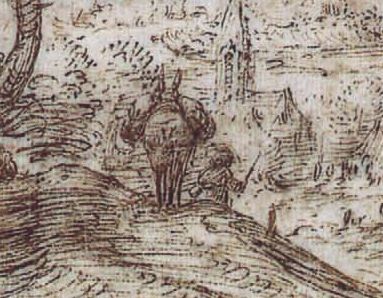
The man and mule
The small pair follows the road down the right-hand slope.
The distant church
A small steeple stands in the opening beyond the nearest trees.
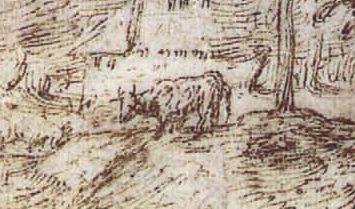
The cow at the left
A small cow stands below the village roofs.
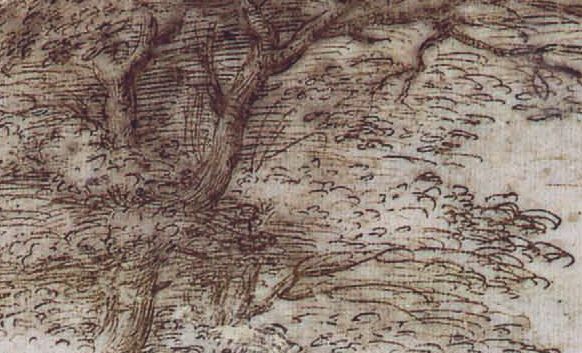
Broken strokes in the foliage
Clusters of short strokes and open paper describe the spreading foliage.
Pieter Bruegel the Elder, Landscape with a Group of Trees and a Mule, about 1554. The Phoebus Foundation, Antwerp. Reproduced from the 2001 exhibition catalogue, cat. no. 17, via Wikimedia Commons. Public domain.
The Mule and the Near Ground
Look below the church at the right for the man and mule. The exhibition catalogue describes them as descending towards the valley. Bruegel makes them large enough to see in relation to the path, while leaving their forms partly absorbed by the adjoining pen strokes. The track appears beneath them as a group of lines that bends around the bank and widens nearer the bottom. The mule supplies a measure of how narrow that route is where the figures are walking [1].
There is also a cow on the other side of the trees. The catalogue compares its shape with the cattle in Bruegel’s Landscape with Fortified City. It gives the left slope another scale, close to the roofs but lower down. You can move from the animal to the nearby house and up to the tower, then across the trunks to the descending group. The eye passes between one side and the other through a series of forms that belong to different distances. The title directs attention to the mule and the central trees, and a closer look makes the smaller animal at the left part of the same comparison [1].
The Speed of the Pen
Across the sheet, a stroke can be strong where the pen first meets the paper and weak where it moves on. The exhibition catalogue draws attention to the uneven deposit of ink and the broken lines. Some lines run together in dark patches beneath the branches. Others separate as they approach a light area. Parallel sweeps describe sections of the bank, and the orientation of those sweeps changes with the ground. The same rapid handling helps differentiate foliage from earth and gives the sky marks that can be read at a much greater distance [1].
Orenstein compares the sweeping hatching with marks in drawings by Titian and Domenico Campagnola. The angular roofs also recall Bruegel’s own Path through a Village, shown below. The Leiden drawing gives the road a more continuous place among the roofs and slopes. In the Phoebus sheet the group of trunks occupies that central position. Compare the gables near the left of each sheet, where short angled strokes are enough to describe a building partly screened by vegetation. The similar strokes can serve rather different arrangements [1].
The pen sometimes passes over an area already worked. The catalogue mentions the tower at the left as a place where a building seems to have been set over hatching. Such overlaps have been used to suggest that the sheet might have been a compositional sketch. Its precise function remains open. What can be seen is a design in which the large trunk, the open sky and the small tower have been fitted together without smoothing away every trace of the pen’s movement [1].
Date and Collection History
The drawing carries no signature, so attribution and dating draw on its handling of the pen and comparisons with other work. Orenstein finds grounds for setting it towards the end of Bruegel’s Italian journey, in part through similarities to dated sheets. The Phoebus Foundation also uses about 1554. The broken strokes and loose handling are part of the dating discussion. Close parallels with other drawings provide a stronger basis for the date than the appearance of any single motif would on its own [1] [2].
Christie’s catalogued the drawing in 2015 as A Village with a Group of Trees and a Mule. Its catalogue connects that sheet with the example included in the 2001 Bruegel exhibition. The Phoebus Foundation’s later publication illustrates the same composition and credits its Antwerp collection. The change from an unnamed private collection in the exhibition catalogue to a named collection in the later publication explains why different records give different locations. The Foundation has also documented lending it for the Bruegel exhibition at the Kunsthistorisches Museum in Vienna [4] [2] [3].
Discussion
Which detail in this work most changes how you read it?
Frequently Asked Questions
The left view opens past an angled roof towards a tall tower. Bruegel uses relatively long strokes for the roof and short ones to suggest openings at different heights on the tower. [1]
Look below the church at the right for the man and mule. The exhibition catalogue describes them as descending towards the valley. [1]
Across the sheet, a stroke can be strong where the pen first meets the paper and weak where it moves on. The exhibition catalogue draws attention to the uneven deposit of ink and the broken lines. [1]
References
- Nadine M. Orenstein, ed., Pieter Bruegel the Elder, Drawings and Prints, 2001, cat. nos. 5 and 17, View source.
- The Phoebus Foundation, collection publication, Village with a Group of Trees and a Mule, View source.
- The Phoebus Foundation, Loans and Collaborations, 2020 brochure, View source.
- Christie’s, A Village with a Group of Trees and a Mule, lot 31, London, 7 July 2015, View source.








