


 by Tom Gurney
Tom Gurney BSc (Hons) is an art history expert with over 20 years experience
Published on June 19, 2020 / Updated on October 14, 2023
Email: tomgurney1@gmail.com / Phone: +44 7429 011000
Pastoral Landscape: Introduction
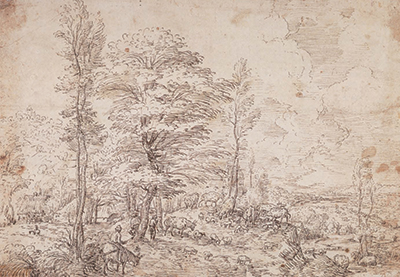
In Pieter Bruegel the Elder’s Pastoral Landscape, cattle and sheep graze among tall trees while a few people tend them. Beyond the pasture, brief strokes suggest a river valley and a settlement. The Nasjonalmuseet in Oslo keeps the pen drawing under inventory number NG.K&H.B.15647 and dates it to probably 1552. The date sits with a partly legible signature that was crossed out by another hand. Hans Mielke’s study of the drawing helped bring it into Bruegel’s recognised body of work. It has since served as a point of comparison for several landscapes from early in his career [1] [2].
This work across Bruegel’s career
Tower of Babel
1563The Harvesters
1565Peasant Wedding
1568Children's Games
1560Triumph of Death
1562–1563Pastoral Landscape
This artworkContents
- Introduction
- Trees around the Pasture
- Livestock and Figures
- The Valley and the Open Sky
- A Crossed-Out Signature and an Early Date
- Annotated Details
Trees around the Pasture
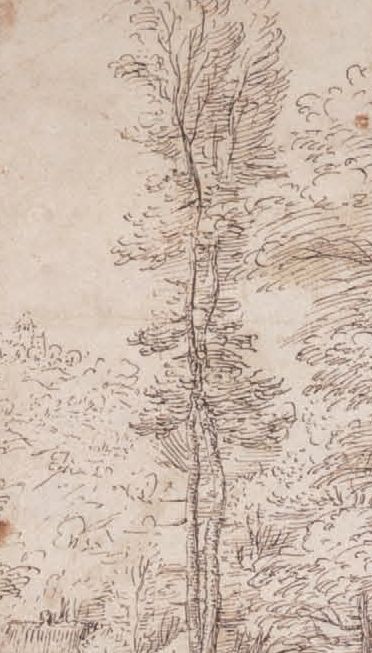
Start with the trees rather than the horizon. A slender trunk at the left rises almost the full height of the sheet, while the broader tree just to its right spreads branches in several directions. It divides the ground behind it into small openings. A third, thinner tree stands farther right. Bruegel gives each a different kind of outline so the eye can separate neighbouring trunks and crowns even where the foliage overlaps. The group can be read as a wooded margin before the viewer has identified any one animal beneath it.
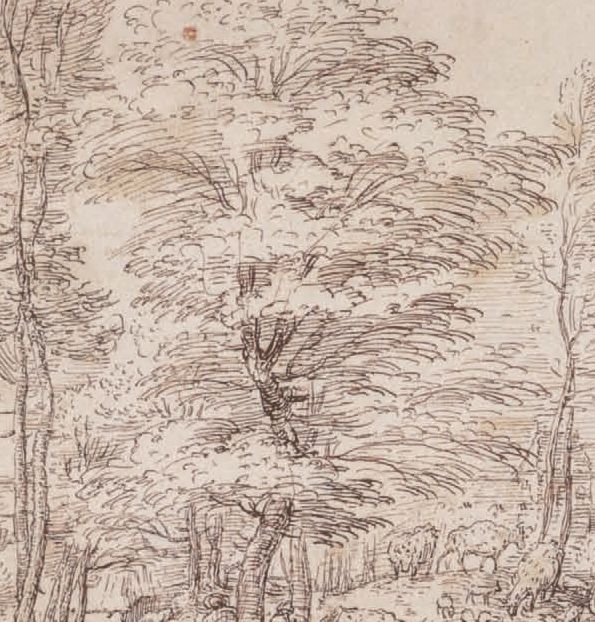
The broad tree has dark accents along its trunk and branches. Its foliage is suggested by a succession of small curved marks, many repeated along the same direction before a branch turns or the foliage thickens. Light paper shows through elsewhere. Compare the lower boughs with the foliage above and the pen gives a sense of weight at the base and room for the crown to spread. It is this lively handling of the leaves, especially the small hooked shapes, that the exhibition catalogue compares with the bush in the Braunschweig drawing [2].
The trees also make the pasture easier to locate. The low ground at their feet has room for animals to occupy individual positions. An open interval to the right then leads towards more distant country. The resulting view is unevenly divided. The nearest trees occupy a large part of the left and central area, and the simplest stretches of distant terrain can be seen beside them. The whole composition depends on the relation of those two areas, a comparatively concentrated group and a landscape only partly visible through and around it.
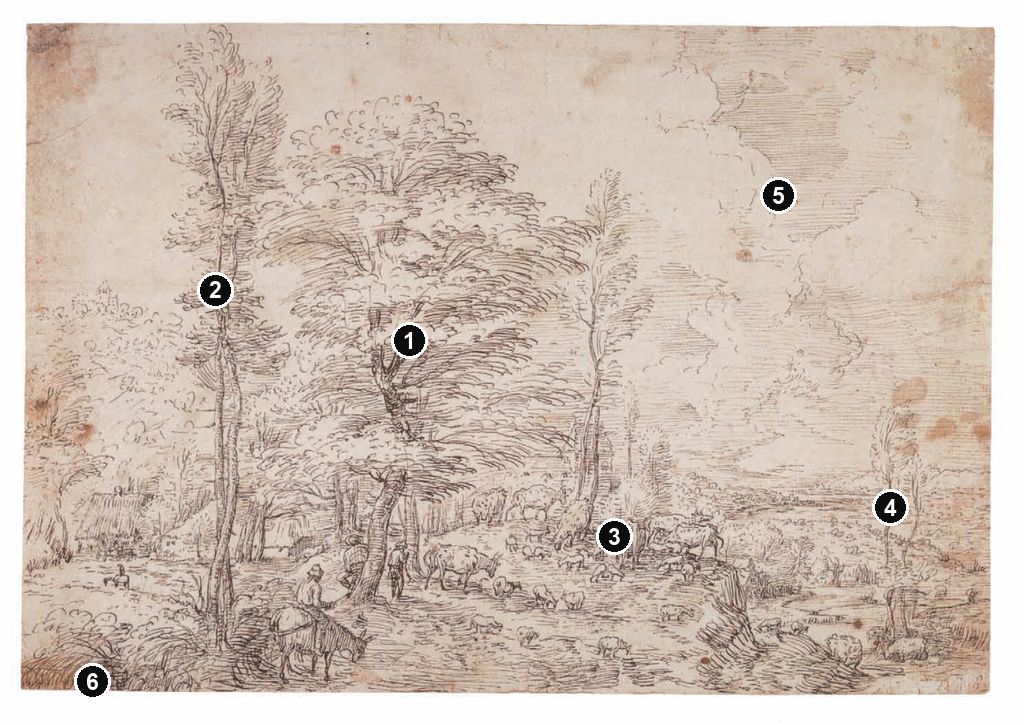
Annotated Details from Pastoral Landscape
Follow the tree trunks down into the pasture, then look out past the herd.
Details from PASTORAL LANDSCAPE
Six details show the trees, animals, sky and inscription area.
The broad central tree
Short hooked strokes run along the branches of the broadest tree.
The tall slender trunk
A narrow trunk gives the left side of the pasture a vertical edge.
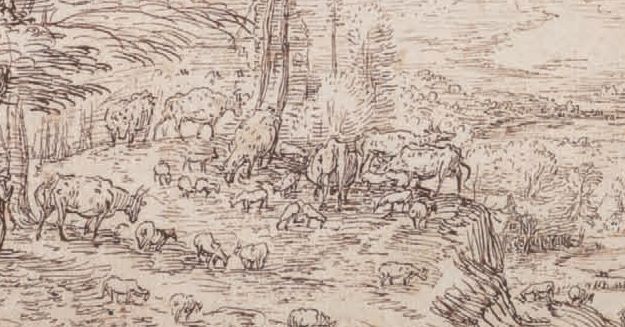
Livestock in the pasture
The herd is spread across the open ground among the trees.
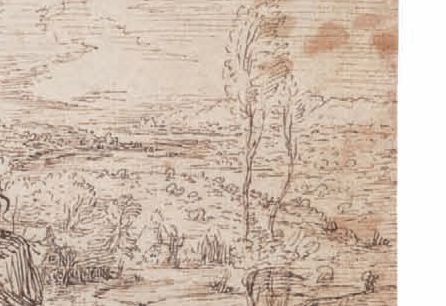
The valley beyond the pasture
Short marks suggest distant low ground and settlement.
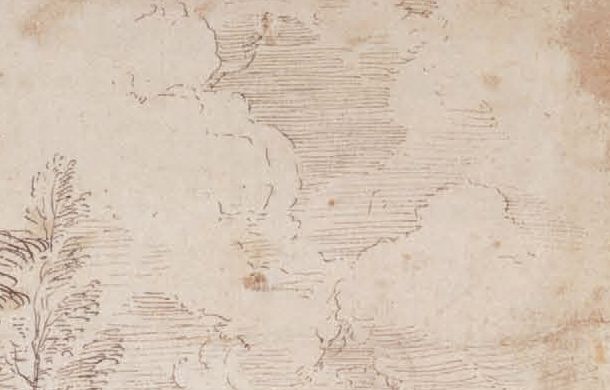
Clouds and hatching
Parallel strokes break around the irregular cloud edges.
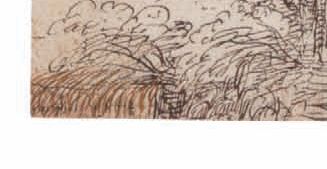
The lower-left inscription area
The catalogue records the crossed-out name and date near the lower left.
Pieter Bruegel the Elder, Pastoral Landscape, probably 1552. Nasjonalmuseet, Oslo, NG.K&H.B.15647. Reproduced from the 2001 exhibition catalogue, cat. no. 3, via Wikimedia Commons. Public domain.
Livestock and Figures
The herd appears in small groups among the trees and across the clearer ground. The catalogue identifies cows and sheep watched by herdsmen. A few forms are particularly solid because Bruegel has drawn their backs in longer lines. Others are built up with much shorter marks. The legs and heads become easier to distinguish by comparing one animal with a nearby patch of vegetation. The sketch leaves parts of some forms open, so a reader moves between recognising a group of livestock and finding a single discernible animal [2].
Look also at the people among the trunks. Their presence helps establish the height of the trees, while the livestock gives a measure of the open ground. Much of what distinguishes a person from an animal here depends on angle and posture. A relatively upright mark can stand out among the more horizontal backs of the herd. The viewer is given enough evidence to recognise activity in the pasture and enough freedom to move on to the space around it. No individual herdsman becomes the centre of the whole picture.
The Valley and the Open Sky
The strokes change as the view extends past the pasture. Behind the largest trees, small marks and open spaces suggest land falling towards water. The exhibition catalogue reads a river and a city in the distance. It also observes how summarily Bruegel described this part of the scene. The town can be sought through tiny repetitions and changes of contour. The pen does much less there than in the central crown, inviting a viewer to read the suggestion of a settlement with only a few visible clues [2].
Above the distant ground, parallel strokes occupy patches of sky. Trace the interruptions around the cloud outlines and the hatching becomes easier to see as sky instead of a uniform surface. The way those short lines meet the broken cloud edges is another feature that the catalogue compares with the Braunschweig sheet. The early landscape was also discussed in relation to Italian drawing, particularly the emphatic parallel hatching and loose penwork. The catalogue considers Peeter Baltens as another possible point of comparison, especially for the handling of small figures and the space around them [2].
A Crossed-Out Signature and an Early Date
The exhibition catalogue describes a partly legible name and the date 1552 at the lower left. Another hand crossed them out. Mielke treated the signature as significant, and the 2001 catalogue compares it with the inscriptions on Wooded Landscape with Mills and Path through a Village. Its authors accept those signatures as Bruegel’s. The Nasjonalmuseet’s display of the date as probable reflects the judgement involved in reading the evidence. The record also notes that the drawing entered the collection in 1903. The exhibition catalogue traces it back to Johan Christian Clausen Dahl and his heirs [1] [2].
The catalogue also records a shield-and-cross watermark. The watermark belongs to the paper itself. The crossed-out writing and the later collection history show what happened to the sheet after the paper was made [2].
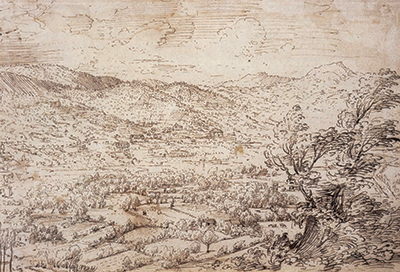
The date matters outside this particular sheet. In Mountain Landscape with Ridge and Valley, shown below, the bush on the right gives the viewer a way to compare foliage made up of short hooked strokes. Similar broken cloud outlines and little loops for distant trees add to the evidence. The Braunschweig sheet had previously been given to other hands. Comparing several parts of it with the signed Oslo drawing helped support the attribution to Bruegel and a date of about 1552 [2].
The two landscapes remain distinct in the way they establish depth. In the Oslo drawing, the tree group and grazing animals occupy a substantial area. The lower ground opens around them in several directions. In the Braunschweig sheet the largest foliage stands at an edge above a broad valley. Looking back and forth between the near trees makes it possible to see the marks that connect the drawings and the different jobs those marks do in each composition [1] [2].
Discussion
Which detail in this work most changes how you read it?
Frequently Asked Questions
The broad tree has dark accents along its trunk and branches. Its foliage is suggested by a succession of small curved marks, many repeated along the same direction before a branch turns or the foliage thickens. [2]
The herd appears in small groups among the trees and across the clearer ground. The catalogue identifies cows and sheep watched by herdsmen. [2]
The strokes change as the view extends past the pasture. Behind the largest trees, small marks and open spaces suggest land falling towards water. [2]
References
- Nasjonalmuseet, Pastoral Landscape, NG.K&H.B.15647, View source.
- Nadine M. Orenstein, ed., Pieter Bruegel the Elder, Drawings and Prints, 2001, cat. nos. 2–5, View source.








