


 by Tom Gurney
Tom Gurney BSc (Hons) is an art history expert with over 20 years experience
Published on June 19, 2020 / Updated on October 14, 2023
Email: tomgurney1@gmail.com / Phone: +44 7429 011000
The Resurrection of Christ: Introduction
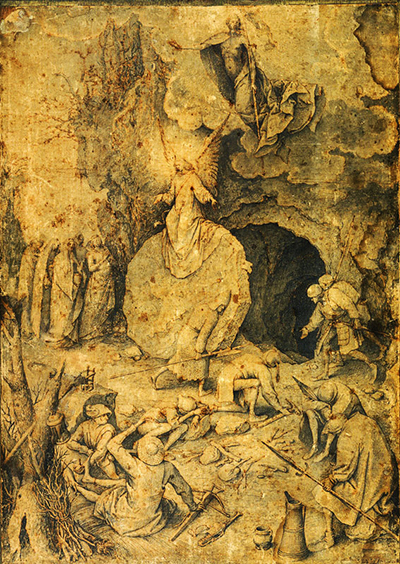
In Pieter Bruegel the Elder’s The Resurrection of Christ, a winged angel is poised over a great stone, guards stir below, and Christ appears above the tomb. The drawing is on loan from the Stichting Museum Boijmans Van Beuningen to the museum in Rotterdam, where it is catalogued as N 121 (PK) and dated about 1562. It measures 43.1 by 30.6 centimetres and is adhered to an oak panel. The drawing uses brown ink, grey brushwork and grey-blue wash. Philips Galle’s engraving after it provides a second way to see a design whose details have become difficult to read in the original [1] [2] [3].
This work across Bruegel’s career
Tower of Babel
1563The Harvesters
1565Peasant Wedding
1568Children's Games
1560Triumph of Death
1562–1563The Resurrection of Christ
This artworkContents
- Introduction
- The Stone and the Tomb
- The Guards and the Figure above Them
- The Surface of the Drawing
- From Drawing to Engraving
- Annotated Details
The Stone and the Tomb
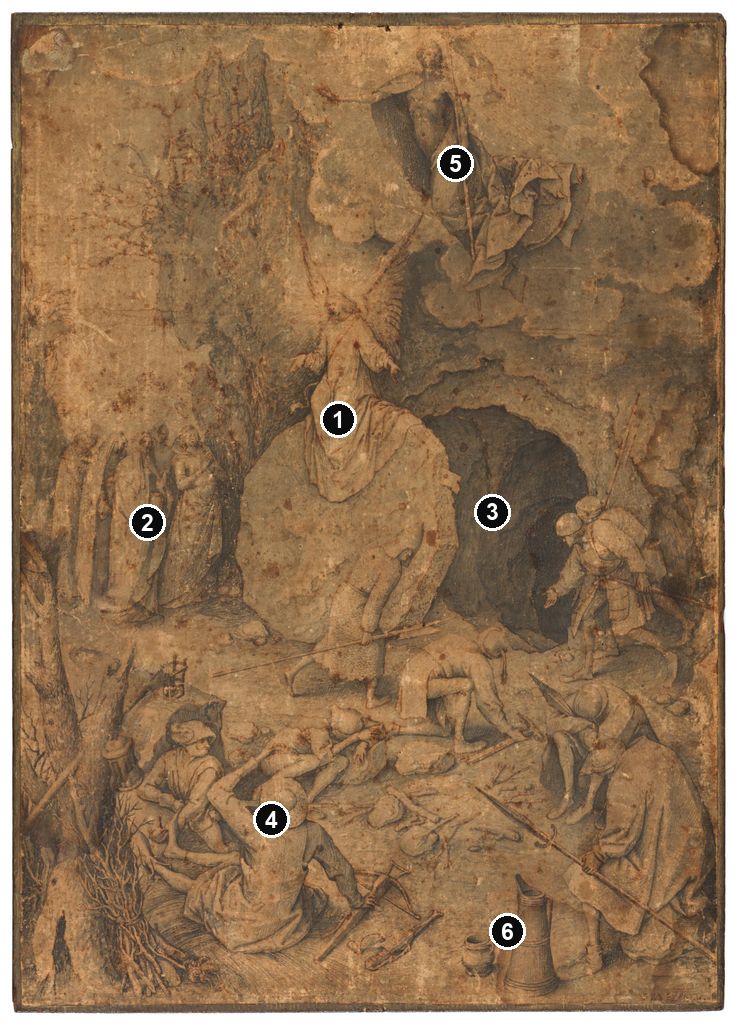
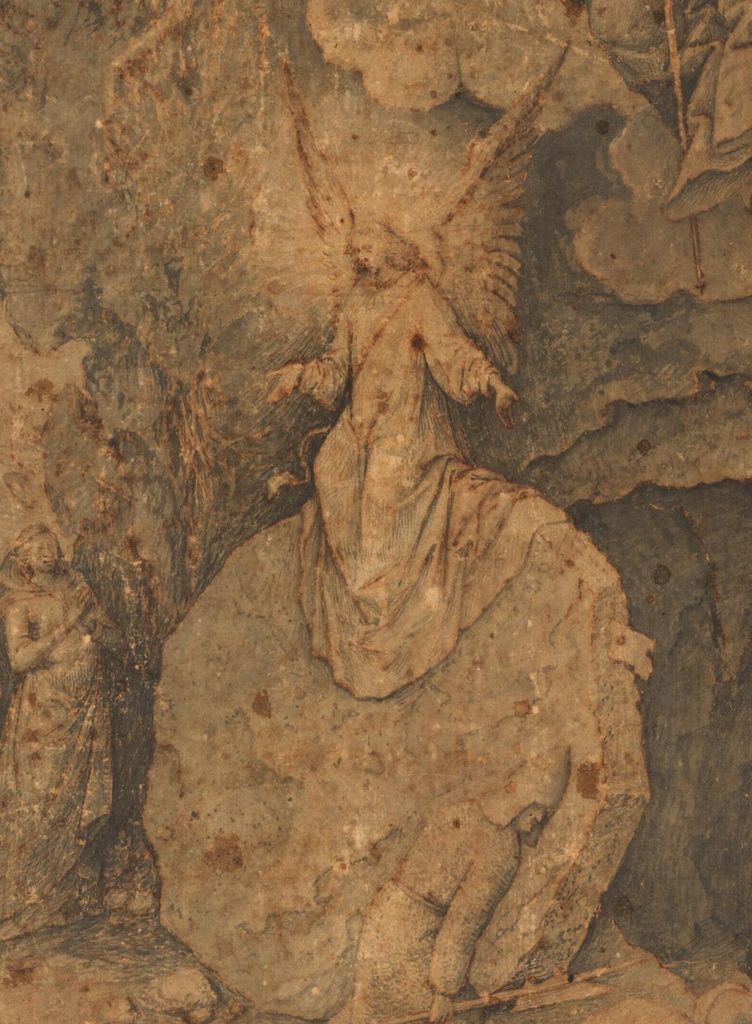
Start in the middle of the drawing, where an expanse of pale paper describes the stone. Its broad rounded edge is visible against the darker opening to the right. The angel’s wings and drapery rise above this shape. Parts of the figure are faint, but the arrangement of the stone, the robes and the opening still makes a clear cluster. It is one of the few places where the difference between the light and dark passages can be grasped easily without enlarging the drawing.
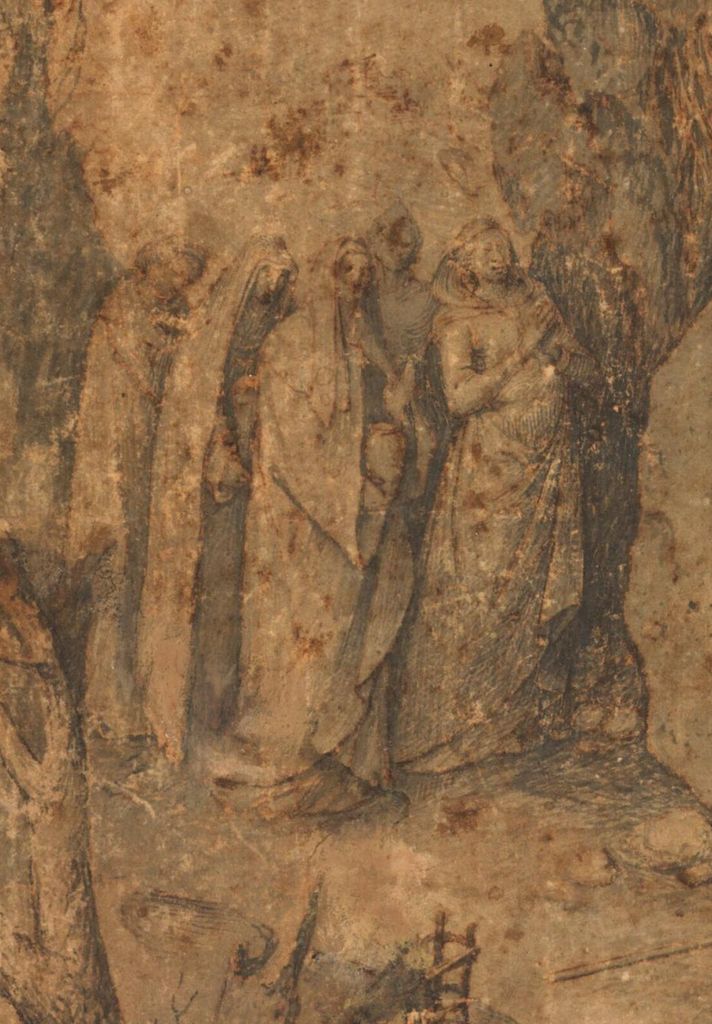
Three women approach at the left, beyond the group of soldiers below. They stand close together and their vertical forms help distinguish them from the movement of the guards. In Matthew’s account, the women come to the tomb and an angel rolls the stone away. The soldiers are terrified and the angel tells the women that Christ has risen. Bruegel brings these arrivals and reactions together around the large stone. The angular edges and heavily worked outlines in the foreground make the women’s more contained grouping especially apparent once you know where to look [4] [1].
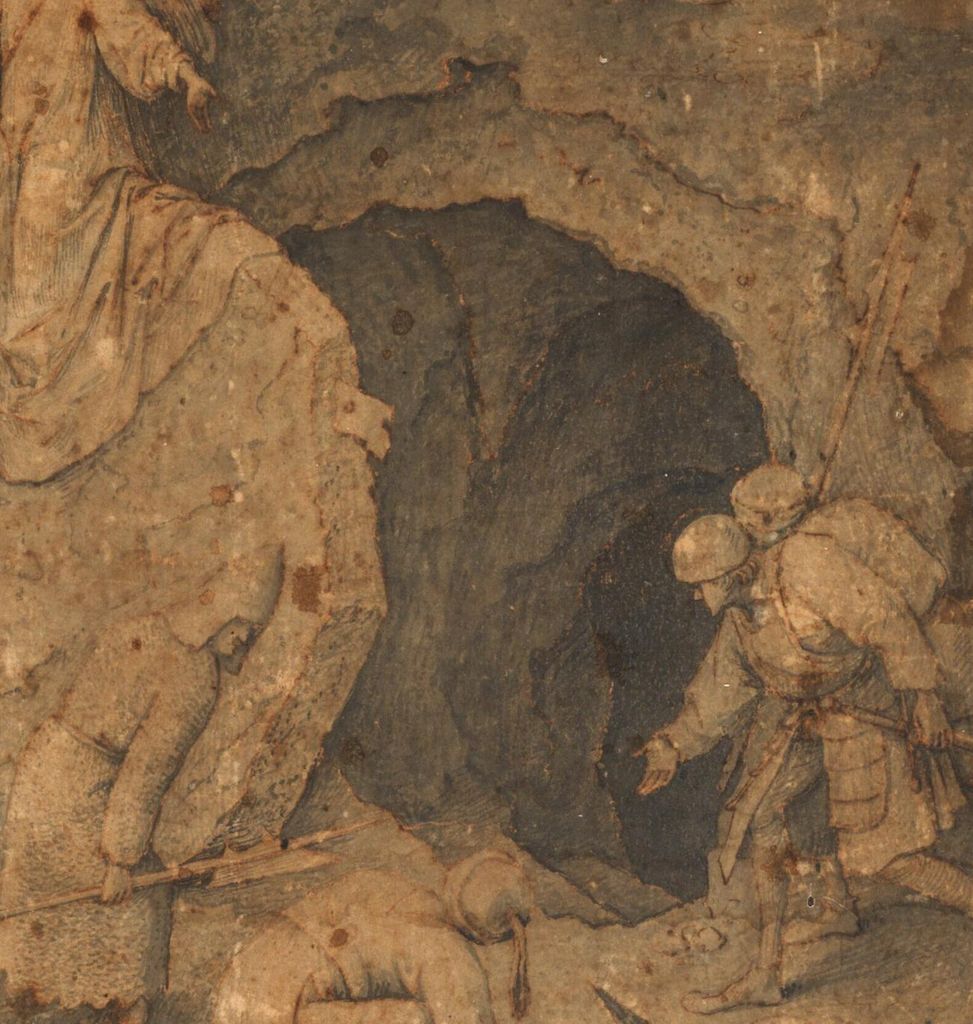
The cave to the right of the angel remains a strong area of darkness even where the surrounding paper has become difficult to read. Its curved edge cuts across the texture of the rock. Around it, a number of shorter outlines pick up the shape of the ground. The open tomb is one part of a larger hillside, and it takes a moment to see where its outline ends and the natural surfaces begin. The brightness of the stone makes that distinction easier to follow.
Annotated Details from The Resurrection of Christ
Start with the angel, then look down to the figures on the ground and up to Christ.
Details from THE RESURRECTION OF CHRIST
Six details follow the arrangement of the original drawing.
The angel and the stone
The angel appears above the pale stone at the tomb.
The approaching women
Three women stand close together at the left.
The open tomb
The dark opening of the tomb contrasts with the stone.
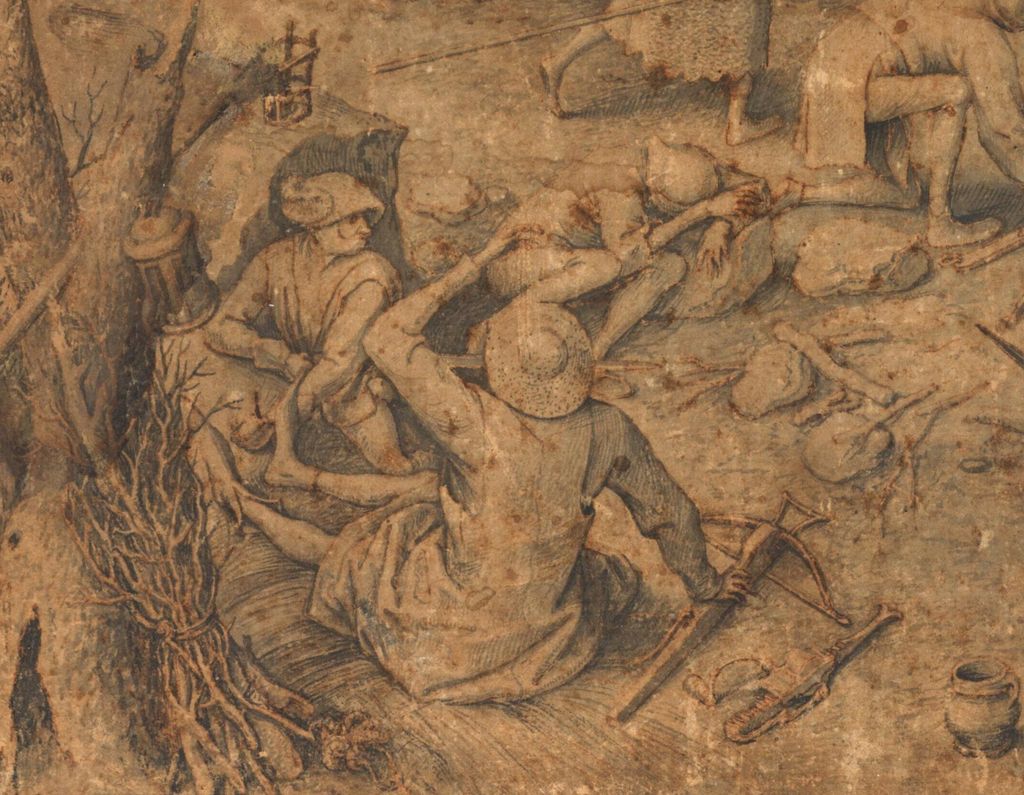
The guards below
The guards turn and bend across the ground beneath the tomb.
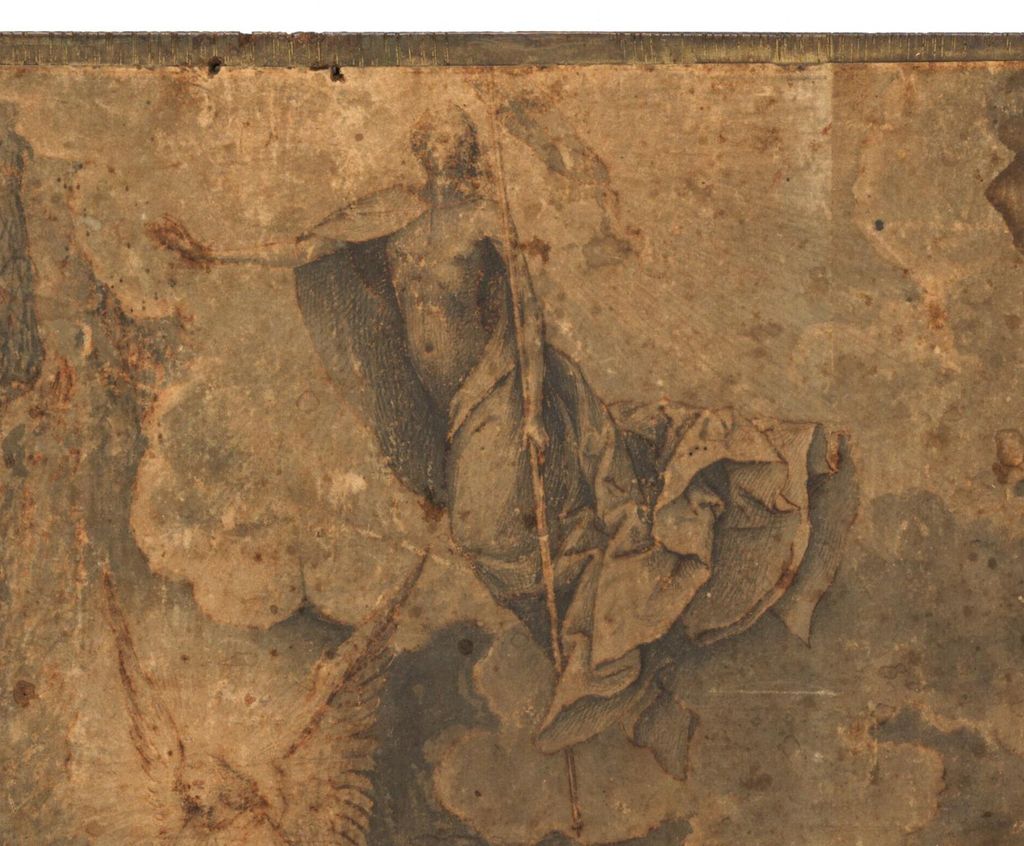
Christ above the tomb
Christ appears in the clouds above the angel.
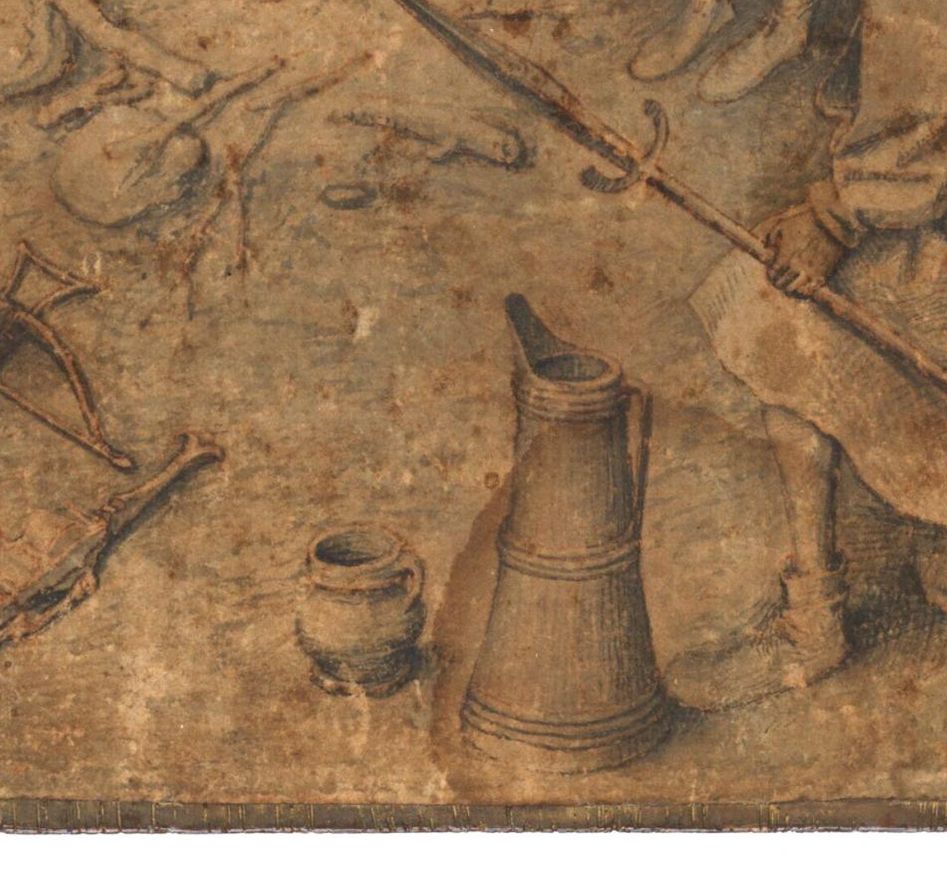
Vessels on the ground
Two vessels help establish the scale of the foreground.
Pieter Bruegel the Elder, The Resurrection of Christ, about 1562. Image source: Museum Boijmans Van Beuningen, N 121 (PK), on loan from Stichting Museum Boijmans Van Beuningen. Reproduction via Wikimedia Commons, CC BY-SA 4.0. The splash was resized. The numbered overview and detail crops are adaptations shared under the same licence.
The Guards and the Figure above Them
Below the stone, the guards form a succession of forms seen from different angles. At the left, one figure has turned and another raises an arm. Others are bent or stretched across the ground. Their arms and legs create a less stable arrangement than the three upright women. Objects around the soldiers are spread over the floor of the scene. At the lower right, a tall vessel and a smaller one give a sense of how close the viewer is to this part of the ground.
Christ’s appearance above the angel extends the scene into the upper part of the sheet. The drapery and dark shapes around him can be picked out where the surface permits. Looking from below, the eye moves past the limbs of the guards to the stone and then up to the figure in the clouds. Matthew tells the story through the women’s arrival and what they hear from the angel. The drawing gives the risen Christ a visible place within the sequence. His position above the tomb presents the event to viewers as well as showing the people through whom it becomes known [4] [1].
The Surface of the Drawing
The Rotterdam catalogue describes a combination of brown pen lines, grey brushwork and washes, with traces of green bodycolour. Bruegel’s fine lines can still be found along figures and objects, but some passages are difficult to assess because of discolouration, damage and later retouching. The museum discusses how infrared imaging gives a clearer account of some contours. A photograph of the sheet in visible light records the appearance of the surviving object. The engraving and technical images give other ways of recovering information within it [1].
The museum records an inscription at the lower right and describes it as partly covering an older inscription or possible signature. The object record lists no signature. Attribution has instead depended on close examination and comparison with other works. The 2001 catalogue describes earlier doubts about the use of the brush and credits Fritz Grossmann’s study with establishing a stronger case for Bruegel. It also compares the elongated figures and costume details with Bruegel’s Fall of the Rebel Angels, which helps explain the approximate date assigned to the drawing [1] [2].
From Drawing to Engraving
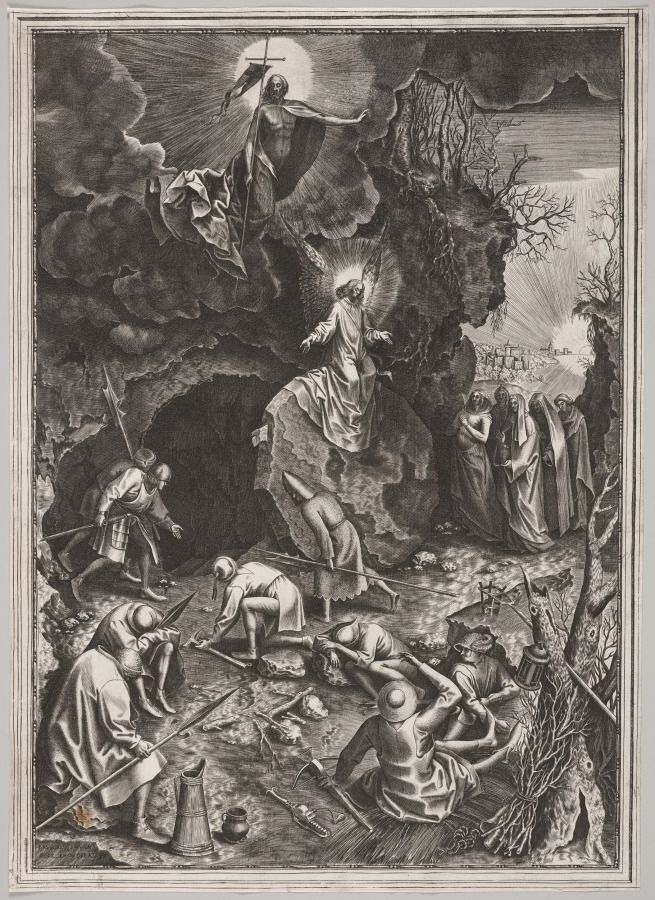
The contours are indented, which the catalogues connect with the transfer of the composition for printing. The engraving was made by Philips Galle and published by Hieronymus Cock. Comparing the two shows how much of the arrangement survives the change of medium. The angel still sits above the stone, the soldiers still spread across the lower ground, and Christ still appears high above them. Their positions are reversed in the print. The women approach from the right in Galle’s image, while they stand at the left in the drawing [1] [2] [3].
The Cleveland impression, shown below, makes the contrast between the figures and the hillside easier to see. In the engraving, Galle built shadows from groups of closely spaced strokes. The lines change direction at the edges of limbs, garments and rock faces. Some open areas of paper contribute directly to the light around Christ and the angel. The effect can be compared with the brown lines and areas of tone in the drawing, where a transition can be set out with the brush. The comparison shows how the engraver made Bruegel’s design legible with marks that could be repeated in print [1] [3] [2].
The engraving can clarify a gesture that is now hard to see in the drawing, and the drawing can reveal what was involved in adapting it for another medium. Begin with the arms of the soldier near the bottom, then move up to the two silhouettes separated by the clouds and the stone. The same sequence survives in both works. The strongest darks and lights give it a different emphasis in the engraving, while the original preserves the scored contours and remnants of wash that belong to the earlier preparation of the image [1] [2].
Discussion
Which detail in this work most changes how you read it?
Frequently Asked Questions
In Pieter Bruegel the Elder’s The Resurrection of Christ , a winged angel is poised over a great stone, guards stir below, and Christ appears above the tomb. The drawing is on loan from the Stichting Museum Boijmans Van Beuningen to the museum in Rotterdam, where it is catalogued as N 121 (PK) and dated about 1562. [1][2][3]
The Rotterdam catalogue describes a combination of brown pen lines, grey brushwork and washes, with traces of green bodycolour. Bruegel’s fine lines can still be found along figures and objects, but some passages are difficult to assess because of discolouration, damage and later retouching. [1]
References
- Museum Boijmans Van Beuningen, The Resurrection of Christ, N 121 (PK), including catalogue entry by Peter van der Coelen, View source.
- Nadine M. Orenstein, ed., Pieter Bruegel the Elder, Drawings and Prints, 2001, cat. nos. 96–97, View source.
- Cleveland Museum of Art, The Resurrection of Christ, 1996.5, View source.
- United States Conference of Catholic Bishops, Matthew 28, View source.








