


 by Tom Gurney
Tom Gurney BSc (Hons) is an art history expert with over 20 years experience
Published on June 19, 2020 / Updated on October 14, 2023
Email: tomgurney1@gmail.com / Phone: +44 7429 011000
Ripa Grande in Rome: Introduction
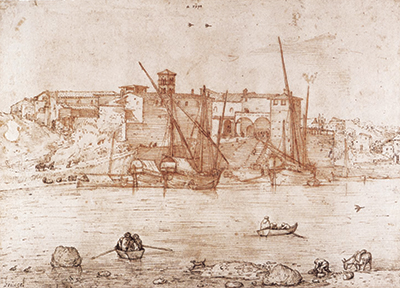
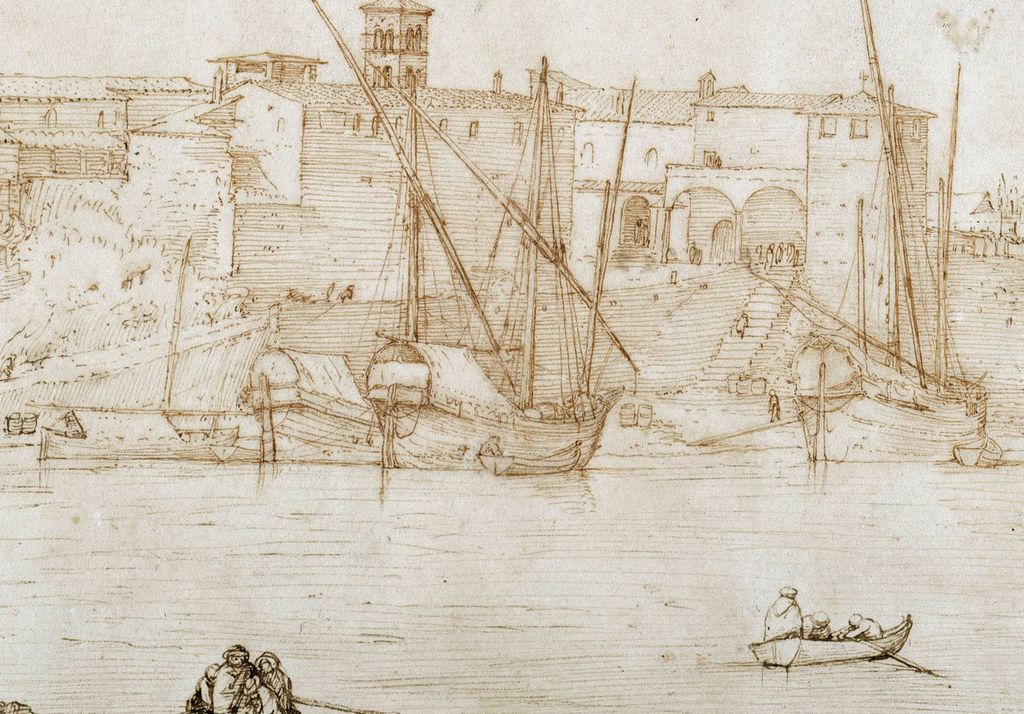
Pieter Bruegel the Elder drew the buildings of Rome’s Ripa Grande from across the Tiber. Large vessels lie against the farther bank, and two small boats cross the open water. At the nearest edge of the sheet, people and animals occupy a strip of exposed shore. The drawing belongs to the Devonshire Collection at Chatsworth, where the 2001 exhibition catalogue identifies it as number 841. It measures 20.7 by 28.3 centimetres and is drawn in two shades of brown ink. The buildings can be identified more securely than the date when Bruegel brought the whole composition together [1] [2] [3].
This work across Bruegel’s career
Tower of Babel
1563The Harvesters
1565Peasant Wedding
1568Children's Games
1560Triumph of Death
1562–1563Ripa Grande in Rome
This artworkContents
- Introduction
- The Customs House across the Tiber
- From the Moored Ships to the Near Bank
- Two Inks and an Undated Sheet
- Comparing the Two Shores with a Landscape Drawing
- Annotated Details
The Customs House across the Tiber
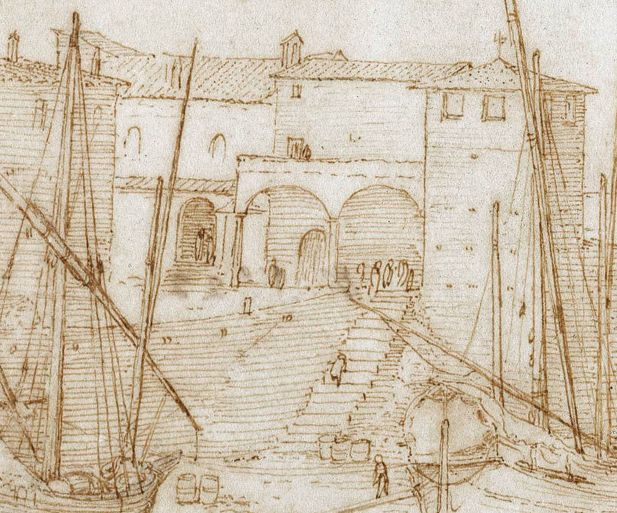
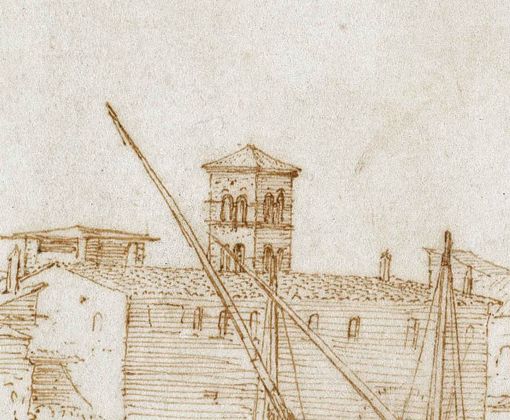
Start at the farther bank, where a stair and a ramp rise towards two adjoining arches. The exhibition catalogue identifies them as the entrance to the Dogana Vecchia, the old customs house. Behind and slightly to the left is the bell tower of Santa Maria in Turri. Its open levels rise above a much longer line of wall and roof. The distinction between the two buildings is easier to see if you trace the roof from the bell tower towards the double arch. The intervening walls bring them into the same cluster without making them parts of one structure [2].
The view is low enough to show the space between the ships and the buildings. The masts cut across the windows, roofs and distant sky. A vessel may conceal part of a shore building at one point while the next one leaves a clear gap. The angles of rigging also cross the more regular rows of lines in the walls. The drawing records an active landing place through those overlaps. A viewer looking for architecture has to find it among boats and the structures that support their movement.
Orenstein describes the Ripa Grande as the principal landing place for seagoing vessels in sixteenth-century Rome. Bruegel’s comparatively small view includes several levels of access to that landing. The far shore has space for ships against the bank, and the approach to the customs house runs up above them. The scale of a person on the stairs makes the route more legible. It is possible to follow movement from river to land without losing sight of the buildings that define where the traffic is going [2].
Annotated Details from Ripa Grande in Rome
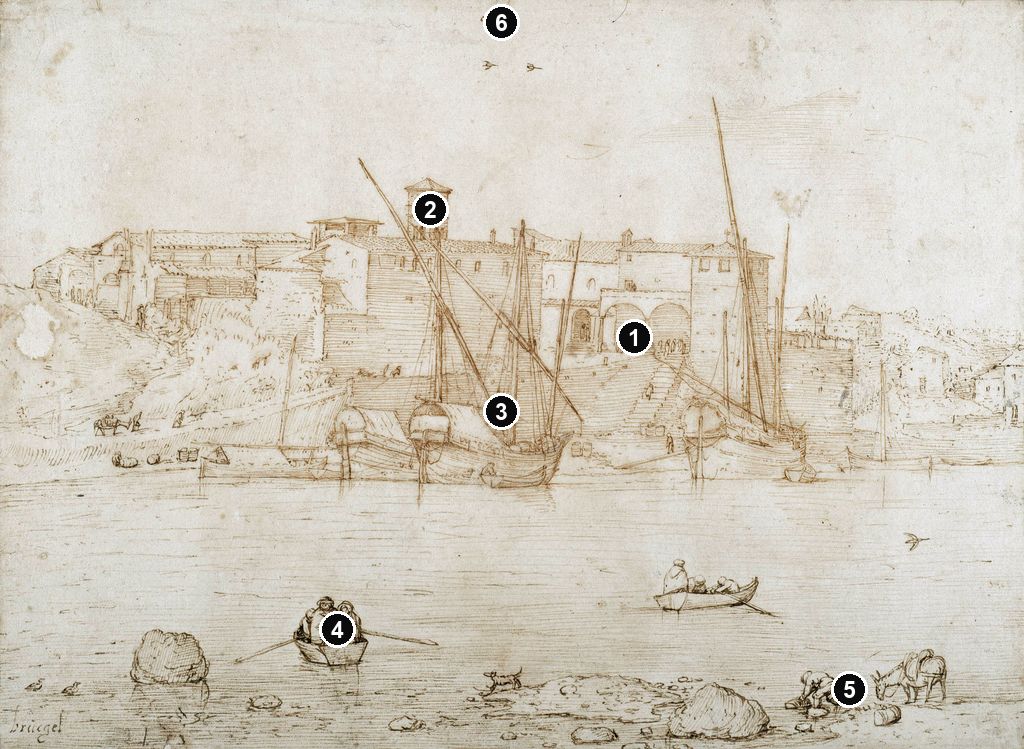
Find the customs house and follow the boats across the Tiber.
Details from RIPA GRANDE IN ROME
Six details show the buildings, the boats and the inscription.
The customs house
A stair and a ramp rise towards the paired arches.
The bell tower
The tower of Santa Maria in Turri rises above the roofline.
The ships against the bank
Tall masts and rigging cross the outlines of the buildings.
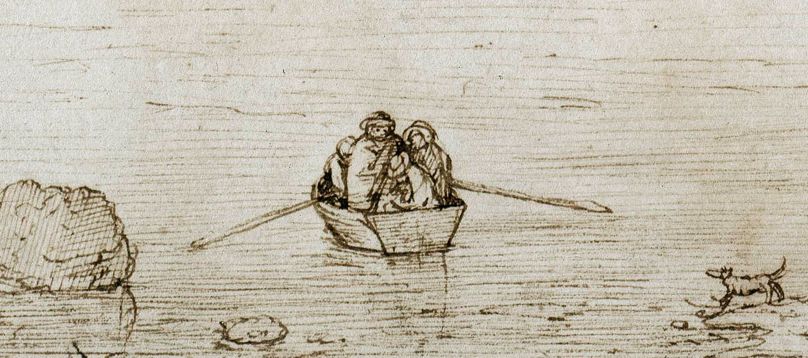
The nearer rowboat
Oars stretch from the hull across the open river.
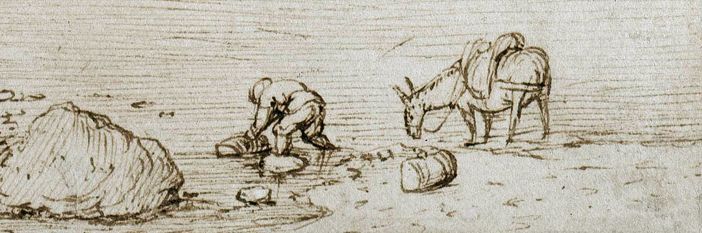
People on the near shore
Figures and animals occupy the exposed bank.
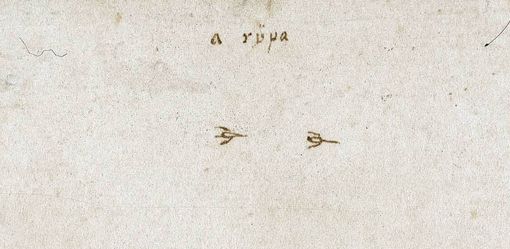
The place inscription
A short inscription appears above two birds.
Pieter Bruegel the Elder, View of the Ripa Grande. Devonshire Collection, Chatsworth, 841. Reproduction via Wikimedia Commons.
From the Moored Ships to the Near Bank
The rowboats occupy more open water. The one nearer the bottom left is seen almost end-on. Its oars stretch outward, with several people gathered in the small hull. The farther boat at the right is seen more from the side. The different orientations let the oars and the hulls describe how each craft lies in the river. They also make the intervening water look broader than the blank paper would on its own. The biggest vessels at the far shore therefore have two nearer groups against which to be judged.
The near bank appears only in fragments. Several rocks break the surface, and the people at the right are separated from the nearest boat by a short stretch of open water. A few marks around the rocks can be read as ripples, while those behind the boat run almost horizontally. Bruegel gives the shore enough room for small actions to be visible without obscuring the wide stretch of river. The darker detail near the bottom also makes the buildings on the opposite shore seem more remote.
Above the roofline, two birds sit below a short inscription. Another bird is visible lower down towards the right, above the water. Their placements give the larger fields of light paper a few points of reference. The tallest masts extend well into the upper area, making it possible to compare the height of the boats with the lower buildings. Near the bank the pen works across the sheet in short horizontal lines. The masts and birds direct attention upwards and help connect the levels of the view.
Two Inks and an Undated Sheet
Orenstein distinguishes the reddish-brown ink of the main building group from darker brown ink used in much of the foreground, the inscription and some other details. She proposes that Bruegel recorded the principal buildings on site and continued the drawing later. The distinction in the inks helps explain that possibility. It cannot establish how much time passed between the two stages. Lichtert discusses the debate over whether the finished drawing belongs to Bruegel’s stay in Rome or to a later moment. The sheet itself is undated [2] [3].
The lettering above the birds identifies the place. It is also part of the attribution history. The 2001 catalogue accepts this inscription as Pieter’s and treats the name at the lower left more cautiously. The drawing had previously been given to his son Jan Brueghel, and some scholars returned to that attribution after it had first been proposed as a work by the elder artist. The accepted attribution draws on the handwriting and comparisons with Pieter’s drawings. These details give more specific evidence than the location alone could supply [2] [1].
Comparing the Two Shores with a Landscape Drawing
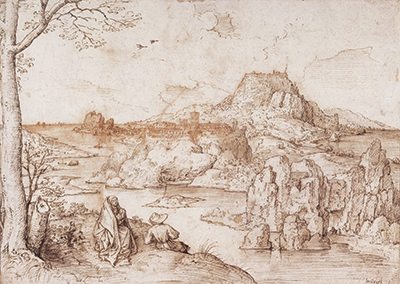
A comparison with Rest on the Flight into Egypt, shown below, brings out what Bruegel did with the two shades of ink. The Berlin drawing also opens across water towards a cluster of buildings and uses inks of different hues. In the Rome drawing, Orenstein finds a clearer division between the inks used for the main buildings and those used for the foreground. A reader can compare the darker lines around the near rocks and boats with the lighter building group, and then look at how the pen marks cross from one area into another in the Berlin landscape [2] [4].
The two views also make different demands on the viewer. In Berlin the figures on the bank give the landscape its biblical subject, and the distant building can be considered within that setting. In the Chatsworth drawing the customs house and the church anchor the view to a named point on the Tiber. The near people and boats show what can be seen from across the river. Together, these details allow the drawing to be read as a record of particular buildings and as an arrangement of daily activity along two banks [1] [2].
Discussion
Which detail in this work most changes how you read it?
Frequently Asked Questions
Start at the farther bank, where a stair and a ramp rise towards two adjoining arches. The exhibition catalogue identifies them as the entrance to the Dogana Vecchia, the old customs house. [2]
References
- Chatsworth, View of the Ripa Grande, Devonshire Collection, View source.
- Nadine M. Orenstein, ed., Pieter Bruegel the Elder, Drawings and Prints, 2001, cat. nos. 8 and 20, View source.
- Katrien Lichtert, New Perspectives on Pieter Bruegel the Elder’s Journey to Italy, Oud Holland 128(1), 2015, View source.
- Staatliche Museen zu Berlin, Rest on the Flight into Egypt, KdZ 5730, View source.








