


 by Tom Gurney
Tom Gurney BSc (Hons) is an art history expert with over 20 years experience
Published on June 19, 2020 / Updated on October 14, 2023
Email: tomgurney1@gmail.com / Phone: +44 7429 011000
The Gooseherd After Pieter Bruegel the Elder: Introduction
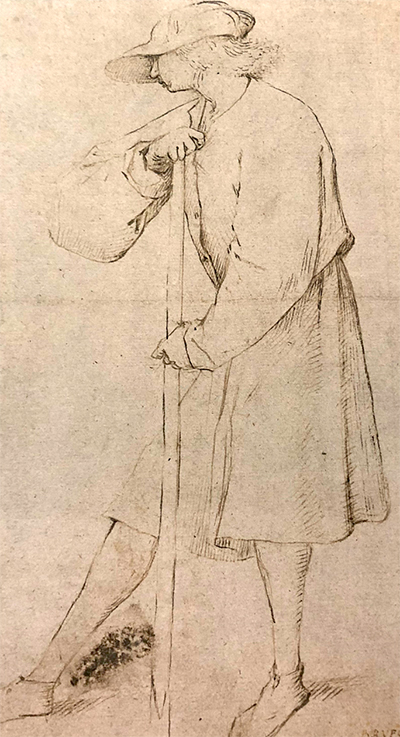
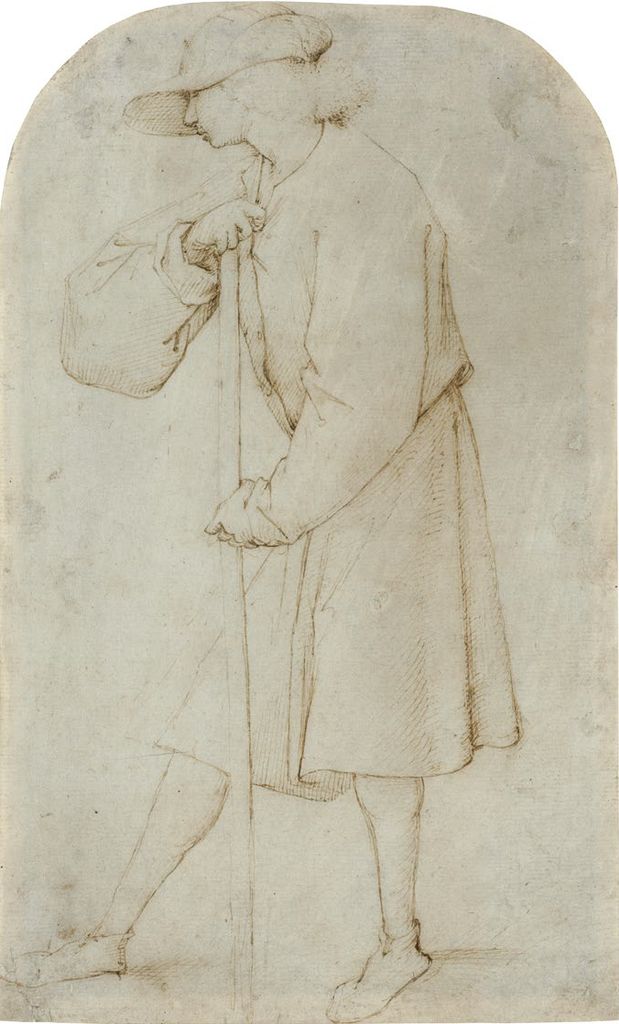
A man in a broad hat leans both hands on a staff and looks towards the left edge of the sheet. This drawing, previously shown here as The Shepherd, matches the copy of The Gooseherd in the Albertina in Vienna. It preserves a figure drawn by Pieter Bruegel the Elder around 1565 in a sheet now in the Kupferstich-Kabinett in Dresden, inventory C 2128. The Vienna drawing is catalogued as a copy after Bruegel. The stained area beside the extended leg and the lettering low on the right distinguish it in reproduction from the Dresden original [1] [2] [3] [4].
This work across Bruegel’s career
Tower of Babel
1563The Harvesters
1565Peasant Wedding
1568Children's Games
1560Triumph of Death
1562–1563The Gooseherd After Pieter Bruegel the Elder
This artworkContents
- Introduction
- The Staff and the Stance
- Brown Lines and Open Paper
- Comparing the Dresden Original
- A Figure Used in Different Settings
- Annotated Details
The Staff and the Stance
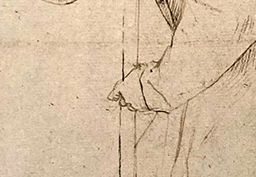
Start with the upper hand immediately below the face. Its knuckles cross the staff, and the full sleeve on the left ends in a tightening curve at the wrist. The hand below it comes across from the opposite direction. It closes around the shaft where the figure’s other sleeve narrows. Because the hands are far apart, the staff can be followed between them and then down towards the ground. That nearly vertical line gives the pose a fixed point while the shoulders, sleeves and legs spread away from it.
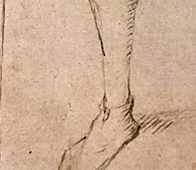
The legs are placed at different distances from the staff. One descends below the right half of the coat, with its shoe turned out along the lower edge. The other extends diagonally towards the left. The line of the knee is faint where it emerges under the coat, then becomes stronger at the calf and shoe. Small, quick strokes around the shoes indicate the ground. One foot appears near the end of the staff and the other almost reaches the edge of the paper. The difference is enough to give the figure a broad stance and a sense of weight.
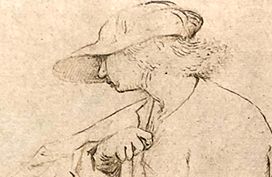
The head shows how little information the draughtsman needed to indicate a direction of attention. The brim conceals much of the face. A few strokes pick out the nose and lower edge of the profile, and the hair extends behind the crown. The hat sits at an angle to the staff and repeats the forward inclination of the head. If you follow those two lines towards the left, they lead into empty paper. The drawing lets the turn of the body and the downward angle of the head suggest where the man is looking.
Annotated Details from The Gooseherd
Follow the staff from the upper hand to the figure’s planted feet.
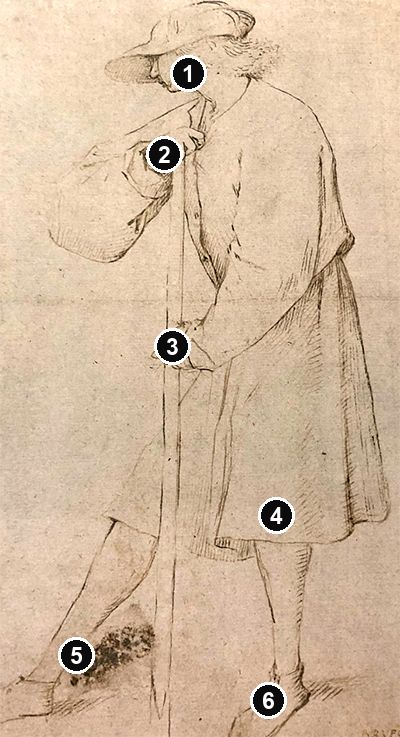
Details from THE GOOSEHERD
Six details show how the figure is balanced around the staff.
The lowered brim
A projecting brim shades the left-facing profile.
The upper hand
The hand crosses the staff just below the face.
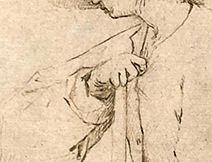
The lower grip
The bent sleeve leads towards a hand lower on the same shaft.
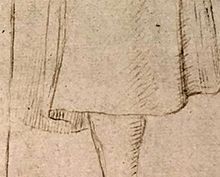
Folds at the hem
Short marks shade the cloth near the lower edge of the coat.
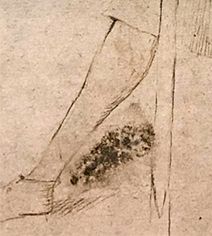
The outward step
The extended leg ends near the edge, beside a dark patch on the sheet.
The planted shoe
The shoe and short ground strokes support the straighter leg.
Anonymous, after Pieter Bruegel the Elder, The Gooseherd, Albertina, Vienna. Legacy reproduction. Illustrated reference, Mielke 57a.
Brown Lines and Open Paper
The coat takes up a large part of the sheet, although much of its surface is left open. On the sleeve, a few curved lines indicate how the cloth gathers as the arm bends. Along the side of the skirt, thin strokes follow a long fold down from the waist. Shorter parallel marks near the hem and on the stockings make those parts appear darker. The eye can therefore separate a sleeve, a fold and a leg chiefly by noticing where pressure, direction and spacing change in the lines.
The paper beyond the figure makes small marks unusually conspicuous. The stain near the extended ankle can be seen in the fuller reproduction of the Vienna sheet. The partial letters at the lower right of the legacy image correspond to the lettering visible there in the fuller view. An early Dresden catalogue already distinguished the two sheets and noted that the lettering on the Albertina version was later than the drawing. Those details are especially helpful here because the main pose was copied closely. To distinguish the sheets, look beyond the hat and hands that they share [2] [5].
Comparing the Dresden Original
The Dresden drawing preserves the same leaning figure, with a similarly high grip and a second hand lower on the staff. Compare the hat in the two views. The original has the same broad projection of brim and a similarly turned crown, while the surrounding paper has a rounded top. In the Vienna reproduction the figure sits within a rectangular border. The Dresden sheet also leaves the ground near the extended shoe relatively clear, where the stain in the Vienna copy interrupts the pale space. These are ways to distinguish reproductions even when differences of exposure or colour make the ink hard to compare [3] [2].
The Dresden exhibition catalogue dates Bruegel’s drawing to around 1565 and describes brown pen on grey paper. Research published by the Fingerprint project treats it alongside other Bruegel figure studies and considers its precise function uncertain. The figure could be used in a composition, as it later was, but the surviving evidence allows the single sheet to be studied as a drawing in its own right. The coat and staff are developed enough to convey the pose without a setting, and the balance across the feet remains readable whether or not a landscape is supplied [3] [4].
A Figure Used in Different Settings
The name Gooseherd makes more sense in relation to later pictures than it does on the unoccupied paper. Dresden’s exhibition booklet points to a painted roundel in Antwerp in which the figure appears among geese. Its subject is a proverb that asks why geese walk barefoot. The painter gives the familiar figure an occupation and a setting that the sheets leave open. The tall staff and the tilt of the head remain legible even when the figure occupies a much smaller part of the picture [3].
The same pose also appears in a religious composition. The National Gallery’s catalogue traces a figure in Jan Brueghel the Elder’s Adoration of the Kings to his father’s Dresden drawing. Dresden discusses the figure as a shepherd in versions of this composition. The stance that helps identify a gooseherd in the proverb can work equally well for a shepherd who has come to see the child. The connection concerns the way the body is drawn and carried over, while the people and animals introduced around it determine its new role [6] [3].
That transfer is visible at the level of the outline. The hat, the raised elbow and the downward line of the staff form a recognisable sequence before the individual folds can be seen. They are also parts of the drawing that a copyist could preserve while changing the spacing around the figure. In the Vienna sheet the outline is close enough to the Dresden version that the copies can be compared point by point. In the paintings those same lines help the figure remain recognisable after a busy background has been added [2] [3] [6].
Discussion
Which detail in this work most changes how you read it?
Frequently Asked Questions
The name Gooseherd makes more sense in relation to later pictures than it does on the unoccupied paper. Dresden’s exhibition booklet points to a painted roundel in Antwerp in which the figure appears among geese. [3]
References
- Pieter Bruegel Complete Catalog, Drawings, entries for A Gooseherd and A Gooseherd (Copy), View source.
- Albertina copy, Vienna, illustrated catalogue reference Mielke 57a, View source.
- Staatliche Kunstsammlungen Dresden, Teamwork! in Antwerpen exhibition booklet, pp. 24–25, View source.
- Fingerprint project, Functions of Drawings, with Mielke 57 and Dresden C 2128, View source.
- Karl Woermann, Dresden folio catalogue, plate XIII, item 127, View source.
- National Gallery, The Adoration of the Kings (2), note 24, View source.








