


 by Tom Gurney
Tom Gurney BSc (Hons) is an art history expert with over 20 years experience
Published on June 19, 2020 / Updated on October 14, 2023
Email: tomgurney1@gmail.com / Phone: +44 7429 011000
The Temptation of St Anthony: Introduction
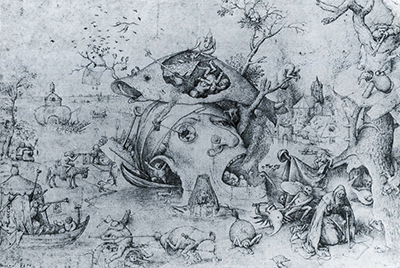
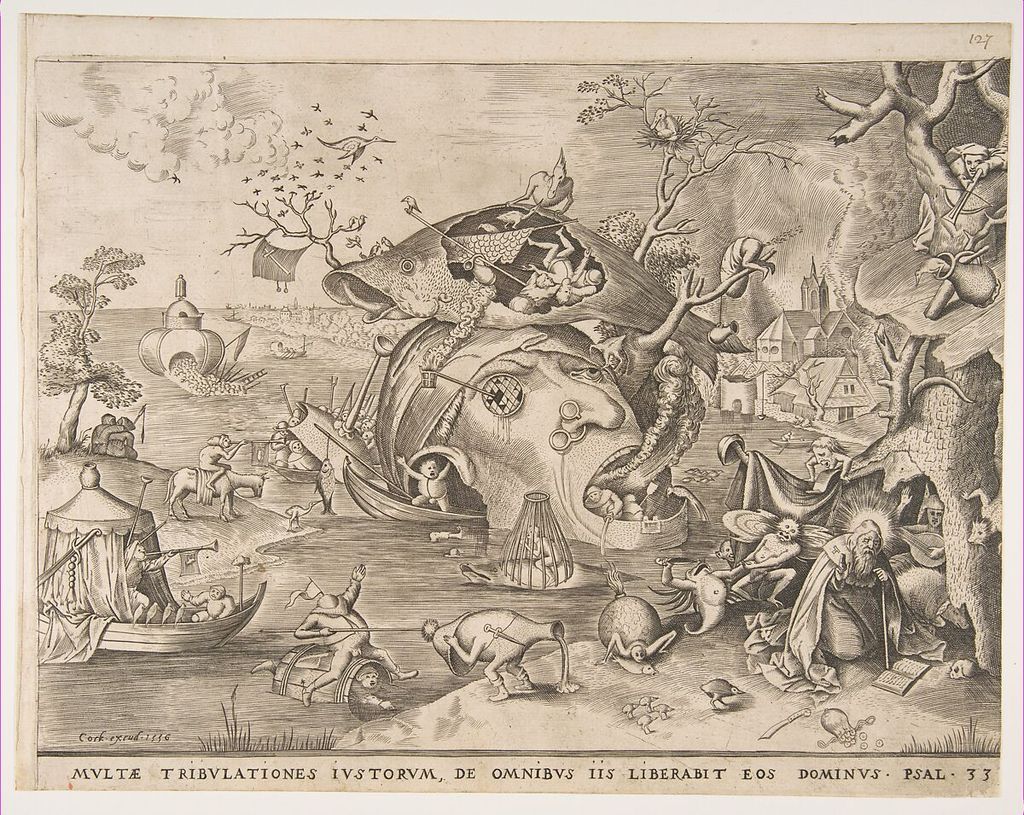
Saint Anthony kneels at the foot of a tree while a world of strange creatures gathers around him. In the middle of the drawing, a giant head lies beside the river with a fish perched on top. Small figures use its openings and approach it in boats. Pieter Bruegel the Elder prepared this drawing around 1556. It is held by the Ashmolean Museum, Oxford, and the 2001 exhibition catalogue lists it as number 130. Pieter van der Heyden engraved the design, and Hieronymus Cock published the print in 1556. The drawing and the print show the saint on the same side, an unusual feature among Bruegel’s designs for print [1] [2] [3].
This work across Bruegel’s career
Tower of Babel
1563The Harvesters
1565Peasant Wedding
1568Children's Games
1560Triumph of Death
1562–1563The Temptation of St Anthony
This artworkContents
- Introduction
- The Saint at the Foot of the Tree
- A Head, a Fish and a River
- Ink Lines That Could Be Engraved
- What the Print Adds
- Annotated Details
The Saint at the Foot of the Tree
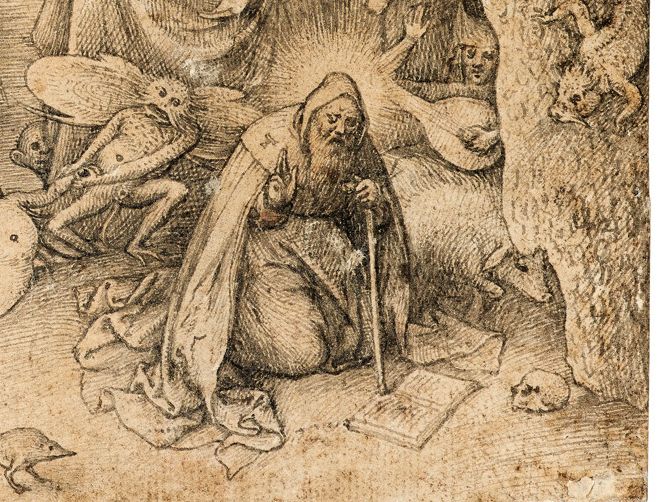
Start at the right, where Anthony kneels under the trunk beside an open book. His robe gathers around his body and makes an outline that remains comparatively still beside the gestures of the figures and creatures behind him. The trunk gives him a place in the landscape, while his position low in a corner makes him easy to miss among the much larger motifs nearer the centre. A viewer may find the fish and head first and discover the saint only after looking at the edge of the sheet [1] [3].
The scene depends in part on this difference of direction. Anthony turns away from much of the commotion. A number of the figures near him bend sharply or reach towards something outside themselves. The open book lies in a comparatively clear stretch of ground, and the inclination of his head helps give the posture its focus. The temptation is represented through a whole setting that can draw a viewer’s attention in several directions at once, while Anthony’s response is concentrated in the one figure [1].
Annotated Details from The Temptation of St Anthony
Find the saint and then follow the river past the hollow head.
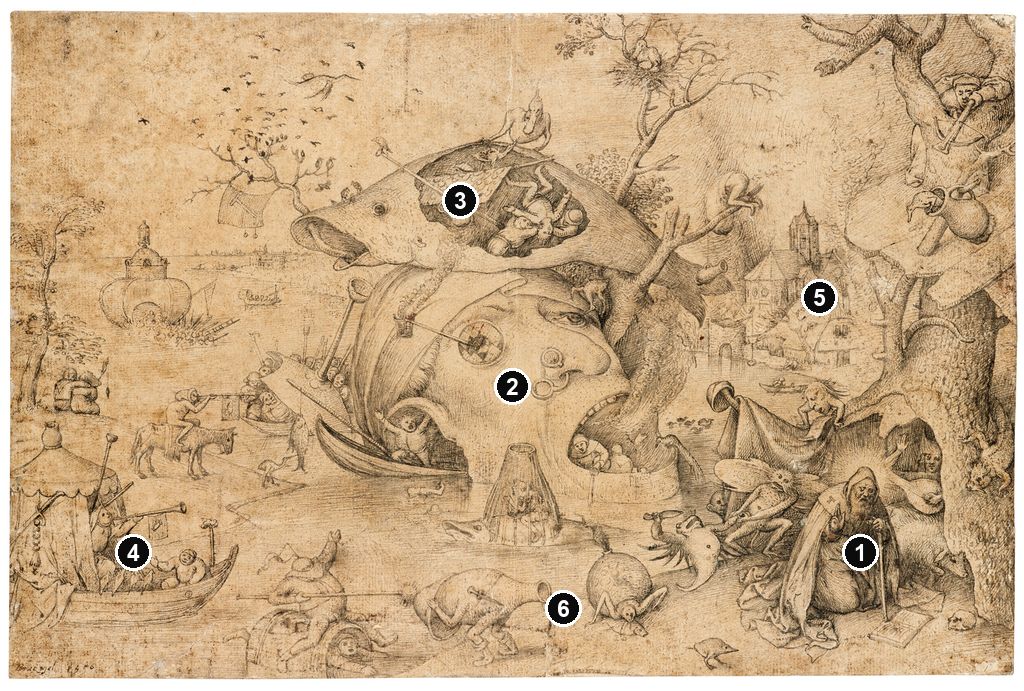
Details from THE TEMPTATION OF ST ANTHONY
Six details trace the saint, the landscape and its strange inhabitants.
Anthony at prayer
Anthony kneels below the tree, apart from much of the action.
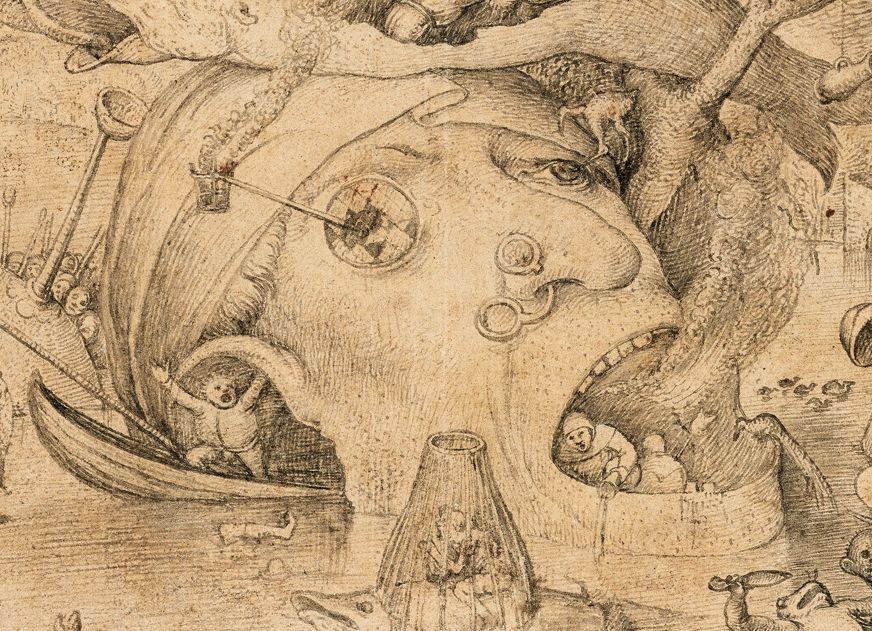
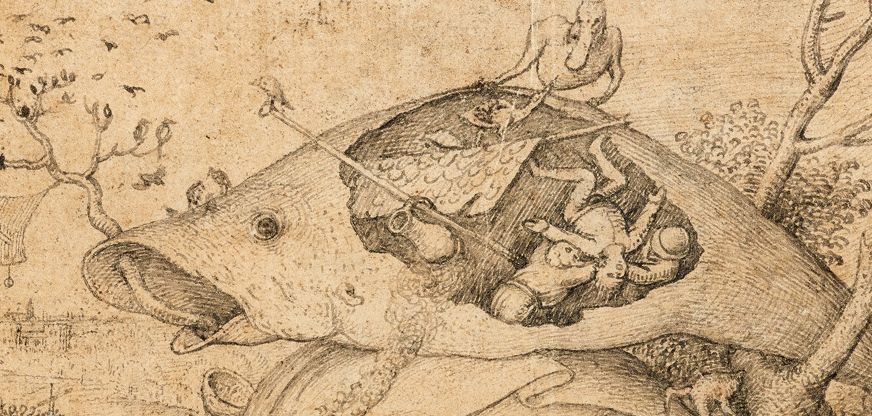
The hollow head
Openings in the head are occupied by small figures.
A fish above the head
Figures are visible inside the large fish.
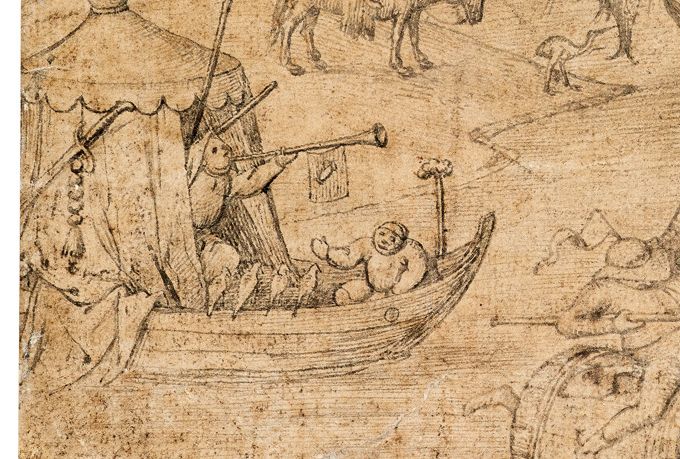
Boats on the river
The passengers are tiny beside the hollow head.
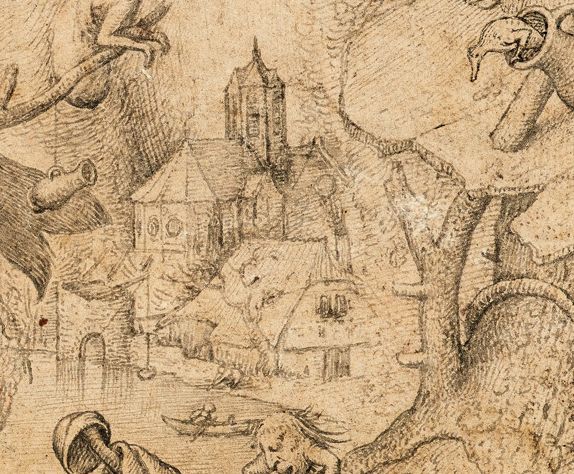
The settlement beyond the river
Roofs and a tower lie behind the larger forms.
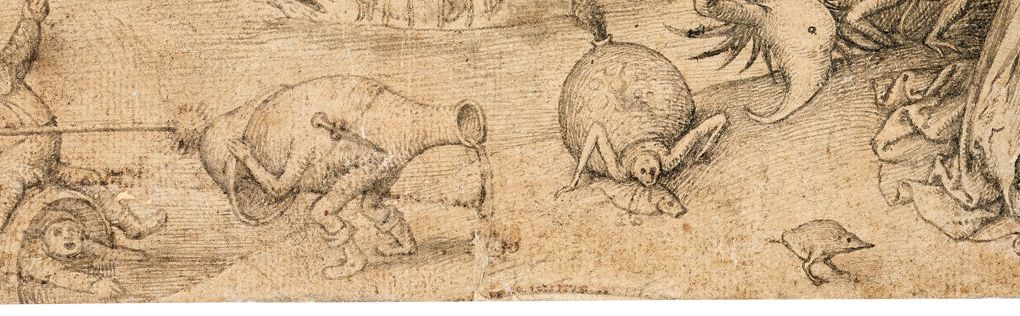
Creatures in the foreground
Unusual forms occupy the ground between the head and the saint.
Pieter Bruegel the Elder, The Temptation of St Anthony, about 1556. Ashmolean Museum, Oxford, WA1863.162, Douce bequest. Museum-sourced reproduction via Wikimedia Commons.
A Head, a Fish and a River
The large head can be read at first as a face. The eye, nose and mouth have recognisable positions, and a bandage follows the shape of the head. At closer range, the openings turn it into something closer to a structure. Small figures appear at the mouth and around the side. The eye is treated as a window, and the fish above the head has an opening of its own. Bruegel invites the viewer to change scale repeatedly, from seeing a single face to looking for the people using it [3].
Boats in the lower left and near the centre extend that play with scale into the landscape. Their passengers are much smaller than the features of the head. Some approach as if the head were a place that could be reached from the river. Farther back, towers and buildings occupy the land along the water. The collection of activities is tied together by a channel that can be followed despite the unlikely forms beside it. The river gives the invention a navigable space and lets the approach to the head be read as an event within it.
The Ashmolean and the 2001 catalogue relate the imagery to Hieronymus Bosch. The use of bodies that are also structures, and of familiar animal shapes brought into improbable relations, makes the comparison especially visible here. Orenstein also notes a related head in the print of Gluttony. The recurrence gives a way to look at Bruegel’s use of such forms beyond a single subject. Here the head dominates the river, while the saint and the tree locate the story at a much smaller scale [1] [3].
At the far left there is a smaller building raised above the water. It has a tower and a rounded opening underneath, a combination that can be compared with the anatomy of the giant head. Above it, very small shapes break the open sky. Their size brings out how much distance lies between the river traffic and the horizon. The drawing repeatedly sets these tiny incidents beside much larger forms, so that the viewer can approach the same scene as a panorama or as a collection of episodes.
Ink Lines That Could Be Engraved
The Oxford design uses pen, brush and brown and grey-brown ink. The 2001 catalogue draws attention to carefully defined outlines and patches of cross-hatching. Compare the edge of the fish with the strokes inside its body. One establishes an outline large enough to recognise across the image. The other divides the surface into light and shaded areas. This more controlled handling supplied an engraver with contours and tonal patterns to follow. It is different in pace from the sweeping lines of some of Bruegel’s earlier landscapes [3].
The museum records the drawing and Van der Heyden’s engraving as separate objects. The engraved lines can be compared with the penwork below. Van der Heyden keeps the main motifs in the same orientation. The fish, the head and the saint retain their places. This agreement once contributed to doubts about whether the drawing was an original design, because many other drawings for prints are reversed in the finished impression. The later name on the drawing also complicated the question. The 2001 catalogue describes how the quality and character of the penwork supported the attribution to Bruegel [1] [2] [3].
What the Print Adds
The lower edge is a particularly useful place to compare the two objects. Orenstein notes details in the print that are absent from the surviving drawing, including a bag with coins, a knife, birds and a strip of grass. Trimming has been proposed as an explanation. The catalogue also considers the possibility that the engraving extended a little beyond Bruegel’s design. Looking first at the large shapes common to both makes it easier to see where those smaller elements appear [2] [3].
The Oxford sheet was part of Francis Douce’s collection before it reached the Ashmolean through the Bodleian Library. That history belongs to the original drawing, while surviving impressions such as the Met’s have their own collection histories [3] [2].
The print adds a Latin caption below the image, paraphrasing a psalm about the afflictions of the righteous and their deliverance. It directs attention back to the saint even after the figures on the river and in the trees have claimed much of the view. The publisher’s name and the year are inscribed in the print. The collection records identify the engraver and designer through the attribution of the work. Together the drawing and the impression show how a specialist engraver and publisher helped turn Bruegel’s design into an image that could circulate [1] [2] [3].
Discussion
Which detail in this work most changes how you read it?
Frequently Asked Questions
The large head can be read at first as a face. The eye, nose and mouth have recognisable positions, and a bandage follows the shape of the head. [3]
The Oxford design uses pen, brush and brown and grey-brown ink. The 2001 catalogue draws attention to carefully defined outlines and patches of cross-hatching. [3]
References
- Ashmolean Museum, Spotlight on Bruegel’s Temptation of St Anthony, View source.
- Metropolitan Museum of Art, The Temptation of St. Anthony, 28.4(13), View source.
- Nadine M. Orenstein, ed., Pieter Bruegel the Elder, Drawings and Prints, 2001, cat. nos. 36–37 and 45, View source.








