


 by Tom Gurney
Tom Gurney BSc (Hons) is an art history expert with over 20 years experience
Published on June 19, 2020 / Updated on September 27, 2026
Email: tomgurney1@gmail.com / Phone: +44 7429 011000
Paul Klee’s Kettledrummer
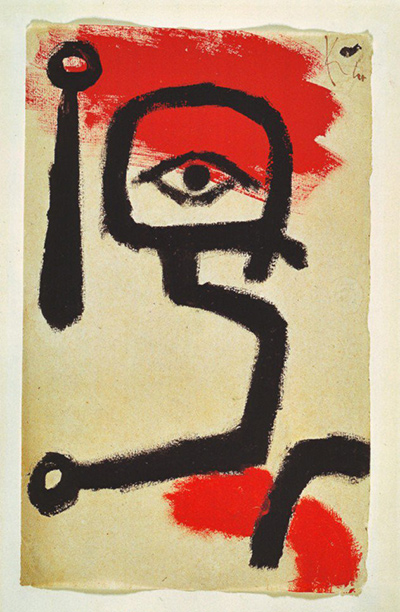
Paul Klee's Kettledrummer (Paukenspieler) is a work of 1940, the year of his death. The Zentrum Paul Klee, Bern, records it as 1940, 270, made with coloured paste on paper mounted on cardboard, approximately 34.6 × 21.2 cm. The picture belongs to that museum. Its broad black strokes, staring eye and red passages are the features reproduced in the site's established image. A comparison with the work photograph published by the Phillips Collection confirms the same composition,[1][2][3]
How the figure takes shape
The form is spare but emphatic. A large eye occupies a black arch in the upper middle. At the left, a vertical black stroke ends in a ring; another long stroke extends sideways near the bottom. A heavy line connects the arch to the lower field. Red appears across the upper background and in two smaller lower patches. The work's title lets these compact signs cohere as a drummer, while the image does not draw a conventionally proportioned person standing at a fully described instrument.[1][2]
This economy makes gesture more visible than anatomy. A line can suggest an arm, mallet or motion without having to settle into just one of those functions. The Phillips Collection's 2018 essay reads the round-ended black strokes as mallets moving up and down against a drum. The Jewish Museum's 2026 exhibition label likewise treats the abbreviated forms as a way to convey both musician and action. These are informed institutional interpretations of the graphic signs, not a claim that every line has a fixed literal identity.[1][2]
The red paint is not a smooth background. It is brushed thickly and unevenly around the upper form, leaving the paper's light ground visible. In the Phillips account, this difference between black graphic line and red colour distinguishes the work from earlier, more monochrome treatments of the drummer motif. A small thumbnail communicates the stark arrangement, but the tonal and surface variation becomes harder to judge from the inherited local crop.[1]
The motif and the separate Eidola drawing
The Phillips Collection describes Kettledrummer as a culmination of at least five treatments of the drum motif. That does not make them all versions of one object. The Jewish Museum's 2026 checklist separately identifies Eidola: Knayeros, Erstwhile Kettledrummer (Eidola: Knayeros, weiland Pauker) as 1940, 102, a chalk drawing on paper on cardboard also held in Bern. The site's former article compressed that drawing, its title and its possible associations into an account of the later coloured-paste work. They should remain distinct in title, catalogue number, medium and visual analysis.[1][2]
Klee could return to a theme while changing its material and pictorial language. Here he reduces body and instrument to a few almost emblematic strokes, then activates them with red. The different annual numbers establish that Paukenspieler and the Eidola drawing were registered separately. The sequence between them should not be reconstructed more precisely from these numbers alone; Klee's work register and dated documents would be needed for that.[2]
Music, pause and mortality
The Phillips essay notices a form at the top that resembles a fermata, the musical sign for a held pause, and places an eye beneath it. This gives a concrete basis for discussing a musical sign in the composition. The eye can seem alert or enigmatic, but there is no surviving statement here that fixes it as an apocalyptic warning. The old article's pronouncement that the figure announces “it is time” turned a possible response into an asserted message.[1]
The Phillips author and the Jewish Museum also propose a connection between the drum and mortality through Mozart's Requiem, which Klee had heard during his Dessau years. Their language is cautious: the kettledrum may work as a metaphor for death. The subject's making in Klee's final year makes that proposal understandable, but neither the date nor the musical association proves that he conceived this sheet as a personal memento mori. The earlier page linked it to Holbein's Dance of Death and a specific Dresden musician without supplying documentary support. Those claims are withheld here.[1][2]
The Jewish Museum adds a historical dimension to the subject. Its label describes kettledrummers as figures associated with older German soldier and court music, sometimes performing on horseback to mark noble or military presence. That is a curator's contextual reading of the motif, not a claim that the abstracted figure records a particular rider or event. It helps explain why the title can carry ceremonial weight despite the picture's radical simplification.[2]
Material and collection record
The German material term Kleisterfarbe appears in an Erich Schmidt Verlag book credit that names the Bern object and gives the same 1940,270 number and 34.6 × 21.2 cm measurement. English institutional captions render it as coloured paste. The term should not be flattened into oil paint or treated as a generic digital colour effect. The museum description establishes support and medium, but not the precise pigment recipe or how each stroke was applied.[2][3]
The Phillips Collection displayed the work in its 2018 exhibition Ten Americans: After Paul Klee, and the Jewish Museum included it in its 2026 Klee exhibition. These records show the work's later presentation and distinct curatorial approaches. They do not establish a complete custody history from Klee's studio to Bern. The current owning institution remains the appropriate anchor for catalogue identity.[1][2]
Related artworks
Explore eight other Klee works from the researched artwork cluster.
Hammamet with Mosque
1914
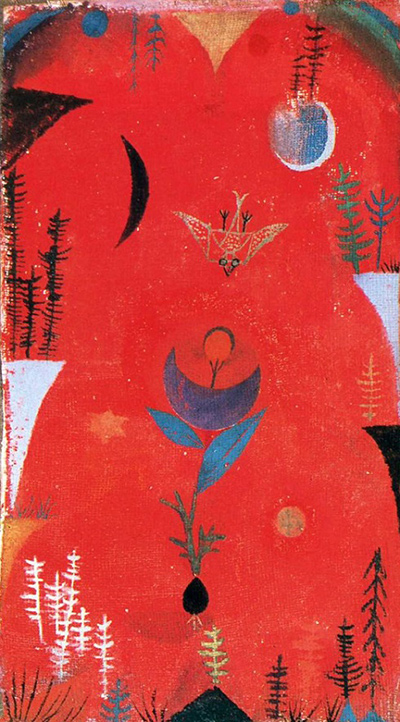
Flower Myth
1918
Angelus Novus
1920
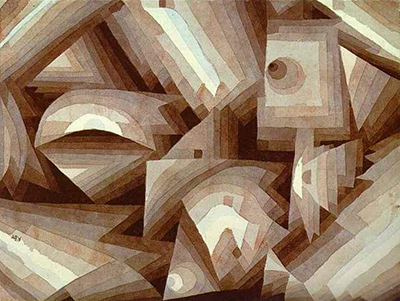
Crystal Gradation
1921
Red Balloon
1922
References
- Phillips Collection, Paul Klee’s Kettledrummer, 26 April 2018: illustrated 1940 work, material, motif series, mallets, fermata and attributed Requiem reading, View source.
- Jewish Museum, Paul Klee: Complete Exhibition Texts, 2026, labels for Kettledrummer (1940,270) and Eidola: Knayeros, Erstwhile Kettledrummer (1940,102): separate works, materials and curatorial interpretation, View source.
- Erich Schmidt Verlag, 2019 book front matter: cover-picture credit for Paukenspieler, 1940,270, Kleisterfarbe auf Papier auf Karton, 34.6 × 21.2 cm, Zentrum Paul Klee, View source.