


 by Tom Gurney
Tom Gurney BSc (Hons) is an art history expert with over 20 years experience
Published on June 19, 2020 / Updated on September 27, 2026
Email: tomgurney1@gmail.com / Phone: +44 7429 011000
Paul Klee’s Landscape with Yellow Birds
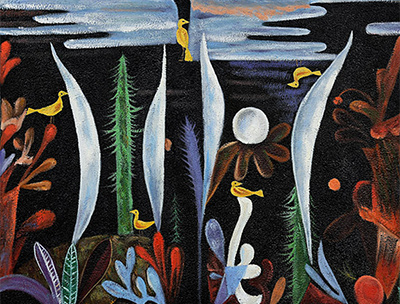
Paul Klee’s Landscape with Yellow Birds is Landschaft mit gelben Vögeln in German. The Bildarchiv Foto Marburg record, supplied through the Deutsche Digitale Bibliothek, describes an oil painting of 1923, 35 × 43.5 cm, in a private collection in Basel. A Zentrum Paul Klee annual report identifies the work as 1923,32 while recording a later textile based on its motif. These records establish the title, basic material, date and annual number more securely than the site's older article, which supplied a broad artist biography but little object evidence. The archive entry does not specify the painting's support, so “oil on canvas” should not be assumed.[1][2]
Birds in a dark garden
The picture is organised around pale, narrow plantlike forms rising through a dark field. Yellow birds occupy different positions among them; some perch or appear suspended, while one at the upper edge is partly interrupted by the composition's boundary. A pale round form glows near the centre-right. Red and blue shapes gather lower down. The eye can follow the yellow birds around the picture, but they do not form an ordinary flock in a continuous natural setting. Klee gives enough cues for a landscape and its inhabitants, then makes the space difficult to map.[1]
The contrast is striking: the birds are small and bright against broad black or dark blue passages, while the long pale plants are nearly as prominent as the animals. The shapes seem to grow, bend and cross through one another. A viewer may experience the scene as playful or eerie; neither response has to be Klee's documented intention. What the image certainly does is move attention from one small bright form to the next, across a field that resists conventional depth.[1]
The older page declared that the birds, rhythm and colour expressed Klee's humour and irony. Those ideas might form a critical reading, but the archival record does not attach them to this specific painting. Formal description should come first: light birds, dark ground, pale verticals and a circular point of light. The birds are called yellow by the original title, a welcome anchor amid the picture's unstable forms.[1][2]
Identity, collection and material limits
The Foto Marburg entry is an archival documentation record, not an online catalogue from the private owner. It names Basel as the location of a private collection and classifies the object as an oil painting. It gives 35 × 43.5 cm. A commercial print seller lists a slightly different measurement, but the archive's figure is the better documented value used here. Neither the archive entry nor the Zentrum Paul Klee annual-report line describes the support or provides a complete chain of ownership. Those gaps should remain explicit.[1][2]
The Zentrum Paul Klee's work-number reference is embedded in a report on its 2006 acquisition of a tapestry by Woty Werner bearing the motif of Klee's Landschaft mit gelben Vögeln, 1923,32. The tapestry is a later object based on the painting, not the painting's current location or a second Klee original. It shows that the composition continued to circulate beyond its private ownership. This is a concrete reception point without claiming that the archive acquired the oil painting itself.[2]
A painting that later artists answered
The title reappears in the work of Spanish poet José Ángel Valente. The Instituto Cervantes records Paisaje con pájaros amarillos as a section of No amanece el cantor and explains that the poems followed the death of Valente's son. Scholar Alejandro Piña, in a 2016 comparative-literature article, examines the relationship between Klee's painting and that poetry. He argues that the poems are not a straightforward verbal description of the image; they work through a related sense of presence, absence and seeing. His article also notes that a detail of Klee's painting appeared on the cover of a collected volume containing the poems.[3][4]
This later literary connection should not be projected backwards as the meaning of Klee's 1923 painting. Valente's poems belong to a very different personal and historical moment. What can be said securely is that the painting's title and image became a point of reference for the poet and for a scholar interpreting his work. That is more specific than the former page's suggestion that the painting simply “inspired” a collection, and it preserves the distinction between Klee's work and a later writer's appropriation.[3][4]
The European Film Gateway catalogues Kostas Sfikas's 1995 film Paul Klee's Prophetic Bird of Sorrows. Its synopsis explicitly places a bird leaving Klee's Landscape with Yellow Birds at the start of the film's imaginative story. Again, this is a later artistic use of the image, not evidence for a hidden narrative that Klee planned. The film's bird is a character created by Sfikas from the painting's imagery.[5]
Place in Klee’s work
The year 1923 falls within Klee's Bauhaus teaching period. That context helps locate the painting chronologically, but it does not justify calling it a Surrealist exhibition work or labelling it “Elementarist Art” without a specific exhibition or critical source. A 1923 work can combine plant, bird, moonlike light and abstract shape without fitting neatly into a single movement label. The painting's own title and material record are firmer grounds for a reader than a list of movements Klee encountered.[1][2]
Its afterlife is unusually revealing. The image could be translated into Woty Werner's textile motif, echoed in Valente's title and poetic sequence, and used as the departure point for Sfikas's film. Each later work selects something different: graphic pattern, an image of elusive presence, or a bird as a narrative agent. None replaces the original oil painting. Looking back at the small yellow forms against the dark garden, one can see why artists working in other media found room to respond to it—without making their responses the definitive explanation of Klee's picture.[2][3][4][5]
Related artworks
Explore eight other Klee works from the researched artwork cluster.
Hammamet with Mosque
1914
Flower Myth
1918
Angelus Novus
1920
Crystal Gradation
1921
Red Balloon
1922
References
- Deutsche Digitale Bibliothek / Bildarchiv Foto Marburg, Landschaft mit gelben Vögeln, updated 2026: title, 1923, oil paint, 35 × 43.5 cm, private Basel location and image-rights mark. Bildindex partner record supplies the archival photograph record.
- Zentrum Paul Klee, 2006 annual report, p. 16: acquisition of a Woty Werner tapestry with the motif of Klee's Landschaft mit gelben Vögeln, 1923,32. The line identifies the Klee work but does not make the tapestry that work, View source.
- Instituto Cervantes New York, Paisaje con pájaros amarillos, 2013: Valente's title, publication context and bereavement background, View source.
- Alejandro Piña, “La mirada de un poema: Paul Klee en No amanece el cantor de José Ángel Valente”, 1616: Anuario de Literatura Comparada 6 (2016), pp. 255–263: Spanish-language analysis of the painting's relationship to Valente's poems and its limits, View source.
- European Film Gateway, Paul Klee's Prophetic Bird of Sorrows, 1995: film catalogue and synopsis naming the Klee painting, View source.