


 by Tom Gurney
Tom Gurney BSc (Hons) is an art history expert with over 20 years experience
Published on June 19, 2020 / Updated on September 27, 2026
Email: tomgurney1@gmail.com / Phone: +44 7429 011000
Paul Klee’s A Young Lady’s Adventure
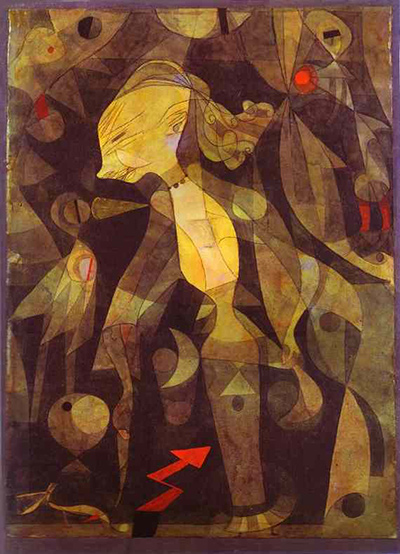
Paul Klee’s A Young Lady’s Adventure is a watercolour on paper made in 1922 and now in Tate’s collection as N05659. Tate records the support as 62.5 × 48 cm and the purchase as 1946. These details matter because the existing account on this site confused the acquisition year with the year of Klee’s death. Klee died on 29 June 1940; Tate bought the work six years later. Neither the purchase record nor the painting itself identifies the seller, so the page should not invent one.[1][2][3]
A figure assembled from shifting shapes
The young woman is immediately visible, but her outline is unstable. A pale, elongated face turns left, with a narrow neck and bright upper body descending into darker, angular forms. Curving outlines and translucent planes cross her hair, shoulders and clothing. Small circular forms and a vivid red disc occupy the space around her. Near the lower edge, a red arrow points diagonally upward. These observations describe what is visible in the reproduced image; they do not settle what the arrow or the surrounding shapes mean.[1][2]
Klee lets a recognisable figure emerge from a network of overlapping colour. Dark browns and muted greens make the lighter face and body stand out, while lines that might describe dress or surroundings also cut across the figure. The effect is less like a portrait of a named individual than a staged encounter between a person and a restless pictorial environment. That is a formal reading of the image, not a claim that Klee documented a particular event.[2]
Calling the work simply an “impressionistic painting,” as the former page did, hides its material and construction. Tate’s own description is watercolour on paper. Its intersecting contours, deliberate colour divisions and ambiguous symbols need to be discussed directly rather than assigned to a single movement by resemblance.[1][2]
What kind of adventure?
The title encourages a narrative, yet it does not specify an episode or outcome. The face and torso are legible; the activity and setting are not. The arrows, circles and layered forms make the woman appear surrounded by forces that the picture leaves unnamed. A viewer can move between the figure, the red arrow and the enclosing dark shapes without finding a single stable route through the scene. The result is a visual question rather than an illustrated story.[2]
Tate notes that critics have disagreed about the picture. It reports an erotic reading of the title and arrows, and contrasts that with art critic Will Grohmann’s view of an elegant woman made vulnerable by oppressive spirits. These are attributed interpretations in Tate’s account. The visible arrow is evidence for their discussion; it is not proof that Klee intended only one of them. Grohmann’s wording is also a historical critic’s reading, not a statement by the artist.[2]
One can see why both interpretations were proposed. The forceful red arrow directs attention toward the figure from below, while the face is poised and the body seems hemmed in by intersecting planes. Yet the image does not establish the figure’s feelings or an external cause of distress. The earlier article described her as pained and declared that all readings were equally valid. A more useful account distinguishes what the image shows from what a critic infers.[2]
Material, scale and collection history
The recorded dimensions refer to the paper support, not an independently measured painted area. At 62.5 cm high, this is more than a tiny sketch. The watercolour medium is central to the picture’s effect: dark and light passages meet through transparent or semi-transparent-looking layers, and drawn edges can remain active within colour. The visible reproduction allows description of these relationships, but it cannot establish the exact order of Klee’s applications or his pigments. Those would need technical study.[1][2]
Tate’s accession number N05659 gives the work a stable collection identity, while its recorded 1946 purchase supplies one documented point in its later history. The available Tate metadata does not provide a full chain of owners before that acquisition. It also does not supply a verified German title or Klee annual work number in the sources used for this page. Those details should be added only after comparison with an authoritative catalogue entry, rather than inferred from an online title index.[1]
The original belongs to Tate, whose object record and image provide the strongest basis for the identification and description here.[1][2]
Why the ambiguity matters
The work offers a precise example of Klee’s ability to make a figure readable while withholding a literal explanation. The woman, arrow and floating forms can be named; their relation remains open. Tate’s two reported interpretations show how a critic may turn the same visible elements toward different narratives. The strongest reading begins with the actual watercolour, states the evidence for each proposal, and leaves the unsupported parts as questions.[2]
Related artworks
Explore eight other Klee works from the researched artwork cluster.
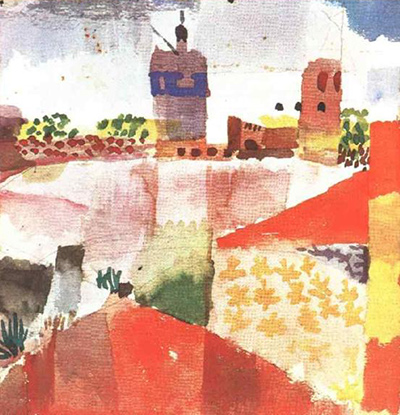
Hammamet with Mosque
1914
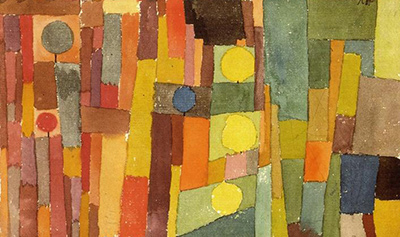
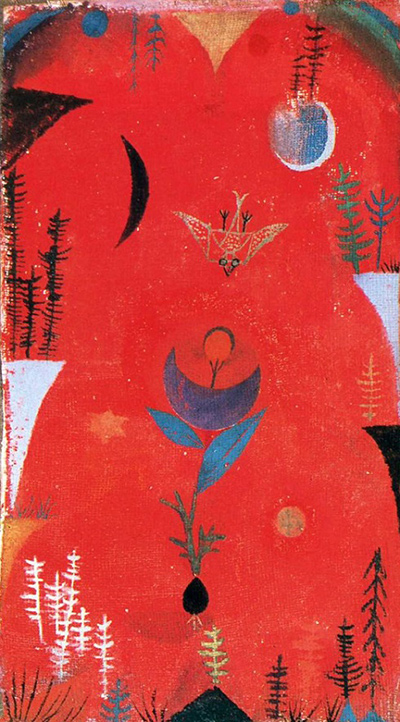
Flower Myth
1918
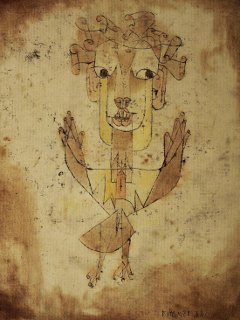
Angelus Novus
1920
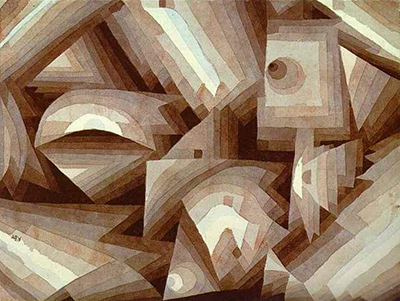
Crystal Gradation
1921
Red Balloon
1922
References
- Tate, Collection metadata, artwork accession N05659, last public dataset update October 2014: title, 1922, watercolour on paper, support 625 × 480 mm, purchased 1946. The dataset is a historical snapshot; Tate says it is no longer actively maintained, View source.
- Tate Shop, Paul Klee: A Young Lady’s Adventure: object date, medium, dimensions and Tate’s summary of the competing readings. Its artist biography contains a typographic error in Klee’s death year; that line is not used, View source.
- Zentrum Paul Klee, Paul Klee: Biography: death on 29 June 1940 in Locarno-Muralto, View source.