


 by Tom Gurney
Tom Gurney BSc (Hons) is an art history expert with over 20 years experience
Published on June 19, 2020 / Updated on October 14, 2023
Email: tomgurney1@gmail.com / Phone: +44 7429 011000
Alpine Landscape with Deep Valley: Introduction
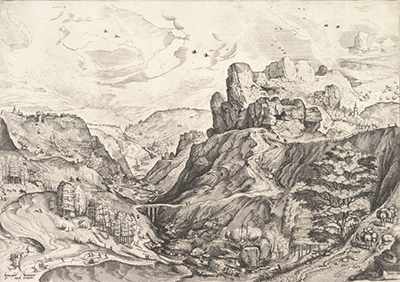
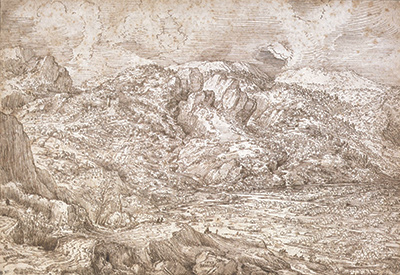
A small pack train climbs the slope at the right of Alpine Landscape with Deep Valley. Across the ravine, tiny buildings stand on a shelf of land, and near the centre a bridge crosses the gorge below a wall of rock. The design is Pieter Bruegel the Elder’s. Johannes and Lucas van Doetecum made the print, and Hieronymus Cock published it as part of the Large Landscapes, generally dated to about 1555–56. The reproduction here is from the National Gallery of Art’s Rosenwald Collection, accession 1964.8.411. The plate carries credits for Bruegel and Cock in the lower corners [1] [2] [5].
This work across Bruegel’s career
Tower of Babel
1563The Harvesters
1565Peasant Wedding
1568Children's Games
1560Triumph of Death
1562–1563Alpine Landscape with Deep Valley
This artworkContents
- Introduction
- The Pack Train and the Valley Floor
- Rock, Settlement and Weather
- From Bruegel’s Drawing to Cock’s Print
- Reading the Credits and the Blank Margin
- Annotated Details
The Pack Train and the Valley Floor
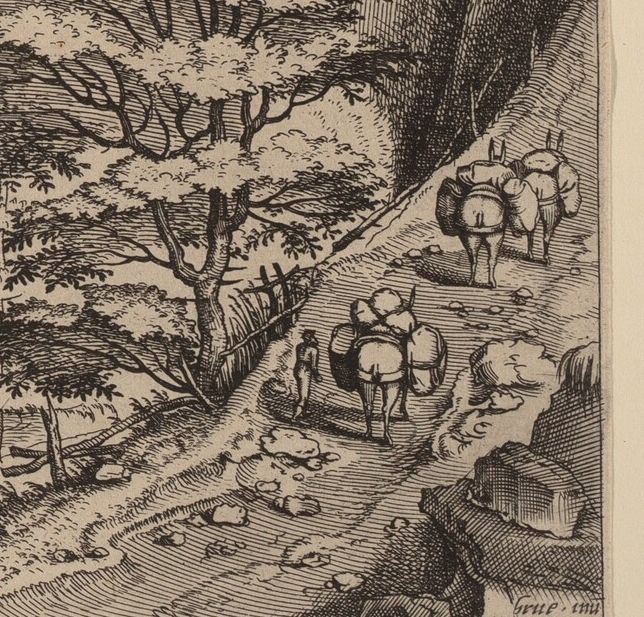
The pack train is easiest to pick out against the open slope immediately to the right of the tree. Several animals carry bulky loads above their backs. A small figure accompanies them. The track rises towards the edge of the sheet, and the direction of travel becomes clearer when the animal groups are viewed together. Bruegel gives the foreground enough information to show what it takes to move through this terrain. The animals are close to the viewer and still occupy only a thin strip of the land around them [5].
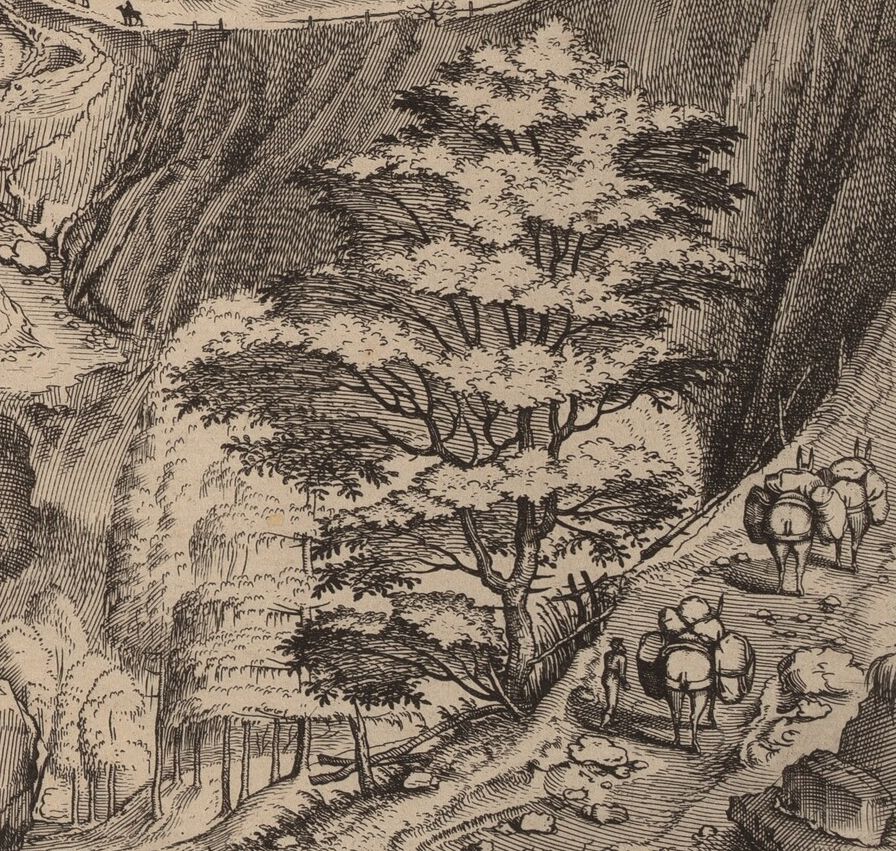
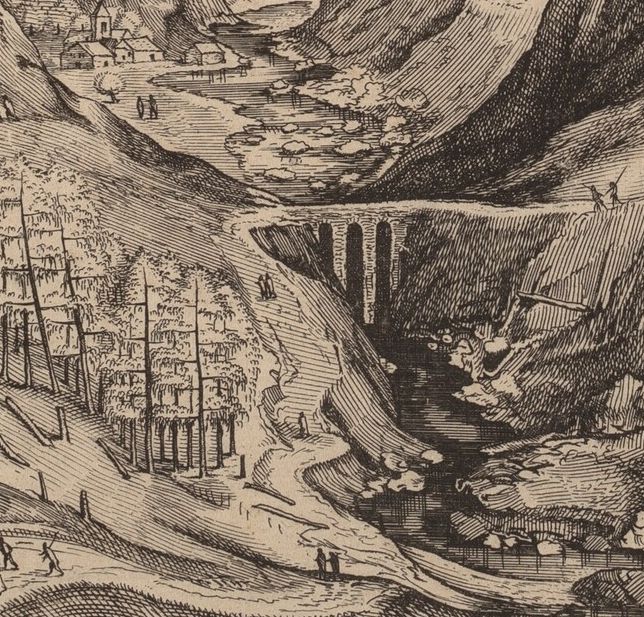
The tree provides a second measure of that slope. Its spread of foliage hides parts of the bank, and the trunk runs almost at a right angle to the path. Looking across the tree rather than along the track leads down into the cleft. Farther left the line of a bridge briefly interrupts the fall of the land. Its upright supports make the distance from the road above to the dark floor below more tangible. Small routes and crossings divide a scene that looks from afar like a continuous mass of mountains.
Near the lower edge the stream makes its way among large boulders. The surface of the water opens in one place and narrows in another where the shapes of the boulders nearly meet. More distant stretches are harder to see, partly concealed by the slopes on either side. Follow the water away from the foreground and the opening closes towards the centre of the plate. It is possible to trace the valley through these successive views even when the channel disappears for a stretch.
Annotated Details from Alpine Landscape with Deep Valley
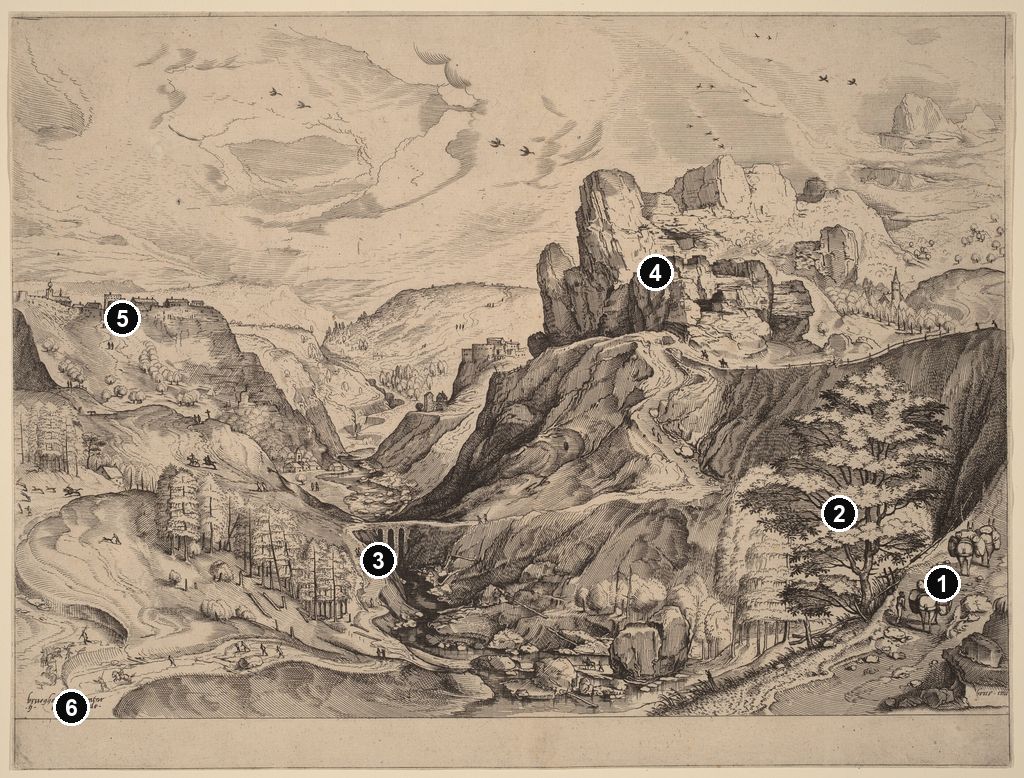
Follow the pack train from the right edge towards the bridge and the valley beyond.
Details from ALPINE LANDSCAPE WITH DEEP VALLEY
Six details show the routes through the landscape and the printed credits.
The pack train
Animals carry bulky packs along the rising road at the right.
The tree above the gorge
A dark tree spreads its branches across the near slope.
The bridge and gorge
The bridge crosses a narrow cleft above the stream.
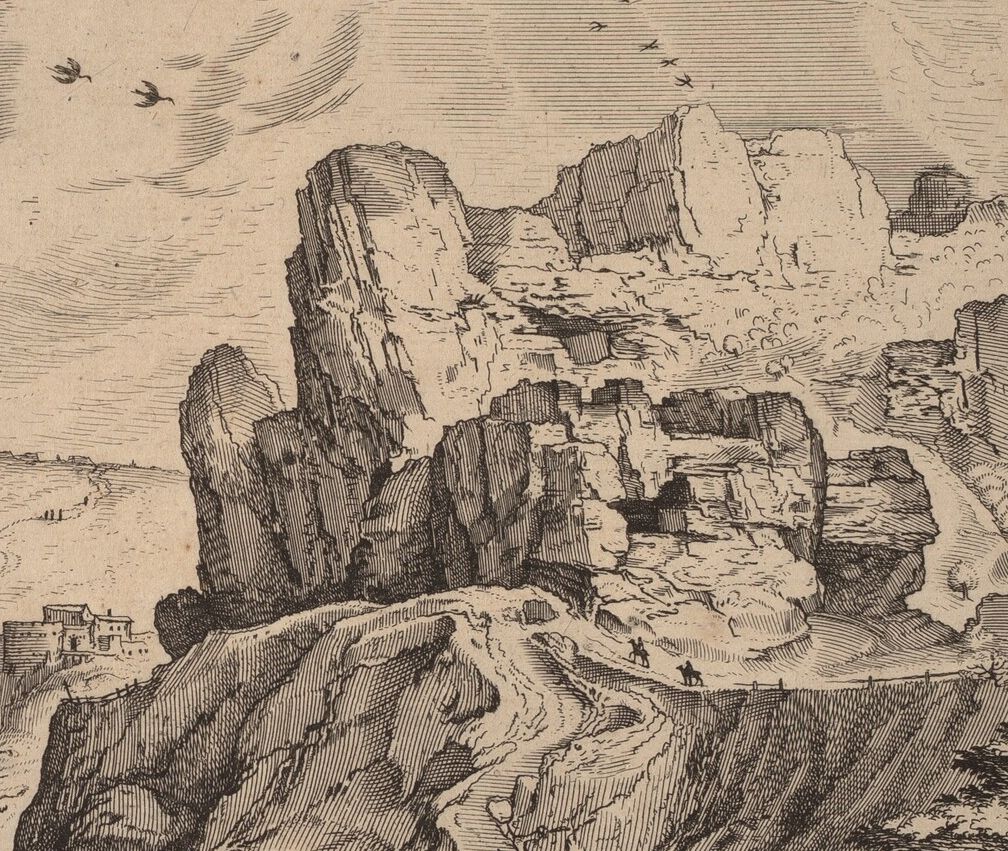
Rock faces and shelves
Light rock faces stand out against thinly hatched clouds.
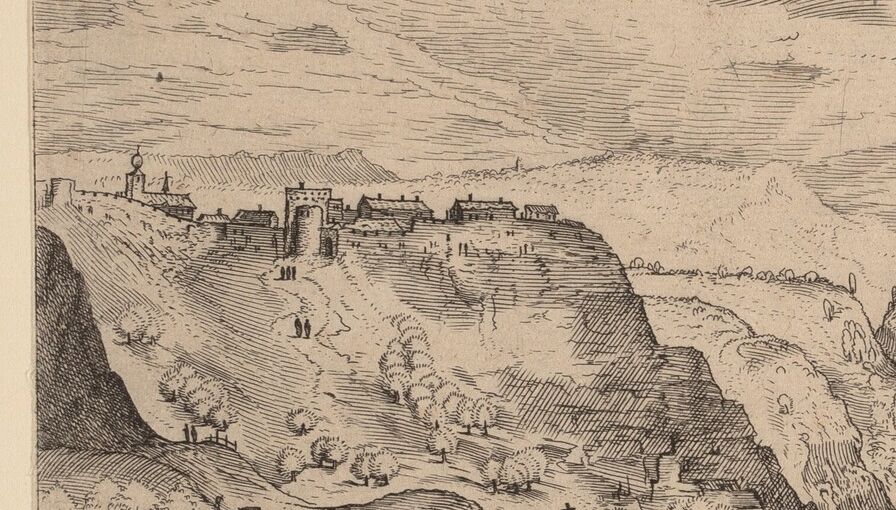
The settlement on the plateau
Walls and roofs occupy a ledge on the left side of the valley.
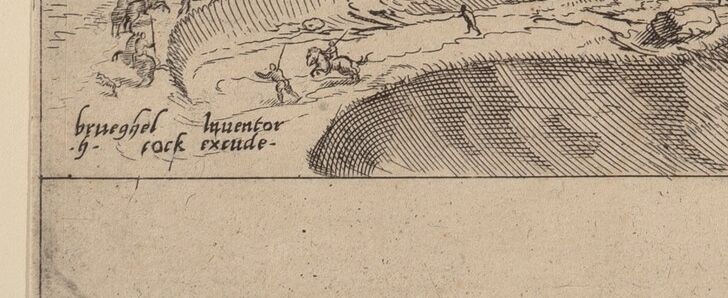
The lower left credits
The longer credit for Bruegel and Cock appears just above the blank strip.
Johannes and Lucas van Doetecum, after Pieter Bruegel the Elder, Alpine Landscape with Deep Valley. Published by Hieronymus Cock. Rosenwald Collection, National Gallery of Art, 1964.8.411. Public domain.
Rock, Settlement and Weather
The large formation right of centre includes steep upright faces and shelves that catch the light. Strokes run in roughly parallel groups down the darkest faces and change direction across the sloping ground below. Near the base, small points of foliage interrupt the drawn surfaces. Near the top, the light faces stand out against the shaded sky. The print gives the rock both a recognisable silhouette and a fine texture that becomes apparent only with enlargement.
Look across to the buildings at the left. A set of rooflines sits close to the edge of a plateau. On the other side, roofs and a spire are tucked into the slopes behind the large rock formation. A building in one place can be used to judge how far away another stands. The groups also suggest different relationships between settlement and terrain. The plateau makes room for structures beside one another, while the walls of the valley divide other buildings into separate pockets.
The sky occupies a substantial part of the print and is broken up by clouds with bright and shaded edges. Tiny birds cross several of the open stretches. A bird’s shape is quickly read against a pale area, while the dense texture of the foreground asks the eye to pause over each slope. The contrast matters to the composition. The same print that requires a stream to turn repeatedly around obstacles gives the birds room to travel across broad intervals.
From Bruegel’s Drawing to Cock’s Print
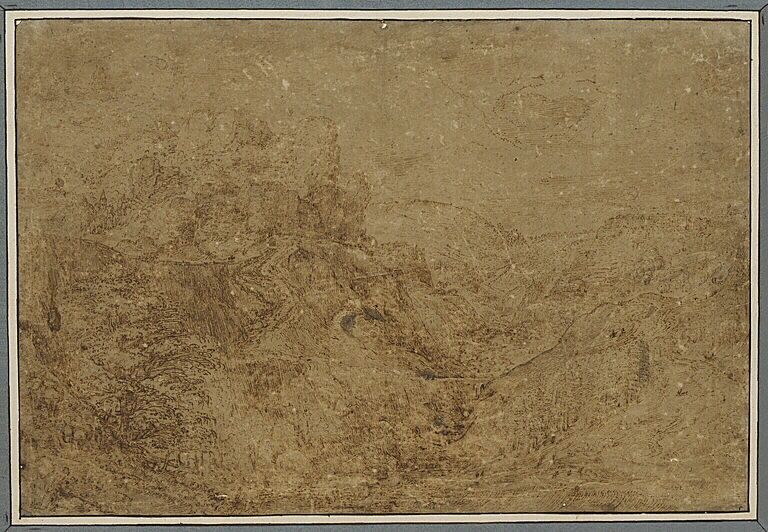
The Louvre preserves Bruegel’s design as Grand paysage alpestre, INV 20720 recto, dated 1555 in the 2001 exhibition catalogue. Its surface has darkened and its lines are harder to read than those of the Washington impression. The two images can still be compared by looking for the broad rock formation, the near tree and the gorge. The print reverses their positions. The tree and the near route are at the left of the drawing and at the right of the print. The ravine runs between forms whose relation survives the reversal [3] [5].
The makers translated pen lines into marks that could be printed in ink from a metal plate. The Washington sheet is catalogued as etching and engraving. Close parallel marks model slopes, and lines crossing one another deepen shadow. The differences between the relatively faint drawing and the clearer print also reflect the condition of the surviving objects. The separate pieces of paper have had different histories. The drawing supplies evidence of the design and the impression shows what a reader could make out from the printed lines [3] [1] [5].
Reading the Credits and the Blank Margin
The longer credit at the lower left names Bruegel as the inventor of the composition and Cock as the publisher. The lower right carries a shorter form of Bruegel’s credit. These inscriptions provide evidence about the circulation of the design, while the individual makers of the plate are identified in modern catalogues. The strip beneath the picture has no descriptive caption. As Orenstein observes, that absence and the repeated credit for Bruegel set the print apart within the series. The catalogue entertains the possibility that the publisher considered using this plate to introduce the series, leaving that proposal open [1] [5].
Museum impressions offer several ways to examine the same design. The 2001 catalogue illustrates the Boston impression, 34.9, and records its watermark and a collector’s mark. The National Gallery of Art identifies its own sheet as trimmed to the plate, with its margins still showing the wide blank strip below the image. Tokyo uses the fuller English title Alpine Landscape with a Deep Valley. The cropped legacy illustration on this page agrees with the printed design. It shows the same bridge, tree and near pack train, but its individual impression remains unidentified [1] [2] [5].
Bruegel’s other Louvre Alpine Landscape is a separate, smaller pen drawing, INV 19728 recto. Both works give travellers a modest place in much larger country. In that drawing a path above the plain leads among deep cuts in the foreground, while the print sets its pack train beside a conspicuous tree and brings the gorge well into the middle of the picture. The two Louvre inventory numbers distinguish the independent drawing from the design reproduced below [4] [3] [5].
Discussion
Which detail in this work most changes how you read it?
Frequently Asked Questions
The pack train is easiest to pick out against the open slope immediately to the right of the tree. Several animals carry bulky loads above their backs. [5]
References
- National Gallery of Art, Alpine Landscape, 1964.8.411, Rosenwald Collection, View source.
- National Museum of Western Art, Alpine Landscape with a Deep Valley, G.2010-0005, View source.
- Musée du Louvre, Grand paysage alpestre, INV 20720 recto, View source.
- Musée du Louvre, Paysage alpestre, INV 19728 recto, View source.
- Nadine M. Orenstein, ed., Pieter Bruegel the Elder, Drawings and Prints, 2001, cat. nos. 12 and 29 and fig. 84, View source.








