


 by Tom Gurney
Tom Gurney BSc (Hons) is an art history expert with over 20 years experience
Published on June 19, 2020 / Updated on October 14, 2023
Email: tomgurney1@gmail.com / Phone: +44 7429 011000
The Beekeepers and the Birdnester: Introduction
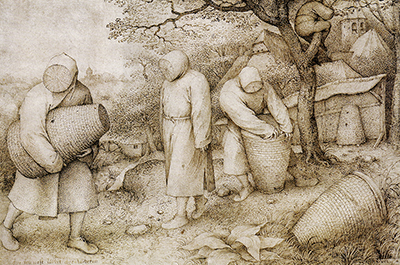
Pieter Bruegel the Elder’s The Beekeepers and the Birdnester is a pen-and-brown-ink drawing made about 1567–68. Three figures in protective clothing work with woven hives, while a fourth has climbed a tree at the right. The drawing is kept in Berlin’s Kupferstichkabinett as KdZ 713. A proverb about knowing where a nest is and taking it appears at the lower left. Its position makes it part of the encounter with the drawing. The viewer can see how the beekeepers carry and handle their hives before turning to words that seem to concern the figure in the tree [1] [2] [3].
This work across Bruegel’s career
Tower of Babel
1563The Harvesters
1565Peasant Wedding
1568Children's Games
1560Triumph of Death
1562–1563The Beekeepers and the Birdnester
This artworkContents
- Introduction
- The Three Beekeepers
- The Tree and the Farmyard
- Reading the Words at the Lower Edge
- A Climber in Another Work
- Annotated Details
The Three Beekeepers
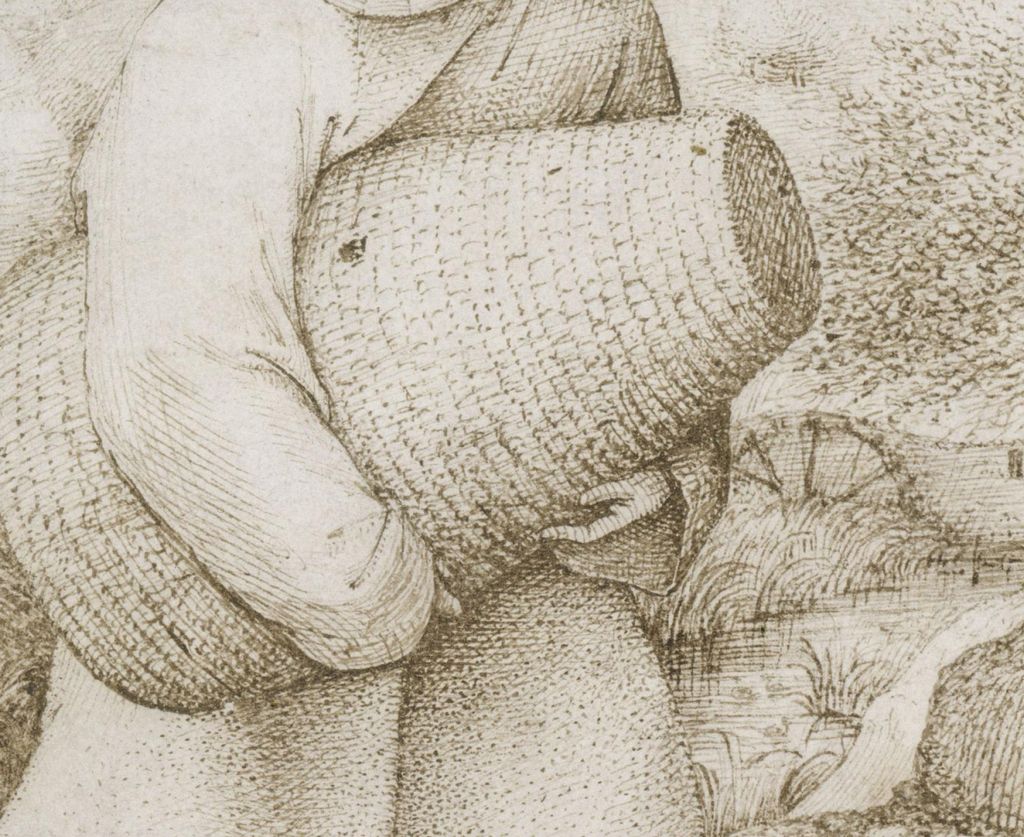
Begin with the figure at the left. He walks with a large woven hive held across his chest. Its curved sides and the small marks describing the weave make it appear solid enough to have weight. His hands meet it from below and from the side. Bruegel sets the hive at an angle, and the inclination of the man’s body gives it somewhere to rest. The fine marks on the fabric of his clothes are quite different from the repeated strokes in the hive.
The beekeeper in the middle stands more upright. His covered head drops slightly towards the ground. A series of lines on his coat leads from his shoulder to his tied waist and then down to his boots. Without a visible face to read, the angle of the head and position of the arms carry much of the gesture. The figure provides a pause between the walking man and the beekeeper bending over a second hive at the right [2] [3].
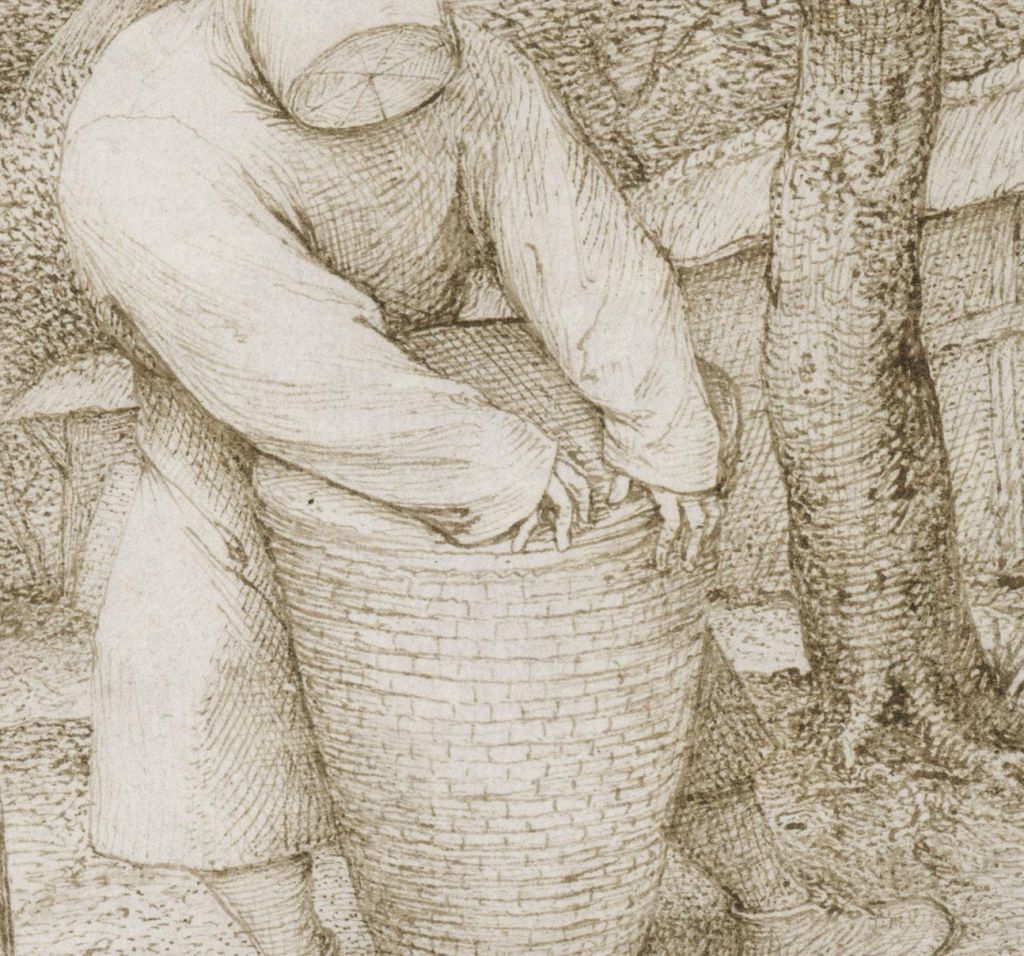
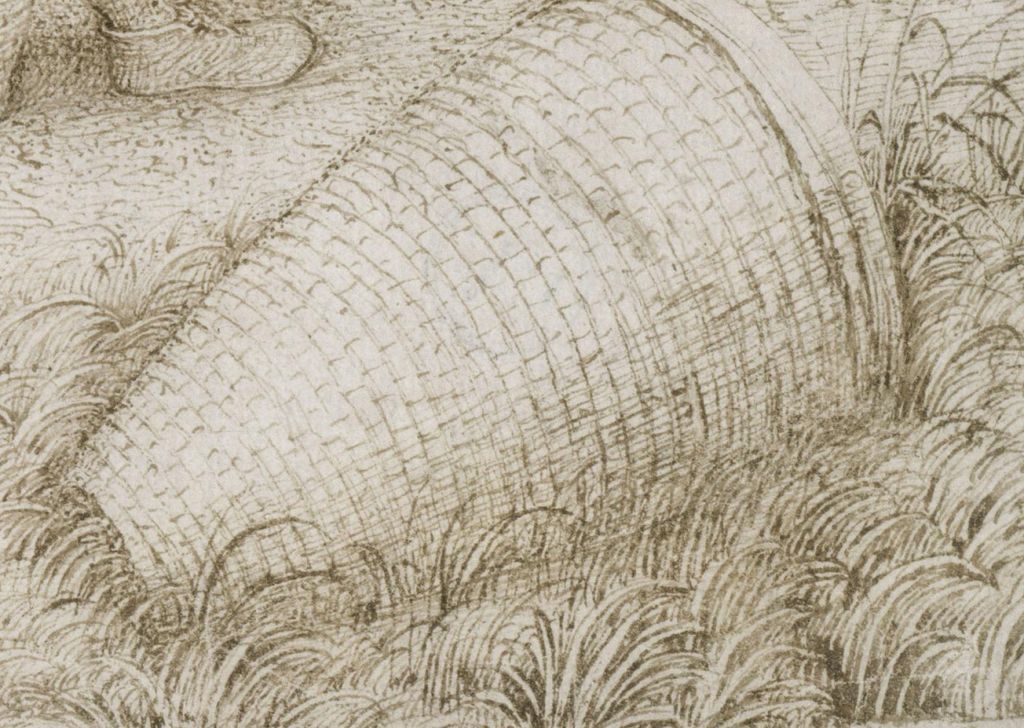
That third figure has both hands near the opening at the top of the vessel. The side of the hive retains its clear pattern even where the man’s sleeve crosses it. Another hive rests at an angle among plants in the near foreground. By looking across these objects, a viewer can follow several ways a hive occupies space. One is carried, one is handled upright and one is on the ground. Their outlines give the near part of the drawing a structure as readily as the figures themselves do.
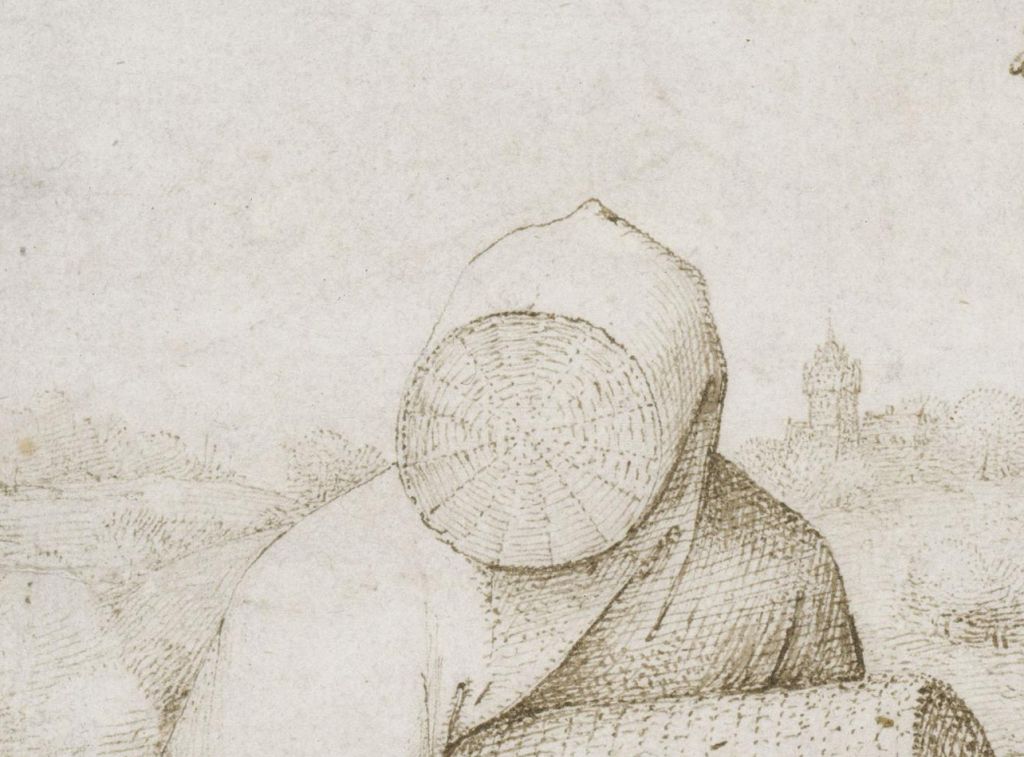
The face coverings make the work easier to recognise and the workers harder to distinguish as individuals. All three have similar garments, while the direction of their heads and arms gives each a position of his own. The drawing lets a viewer compare their movements without relying on expression. That matters especially at the right, where the hand work is clearly visible even as the man’s eyes remain behind the protective covering [1] [2].
Annotated Details from The Beekeepers and the Birdnester
Start with the faces and woven hives, then follow the trunk up to the climber.
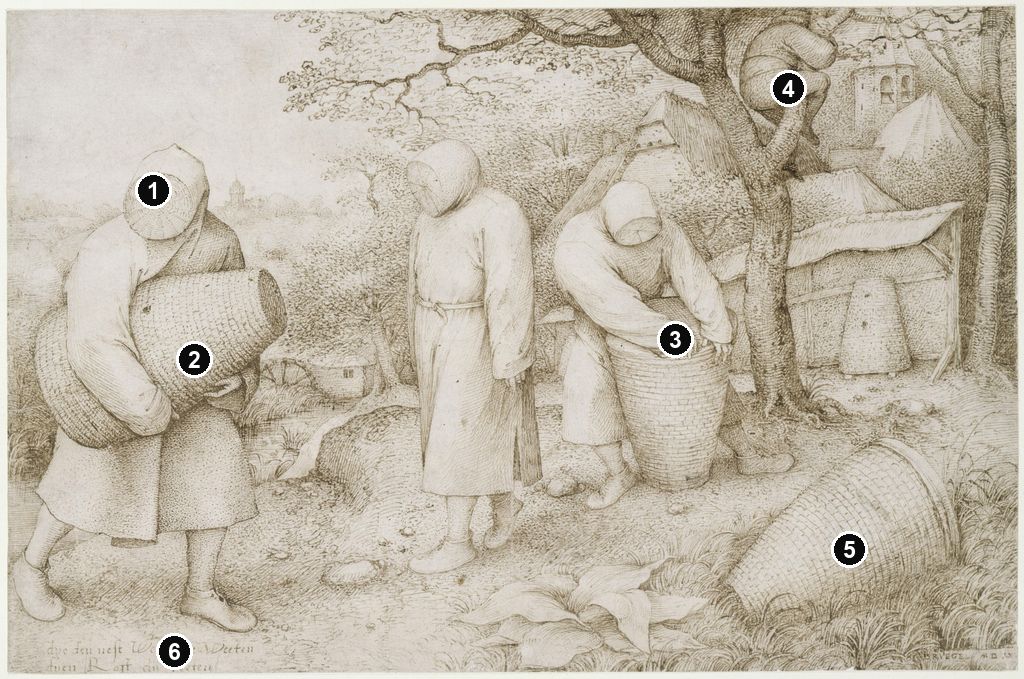
Details from THE BEEKEEPERS AND THE BIRDNESTER
Six details show the work in the foreground, the figure in the tree and the proverb at the lower edge.
The covered face
Regular crossing lines describe the protective covering in front of the face.
The carried hive
The curved weave and the grip beneath it give the hive a sense of weight.
Hands at the hive
The bent worker reaches into the opening at the top of the woven hive.
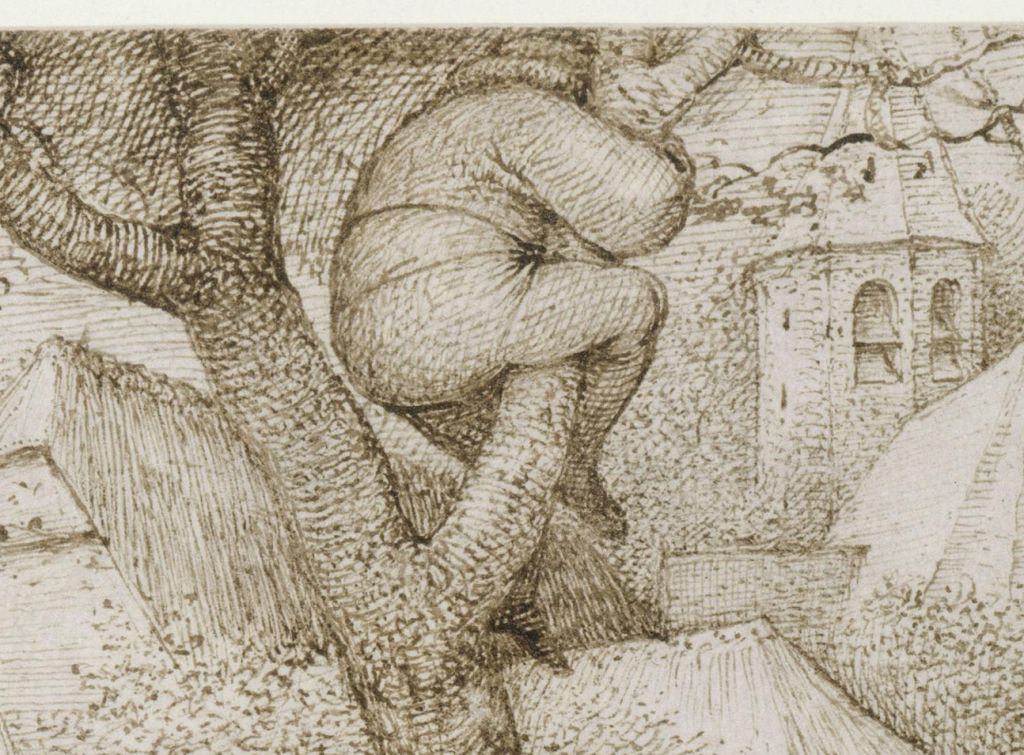
The climber
The small figure holds close to the trunk near the upper edge.
The resting hive
The hive leans into the foreground plants, whose loose outlines interrupt the pattern of the weave.
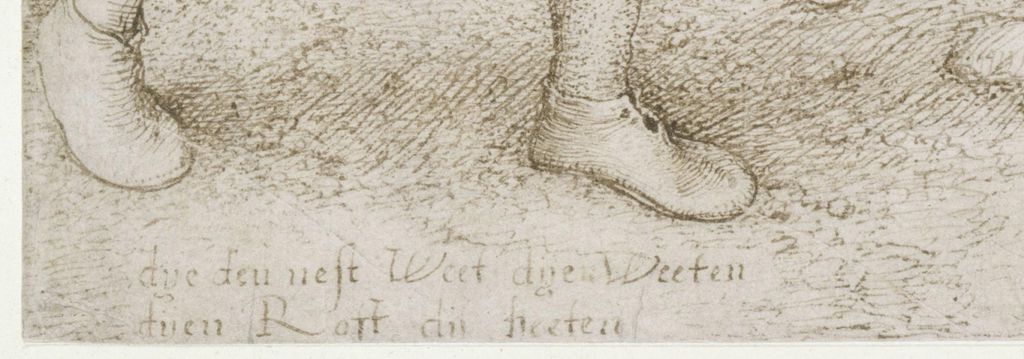
The proverb inscription
The handwriting at the lower left distinguishes knowing where a nest is from taking it.
Pieter Bruegel the Elder, The Beekeepers and the Birdnester, about 1567–68, pen and brown ink. Kupferstichkabinett, Staatliche Museen zu Berlin, KdZ 713. Reproduction via Wikimedia Commons.
The Tree and the Farmyard
The climber appears just below the upper edge. His legs bend around the trunk and his body is partly hidden by a branch. The trunk leads down past him towards the right-hand beekeeper, where several lines and shapes crowd together. There is a considerable shift of scale between the man in the canopy and the workers in front. The viewer has to follow the trunk upwards to recover a figure that can be passed over on a first look.
The setting continues through the spaces between the workers. There is a small building near a stream on the left, identified as a watermill in the Met exhibition catalogue, and a church is visible beyond the tree on the right. Bruegel uses the lighter marks in the middle distance to open the country behind the group. The ground under the hives is much more particular, with plants and small stones. The drawing therefore gives room to the broader rural setting even though most of its strongest outlines belong to people and things at close quarters [3].
Reading the Words at the Lower Edge
The lower-left inscription distinguishes knowing the whereabouts of a nest from having the nest after taking it. The Met exhibition catalogue considers it probably written by Bruegel, and CODART also treats that attribution as likely. The separate signature and date are at the lower right. The date is incomplete because the sheet was trimmed, so the surviving numerals cannot establish an exact year. The catalogue’s dating to about 1567–68 also draws on comparisons with Bruegel’s designs for Spring and Summer [2] [3].
The comparison with the seasonal designs helps explain the scale of the workers. In each case a rural task fills much of the foreground, even though there is room to follow the land beyond it. The Met catalogue also points out two practical differences. The Berlin sheet is slightly larger and carries a written proverb, unlike the two seasonal drawings. The shared manner of placing and drawing figures helps put the sheet in context, while the inscription gives this particular gathering another purpose [3].
One way to read the proverb is as a distinction between knowledge and action. The climber has acted while the people below are occupied elsewhere. The more difficult question is what connects his activity with theirs. Orenstein notes that a proposed interpretation involving a stolen swarm lacks visible support in the sheet, where the climber has no evident container and the inscription concerns a nest. Leaving that question open gives attention back to the precise depiction of the hives and protective garments [3].
Other readings have treated the beekeeping as an allegory, including proposals that relate the hives to churches and view the work through contemporary religious disputes. The Met catalogue discusses that approach alongside substantially different readings, including a story about thieves searching for treasure. These proposals depend on giving a role to the man in the tree and finding a common purpose for the working figures. The drawing gives us the hive shapes, gestures and written saying, but the connection among those pieces remains open to interpretation [3] [2].
A Climber in Another Work
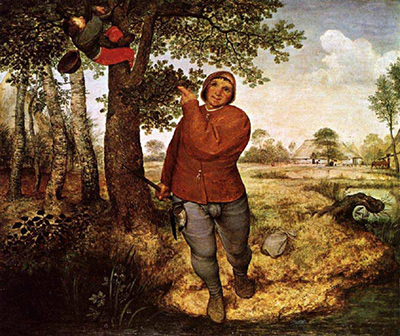
Bruegel’s The Peasant and the Nest Robber, the Vienna painting shown below, gives the climbing figure a different counterpart. A large man points towards the branches, while his feet take him close to water. In the Berlin drawing the covered faces leave the viewer with fewer clues about where the workers are looking. The tree beside the bent beekeeper carries the eye up to the climber. The painting places a conspicuous human gesture between the viewer and the figure in the branches, while the drawing lets the positions of tools, bodies and tree make that connection [4] [5] [3].
Look again at the beekeeper bending over the hive. Both his hands have a task at its edge, while the much smaller figure above him has put his limbs to the work of climbing. The two figures can be compared simply by following the curve of a sleeve or the angle of a leg. What might be an abstract distinction in the proverb becomes a reason to take time over those small physical differences. The words stay present, but there is more to look at than they can account for.
Discussion
Which detail in this work most changes how you read it?
Frequently Asked Questions
The setting continues through the spaces between the workers. There is a small building near a stream on the left, identified as a watermill in the Met exhibition catalogue, and a church is visible beyond the tree on the right. [3]
References
- Staatliche Museen zu Berlin, Die Imker, Kupferstichkabinett KdZ 713, View source.
- CODART Canon, The Beekeepers, catalogue commentary, View source.
- Nadine M. Orenstein, ed., Pieter Bruegel the Elder, Drawings and Prints, 2001, no. 107, View source.
- Kunsthistorisches Museum, Bauer und Vogeldieb, Gemäldegalerie 1020, View source.
- Margaret A. Sullivan, Peasant and Nestrobber, Bruegel as Witness of His Times, Journal of Historians of Netherlandish Art, View source.







