


 by Tom Gurney
Tom Gurney BSc (Hons) is an art history expert with over 20 years experience
Published on June 19, 2020 / Updated on October 14, 2023
Email: tomgurney1@gmail.com / Phone: +44 7429 011000
The Belgian Wagon: Introduction
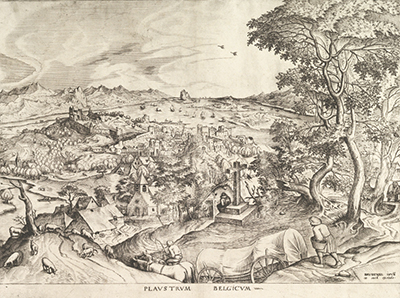
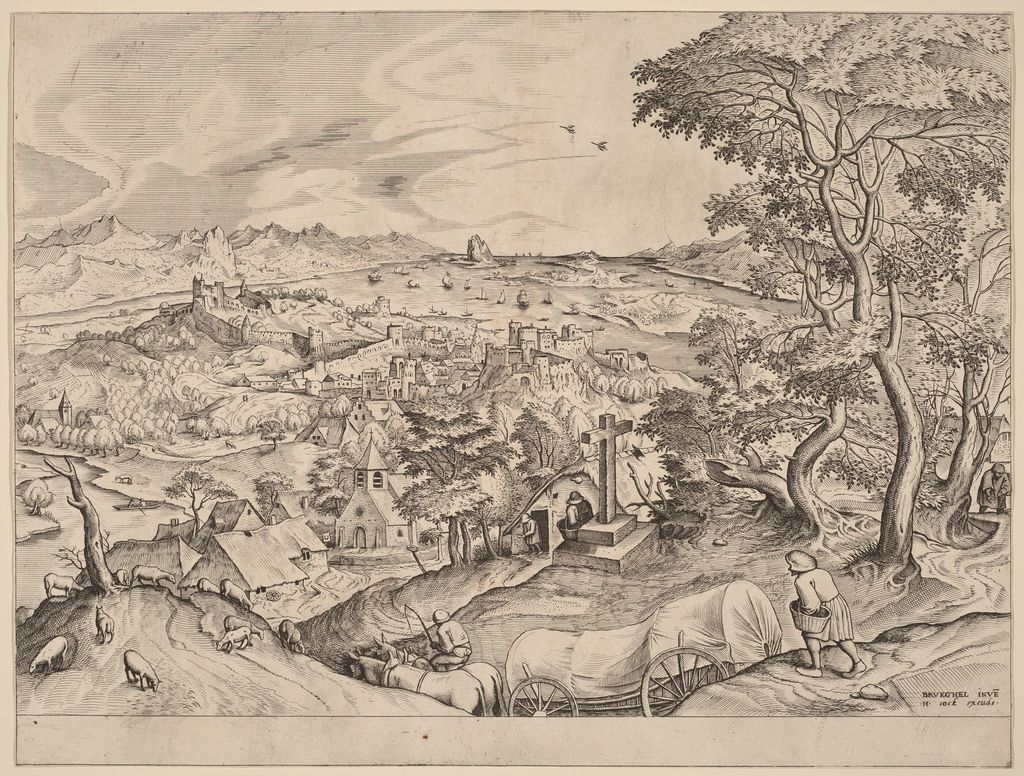
A covered wagon descends from a wooded slope towards farms, a church and a fortified town. Beyond the town, ships are visible on a wide stretch of water backed by mountains. The Belgian Wagon, or Plaustrum Belgicum, is an etching and engraving by Johannes and Lucas van Doetecum after a design by Pieter Bruegel the Elder. Hieronymus Cock published it in the Large Landscapes, which the Metropolitan Museum dates to about 1555–56. The reproduction here is the Met’s second-state impression, 26.72.50. Its Latin title appears below the image [1] [3].
This work across Bruegel’s career
Tower of Babel
1563The Harvesters
1565Peasant Wedding
1568Children's Games
1560Triumph of Death
1562–1563The Belgian Wagon
This artworkContents
- Introduction
- The Wagon on the Slope
- The Cross, the Church and the Harbour
- What Changed between the Two States
- Another Route through the Large Landscapes
- Annotated Details
The Wagon on the Slope
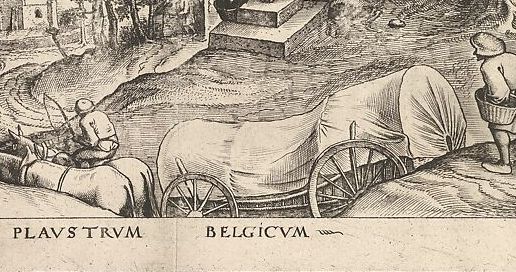
Look along the lower edge, where the wagon’s fabric cover gathers around the arches that hold it up. The wheels cross a change in the level of the ground. The person at the front sits just high enough to be picked out against the road, and another figure stands behind the wagon with a container. The lower border cuts close to the wheels. It makes the vehicle seem to pass immediately beside the viewer before the land opens towards the much smaller houses beyond.
The vehicle’s position also makes the steepness of the road visible. Compare the top of the cover with the line of the ground behind it. The fabric falls at a different angle, while the wheels provide two measurable circles in a part of the drawing otherwise full of irregular shapes. At the left, the track curves past animals on the hillside and leads towards the roofs. It is easy to read the first stretch of road as a route through the scene even as intervening ground conceals sections of it.
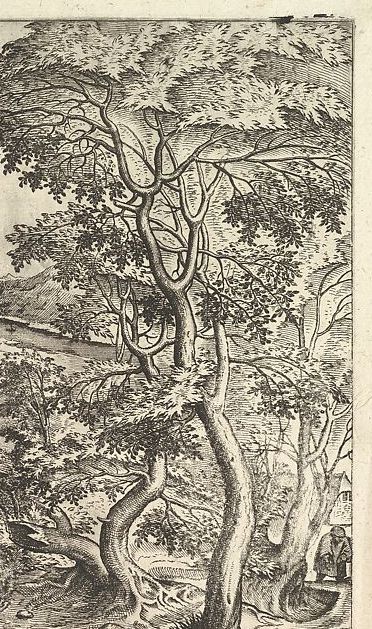
At the right, the foreground trees follow the opposite direction. Their trunks and branches take the eye up from the wagon towards the sky. The larger tree branches repeatedly across the light area above the river, where the marks describing leaves are dark enough to read clearly. Follow one branch back towards the base and the width of the trunk brings the eye again close to the vehicle. The tree is a fixed measure of the slope and helps locate the travelling figures on it.
Annotated Details from The Belgian Wagon
Follow the covered wagon down the slope and look across the town to the harbour.
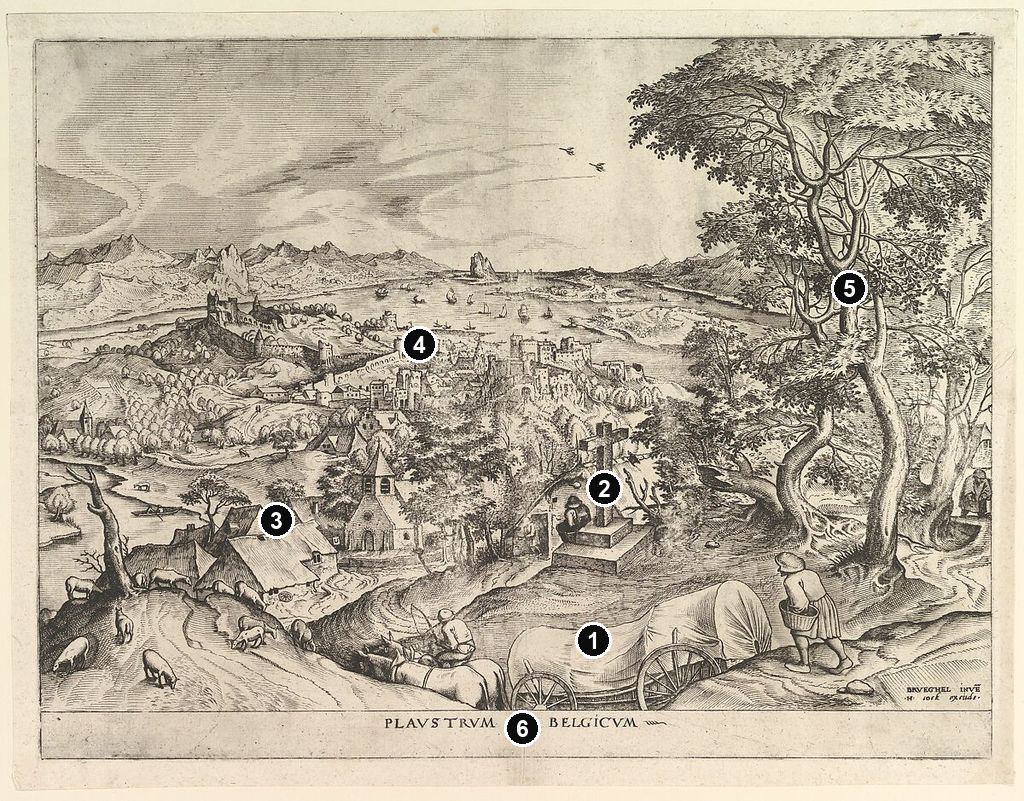
Details from THE BELGIAN WAGON
Six details show the foreground route, the distant settlement and the title.
The covered wagon
Two wheels and the gathered cover occupy the steep lower road.
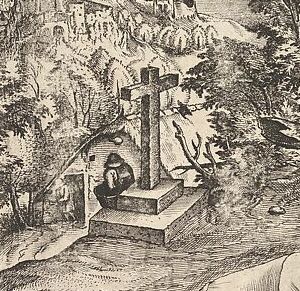
The roadside cross
A stepped base raises the cross above the slope and the doorway behind it.
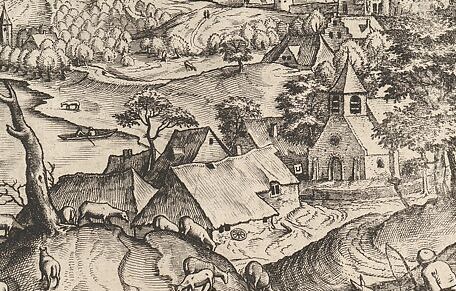
Farms and church
Low roofs cluster beside a church with a tall pointed tower.
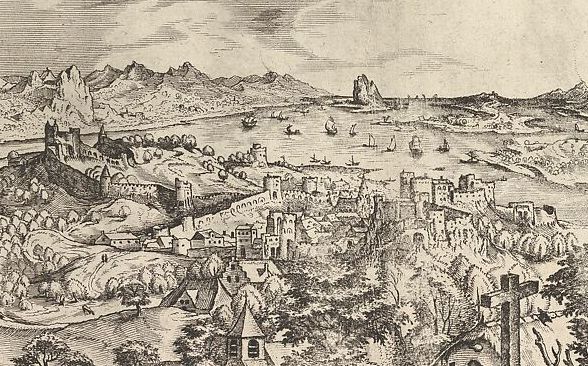
The walled town and harbour
Walls climb across the town below ships and distant peaks.
The large tree
The branching tree frames the pale harbour and sky.
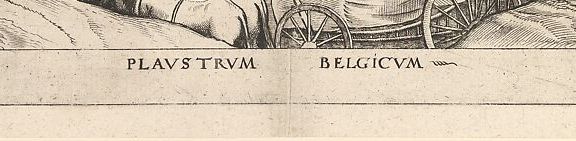
The second-state title
The Latin title appears in two parts below the picture.
Johannes and Lucas van Doetecum, after Pieter Bruegel the Elder, The Belgian Wagon. Published by Hieronymus Cock. Harris Brisbane Dick Fund, 1926. Metropolitan Museum of Art, 26.72.50. Second state. Public domain.
The Cross, the Church and the Harbour
Above the wagon, a large cross stands on a stepped base. Its straight sides make it conspicuous among the surrounding roofs and tree trunks. A figure near a doorway behind it is visible at higher magnification. Look from the cross to the church below and to the left. Their proximity on the page makes the jump from one scale to the other particularly clear. The church is large enough to gather several nearby roofs around it, while the cross is large in the image because it is so much closer to the foreground [4] [3].
Beyond the church, walls climb over uneven slopes and enclose a cluster of buildings. Roofs and towers break the line of the wall. Behind them, the water extends from mid-picture towards the horizon. The little ships can be read against its open surface. Each becomes harder to see as it recedes, eventually giving way to the narrow peaks in the distance. The scene includes roads, enclosing walls and water routes within one view, inviting the reader to compare how each one follows the shape of the land.
Orenstein draws attention to a combination of recognisable Flemish buildings and mountainous country. The farm buildings and small church occupy gently rolling terrain compared with the peaks across the water. Their different forms are brought together by the successive drops in viewpoint from near road to town to harbour. That organisation gives the scene a sense of continuity even where the terrain changes sharply. The printed title locates its wagon in broad geographic terms, while the composition accommodates several kinds of terrain [3] [4].
A band of fine horizontal marks darkens the upper left sky. Where those marks thin out, the surrounding strokes give the clouds a softer edge than the walls below. The sky repeats the change from crowded detail to open water in a different register. The two birds near the tree make that stretch of open sky easier to distinguish from the interval above the distant mountains.
What Changed between the Two States
The National Gallery of Art’s impression 1964.8.412 is a first-state proof. The credits for Bruegel and Cock appear at the lower right within the picture. The strip immediately below the picture is blank where the title would later go. The Met impression places the title across that strip in two widely spaced words. This is the distinction that a reader can see most readily by comparing the reproductions. A state records a change to the plate from which impressions were taken. It can be shared by many surviving sheets [2] [1] [3].
A proof preserves evidence of work still in progress. The 2001 catalogue points to fine ruling lines that served as guides for the credits in the first state. It also notes fine diagonal marks near those guides and proposes that the area may have been smoothed before lettering. These details ask for a closer view than the title does. They are evidence of the preparation of the plate, visible in a part of the image which otherwise looks like ordinary open ground [3].
The earlier page illustration shows the two title words and therefore agrees with the second state. Its margins and resolution leave the specific impression unidentified. The Met sheet used here and the first state from Washington have their own accession numbers. The Fitzwilliam Museum records another example whose lower margin has been cut, leaving its state indeterminate. That example shows why an absent title must be read alongside the edges of the sheet. A viewer needs enough of the original strip to tell whether it was printed blank [1] [2] [5].
Another Route through the Large Landscapes
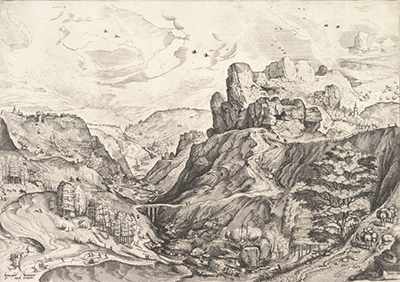
In Alpine Landscape with Deep Valley, the pack train takes a narrow road above a gorge. In The Belgian Wagon, the broad wheels and covered load set a different pace. The wagon lies across the bottom of the composition and the view descends through farms towards a navigable harbour, while the pack train leads up one side of a steep ravine. Both prints let familiar details of travel help the eye judge a much larger view. Their margins also reward comparison. The deep valley plate was issued with a blank caption strip, while the wagon plate acquired a title in its second state [3] [2] [1].
Discussion
Which detail in this work most changes how you read it?
Frequently Asked Questions
References
- Metropolitan Museum of Art, The Belgian Wagon, second state, 26.72.50, View source.
- National Gallery of Art, Plaustrum Belgicum, first state, 1964.8.412, View source.
- Nadine M. Orenstein, ed., Pieter Bruegel the Elder, Drawings and Prints, 2001, cat. nos. 29 and 30, View source.
- Rijksmuseum, Landschap met de Belgische wagen, View source.
- Fitzwilliam Museum, Plaustrum Belgicum, 23.I.8-67, View source.







