


 by Tom Gurney
Tom Gurney BSc (Hons) is an art history expert with over 20 years experience
Published on June 19, 2020 / Updated on October 14, 2023
Email: tomgurney1@gmail.com / Phone: +44 7429 011000
Three Blind Pilgrims After Pieter Bruegel the Elder: Introduction
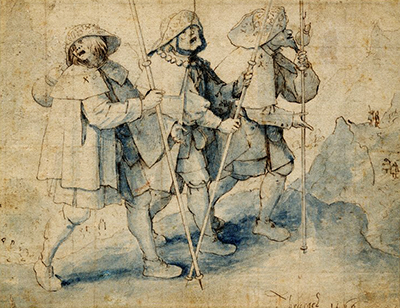
Three travellers fill the foreground of this drawing, each with a broad hat and a long staff. Their bodies face right, but their heads turn in different directions. The British Museum catalogued the sheet as Three Blind Pilgrims, a drawing in pen and brown ink with blue wash, measuring 20.4 by 26.5 centimetres. It came to the museum in George Salting’s bequest as 1910,0212.124. The inscription at the lower right names Bruegel and gives 1566. A. E. Popham, writing in the museum’s 1932 catalogue, treated both the name and date as imitations and considered the sheet probably a copy after a lost original [1] [2].
This work across Bruegel’s career
Tower of Babel
1563The Harvesters
1565Peasant Wedding
1568Children's Games
1560Triumph of Death
1562–1563Contents
- Introduction
- Three Figures on the Road
- Ink, Wash and Distance
- What the Inscription Can Tell Us
- The Drawing and the Painted Parable
- Annotated Details
Three Figures on the Road
The traveller at the left looks back over his shoulder. His hat brim slopes towards his raised collar, and the long cloak hides most of the movement of his arms and legs. One foot emerges from under the hem close to the edge of the sheet, with the other set forward near the centre. His right hand grips a shaft that slants across his body. Following the shaft down towards the road reveals how little of the movement depends on the face. The length and direction of the staff carry the turn of the figure across the drawing.
The middle traveller holds his staff with both hands and brings his head up. His bead-like necklace gives a curved edge to the otherwise angular folds beneath his chin. Both hands remain visible, although parts of his clothes disappear behind the other travellers. The drawing groups the men by making their coats overlap, then separates their gestures by outlining the hands against the shafts. The grip of the middle man looks especially deliberate next to the raised head. His face and his hands seem to attend to different things [1] [2].
The front traveller leans ahead and holds a nearly upright staff in his left hand. His other arm extends towards the open right side, ending in fingers drawn apart. The pale space beyond them lets the small gesture register even though the weight of the drawing lies among the faces and coats. His body is still balanced above the road. The foot lifted to the right and the shaft planted below his hand give the scene the shape of a step in progress. The ground continues past him into a thinner, lightly drawn landscape.
Annotated Details from Three Blind Pilgrims
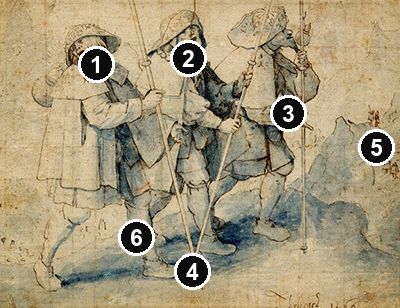
Follow the three travellers from the backward glance at left to the hand reaching forward at right.
Details from THREE BLIND PILGRIMS
Six details show how the drawing makes the travellers’ movement visible.
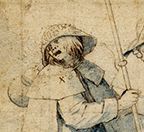
The backward glance
The rear traveller turns his head back as his right hand grips a slanting staff.
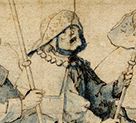
The upturned head
The central traveller lifts his head above the curve of his necklace.
The reaching hand
The front traveller extends his free hand towards the road ahead.
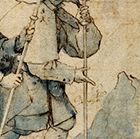
The crossing staffs
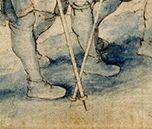
Two staffs cross near the lower edge in front of the travellers’ feet.
Figures on the distant road
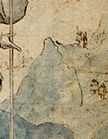
Small figures at the right extend the route into the distance.
Blue wash on the road
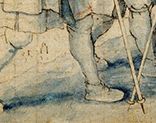
Blue wash gathers beneath the coats and across the ground around the feet.
Anonymous, after Pieter Bruegel the Elder, Three Blind Pilgrims. British Museum, 1910,0212.124. Annotations use the site’s existing reproduction. Read the museum catalogue entry.
Ink, Wash and Distance
Two of the shafts cross near the bottom of the sheet. Their long diagonals descend almost to the margin and lead back up to the hands. The third shaft is close to parallel with the right edge. This arrangement gives the tightly packed group a framework that extends above the hats and below the coats. The short marks describing fingers, fastenings and folds can be read against those long lines. Look at the point where the two sticks meet and then at the feet behind them. The drawing establishes the spacing of the feet without having to show the whole length of every leg.
The blue wash does much of the work of showing which surfaces sit back and which come forward. It gathers in the recesses of the coats and along the ground beneath the feet, while the unwashed paper remains visible on broad areas of the cloaks. The same colour lies over the rough contours at the right. There the shadows belong to the terrain, whereas around the men the wash makes layers of clothing easier to distinguish. The drawing thus uses one colour at several scales, from a small shadow beside a hand to the larger blue area under the advancing group [2].
The landscape also contains figures much smaller than the three in front. Popham describes four other pilgrims on the road in the distance. The little figures on the right take up only a few strokes each. They make the open space ahead of the first traveller part of a route across the sheet and give the much larger foreground figures a measurable scale. This difference between the two groups explains why the staffs make such a strong first impression. The distant travellers can be understood as people from the slightest indications, but the viewer can follow each movement of a hand or a foot in the foreground [1] [2].
What the Inscription Can Tell Us
The letters at lower right are inside the image and were partly cut off in a narrower reproduction of the sheet. The fuller museum photograph shows them alongside the date. Popham described them as close imitations and recorded a separate inscription on the reverse. His entry also records the medium, dimensions, Salting bequest and museum number. Taken together, those details identify a particular sheet and distinguish the date written on it from the date at which the copy was actually made [1] [2].
Popham followed Campbell Dodgson in suggesting that the drawing copied a lost original. He mentioned Jan Brueghel the Elder and David Vinckboons as possible makers and pointed to the style and blue wash when discussing the former. The entry offers possibilities rather than a named author. An earlier notice in the Gazette des Beaux-Arts reported a drawing dated 1566 in Salting’s collection in connection with Bruegel’s treatment of the subject. The British Museum catalogue supplies the specific registration and description that the early notice lacked. It also gives a reason to question the chronological conclusion the earlier writer drew from the date [1] [3].
The Drawing and the Painted Parable
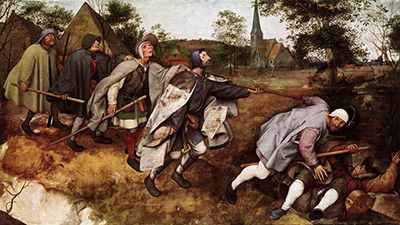
The six men in Bruegel’s 1568 The Blind Leading the Blind form a diagonal that runs down towards a ditch. The two at the front show what is about to happen to those behind. In the London drawing the three main figures advance at nearly the same height, and the shafts give the action a repeated rhythm. The drawing’s foremost figure reaches into the space ahead, while the painting establishes the fall at the front of the line. This is a difference in how the two compositions tell a story, even though both use touch, balance and direction to make walking visible [4] [2].
Another drawing, Die Blinden in Berlin, also shows travellers moving towards the right. The Berlin sheet has a basket carrier set apart at left, a church tower in the background and an inscription at the upper right. The Berlin museum records a date of 1562 and attributes the drawing to Jacob Savery, with Pieter Bruegel the Elder as a former attribution. Comparing the two drawings clarifies how readily a title or a shared subject can bring different sheets together. Their spacing, props, placement of the date and handling of the landscape give each its own visual identity [5] [2].
The biblical parable of blind guides appears in Matthew and Luke and circulated in Netherlandish prints as well as paintings. The Fondation Custodia’s account of Hendrick Goltzius’s engraving describes how pilgrims’ badges distinguish figures in some versions of the subject. That comparison gives the hats and travelling equipment in the London drawing a context. The sheet itself concentrates on the journey. A viewer can follow from the backward turn at left, through the clasped hands in the middle, to the extended hand at right. The open ground shows where the group is going while leaving its next step to the imagination [6] [2].
Discussion
Which detail in this work most changes how you read it?
Frequently Asked Questions
The blue wash does much of the work of showing which surfaces sit back and which come forward. It gathers in the recesses of the coats and along the ground beneath the feet, while the unwashed paper remains visible on broad areas of the cloaks. [2]
References
- A. E. Popham, Catalogue of Drawings by Dutch and Flemish Artists Preserved in the Department of Prints and Drawings in the British Museum, vol. 5, 1932, p. 147, no. 13, View source.
- British Museum, repository photograph AN00182634 of drawing 1910,0212.124, View source.
- Gazette des Beaux-Arts, discussion of the painted Parable and the Salting drawing, p. 36 and note 3, View source.
- Museo e Real Bosco di Capodimonte, La parabola dei ciechi exhibition, View source.
- Staatliche Museen zu Berlin, Die Blinden, Kupferstichkabinett, KdZ 1376, View source.
- Fondation Custodia, catalogue entry for Hendrick Goltzius, The Blind Leading the Blind, View source.







