


 by Tom Gurney
Tom Gurney BSc (Hons) is an art history expert with over 20 years experience
Published on June 19, 2020 / Updated on October 14, 2023
Email: tomgurney1@gmail.com / Phone: +44 7429 011000
The Crafty Bird-Catcher: Introduction
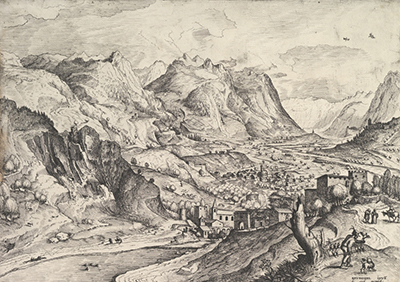
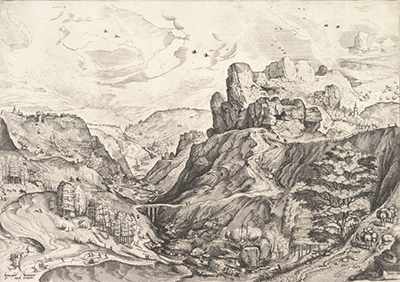
A man carrying birds walks along a track above a settlement in The Crafty Bird-Catcher. The track occupies a corner of the print, while mountains, water and a succession of villages fill most of the sheet. The National Gallery of Art’s impression, 1964.8.413, preserves the Latin title Insidiosus Auceps beneath the picture. Johannes and Lucas van Doetecum made the etching and engraving after a design by Pieter Bruegel the Elder. Hieronymus Cock published it as part of the Large Landscapes. The 2001 exhibition catalogue dates the print to about 1555–56 [1] [3].
This work across Bruegel’s career
Tower of Babel
1563The Harvesters
1565Peasant Wedding
1568Children's Games
1560Triumph of Death
1562–1563The Crafty Bird-Catcher
This artworkContents
- Introduction
- Finding the Bird-Catcher
- The River and the Settlements
- How the Mountains Hold the View
- The Print and Its Comparisons
- Annotated Details
Finding the Bird-Catcher
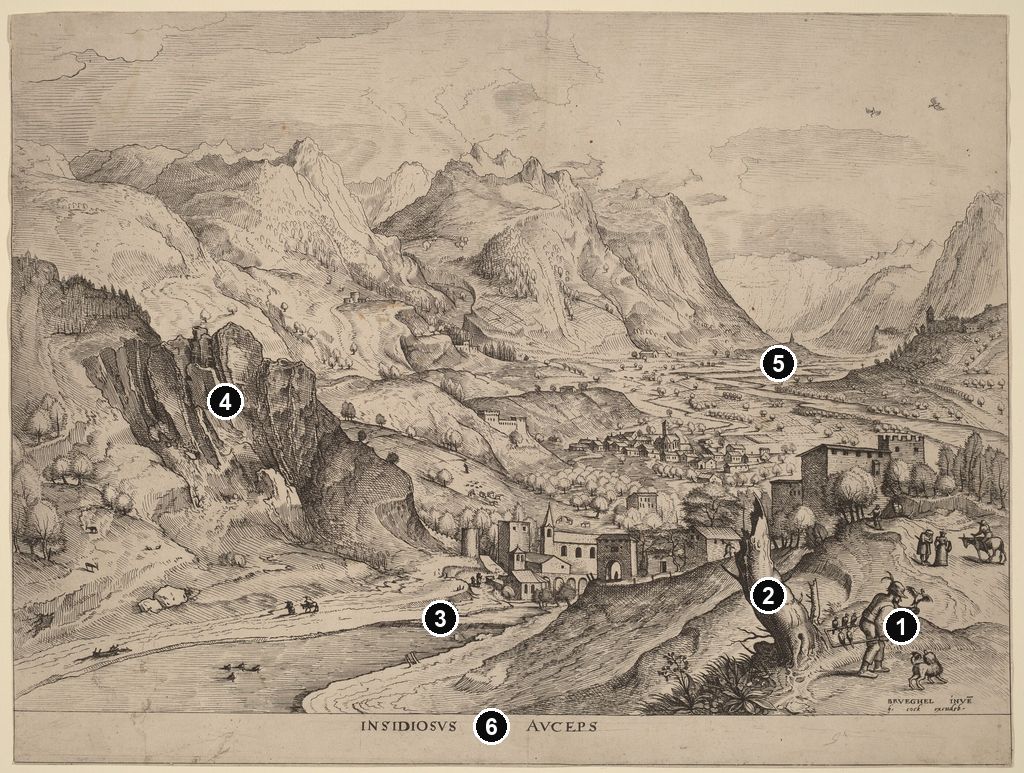
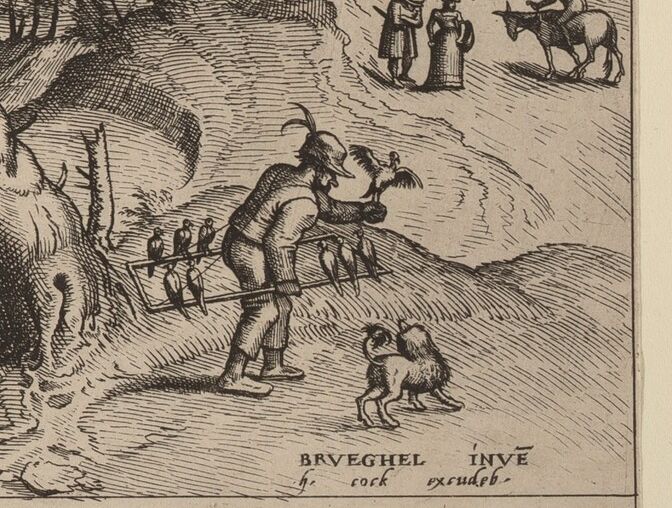
Start just above the credits at the lower right. A man leans into his stride, with birds clustered on a frame that he carries. People farther up the slope are easier to separate from one another, but it is the man nearest the broken trunk whom the title invites the viewer to find. When the image is reduced to page size, the details of his load can disappear into the marks around his shoulders. The title directs attention to a small and otherwise relatively inconspicuous part of the landscape [1] [3].
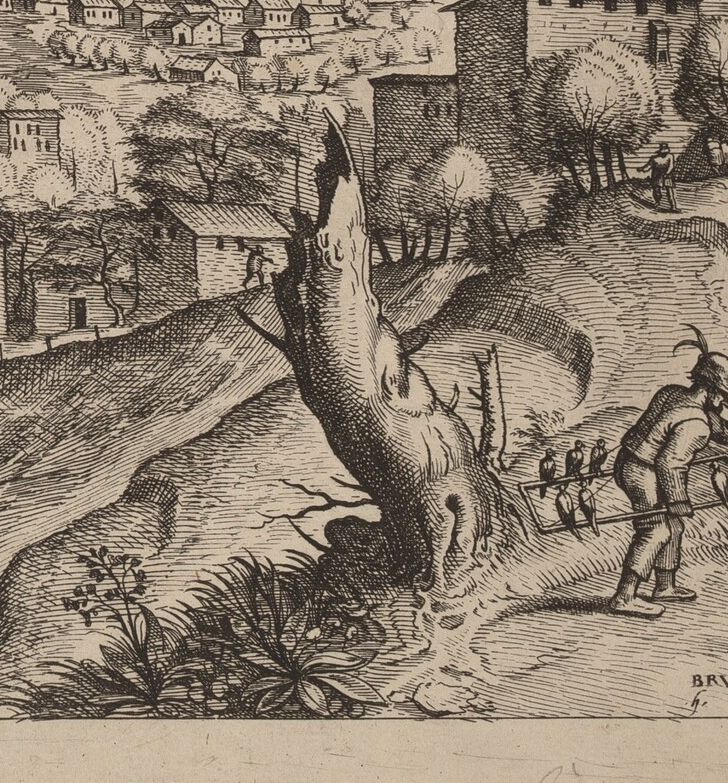
The bare trunk beside him helps locate the foreground. It is broad near the ground and ends in a jagged top. Look along its base and you can follow the edge of the bank towards the water. The figure takes a different line, following the path up and into the right side of the picture. The print offers several such changes of direction, and a broad view of the valley emerges as the eye moves among them. The traveller establishes how high the near track stands over the open water at the left.
The title describes him as crafty. Orenstein suggests that he might be taking the birds to market and points out that a bird-catcher could also suggest temptation or deception in emblematic literature. Both observations start with features of the same print, the frame carrying birds and the wording of the title. The landscape supplies a credible route towards a village, and the wording invites a question about how to understand the person using it. The catalogue leaves the intended meaning open [3].
Annotated Details from The Crafty Bird-Catcher
Find the small figure at the right and follow the terrain down to the water.
Details from THE CRAFTY BIRD-CATCHER
Six details show the figure, the valley and the title that connects them.
The bird-catcher and his frame
The man carries birds along the near track.
The broken trunk
A jagged trunk rises above the near bank.
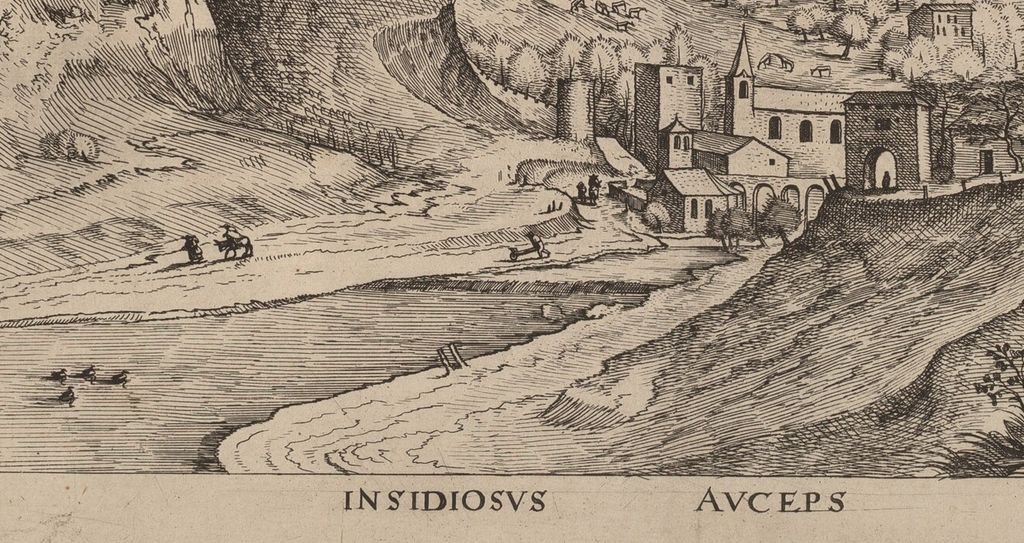
The water and nearer buildings
Lines of water guide the eye towards the roofs at centre.
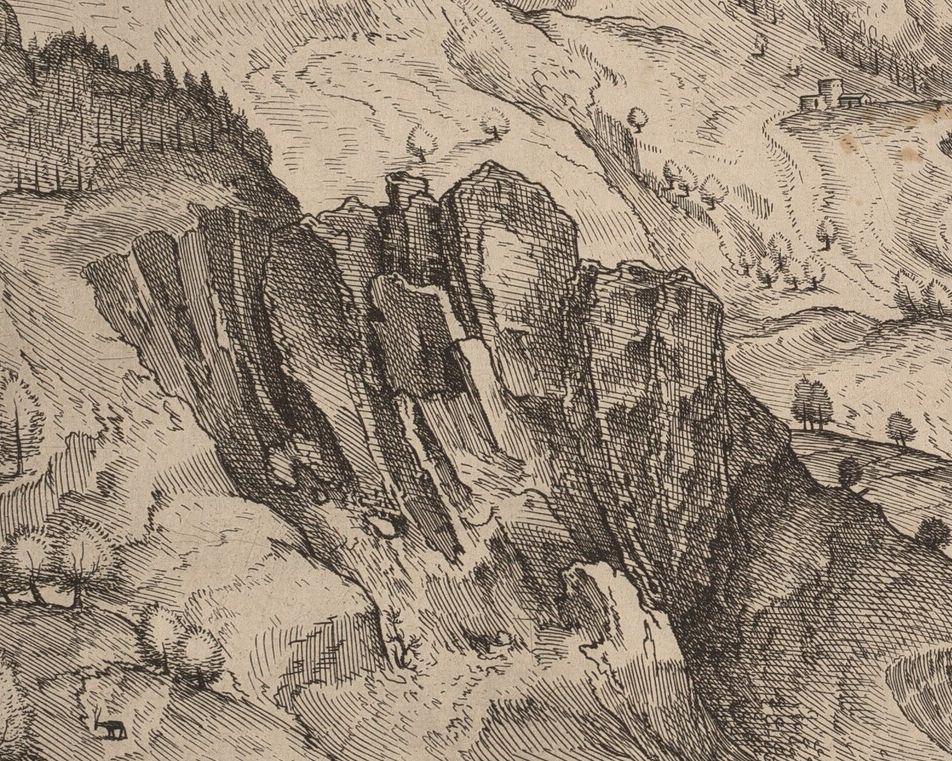
The dark wall of rock
Light gaps separate the steep rock faces at the left.
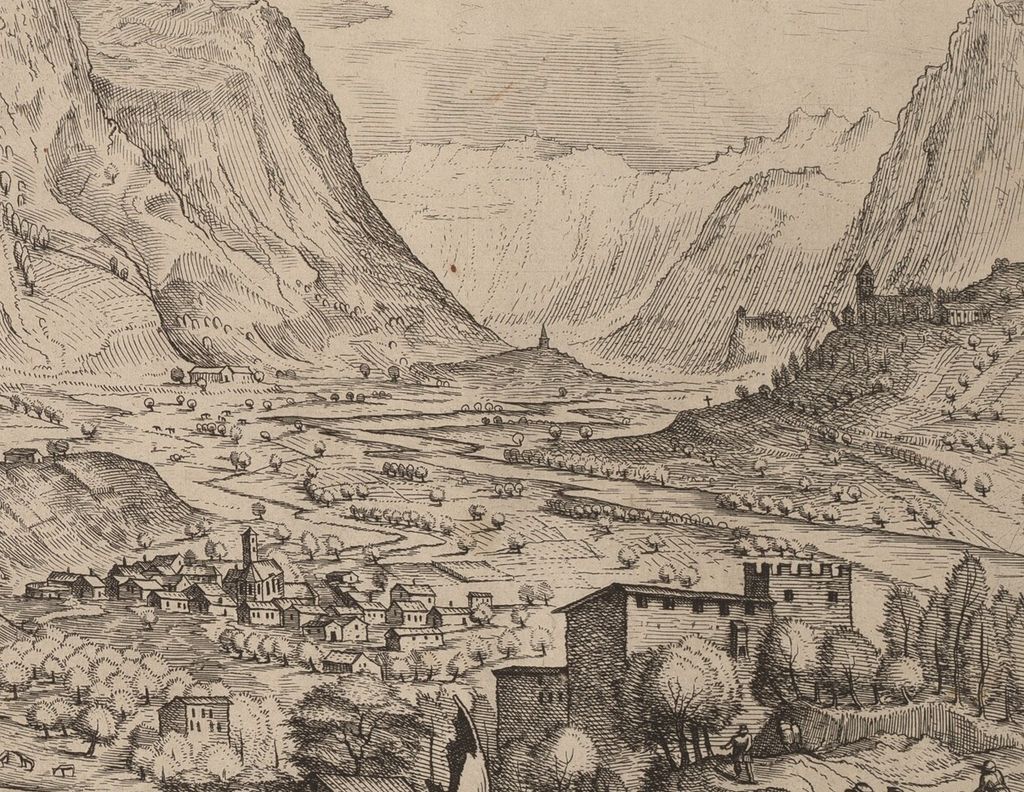
The far valley
The ground opens between ridges above the more distant settlements.
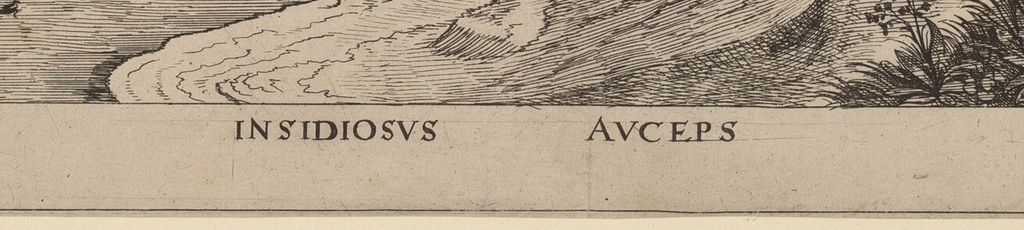
The Latin title
The caption names the traveller singled out by the print.
Johannes and Lucas van Doetecum, after Pieter Bruegel the Elder, The Crafty Bird-Catcher. Published by Hieronymus Cock. Rosenwald Collection, National Gallery of Art, 1964.8.413. Public domain.
The River and the Settlements
The water at the lower left presents a light interval between long banks. A few marks on its surface interrupt the horizontal lines. The inner shoreline bends towards a group of buildings close to the centre. Their walls and rooflines are clearer than those of the town behind. Looking from one group to the next provides a rough measure of distance. In the farther settlements, a single upright can establish the position of a tower above an area of much shorter marks.
At the right, the buildings above the traveller appear larger and more sharply defined. Their straight walls contrast with the uneven profile of the trunk. At the centre, groups of trees and houses occupy successive shelves of ground. The marks indicating these shelves meet the more horizontal pattern of the low country. Bruegel brings inhabited places into the mountain terrain by allowing their outline to follow each rise. Across the valley, the settlements are spaced far enough apart that the viewer can still make out broad stretches of land between them.
The water, people on foot and figures on the right road give the scene more than one route into the distance. Looking for all of them can make the bird-catcher seem surprisingly close. The next group of travellers appears higher on the page and is much smaller in relation to the trees. Together those two groups help account for a stretch of road whose surface is carried by only a few curving marks.
How the Mountains Hold the View
At the left, a dark wall of rock rises from the open banks. Its face is cut into separate projections by alternating bands of light and shade. Several ridges behind it take up similar diagonals. Near the centre those overlaps lead towards the jagged peaks, while at the far right a darker slope marks the other side of the valley. The widest interval between steep slopes reveals the land furthest away. Its small marks describe fields and trees with considerably less detail than the strong lines at the foreground trunk.
Etching and engraving allow the printmakers to give the rock, the road and the sky distinct textures within the same range of ink. Closely spaced lines gather into dark faces, and looser marks let light paper show between patches of foliage. At the top, the effect of the sky depends partly on the nearly horizontal spacing of the strokes. The birds in flight are tiny but legible there. They add a point of comparison with the captured birds. The image gives each group a very different setting, one in open air and the other beside a man following a road [1].
The Print and Its Comparisons
The National Gallery of Art records a lower-right inscription that credits Bruegel with the design and Cock with publication. Tokyo’s impression records the same position for the credit and the Latin title in the lower margin. The legacy image matches the arrangement of the broken tree, the rock wall and the river. Its crop ends above the title strip, and its specific impression remains unidentified. Washington’s impression supplies a documented view with the title visible. Orenstein’s catalogue illustrates the Boston impression, MFA 34.10, and identifies a watermark in that sheet [1] [2] [3].
The dark rock wall at the left also helped scholars assess drawings formerly given to Bruegel. Orenstein notes that a similar set of rocks appears in a sheet known as Landscape with a Mule, now assigned to the Master of the Mountain Landscapes. Its recurrence is evidence that later artists could use this print as a source of individual motifs. The distinctive rock profile is worth comparing independently of the scene’s foreground figure [3].
In Alpine Landscape with Deep Valley, reproduced below, the same printmakers worked with another design in which a road runs beside a prominent foreground tree. There it carries a pack train above the gorge. The animal loads give a scale to the slope, much as the bird-catcher’s frame does in this print. The caption strips differ. The deep valley print has credits within the picture and no descriptive caption below it. Here the Latin title tells the viewer which traveller to look for within a scene far larger than his occupation requires [1] [4] [3].
Discussion
Which detail in this work most changes how you read it?
Frequently Asked Questions
Etching and engraving allow the printmakers to give the rock, the road and the sky distinct textures within the same range of ink. Closely spaced lines gather into dark faces, and looser marks let light paper show between patches of foliage. [1]
References
- National Gallery of Art, Insidiosus Auceps, 1964.8.413, Rosenwald Collection, View source.
- National Museum of Western Art, The Crafty Bird-Catcher, G.2010-0006, View source.
- Nadine M. Orenstein, ed., Pieter Bruegel the Elder, Drawings and Prints, 2001, cat. nos. 27 and 29, View source.
- National Gallery of Art, Alpine Landscape, 1964.8.411, Rosenwald Collection, View source.







