


 Pieter Bruegel.jpg)
 by Tom Gurney
Tom Gurney BSc (Hons) is an art history expert with over 20 years experience
Published on June 19, 2020 / Updated on October 14, 2023
Email: tomgurney1@gmail.com / Phone: +44 7429 011000
Desidia (Sloth): Introduction
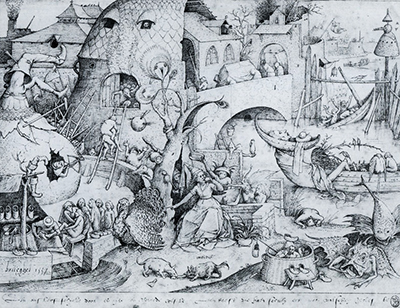
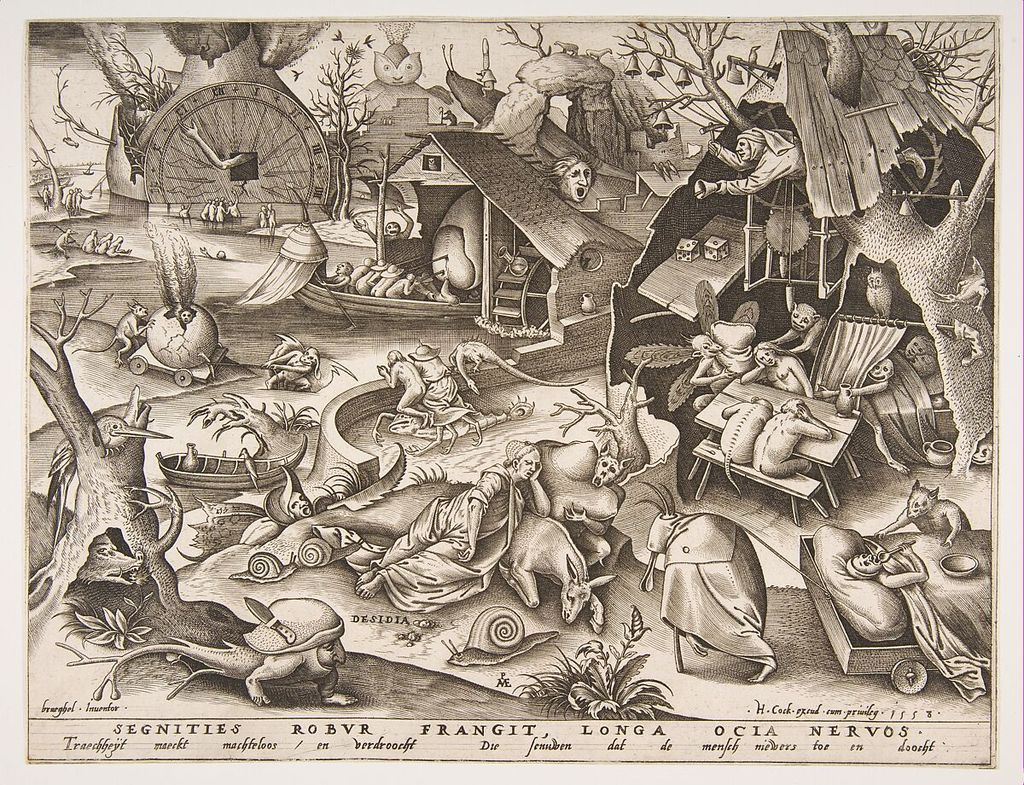
Pieter Bruegel the Elder’s Desidia, or Sloth, is a signed drawing of 1557 in the Albertina, Vienna. The drawing above shows a woman asleep beside an ass, a bed on wheels and a clock whose hand takes the form of an arm. Pieter van der Heyden engraved the design for Hieronymus Cock’s Seven Deadly Sins, published in 1558. The subject is easy to name once you find the woman. Further up the sheet, the clock, the figures at the inn and the slow progress of travellers give a viewer several ways to think about how time passes [1] [2].
This work across Bruegel’s career
Tower of Babel
1563The Harvesters
1565Peasant Wedding
1568Children's Games
1560Triumph of Death
1562–1563Desidia (Sloth)
This artworkContents
- Introduction
- The Sleeper and the Ass
- A Bell and a Clock
- What Changed in the Engraving
- Sloth and Envy
- Annotated Details
The Sleeper and the Ass
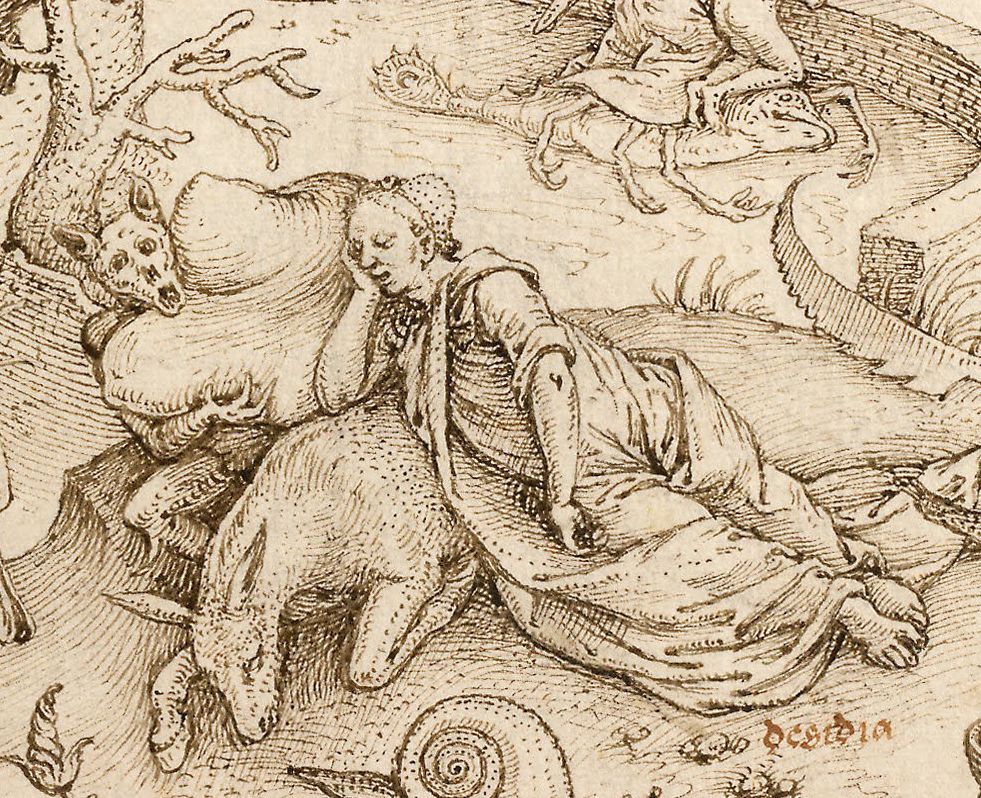
Look in the lower centre for the heavy folds of a dress. Most of the figure’s weight is low, and the upper body is supported by the animal beside her. Its back gives her a place to lean. Her head and arms fall into a relatively small area, which makes the curve of her posture easy to follow even when the lines around her are busy. The Met identifies this woman as the personification of sloth and the ass as the animal that accompanies her in the series [1] [2].
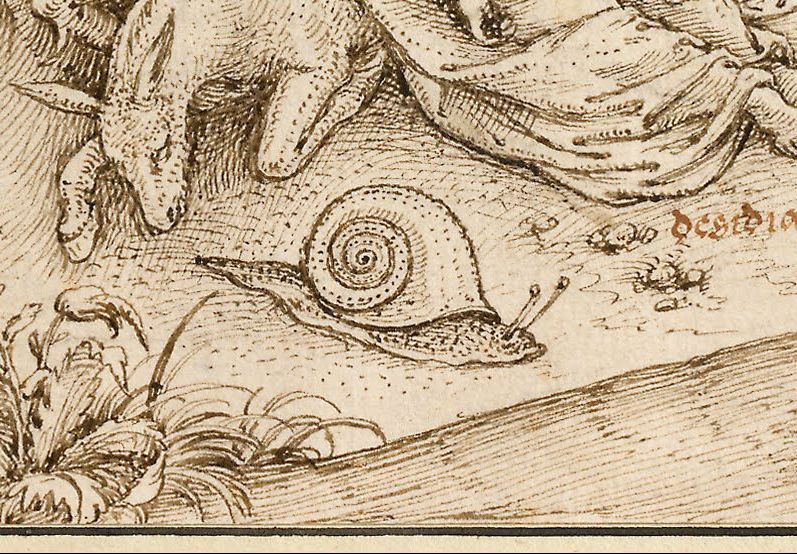
The ass’s lowered head carries the eye closer to the earth, where a snail goes along on its own. A spiral is easier to find than the tiny marks that give its body a direction. Other snails occupy different parts of the ground. Together they suggest the speed at which the eye might travel through this landscape. Their place in the drawing also makes it possible to see how differently figures use the earth beneath them. One crosses it under its own power. The woman rests on a larger animal with no evident wish to go anywhere [1].
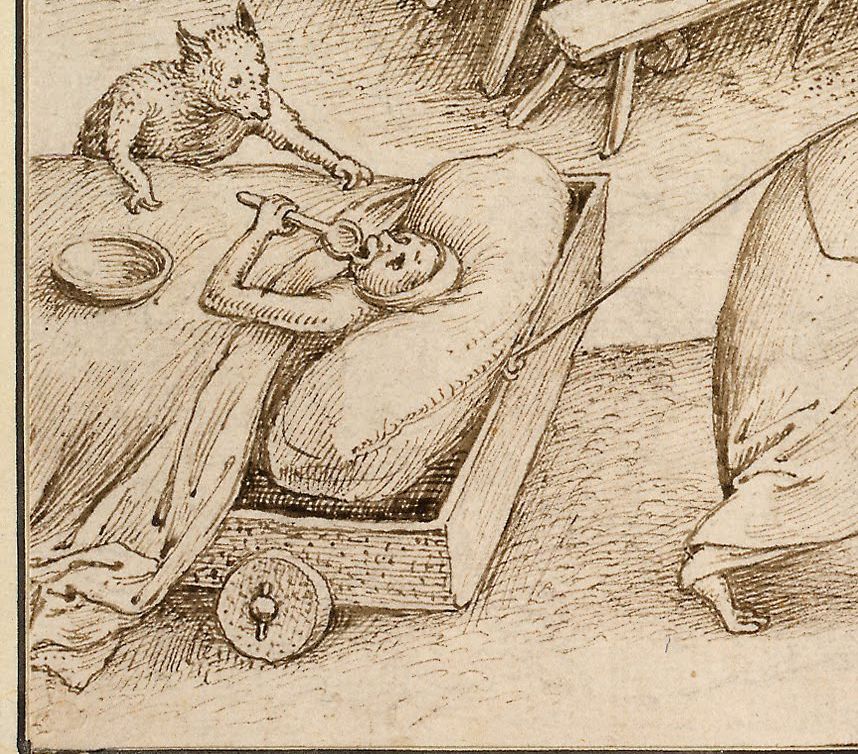
A bed near the lower edge offers a further variation. Its occupant has the space to lie down, and the wheels give the bed a means of travelling with him still in it. From the shape of the bed look at the connection to the figure ahead. The practical arrangement transfers the labour of movement away from the person being carried. That makes the bed as much a device for continuing to lie down as a vehicle. Bruegel gives a separate example of inactivity a means of passing through the same terrain [1].
The Albertina also identifies a pig feeding on an easily reached thistle. This makes a smaller point about effort than the rolling bed. The animal can eat by taking what is immediately to hand. A reader who starts with the large woman and ass can return to these smaller examples and see that Bruegel represents sloth through choices about movement and labour as well as through sleep [1].
Annotated Details from Desidia (Sloth)
Find the sleeping woman and follow the paths that lead from the wheeled bed to the distant clock.
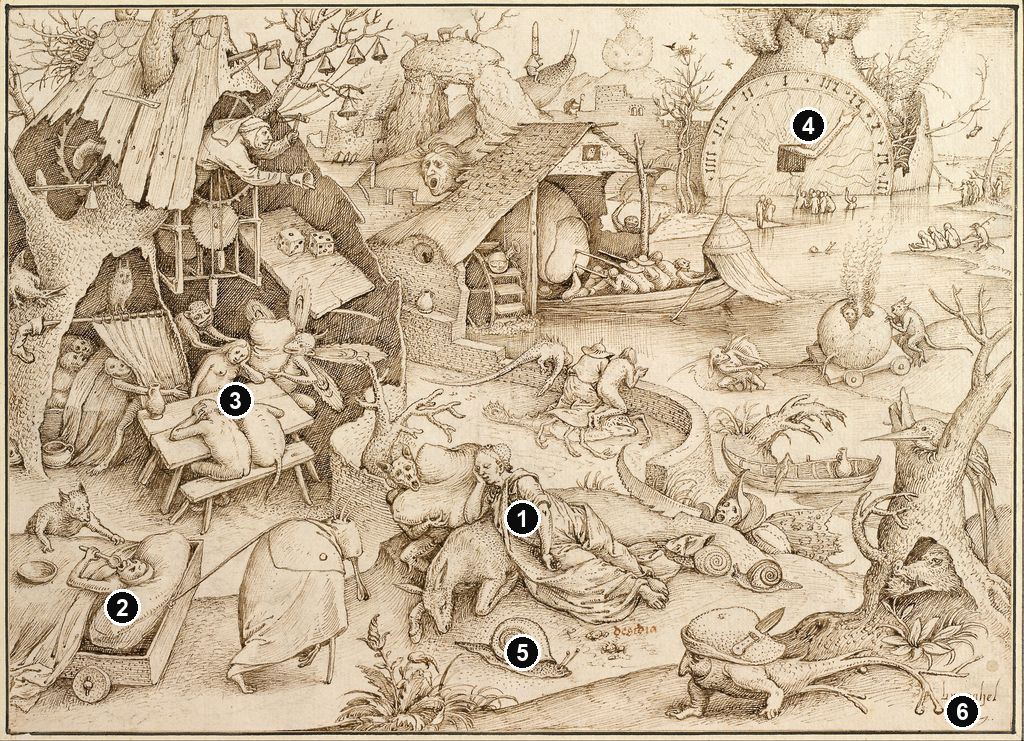
Details from DESIDIA (SLOTH)
These details bring the signs of movement and delay into view.
The sleeper and ass
The woman lets her weight settle against the animal. The drooping head of the ass carries the eye down towards the ground.
A bed on wheels
The bed moves with someone still lying in it. Follow its line towards the figure up ahead.
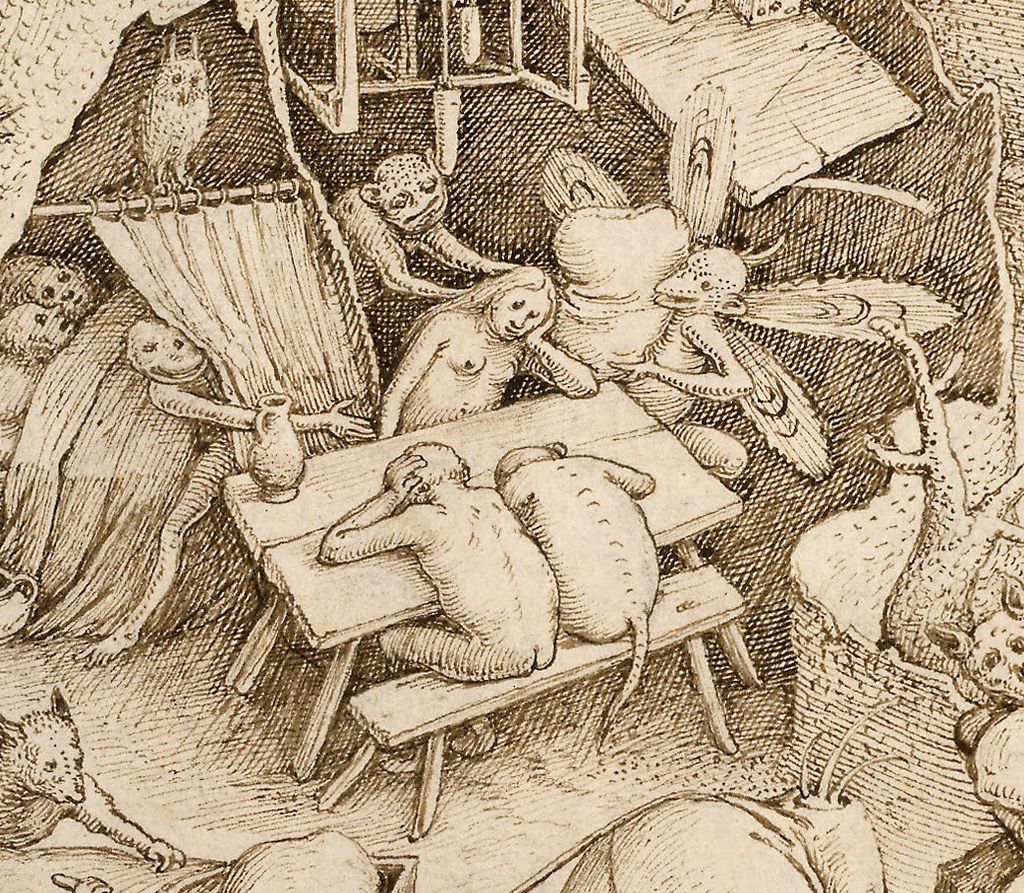
Company at the inn
The figures remain gathered around the table. Look how the two people closest to us lean forward over the bench.
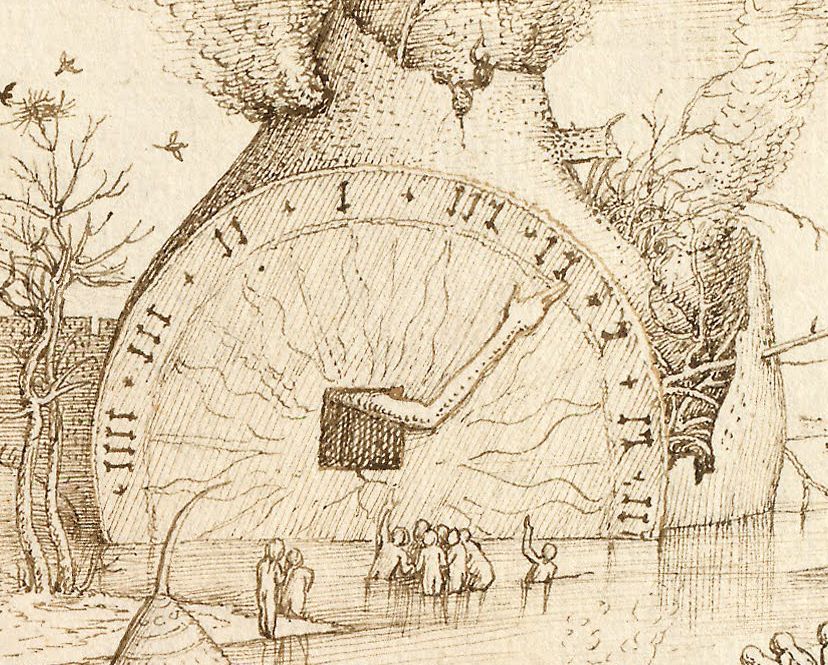
The clock with an arm
An arm points across the dial in place of an ordinary clock hand. The Roman numerals were drawn to be reversed by printing.
Snail in the path
A spiral shell and a short body make a small figure against the ground, close to where the ass lowers its head.
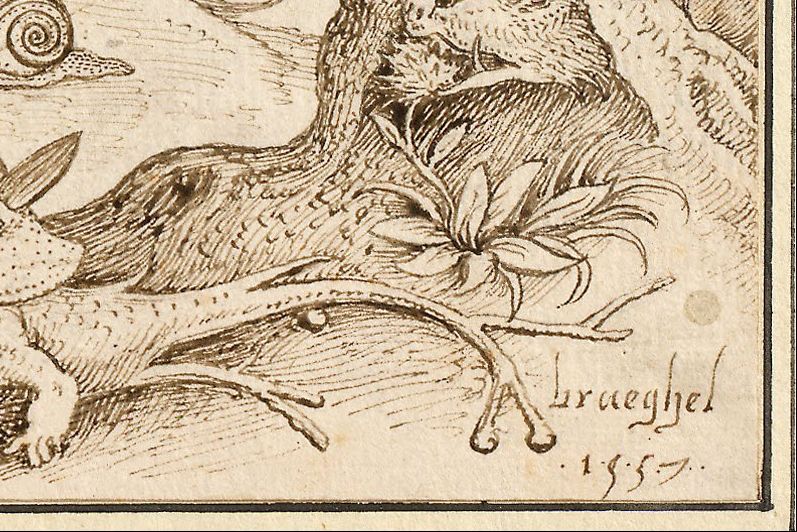
Signature and date
The signature and the date 1557 are written just inside the lower right edge.
A Bell and a Clock
At the left of the drawing several people sit together at a table outside a building. There is room for their feet, benches and the objects on the table. Just beyond that familiar gathering are forms less easy to place, including the figure associated with a bell. The Albertina describes a monk trying in vain to disturb the company’s lethargy by ringing it. A bell can be seen even though the response to it is slight. The gathered bodies are the place to look for evidence of whether it has made any difference [1].
Farther back, the clock gives a more overt signal about time. Its face occupies a stretch of curved surface large enough for a viewer to pick out the marks around the edge. An arm takes the place of the usual pointer. The Albertina notes that the eleventh hour, which it relates to folly, was drawn in reverse so that it would read correctly in the engraving. That makes the tiny dial a practical example of a decision Bruegel made for publication. The engraver had to preserve something that would only become legible after reversal [1] [2].
The two signals can be read together. A bell can call attention to a moment and a dial can give it a place in a sequence. In this scene both are placed among people whose bodies suggest little urgency. The clock is conspicuous in the distance, while the bed and the ass are close enough for the viewer to see how they carry someone’s weight. The image puts the passage of time within sight of figures who have settled into places where they can wait.
What Changed in the Engraving
The Albertina records the signed drawing as inventory 7872. The 2001 Metropolitan Museum catalogue describes pen and gray-brown ink and notes that contours were indented for transfer. It also records a Dutch verse formerly at the lower margin and now on the back of the sheet. The engraving gives the wording its own printed place below the picture. The Met paraphrases its warning as a claim that sloth deprives people of strength and leaves them incapable of useful action. The reader can relate that warning directly to the sleeping woman, the bed and the company that stays at the table [1] [3] [2].
The engraving, Met accession 26.72.34, reverses the composition. The clock moves to the upper left, the table to the right and the wheeled bed to the other end of the foreground. Compare these relatively large shapes before searching for smaller creatures. They make the reversal easy to see and give a consistent means of finding the same passage on a different sheet. The maker credits also establish how the two objects are related. Bruegel designed the image, Van der Heyden engraved it and Cock published it [3] [2].
Sloth and Envy
The series uses a named vice and an accompanying animal to make each subject recognisable. In Invidia, the turkey stays close to a figure who brings a heart to her mouth. In Desidia, the ass helps hold up the figure’s body. Beside the turkey, attention narrows to the movement of one hand. In the slothful landscape, several groups show what happens when a person lets an animal, a bed or another figure take over the task of supporting or moving them [1] [2] [4].
Both prints also give readers unfamiliar creatures and buildings to spend time on after the main figure has been found. The Met relates those crowded and improbable settings to Bosch. The framework of the series keeps them readable even when particular forms have no obvious explanation. A reader can start with the animal, see what the woman is doing and use the inscription to connect her posture with the title. The clock and the bell then add a question about what signals could still make her move [1] [2].
Try following the lower edge from the bed to the snail, then move up to the ass and farther back to the clock. Each of these details has a different relation to time. Some make it visible, while others show how much of it can pass without anyone changing position. Bruegel makes the scene worth moving through even as the people in it seem content to stay where they are.
Discussion
Which detail in this work most changes how you read it?
Frequently Asked Questions
At the left of the drawing several people sit together at a table outside a building. There is room for their feet, benches and the objects on the table. [1]
References
- Albertina, Trägheit (Desidia), drawing 7872, View source.
- The Metropolitan Museum of Art, Sloth (Desidia), engraving 26.72.34, View source.
- Nadine M. Orenstein, ed., Pieter Bruegel the Elder, Drawings and Prints, Metropolitan Museum of Art, 2001, nos. 52–53, View source.
- The Metropolitan Museum of Art, Envy (Invidia), engraving 26.72.46, View source.







