


 by Tom Gurney
Tom Gurney BSc (Hons) is an art history expert with over 20 years experience
Published on June 19, 2020 / Updated on October 14, 2023
Email: tomgurney1@gmail.com / Phone: +44 7429 011000
Invidia (Envy): Introduction
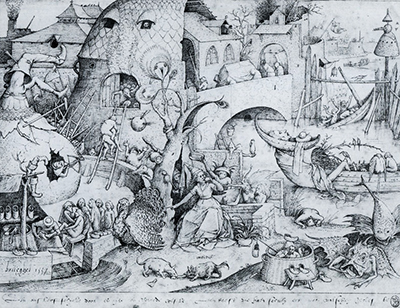
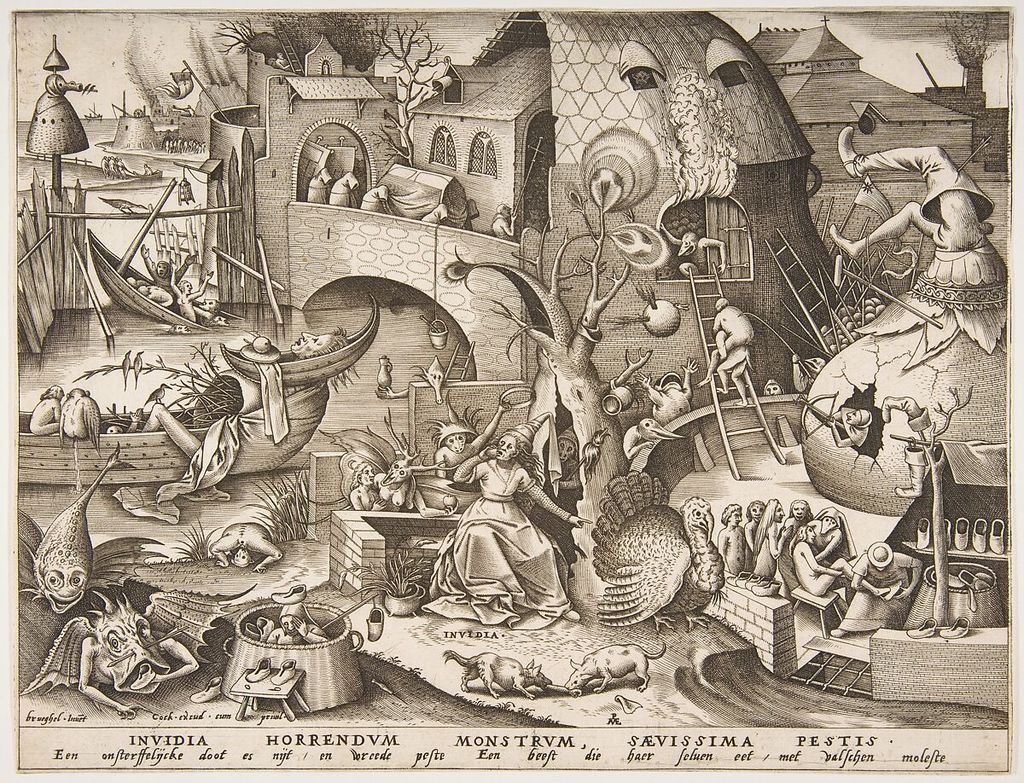
Pieter Bruegel the Elder’s Invidia, or Envy, is a signed drawing of 1557 for the series of prints known as The Seven Deadly Sins. The image above shows the drawing, with a handwritten verse below the scene. Pieter van der Heyden engraved the design for Hieronymus Cock’s publication in 1558. A woman seated near the middle of the foreground bites into a heart. Beside her is a turkey. The act is small enough to miss among the boats, creatures and buildings that fill the scene, but it gives the crowded design a place to begin [1] [2] [4].
This work across Bruegel’s career
Tower of Babel
1563The Harvesters
1565Peasant Wedding
1568Children's Games
1560Triumph of Death
1562–1563Invidia
This artworkContents
- Introduction
- Envy and the Heart
- A World of Awkward Passages
- From the Drawing to the Printed Verse
- Reading Envy among the Sins
- Annotated Details
Envy and the Heart
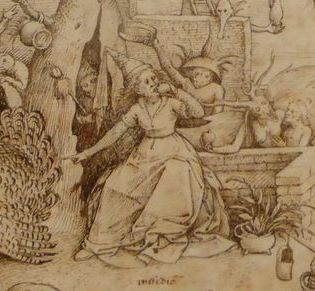
Look near the foot of the tree to find Envy. Her skirt has several large folds, with clear light and dark areas that help the eye locate the seated body. One arm reaches away from her torso. The other hand brings the heart up towards her mouth. The shape of the heart and the position of her hand matter because this sin is being shown through a bodily action. The catalogue of the Rijksmuseum describes the personification as gnawing on a heart, while the Allen Memorial Art Museum reads it as her own [3] [4].
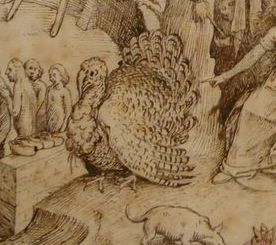
The turkey stands close enough for its tail to touch the edge of the space occupied by the woman. Its feathers make a densely patterned surface, very different from the broad folds in her clothes. The contrast in texture makes the bird conspicuous even in a scene filled with creatures. It is also useful when reading a reproduction in which the heart is difficult to see. Once you find the feathers, you can follow their edge towards the woman’s hand and the small space occupied by her face [3] [4].
The woman’s position is relatively settled. She bends the arm and head towards what she holds, and most of her weight remains near the ground. Around her, figures seem to be climbing, reaching or in the process of being carried somewhere. Remaining at the centre with the woman brings out how much of the image continues to move around her. Going out among the other incidents changes the scale of the action, from the small injury implied by the bite to a setting in which disturbances keep appearing in new places.
Annotated Details from Invidia or Envy
Start with Envy and the turkey, then look at the bridge, buildings and creatures nearby.
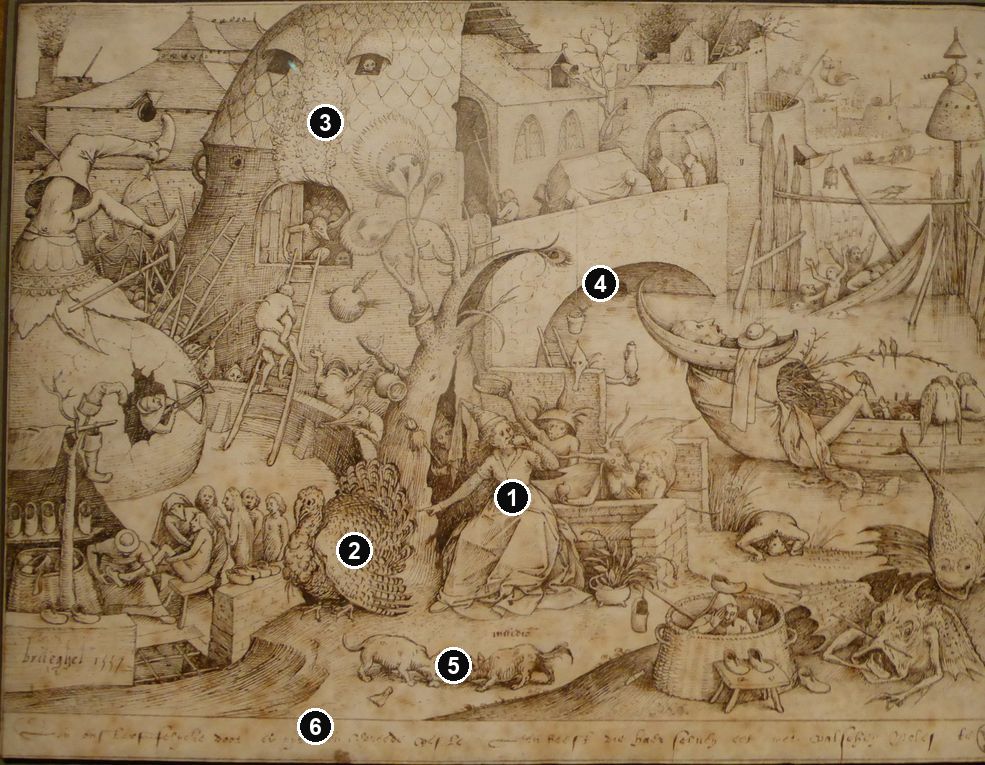
Details from INVIDIA OR ENVY
Six details show the central figure and the setting around her.
Envy with the heart
The seated woman raises one hand towards her mouth.
The turkey beside her
The turkey spreads its tail beside the seated figure.
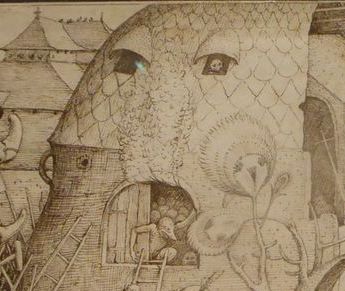
Eyes in the roof
The roof has eyes and a mouth-like opening approached by a ladder.
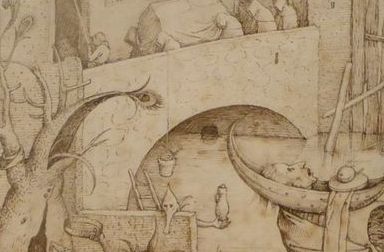
The bridge and boat
A vessel curves beneath the broad arch of the bridge.
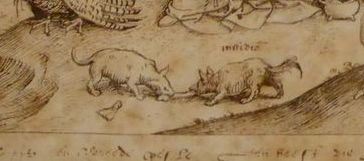
The creatures along the ground
Two animals face one another across the lower foreground.
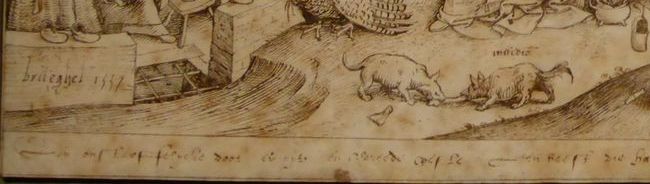
The lower inscription
The signature sits above the writing that runs along the lower edge.
Pieter Bruegel the Elder, Invidia, 1557. Gift of Richard and Ulla Dreyfus-Best, Kunstmuseum Basel, 2012.50. Reproduction via Wikimedia Commons.
A World of Awkward Passages
Behind the woman, a trunk rises through an area full of tightly grouped forms. It gives the centre of the sheet some continuity. A bend in one of its branches carries the eye towards other surfaces, including a pale bridge and the darker openings of buildings. Move along the span of the bridge and look back under it. A structure that offers passage over the water also provides a dark opening in which it is possible to find more activity. Bruegel keeps more than one route open through the same small part of the image.
At one side of the drawing a long ladder gives an idea of height. The rungs define a route up and down, even where the architecture around them looks strange. Farther around the composition, the curved sides of vessels and the smaller lines inside them provide space for figures and creatures to gather. One can begin with a familiar object such as a ladder, vessel or window and follow it until it reaches something harder to name. The possibility of recognising one thing at a time keeps the scene readable even where it is hard to describe the whole landscape as a coherent place.
The small creatures at the front are another way to see how that works. Some have rounded backs, short limbs and long tails, forms that can be read with a quick glance. Others combine familiar shapes in ways that become less plausible the longer you look. The print’s verse gives those inventions a frame of reference by describing envy as a devouring beast. It leaves room for the reader to observe how many ways a creature can seem to be eating, climbing or encroaching upon another thing [1] [2].
From the Drawing to the Printed Verse
The Metropolitan Museum’s 2001 exhibition catalogue records the drawing as pen and gray-brown ink, measuring 22 by 30 centimetres, with contours indented for transfer. It recorded the sheet in a Swiss private collection at the time of publication. Richard and Ulla Dreyfus-Best later donated it to the Kunstmuseum Basel, where the drawing entered the Kupferstichkabinett as 2012.50 [6]. On the drawing, Bruegel’s signature and the date appear at lower left. The catalogue identifies a different hand in the smaller title and the Dutch verse written below. Those details allow the date of the drawing to be read independently of the addition of its explanatory text [1].
The Met’s 1558 engraving, accession 26.72.46, names Cock as publisher and records Van der Heyden as the engraver after Bruegel. The current museum record identifies the impression as the first of two states. Its printed margin incorporates the Latin name Invidia, additional Latin wording and the Dutch lines. The Latin describes envy as a fearsome monster and a severe pestilence. The Dutch verse extends the idea by describing a creature that consumes itself. That brings the printed language much closer to the personification, whose gesture otherwise might be hard to interpret from the image alone [2] [1].
To compare the two objects, find the turkey and the seated figure in each and then follow the bridge and the boats. Reversal changes the order in which a reader moving from left to right reaches particular incidents. The grouping of bird, woman and heart still provides a point of reference. The lettered margin changes more substantially. A handwritten verse can be recognised as a line added to an individual sheet. In the print, the title and verses occupy a block of text that goes with the image from impression to impression [1] [2].
Reading Envy among the Sins
Cock’s publication distributed this design as one of a set concerned with different vices. The figure in the foreground gave each sheet something a reader could identify among its many incidents. Here the turkey, the bite and the title work in concert. The verse makes the threat turn inward. The woman can be understood as destroying something of her own, while figures and creatures around her continue to draw the eye into a much larger world [2] [4] [1].
In the companion design Sloth, the woman leans her weight on an ass and sleeps. The Met points out that the foreground personification and its accompanying animal recur across the series. From one print to the next, this gives the eye a familiar place to start while the gesture changes. Sloth’s lack of movement is the subject of the scene. The envious woman’s movement is concentrated in the hand that raises the heart. Both relatively small actions organise settings crowded with unrelated-looking incidents [5].
Try looking at the order in which those things become clear. The large feathers may be the first clue. Then the hand and mouth make the act legible. The margin ties the action to a name and to the image of a beast consuming itself. Bruegel leaves the reader room to roam before returning to a gesture small enough to fit between one hand and a face.
 Pieter Bruegel.jpg)
Discussion
Which detail in this work most changes how you read it?
Frequently Asked Questions
References
- Nadine M. Orenstein, ed., Pieter Bruegel the Elder, Drawings and Prints, The Metropolitan Museum of Art, 2001, nos. 50–51, View source.
- The Metropolitan Museum of Art, Envy (Invidia), first state, 26.72.46, View source.
- Rijksmuseum, Afgunst, Pieter van der Heyden after Pieter Bruegel, View source.
- Allen Memorial Art Museum, Envy, from The Seven Deadly Sins, View source.
- The Metropolitan Museum of Art, Sloth (Desidia), 26.72.34, View source.
- Kunstmuseum Basel, 2012 annual report, acquisition record for Invidia, inv. 2012.50, View source.








