


 by Tom Gurney
Tom Gurney BSc (Hons) is an art history expert with over 20 years experience
Published on June 19, 2020 / Updated on October 14, 2023
Email: tomgurney1@gmail.com / Phone: +44 7429 011000
The Fair at Hoboken: Introduction
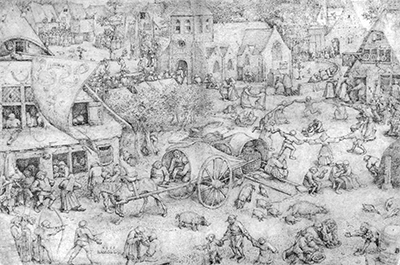
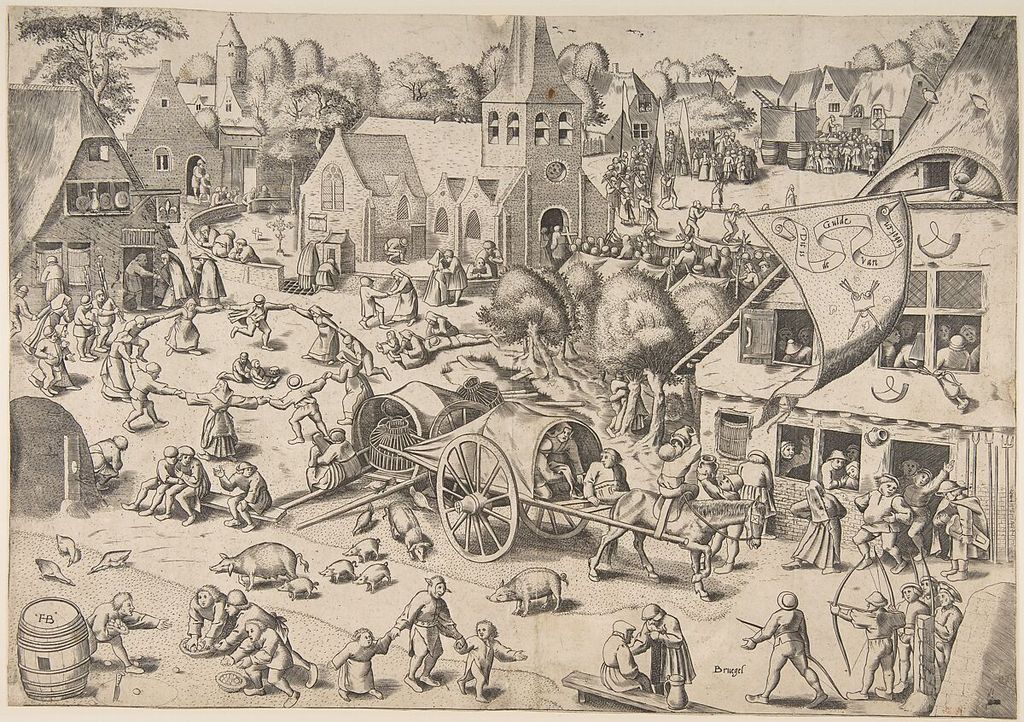
Pieter Bruegel the Elder drew The Fair at Hoboken in 1559 as a design for a print. His drawing is in the Courtauld Gallery in London. Frans Hogenberg made the related print, in which the village appears in reverse. The image above shows the drawing’s arrangement, with the banner at the left and the dancing ring at the right. Bruegel arranges this patron saint’s feast around a church, an inn and a busy stretch of ground shared by dancers, carts, archers and animals [1] [2] [3].
This work across Bruegel’s career
Tower of Babel
1563The Harvesters
1565Peasant Wedding
1568Children's Games
1560Triumph of Death
1562–1563The Fair at Hoboken
This artworkContents
- Introduction
- A Fair with More Than One Centre
- A Saint, a Performance and a Dance
- Following the Drawing into Print
- Finding a Route through the Village
- Annotated Details
A Fair with More Than One Centre
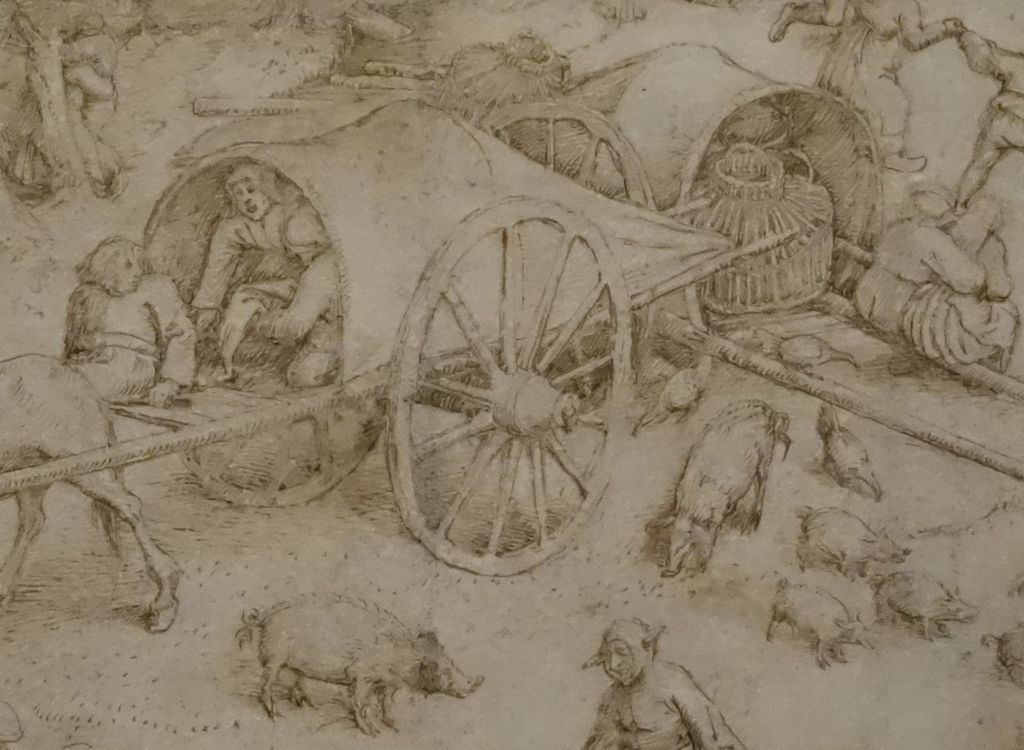
Start at the church tower. Its upright walls and opening give a stable point from which to read the scene. Follow the ground towards the foreground and it spreads into routes of different widths. A group of people can assemble near a doorway, while a cart requires a wider way between people. The carts in the middle of the drawing run through the space at a different angle from the buildings. Their wheels and shafts help you judge how much room people have to get around them.
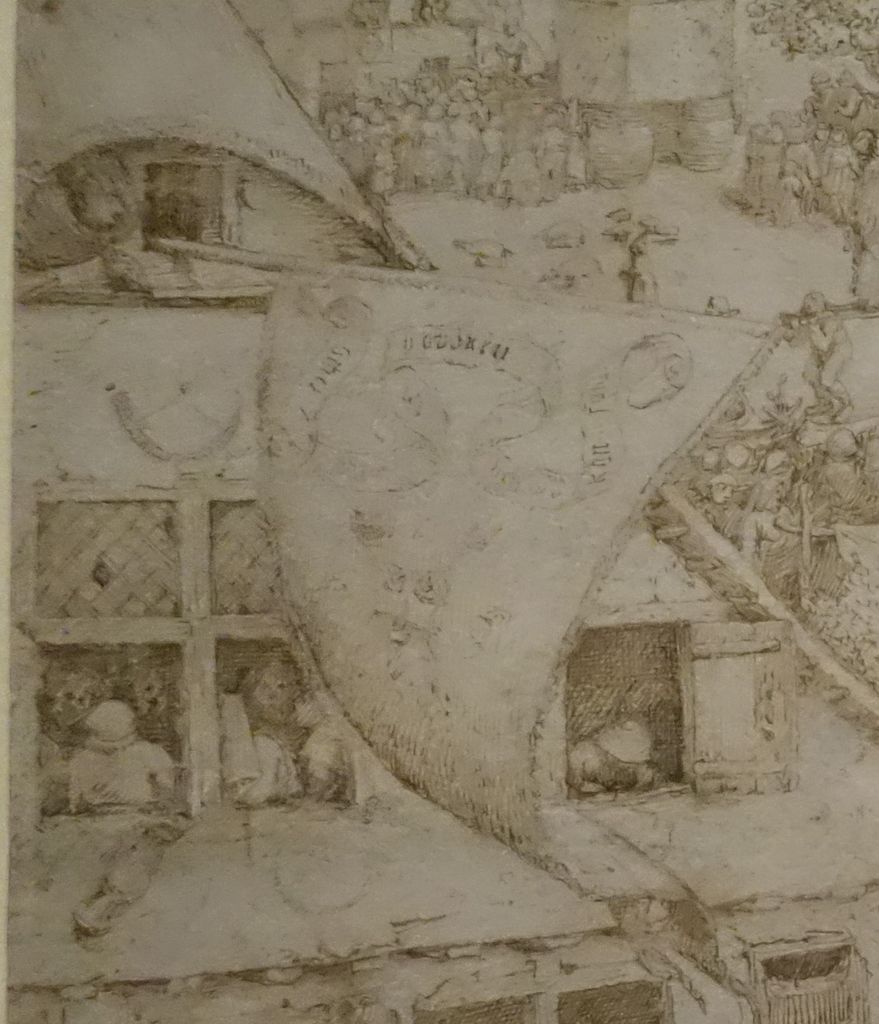
The inn at the left has several ways to take part in the fair. People can stand in front of it, pause at a door or watch from a window. The hanging banner takes up part of the view and shows that an ordinary building can acquire a more public role during the festivities. The Courtauld records traces of wording about Hoboken on this banner. From that detail, look towards the open centre, where the figures have more room to spread out or turn as a group [1].
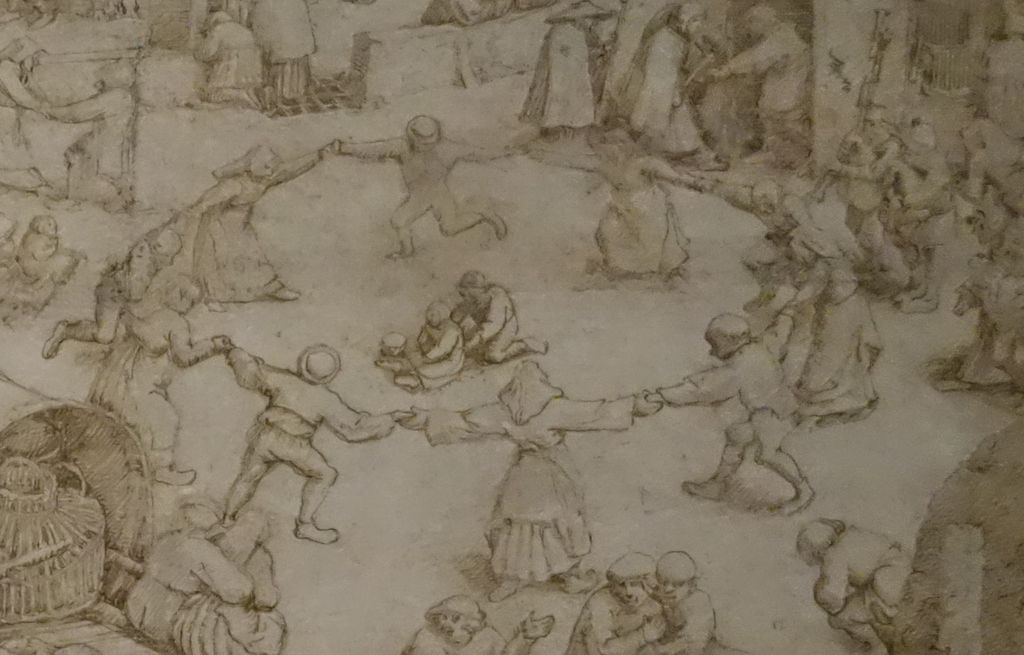
This is a village where a person might be watching one event while another is already underway close by. The wheel in the foreground is nearly as conspicuous as any individual. It supplies a fixed circle near the middle of the street. The people holding hands farther back make a much larger, less regular circle. Comparing the two gives a practical sense of the space each activity requires. The dance belongs to a relatively open patch of ground, although several people sit or move around its edge.
Annotated Details from The Fair at Hoboken
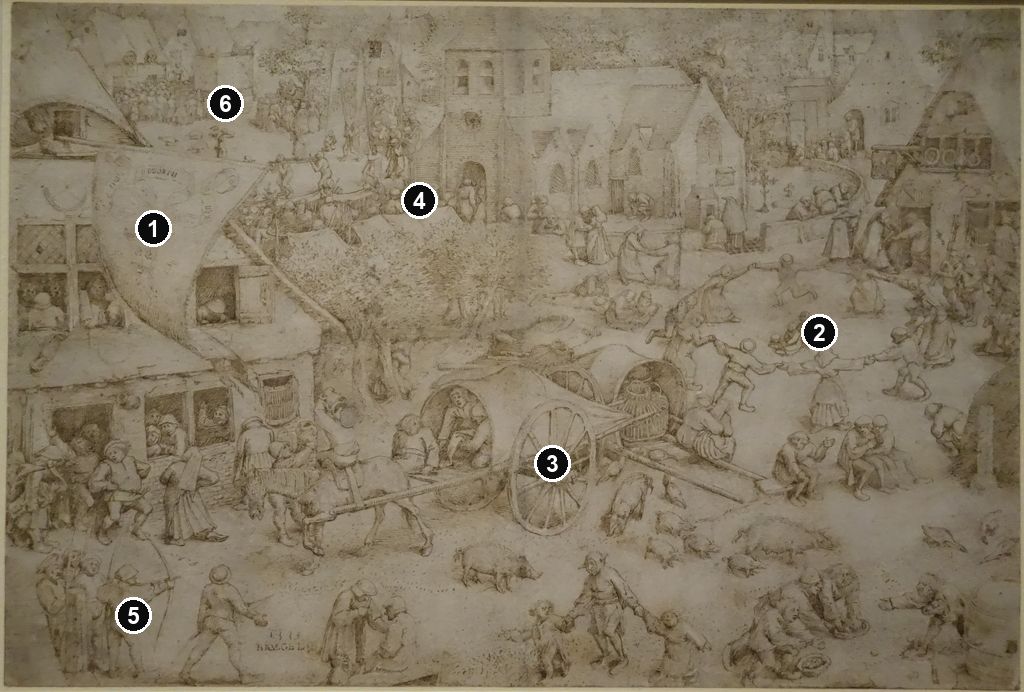
Start at the banner, then find the cart, dancers and procession.
Details from THE FAIR AT HOBOKEN
Six details follow the activities around the village fair.
The banner by the inn
The fabric hangs from the inn over the street.
The dancing ring
Linked hands trace an irregular ring in the open ground.
The cart wheel
The cart and its large wheel occupy the foreground lane.
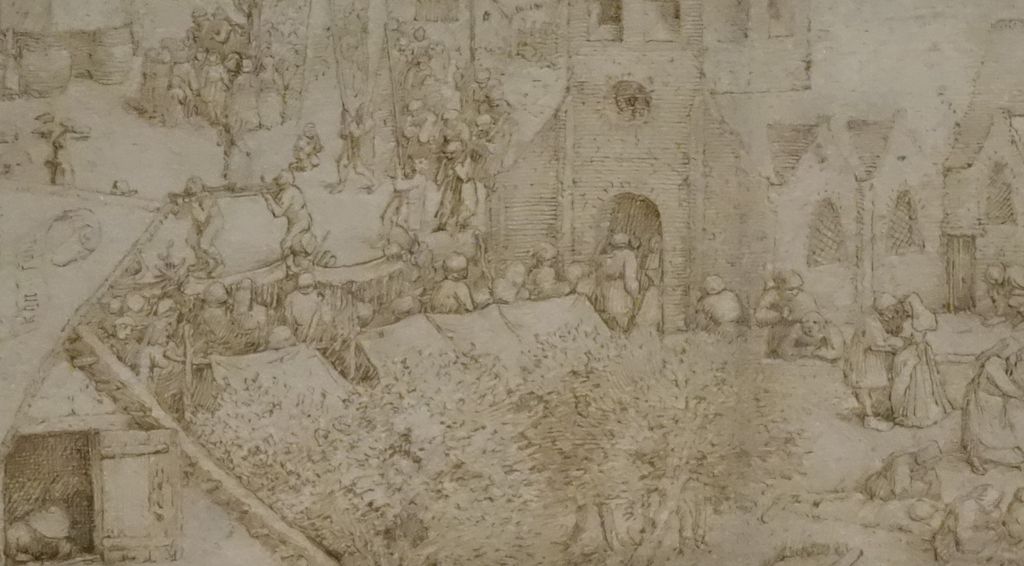
The procession by the church
The procession passes close to the church and behind the trees.
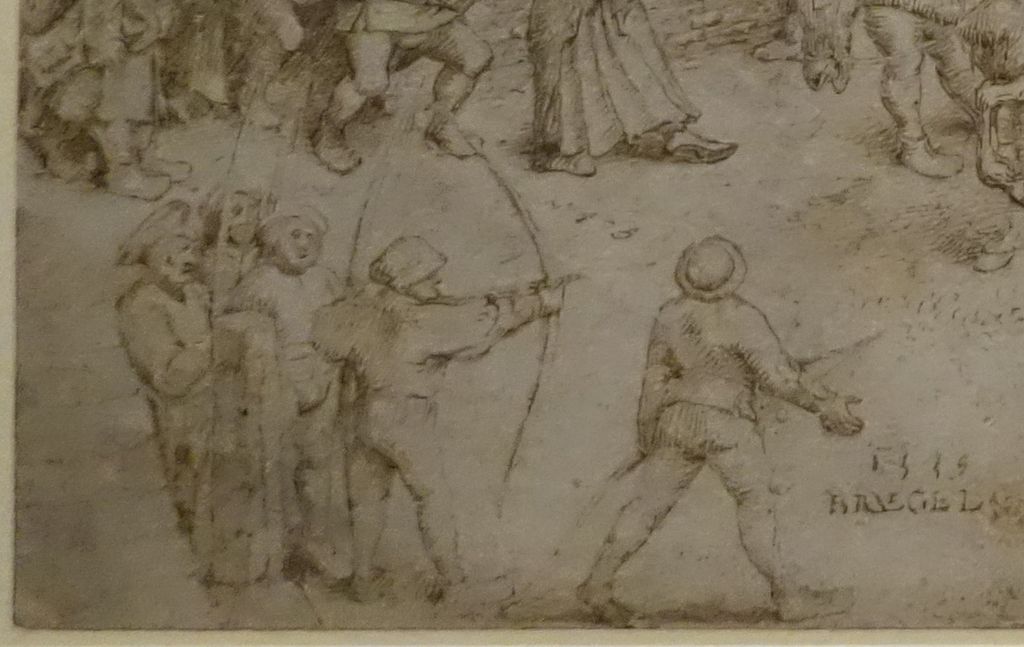
Archery in the foreground
An archer stands low in the composition near the other festivities.
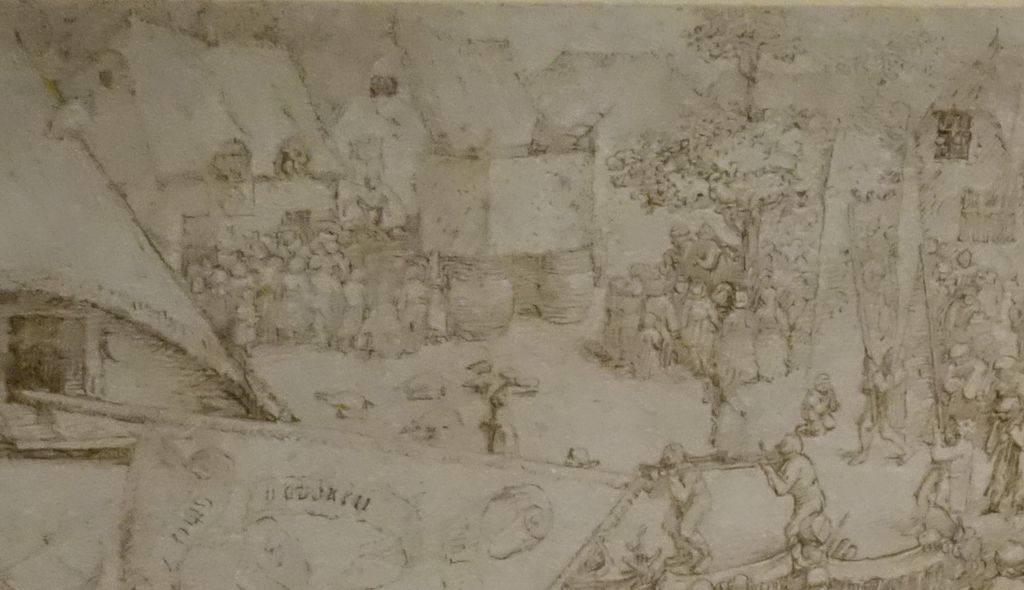
The performance in the distance
A small crowd gathers towards the upper left.
Pieter Bruegel the Elder, The Kermis at Hoboken, 1559. Samuel Courtauld Trust, Lee Bequest, The Courtauld, D.1947.LF.45. Photograph by Karmakolle, CC0.
A Saint, a Performance and a Dance
The Courtauld identifies a religious procession in the drawing, with a statue of a saint carried at its head. The small scale of this detail makes its route as important as the identity of any participant. Look towards the church and the path behind the trees, where the figures gather at closer intervals than the people in the open dance. Their activity belongs to the religious occasion that gives the feast its setting. A theatrical performance by a chamber of rhetoric is visible toward the upper left of the drawing [1].
Several people in the open area have linked hands. The irregular ring sometimes makes a leg or arm stand out against the ground. Farther around, neighbouring bodies overlap. The shape lets you imagine how the dancers are moving together even when an individual figure is momentarily difficult to read. The people nearby can sit, watch or continue on their way. Like other parts of the drawing, the ring includes some figures quite firmly while leaving the boundary porous for everyone else.
The movement of the ring is easy to compare with the space taken by the archers near the foreground. The archery contest needs a line of sight and a safe stretch of ground along which an arrow can travel. The course of that activity crosses a gathering full of people. The Courtauld calls attention to the precariousness of the contest. Look from the archer to the people around the open area to see why that reading has force. For the duration of the fair, several things that ordinarily require their own ground use the same street [1].
Following the Drawing into Print
The Courtauld records a sheet of laid paper measuring 26.6 by 39.4 centimetres, worked in pen and brown ink over traces of black chalk or charcoal. Bruegel signed and dated it near the lower left. The museum also records that contours were incised for transfer and that traces of a dark drawing material survive around the edges on the back. These are clues to the work done before the print was available. A line that shows the edge of a roof or sleeve also helps locate a form when the design is transferred [1].
The Metropolitan Museum of Art identifies its print as an engraving by Frans Hogenberg after Bruegel, circa 1559, and records it as the second state of four. The Rijksmuseum catalogue also credits Hogenberg and dates its impression between 1559 and 1561. Compare the Met impression with the drawing by placing your eye on the wheel and following the shafts. The cart dominates the same part of the scene, and the direction of the shafts is reversed. The banner and the dancers exchange sides as well. This makes the cart a more reliable guide between the two images than any instruction that starts with left or right [1] [2] [3].
Museum Boijmans Van Beuningen records both etching and engraving as techniques for its print. These catalogue descriptions help distinguish the design process from the work of making and printing the plate. They also help explain why a particular impression carries details you can compare independently of Bruegel’s drawing. When looking at a reproduction, the orientation, margins and inscriptions can give better evidence about which object is shown than the shared title on its own [1] [2] [4].
The print also gives the festivities a voice outside the image. The 2001 Metropolitan Museum exhibition catalogue explains that the verse along the margin compares the drinkers to beasts. Its judgement joins the foreground pigs to the human company, an association a viewer of the drawing would have to make without the printed verse. The people in the image still take part in a variety of activities, from the procession to ordinary conversation. The caption makes one part of that company the target of its criticism [5].
Finding a Route through the Village
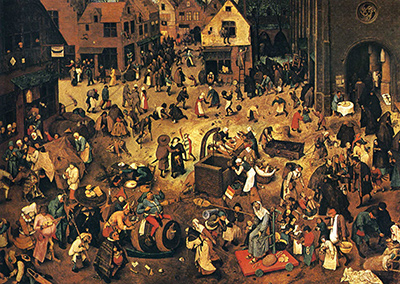
In The Fight Between Carnival and Lent, the setting also offers a church, a busy open space and several seasonal activities to follow. Look at what the two pictures ask the eye to do with that space. In the painting a pair of prominent figures makes a recognisable confrontation. In the Hoboken design the cart, dance and procession offer separate routes with little need for a single encounter to dominate. Following any one of them leads you close to other people who are doing something different.
Try following a person towards the church, then return to the cart and trace a route around its wheels towards the dancers. The first passage helps you read the public occasion. The second gives you the actual crowded ground of the fair. Bruegel leaves space for these routes to cross without making all the participants face a single event. That is how the village remains recognisable while its ordinary places take on several new uses at once.
Discussion
Which detail in this work most changes how you read it?
Frequently Asked Questions
The inn at the left has several ways to take part in the fair. People can stand in front of it, pause at a door or watch from a window. [1]
The Courtauld identifies a religious procession in the drawing, with a statue of a saint carried at its head. The small scale of this detail makes its route as important as the identity of any participant. [1]
The Courtauld records a sheet of laid paper measuring 26.6 by 39.4 centimetres, worked in pen and brown ink over traces of black chalk or charcoal. Bruegel signed and dated it near the lower left. [1]
References
- The Courtauld Gallery, The Kermis at Hoboken, drawing D.1947.LF.45, View source.
- The Metropolitan Museum of Art, The Kermis at Hoboken, second state, 26.72.27, View source.
- Rijksmuseum, Kermis van Hoboken, Frans Hogenberg after Pieter Bruegel, View source.
- Museum Boijmans Van Beuningen, The Fair at Hoboken, collection record, View source.
- Nadine M. Orenstein, ed., Pieter Bruegel the Elder, Drawings and Prints, Metropolitan Museum of Art, 2001, no. 80, View source.








