


 by Tom Gurney
Tom Gurney BSc (Hons) is an art history expert with over 20 years experience
Published on June 19, 2020 / Updated on October 14, 2023
Email: tomgurney1@gmail.com / Phone: +44 7429 011000
Italian Landscape: Introduction
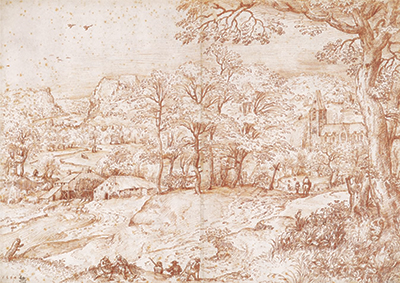
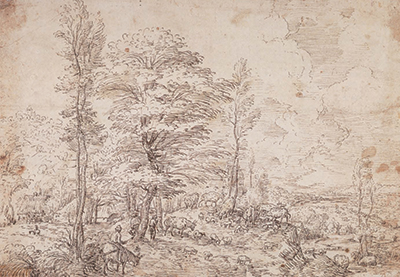
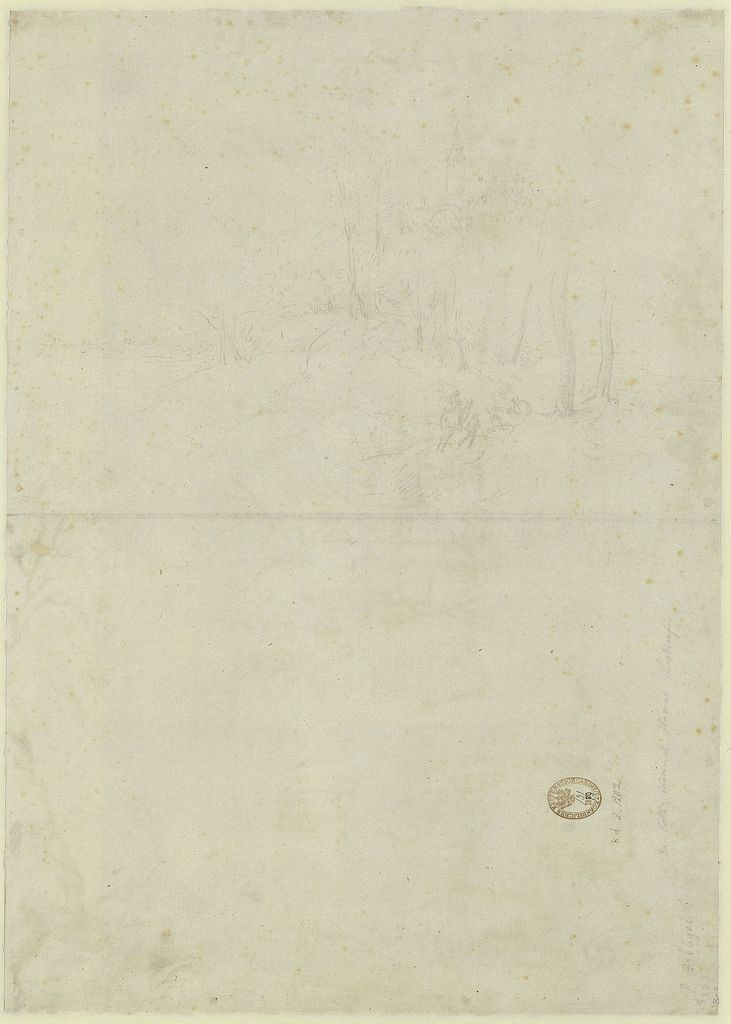
A large tree frames the right edge of Pieter Bruegel the Elder’s Italian Landscape. Below its branches a church rises among smaller trees, and paths and a river wind through the country beyond. The drawing occupies the front of a sheet in Berlin’s Kupferstichkabinett, KdZ 1202. Bruegel worked the front in reddish-brown ink. The sheet measures 33.3 by 46.6 centimetres and bears the date 1554. The 2001 exhibition catalogue identifies the composition as a free copy after Domenico Campagnola. The sheet also carries a much fainter landscape on the reverse. Its two sides give different views of how Bruegel worked with trees, buildings and distant ground [1] [2].
This work across Bruegel’s career
Tower of Babel
1563The Harvesters
1565Peasant Wedding
1568Children's Games
1560Triumph of Death
1562–1563Italian Landscape
This artworkContents
- Introduction
- Looking from the Tree towards the River
- What Bruegel Took from Campagnola
- Turning the Sheet Over
- Date and Collection History
- Annotated Details
Looking from the Tree towards the River
Begin with the trunk at the right. Its base is close enough to reveal changes in the direction of the pen lines across the bark. The branches stretch left along the top, where small groups of leaves interrupt the light sky. From the base of the tree, a route runs inward towards two figures. Their scale makes the trunk seem taller and gives the ground a way to open beyond it. The church occupies the next distinct interval, partly surrounded by foliage that makes its tower easier to recognise than its walls.
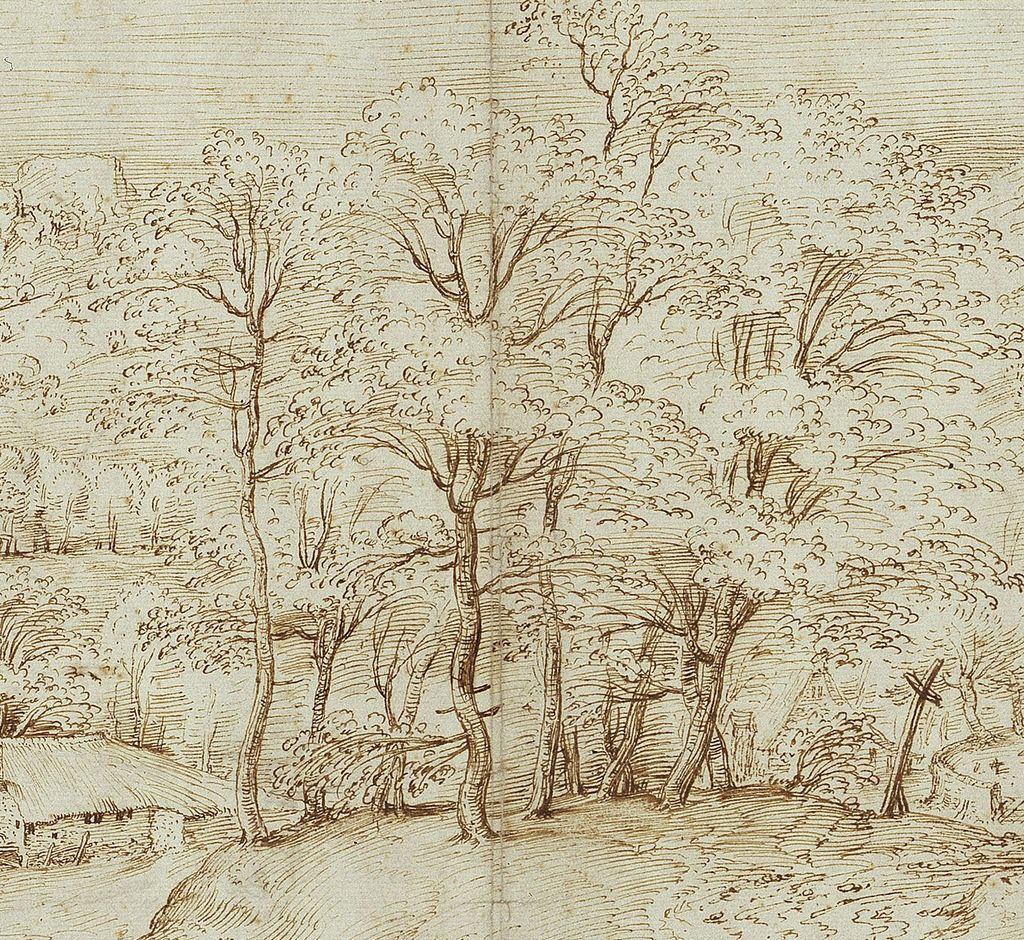
The smaller trees at the centre have enough space between their trunks for the viewer to see parts of the village. A roof can be found on the left of the group, and further roofs and banks emerge farther back. The upper branches repeatedly hide and expose the land behind them. This makes the group both a stand of individual trees and a boundary between an open foreground and the more distant country. The eye can move to the left along the near road or look past the trees towards the hills.
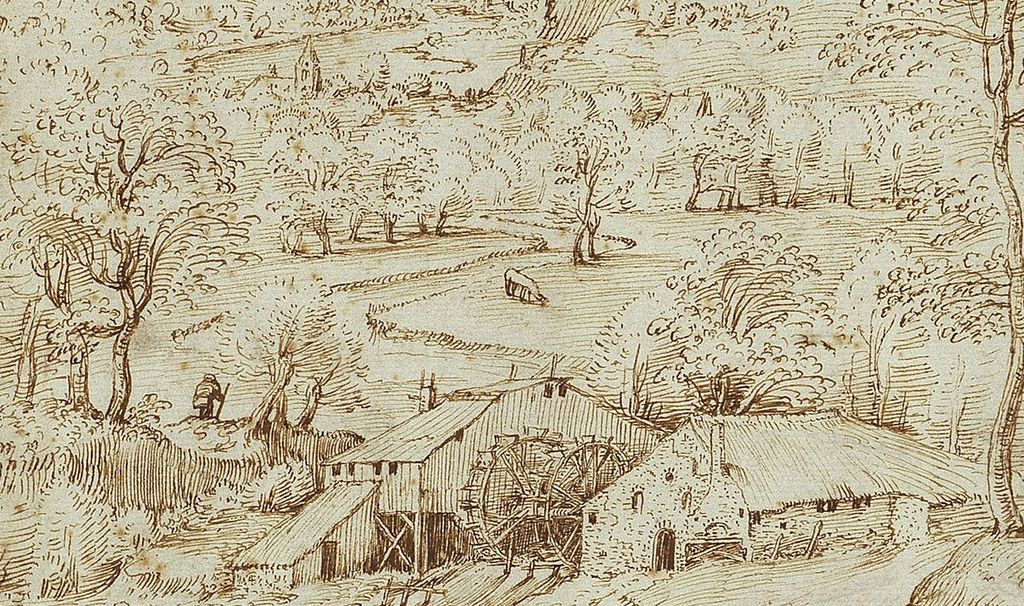
At the left, a winding stretch of water is visible beyond the buildings. Its curves are much less emphatic than the dark lines of the large trunk. Parts of the channel disappear among the trees and fields. Follow the light strip from one visible stretch to the next and the extent of the flatter land becomes clearer. The rocky height above it then looks farther away. Bruegel makes the water and the path both visible within the same sheet, but their different sizes and positions lead to different parts of the view.
Annotated Details from Italian Landscape
Begin with the large tree, then follow the church and winding river through the scene.
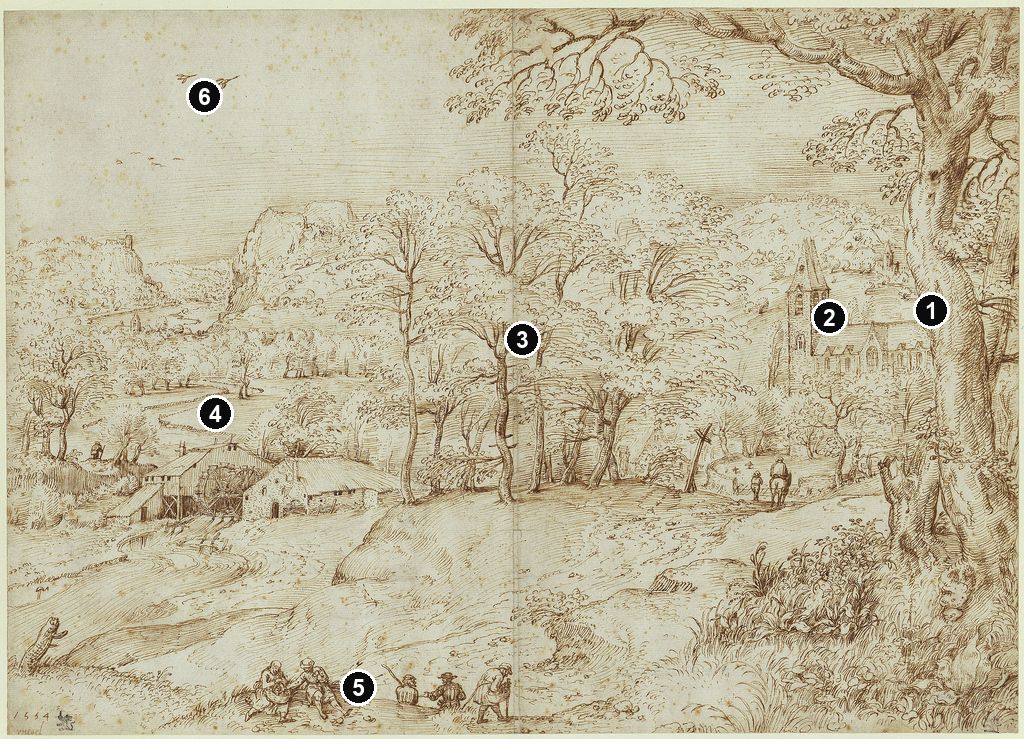
Details from ITALIAN LANDSCAPE
Six details show the relationship between the tree group, the valley and the small figures.
The framing tree
A large trunk rises at the edge and branches across the sky.
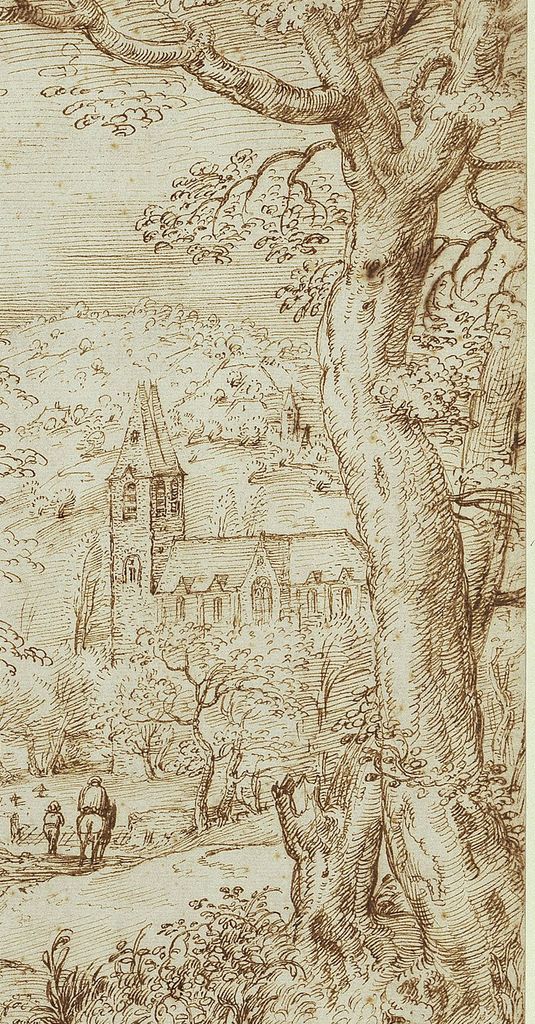
The church among trees
The tower gives the middle distance a distinctive upright.
The central group of trees
Open spaces between the trunks reveal parts of the land behind.
The winding river
A pale reach of water curves beyond the houses.
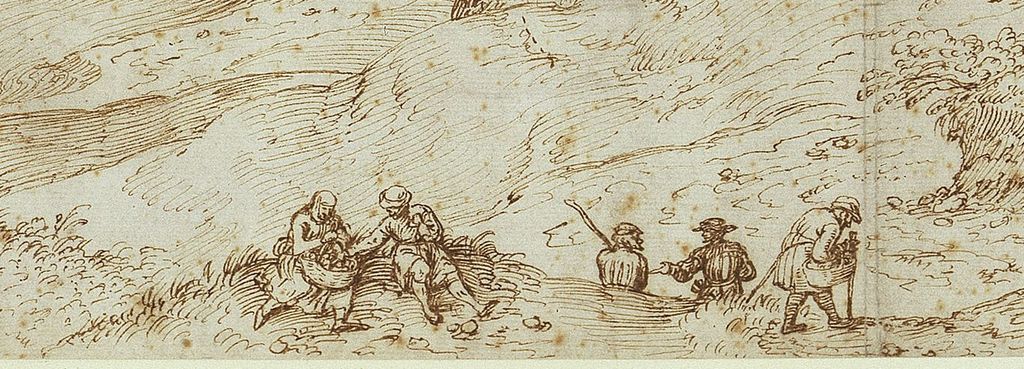
The figures in the foreground
Small figures occupy the open ground below the nearest slopes.
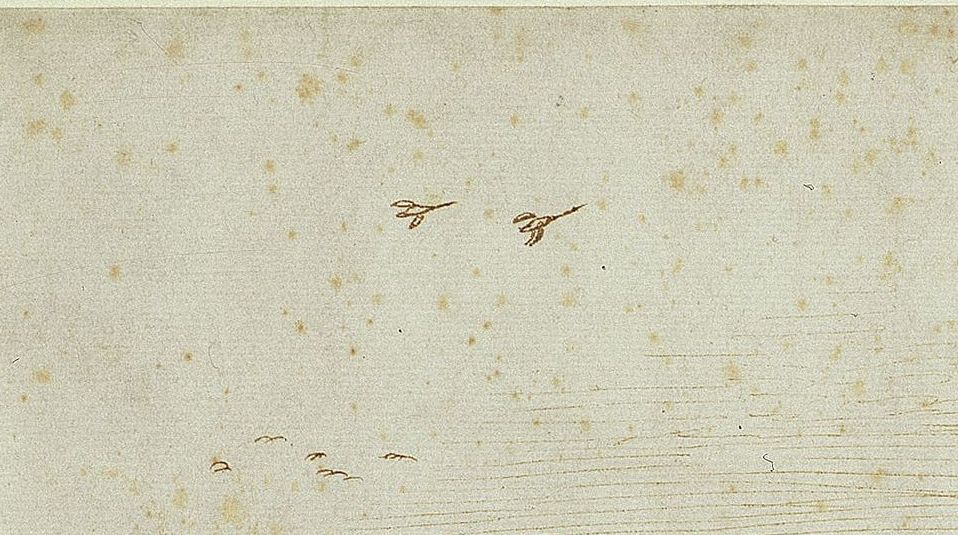
The birds and open sky
Small birds interrupt the long bands of pale sky.
Pieter Bruegel the Elder, after Domenico Campagnola, Italian Landscape, 1554. Staatliche Museen zu Berlin, Kupferstichkabinett, KdZ 1202 recto. Photograph by Jörg P. Anders via Wikimedia Commons. Public domain.
What Bruegel Took from Campagnola
Frits Lugt connected the Berlin drawing with a composition attributed to Domenico Campagnola once in the collection of Dominique Vivant Denon. The original model was known to Lugt through a nineteenth-century lithographic reproduction. Charles de Tolnay proposed the reverse relationship, arguing that Campagnola had drawn on a lost composition by Bruegel. The 2001 exhibition catalogue follows Lugt’s direction of influence and discusses the Berlin sheet as a free copy. It points to differences between the drawing and the composition recorded in the lithograph [1].
Among the differences the catalogue identifies are the church at the right, figures in the foreground and the winding river in the background. The apparent additions are useful places to look because they occur at different distances. The church gives the wooded middle of the picture a distinctive upright. The people at the front occupy comparatively open ground, and the river leads the eye behind the trees. The comparison concerns what survives in the lithograph and what can be seen on the Berlin sheet. It allows for the possibility that transmission through a later reproduction affects what can be compared [1].
The attribution draws on smaller marks as well as the broader layout. Look at the groups of leaves formed from loops or double curves. Other trees farther away have scarcely more than a dotted outline. Birds can be picked out against the open sky near the left. The catalogue compares forms like these, and the abbreviated shape of a cow, with details in accepted drawings by Bruegel. The composition may draw on another artist’s work while the marks that carry it across the page remain recognisable as Bruegel’s [1].
Turning the Sheet Over
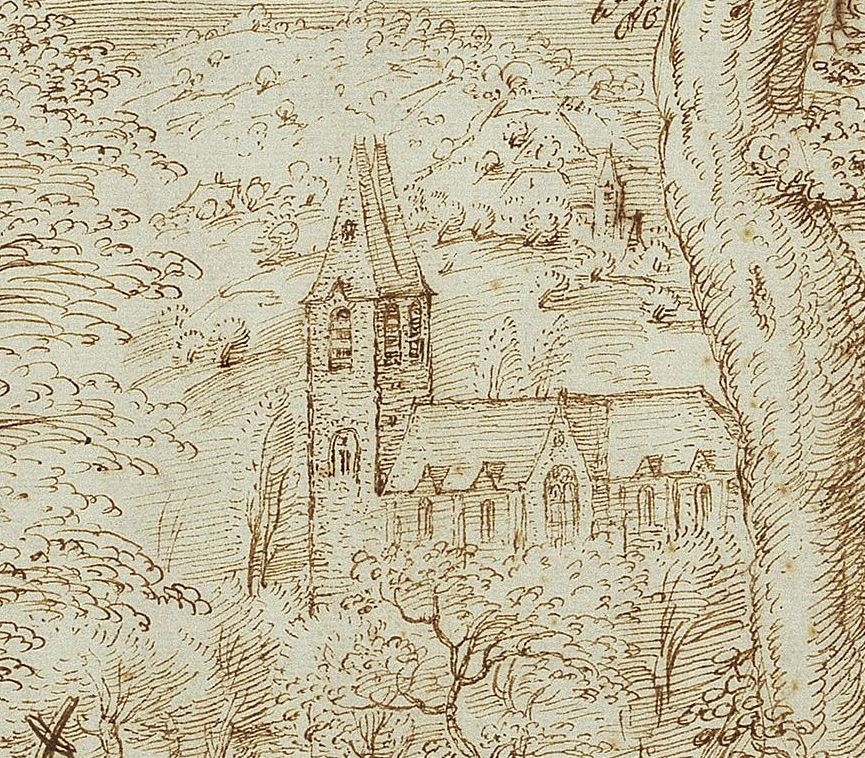
The reverse, shown below, has its own Berlin collection record. The museum titles it Landschaft, or Landscape. The 2001 catalogue calls it Landscape with Castle and dates it to about 1554. The marks are much lighter than the lines on the front. In the photograph the clearest part of the landscape occupies only part of the paper, with faint traces of trees and the outlines of the terrain. Turning the sheet changes the orientation as well as the amount of detail a viewer has to work with [2] [1].
The catalogue traces a separate attribution debate for the reverse. Justus Müller Hofstede accepted Bruegel’s authorship of the front but assigned the reverse to another hand. Hans Mielke argued for Bruegel on both sides, the position followed by the exhibition catalogue. The Berlin record also identifies Bruegel as the draughtsman on the reverse. That agreement leaves room to distinguish the evidence for each side. The dated front can be compared with the model represented in the lithograph, while the reverse belongs with much more lightly sketched landscapes [2] [1].
Date and Collection History
The date on the front and the later writing of Bruegel’s name are separate pieces of evidence. The exhibition catalogue considers the date authentic and describes the name as added by another hand. It also lists a crossed-arrows watermark and collectors’ stamps associated with Henri Hamal and William Mayor. The catalogue traces the sheet through those collections and records its acquisition in 1879. Some of that history is recorded on the reverse alongside the faint drawing, giving another reason to look at the entire sheet [1].
Bruegel’s Pastoral Landscape offers a comparison with an earlier tree group. In the Oslo sheet the trees occupy a broad central area and give shelter to livestock. In Berlin, the largest trunk at the right defines an edge, and the group at centre opens glimpses of the land behind. Both drawings use separate kinds of marks for near branches and distant trees. The great difference in scale between the Berlin tree and the low country gives Bruegel room to adapt the model and still bring his own ways of drawing to the landscape [1].
Discussion
Which detail in this work most changes how you read it?
Frequently Asked Questions
Frits Lugt connected the Berlin drawing with a composition attributed to Domenico Campagnola once in the collection of Dominique Vivant Denon. The original model was known to Lugt through a nineteenth-century lithographic reproduction. [1]
The date on the front and the later writing of Bruegel’s name are separate pieces of evidence. The exhibition catalogue considers the date authentic and describes the name as added by another hand. [1]
References
- Nadine M. Orenstein, ed., Pieter Bruegel the Elder, Drawings and Prints, 2001, cat. nos. 3 and 13, View source.
- Staatliche Museen zu Berlin, Landschaft, KdZ 1202 verso, View source.








