


 by Tom Gurney
Tom Gurney BSc (Hons) is an art history expert with over 20 years experience
Published on June 19, 2020 / Updated on October 14, 2023
Email: tomgurney1@gmail.com / Phone: +44 7429 011000
Mad Meg: Introduction
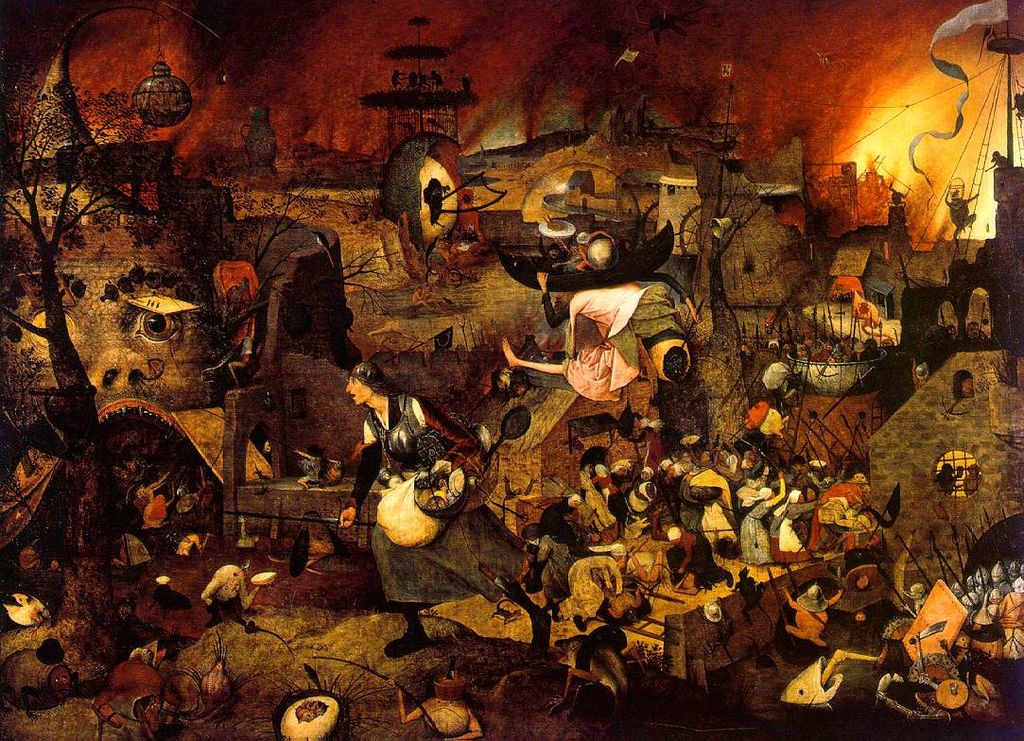
Pieter Bruegel the Elder’s Mad Meg, or Dulle Griet, is a large oil painting on oak in Antwerp’s Museum Mayer van den Bergh. A woman in armour strides across a rise in the foreground, carrying a sword and an assortment of household things. Behind her, people grapple among buildings and fires. At the left, an immense face has an open mouth large enough to admit people. The panel is dated 1563, a reading confirmed during the 2017–18 treatment by the Royal Institute for Cultural Heritage. That treatment also made it easier to follow the woman’s route through the landscape and to see the cooler sky between the red areas overhead [1] [2] [4].
This work across Bruegel’s career
Tower of Babel
1563The Harvesters
1565Peasant Wedding
1568Children's Games
1560Triumph of Death
1562–1563Mad Meg
This artworkContents
- Introduction
- Start with the Woman on the Rise
- A Face Built into the Scene
- Beyond Meg, a Crowd and a Town
- What the Panel Is Made Of
- What Changed with Treatment
- The Düsseldorf Drawing and the Name of the Painting
- Annotated Details
Start with the Woman on the Rise
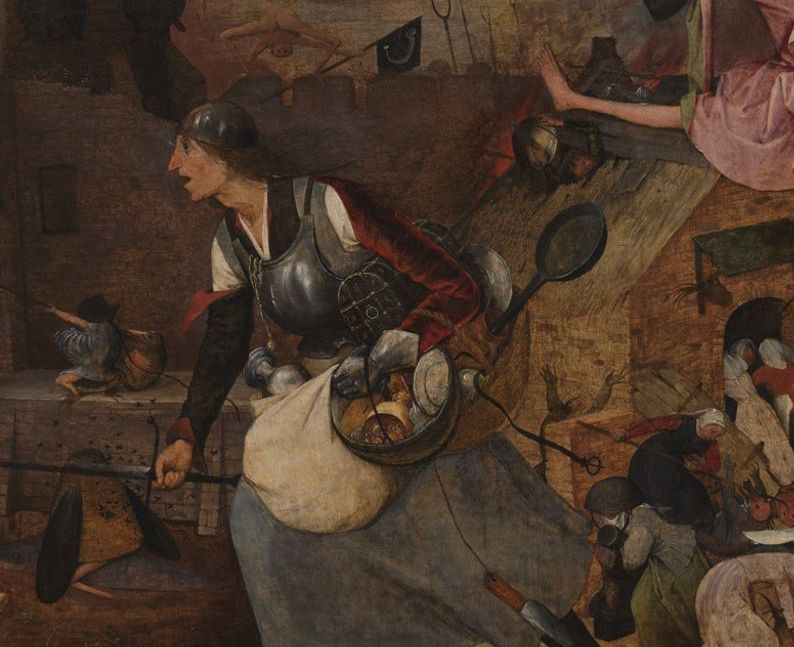
Find Meg a little left of centre. Her head is in profile and points towards the left. Her body is arranged across the slope, with one foot placed firmly ahead of the other. Below her breastplate the skirt spreads back towards the figures behind her. The contrast between the skirt and the ground makes her stride legible, while the armour introduces an abrupt change of texture between the face and the cloth. The distance between her feet is close to the breadth of some of the little groups near the buildings, making her size felt even before the viewer identifies what she is carrying.
The sword runs low across the foreground from her forward hand. Look just above the line it makes to find the objects she has gathered: vessels, bundles and the spoils the museum discusses in its account of the scene. The round containers cluster close to her waist, while a long-handled pan projects behind her. Some of those shapes would be at home in a kitchen. Worn or carried by a woman in armour, they become part of an improbable load. Their separate edges help the viewer register how much she is trying to take with her [1].
Take a little time over the slope rather than going immediately to the creatures. The Antwerp museum argues that the renewed clarity after treatment made it easier to see Meg walking on a hill and leaving the burning town behind her. The ground on which she stands separates her from the crowd at the right and allows her silhouette to read almost from head to foot. That account can sit alongside the older description of a figure raiding before the entrance to Hell. It helps to distinguish the local direction of her stride from a definite claim about where she started or what she ultimately intends [1] [2].
Annotated Details from Mad Meg
Follow Meg’s stride along the foreground rise, then look to the town behind and the open mouth at the left.
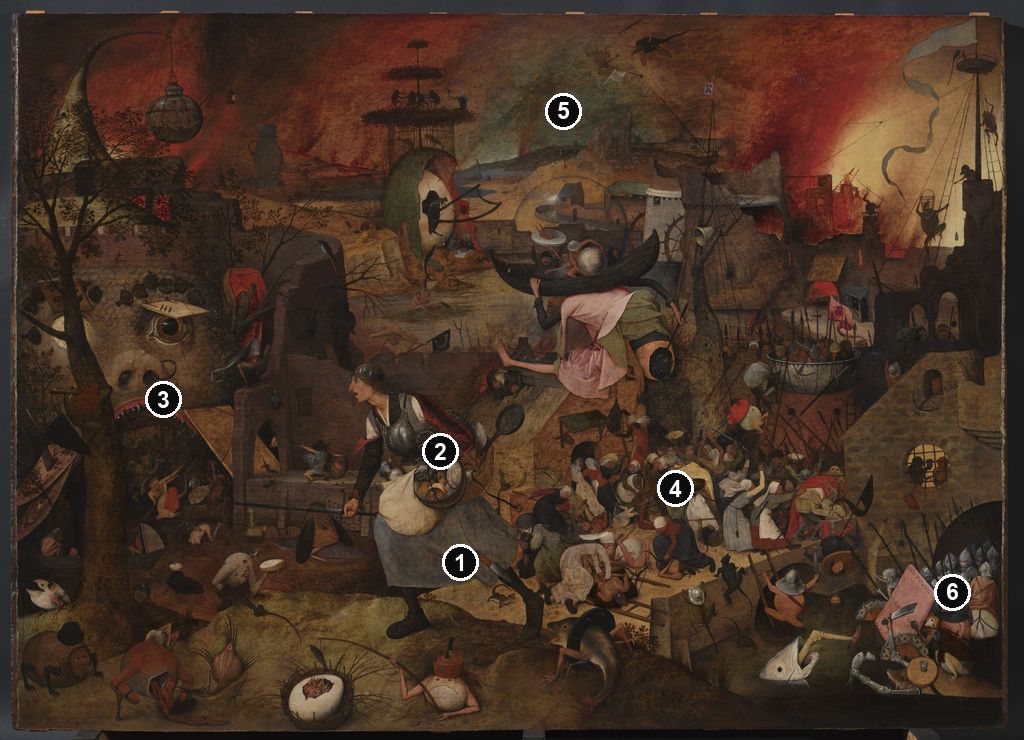
Details from MAD MEG
Six details trace her route and show what the restored surface reveals around it.
Meg’s stride
Meg crosses the rise in front of the town. Her long step separates her from the crowd behind.
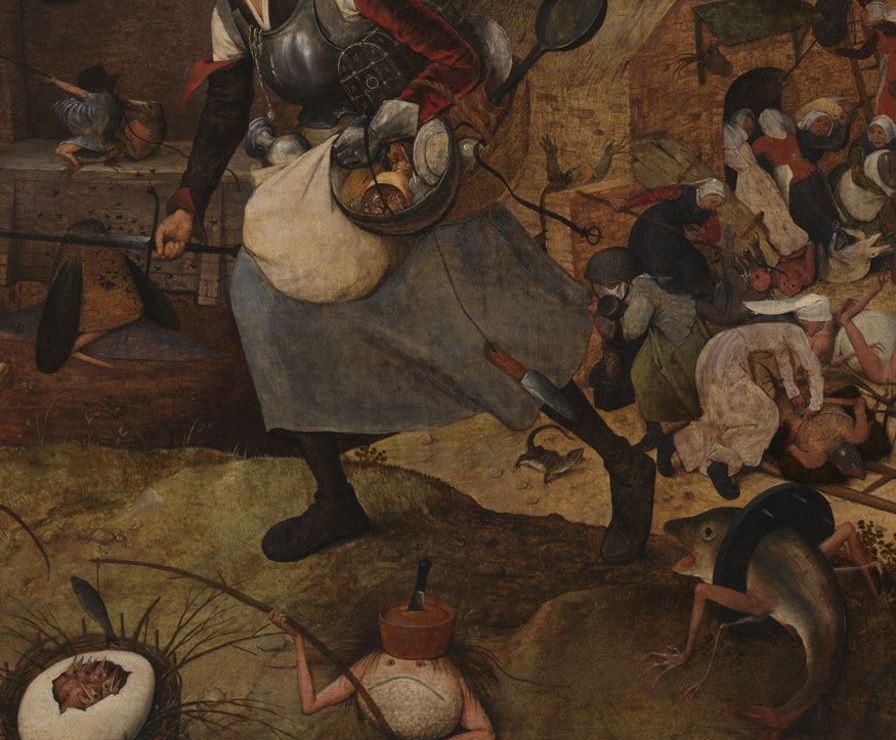
Armour and household objects
The curved breastplate sits above the gathered vessels and bundles. The pan extends behind her.
The mouth at the left
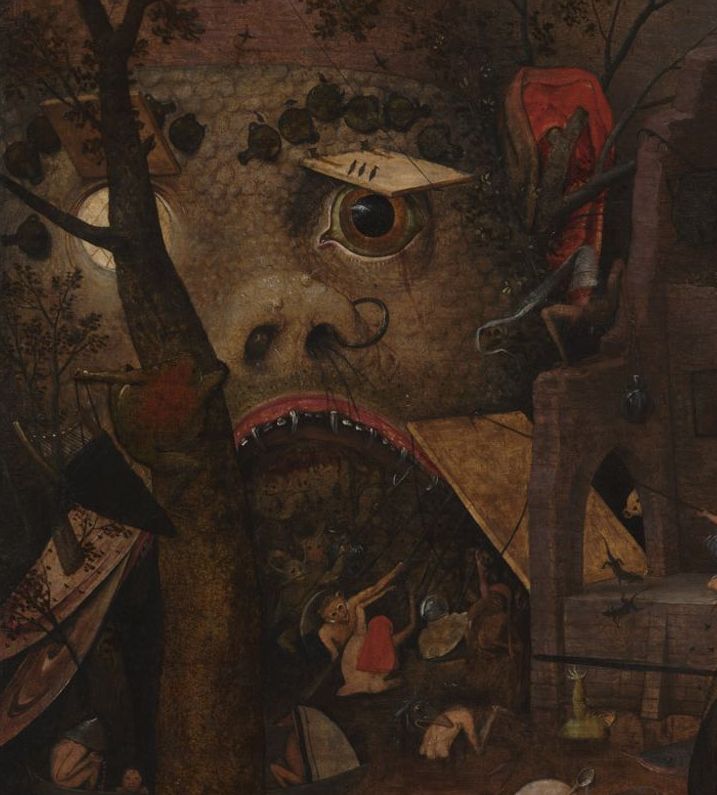
The giant face has an entrance large enough for people and creatures.
The crowd behind Meg
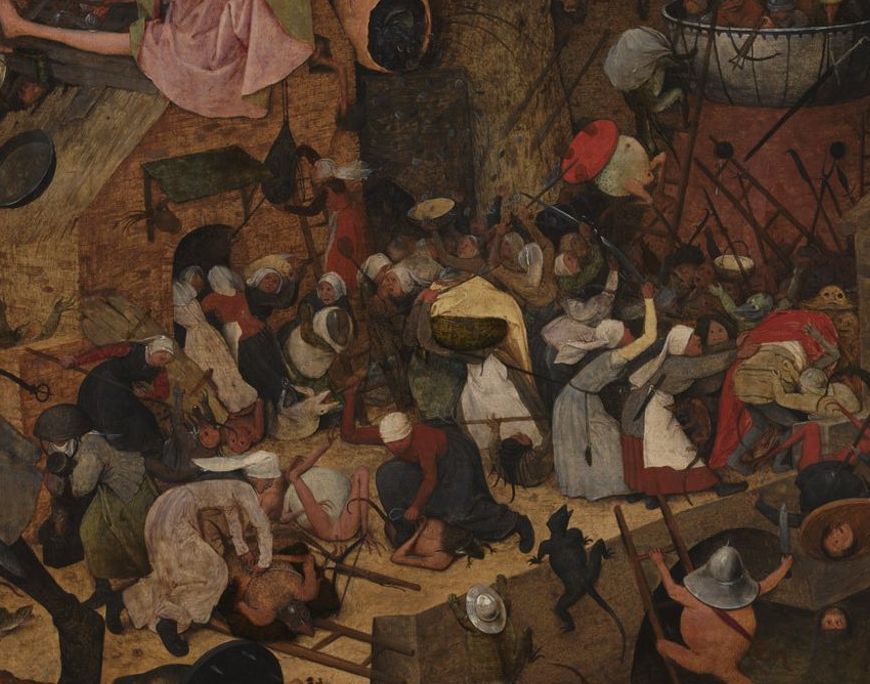
Figures bend and turn among buildings, overlapping at several heights.
The distant opening
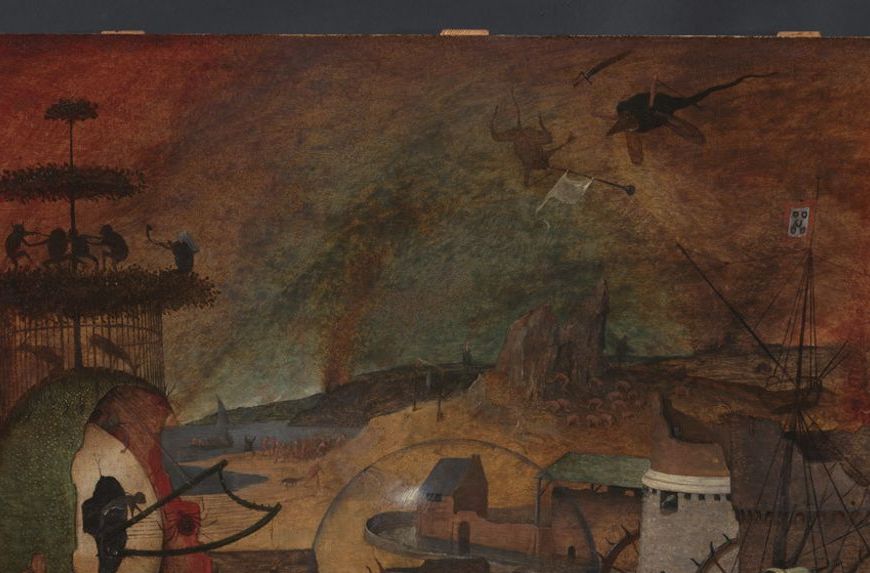
A cooler passage in the sky opens over the background landscape between red areas.
Helmets under the arch
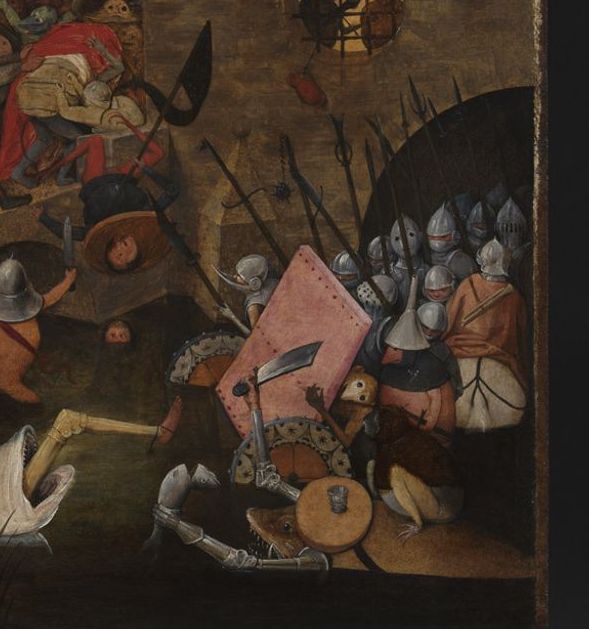
Repeated helmets and shafts make a group at the right edge. Treatment recovered the fine work on the helmets.
Pieter Bruegel the Elder, Dulle Griet (Mad Meg), 1563, oil on oak. Museum Mayer van den Bergh, Antwerp, MMB.0045. Photograph after conservation by KIK-IRPA, CC0, via the Flemish Art Collection.
A Face Built into the Scene
At the left, the giant face belongs to the terrain and to an architecture of openings. Its exposed eye looks outward under a shelf-like lid. Lower down the red edge of the mouth gives way to a dark interior crowded with activity. An ordinary door would preserve a distinction between the place and those entering it. Here the entrance is itself a body. A tree in front interrupts the face and makes it necessary to put together features divided by the trunk. Meg occupies a stretch of ground close to this opening without being absorbed into it.
The wall beside the face has its own holes and projections. Small figures and creatures fit into apertures or pass along ledges where a large figure could barely stand. Compare the deep black of the opening with the much narrower shadows that set off the objects Meg carries. Dark paint can suggest either an enclosure with room inside it or a narrow interval between two surfaces. Bruegel uses both effects close together to make the viewer change scale quickly.
Above the face hangs a rounded object suspended from a high, curved support. The arc also draws the eye towards the tree, creating a succession of shapes that hang over the ground. Farther above and behind, roofs and other elevated forms break the sky into strips. The view keeps offering further pockets of space every time a solid object seems to close it. This is one reason to follow the edges slowly. A detail that reads first as part of the silhouette may turn into a room, a platform or a place with figures on it when seen closer.
Beyond Meg, a Crowd and a Town
To the right of Meg, smaller people lean across one another. Pale head coverings appear at different heights. Some bodies are bent close to the ground, while others reach or turn. The Antwerp museum describes women contending with soldiers and devils in the wake of the principal figure. Certain forms are visible because yellow, red or white catches the eye as it moves away from Meg’s comparatively long, dark outline. The group is easier to explore in short stretches. Find a raised arm, follow it down to the shoulder and then see where a different person overlaps it [1].
Near the right edge, a building with a large dark arch puts several helmeted heads and upright shafts together. The shining surfaces give this group another kind of order. Their repeated pointed shapes differ from the many directions in which clothing and limbs turn across the middle of the painting. The museum singles out the recovered visibility of fine work on the helmets. Bruegel repeatedly uses a structure or a stretch of ground to put a limit around the things happening in it. This opening holds its group just as the foreground rise holds Meg [2].
In the middle distance a gigantic figure bends across the buildings with a vessel balanced above the body. Lower down, the mass of much smaller figures is easy to compare with this single broad shape. The change of scale makes this region hard to interpret by rules of ordinary perspective alone. A viewer can understand intervals between walls and roofs while encountering creatures that seem to ignore those intervals. The mixed scale is part of how the painting can resemble a landscape and still make the ground look unfamiliar.
At the back, red and orange areas rise above towers and rooftops. There are also places where the landscape becomes cooler and less dense. Look at the opening in the upper middle, where the distant terrain can be followed between taller objects. Its function is different from the bright flames near the right edge. The fire can make an individual shape stand out, while the quieter blue-green passage gives the viewer a longer view. Meg’s route forward and the spectator’s view backwards into the town can be followed at the same time because the painting makes room for both [2] [4].
What the Panel Is Made Of
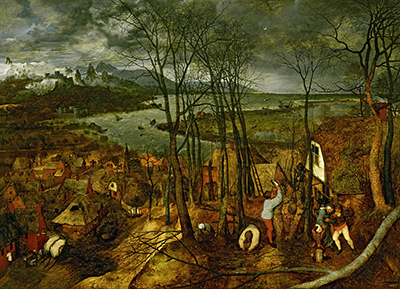
The conservators found a support made from four oak planks. Tree-ring analysis associated the boards with timber from the eastern Baltic and found that the top and bottom boards came from one tree. A board nearer the bottom is from the same tree as one used for Bruegel’s The Gloomy Day, dated 1565. This is evidence of related timber in two supports. It does not fix the year in which either board was worked into a panel, since felling, transport, seasoning and storage all intervene before the painter uses the wood. The date for the Antwerp picture has a different source, in the painted inscription [4].
Over the traditional chalk ground, the team identified a thin white priming layer containing lead white and chalk. Their study describes an economical preliminary drawing with some departures in the painted version. Much of the paint is very thin. Bruegel could leave a space in one passage to paint a figure over the light preparation instead of having to cover a dark colour already applied. A close look at the pale surfaces near Meg’s gleaming armour gives a sense of what such economy can achieve. A few well-placed lighter marks can describe a fold or an edge while the surrounding materials continue to show through [2] [4].
The infrared images show a difference between the planning of the buildings and that of the figures. In the burning structures at upper right, the researchers describe more freely placed marks, including hatching. In the figures, the lines they could see are generally sparse and precise. They give the example of a handle at Meg’s side whose end has a more rounded outline in the underlying design than it does in the paint. These differences help separate the job of establishing the structure of the town from that of placing individual forms within a crowded scene [4].
These physical findings matter for the experience of the surface. From a distance, the lower part of the picture can look like a crowded strip in almost continuous shadow. Closer viewing brings out gaps around bodies and objects. The imagery and the treatment together allow a distinction between the effect of the original thin paint and the interference of varnish and overpainting added later. This matters because a deliberately dark opening and a darkened patch of sky make very different contributions to the composition [2] [4].
What Changed with Treatment
The longer research and treatment project began in 2017. The institute used infrared imaging and macro X-ray fluorescence scanning, among other methods. The latter maps the distribution of elements and gave the team a way to study features below the visible surface. During cleaning, discoloured varnish and older overpainting were removed selectively. The conservation team reports that this revealed finer details and a broader range of colour. Compare the older photograph below with the restored image. Look especially at the sky between the red areas, where the cooler passage makes a distant view easier to follow [2] [4].
Changes to original pigments also affect what can be seen now. The museum reports that Meg’s dress and a flag were originally a stronger blue and that smalt has lost intensity. The post-treatment picture gives a clearer account of the surviving colours. Evidence for vanished strength comes from analysis and from comparison with the early drawing in Düsseldorf. Cleaning and the study of fading therefore answer different questions. One recovers a better view of surviving paint, while the other helps explain why the cleaned panel can still differ from the colour Bruegel first set down [2] [4] [5].
The red and blue passages offer other examples of how the laboratory findings relate to close looking. The researchers found vermilion in bright reds and a greater presence of iron in darker reds, consistent with red ochre. They also identified azurite in a tiny sample from a dark creature in the sky. In that case the cross-section showed blue pigment above a dark red layer. They explain its dark appearance partly through how it was painted and the transparency of the upper layer. A single dark silhouette can therefore have a long material history, even where the eye registers it at first as almost black [4].
The researchers also recovered the date 1563 in the lower-left inscription, correcting the earlier reading of 1561. Another finding concerned marks once read as the word Dul. Element maps helped show that the apparent letters were scratches through the paint that exposed the preparation, rather than a painted title. The two discoveries have different implications. The recovered numerals identify a year. The scratch finding removes a reason to treat the familiar title as an inscription by Bruegel, while leaving its early history in written accounts intact [3] [2] [4].
The revised date bears on the question of place. The museum notes that 1563 was the year of Bruegel’s marriage and that the evidence for his move between Antwerp and Brussels does not resolve where the work was painted. The painted date and the material examination can thus make the panel more securely dated without pinning it to one city. The artwork’s current home in Antwerp offers a point of certainty of a different kind, documented by its acquisition and the history of the collection [1] [2].
The Düsseldorf Drawing and the Name of the Painting
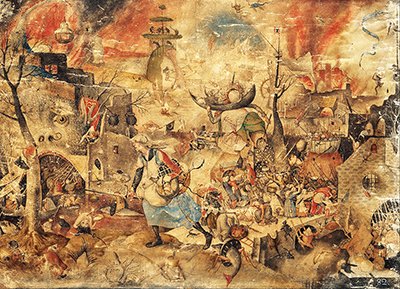
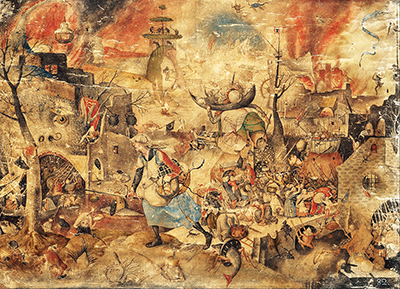
The coloured work on paper in Düsseldorf follows the Antwerp composition. It has its own materials and history. Researchers from KIK-IRPA and the Kunstpalast compared the two objects and concluded that the sheet is an early copy after the painting. The drawing’s blues were useful in interpreting the present appearance of passages such as Meg’s skirt. It remains a separate image with the copyist’s choices of materials and emphasis. The sheet reproduced below is the image formerly used at the top of this page. It gives the reader a third thing to compare with the older and newer photographs of the Antwerp panel [5] [2].
The Düsseldorf team identified a watermark associated with the Basel papermaker Niklaus Heusler, which gives 1578 as the earliest possible date for the copy. That is after Bruegel’s death. The examination also found evidence that the image was transferred with the help of a grid, which helps explain why the overall arrangement corresponds so closely with the panel. The researchers leave the copy’s maker and purpose open. Its usefulness to the conservators comes from specific agreements and differences that can be tested, such as the stronger blues in areas where the older paint has lost colour [5].
The old photographs and the drawing need to be read differently. An older photograph records the state of a painted surface and the way it was photographed. A copy preserves some observations of a composition in another medium. The two kinds of evidence can both be useful when they are labelled. Start with the long path of Meg’s step and the vessels at her side, which persist across the images. Then compare a region such as the sky, where varnish, pigment changes and the practices of a copyist can all make an appreciable difference [4] [5].
Karel van Mander described a work with this subject in his 1604 account of painters, mentioning a woman making a raid before Hell. The Antwerp museum credits Fritz Mayer van den Bergh with connecting that description to the work he bought at a Cologne auction in 1894. In the auction catalogue it had been attributed to Pieter Brueghel the Younger. The museum also notes gaps in the earlier ownership history. The evidence for the title has thus accumulated across the history of the painting’s description and identification, independently of the scratches investigated by the conservators [1] [3].
The museum discusses an interpretation centred on a struggle between women and men, and identifies the fantastic creatures as Bruegel’s reworking of forms associated with Bosch. Neither question requires following every creature to an individual meaning. Watching what Meg actually carries, where she can walk and how far she stands from the crowd gives a way of testing what an interpretation can explain. The restoration made that test more rewarding by recovering distinctions formerly difficult to see between the woman, the building and the distance behind her [1] [2].
Discussion
Which detail in this work most changes how you read it?
Frequently Asked Questions
The sword runs low across the foreground from her forward hand. Look just above the line it makes to find the objects she has gathered: vessels, bundles and the spoils the museum discusses in its account of the scene. [1]
To the right of Meg, smaller people lean across one another. Pale head coverings appear at different heights. [1]
The conservators found a support made from four oak planks. Tree-ring analysis associated the boards with timber from the eastern Baltic and found that the top and bottom boards came from one tree. [4]
References
- Museum Mayer van den Bergh, Dulle Griet, collection interpretation and acquisition history, View source.
- Museum Mayer van den Bergh, Restoration Dulle Griet reveals unseen wealth of colour and fresh discoveries, View source.
- Royal Institute for Cultural Heritage, Dull Gret discloses her true age, View source.
- Christina Currie and colleagues, Lifting the Veil, The Dulle Griet Rediscovered through Conservation, Scientific Imagery and Analysis, 2021, View source.
- Christina Currie, Dominique Allart, Sonja Brink and Steven Saverwyns, The Coloured Drawing of the Dulle Griet in the Kunstpalast, Düsseldorf, 2021, View source.








