


 by Tom Gurney
Tom Gurney BSc (Hons) is an art history expert with over 20 years experience
Published on June 19, 2020 / Updated on October 14, 2023
Email: tomgurney1@gmail.com / Phone: +44 7429 011000
Mountain Landscape with a River: Introduction
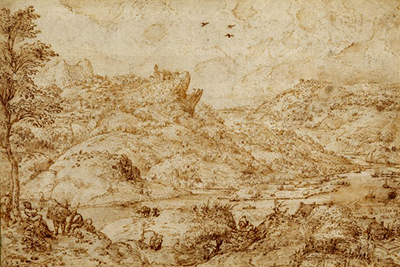
Travellers pick their way down towards a river in Pieter Bruegel the Elder’s Mountain Landscape with a River. A fortress occupies a rocky height above them. Paths run across the near ground and continue on the opposite bank, where the figures become much harder to see. The drawing belongs to the British Museum, O.o.9-9, and is catalogued in the 2001 Bruegel exhibition as Mountain Landscape with River and Travelers. It is dated 1553 at the lower left and measures about 22.8 by 33.8 centimetres. The sheet is worked in red-brown pen and ink with light wash [2] [1].
This work across Bruegel’s career
Tower of Babel
1563The Harvesters
1565Peasant Wedding
1568Children's Games
1560Triumph of Death
1562–1563Mountain Landscape with a River
This artworkContents
- Introduction
- The Travellers on the Near Bank
- River, Hill and Fortress
- Following the Pen
- The London Drawing and the Louvre Sheets
- Annotated Details
The Travellers on the Near Bank
Start below the tree at the left. Several figures stand or sit near the base of the slope, while others have moved farther along the track. Their poses can take a little time to distinguish from the small patches of vegetation around them. The exhibition catalogue identifies two monks among the pedestrians by the hoods of their robes and describes mounted travellers carrying packs. Those details give the near ground more than one pace. Some figures appear ready to continue, while others wait or turn towards one another [2].
Farther right, the curves of the path become easier to see than any one traveller. A low rise conceals part of the foreground. Look from the walkers beside the tree across the open country towards the next people and it becomes possible to infer the route through gaps in the visible track. The pen gives figures enough room to serve as measures of the terrain without labouring their features. An individual person belongs to a small patch of ground, and the steps between groups help establish its relation to the next rise.
The catalogue counts ten figures in the foreground and describes many more along the right bank. They are easier to find by tracing the paths first and then looking for the small upright marks. Once discovered, they change the character of land that first seemed largely empty. Even on the river there are marks that can be read as boats. The drawing gives the viewer several kinds of passage, including travel on foot, on horseback and by water, within the same continuous view [2].
Annotated Details from Mountain Landscape with a River
Follow the paths from the near bank towards the river and fortress.
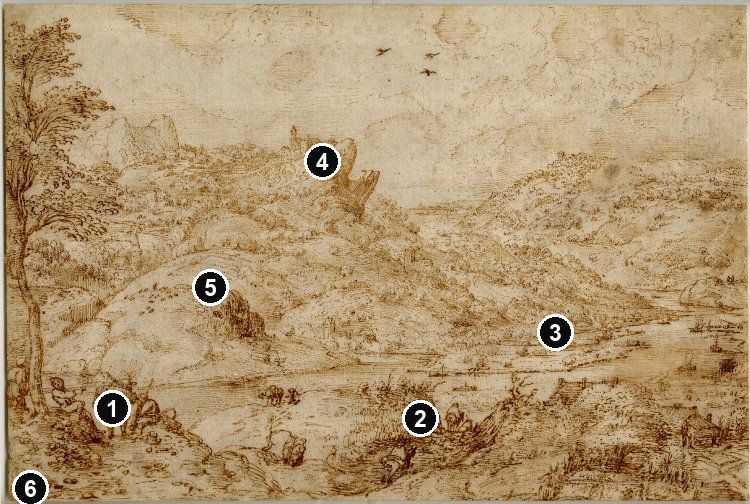
Details from MOUNTAIN LANDSCAPE WITH A RIVER
Six details show the travellers, the terrain and the date.
Travellers below the tree
Small figures gather on the near slope below the trunk.
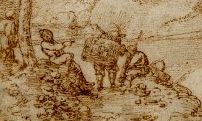
The paths and riders
Riders and pedestrians pick their way across the near ground.
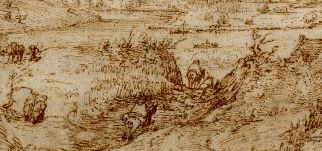
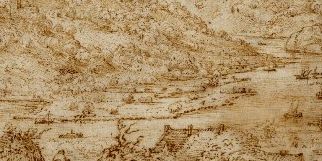
The river
The pale channel winds through low ground between the hills.
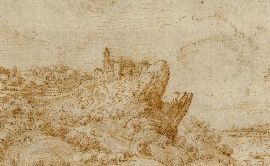
The fortress on the ridge
Small buildings stand above the two projections of rock.
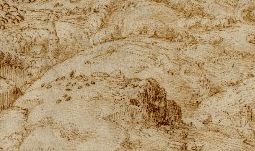
Curved hatching on the slopes
Parallel pen lines curve to describe the rise of the hill.
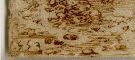
The date
The date 1553 is written at the lower left.
Pieter Bruegel the Elder, Mountain Landscape with River and Travelers, 1553. British Museum, London, O.o.9-9. See the 2001 exhibition record. Museum-sourced reproduction via Wikimedia Commons.
River, Hill and Fortress
The river enters the view through low country below the principal hill. Its intermittent visibility matters. Parts are relatively open and others vanish behind a bank or overlap with lines on the far ground. The pale strip is easier to follow if you look for the points where the direction of the pen changes along its edges. The hills around it are described by strokes that curve or descend, while the water often gives the eye a stretch to follow more nearly sideways.
The double projection of rock near the middle catches the light above the valley. At its top the small buildings have straighter edges than the rock supporting them. They make the height of the formation easier to estimate. A viewer looking from the fortress to the nearest travellers can see how sharply the scale changes across the sheet. Orenstein connects the rocky motif to Cornelis Massys and Joachim Patinir, placing it in a Netherlandish tradition even as other aspects of the drawing recall Italian examples [2].
The tree at the left is close enough for the viewer to see how some of the branches divide. Its dark shape sets a margin to the foreground, but much of the land opens quickly away from it. The hill and fortress therefore have prominence well beyond that of any one near figure. The exhibition catalogue makes this a point of comparison with earlier landscapes by Bruegel in which the foreground occupies a more substantial part of the composition. Here it is a small place from which to enter a broad view [2].
Following the Pen
Closely spaced pen strokes turn with the hills. Near the path, they describe the inclination of relatively small banks. Across the river, the same device makes much larger stretches of ground swell or recede. Bruegel can use a row of parallel strokes to describe a plane and then break it up with the shorter marks of bushes and trees. The two kinds of work are still distinguishable, even where little of the paper is left untouched.
Orenstein relates the curved hatching and the full pen lines to the work of Venetian draughtsmen, including Titian and Domenico Campagnola. The 2001 catalogue treats the scene as invented. Those observations can be held together when looking at the sheet. The pen can adapt ways of setting down a slope or a patch of trees to an arrangement composed for the drawing. The fortress and nearby rocks provide a conspicuous centre, while the distant lines of hills and river give the eye room to travel through the composition [2].
The date is small enough to be missed under the left-hand tree. The exhibition catalogue also records older annotations and numbering on the back. It uses the numbering to connect the sheet with the collection history of another British Museum drawing, Landscape with Fortified City. The date, the annotations and the comparison with other landscapes supply different kinds of evidence about when the drawing was made and where it subsequently travelled [2].
The London Drawing and the Louvre Sheets
The Louvre owns a close copy of the London drawing, INV 19727 recto, catalogued as Paysage de collines traversé par une rivière. It is a different sheet even though much of the composition agrees. The exhibition catalogue notes that the Paris sheet was formerly regarded as the original. That history makes the object number useful when comparing reproductions. A caption can describe the same river, fortress and travelling groups while referring to different pieces of paper [3] [2].
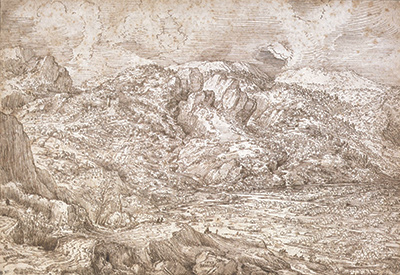
The Louvre also owns Bruegel’s separate Alpine Landscape, INV 19728 recto, reproduced below. Its date of about 1553 is supported in part by comparison with the London sheet. In the Louvre landscape, steep cuts and ridges cross the foreground and lead to a broad plain. The London drawing uses a river to provide a route into the distance and places its fortress on an especially conspicuous height. Look from the angular faces and curved hatching of one sheet to those of the other and the stylistic comparison becomes clearer. The different arrangements also explain why the Louvre landscape and the close Paris copy serve distinct purposes when studying the London original [4] [3] [2].
Discussion
Which detail in this work most changes how you read it?
Frequently Asked Questions
Start below the tree at the left. Several figures stand or sit near the base of the slope, while others have moved farther along the track. [2]
The double projection of rock near the middle catches the light above the valley. At its top the small buildings have straighter edges than the rock supporting them. [2]
Orenstein relates the curved hatching and the full pen lines to the work of Venetian draughtsmen, including Titian and Domenico Campagnola. The 2001 catalogue treats the scene as invented. [2]
References
- Metropolitan Museum of Art, Pieter Bruegel the Elder, Drawings and Prints, exhibition image gallery, View source.
- Nadine M. Orenstein, ed., Pieter Bruegel the Elder, Drawings and Prints, 2001, cat. nos. 9, 10 and 12, View source.
- Musée du Louvre, Paysage de collines traversé par une rivière, INV 19727 recto, View source.
- Musée du Louvre, Paysage alpestre, INV 19728 recto, View source.








