


 by Tom Gurney
Tom Gurney BSc (Hons) is an art history expert with over 20 years experience
Published on June 19, 2020 / Updated on October 14, 2023
Email: tomgurney1@gmail.com / Phone: +44 7429 011000
Mule Caravan on Hillside: Introduction
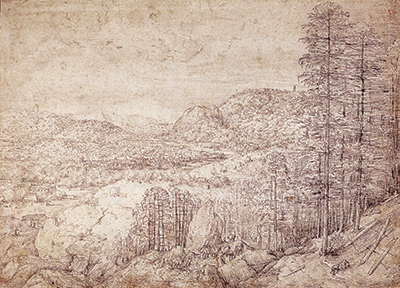
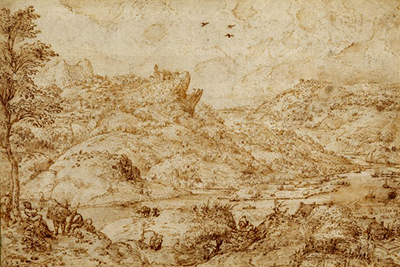
A small caravan follows a slope beneath tall pines in Pieter Bruegel the Elder’s Mule Caravan on Hillside. The view opens past the animals to a valley with a town and low mountains behind it. Museum Boijmans Van Beuningen catalogues the drawing as Mountain Landscape with a Mule Caravan, N 146 (PK). It is on loan from Stichting Museum Boijmans Van Beuningen and measures 21.7 by 30.2 centimetres. The museum dates it to about 1552–55. A later copy in Munich preserves much of the arrangement and helps show where Bruegel’s handling gives the original its character [1] [2].
This work across Bruegel’s career
Tower of Babel
1563The Harvesters
1565Peasant Wedding
1568Children's Games
1560Triumph of Death
1562–1563Mule Caravan on Hillside
This artworkContents
- Introduction
- Finding the Caravan
- Pines, Rocks and the Town
- The Faint Date and the Munich Copy
- Comparing Bruegel’s Early Landscapes
- Annotated Details
Finding the Caravan
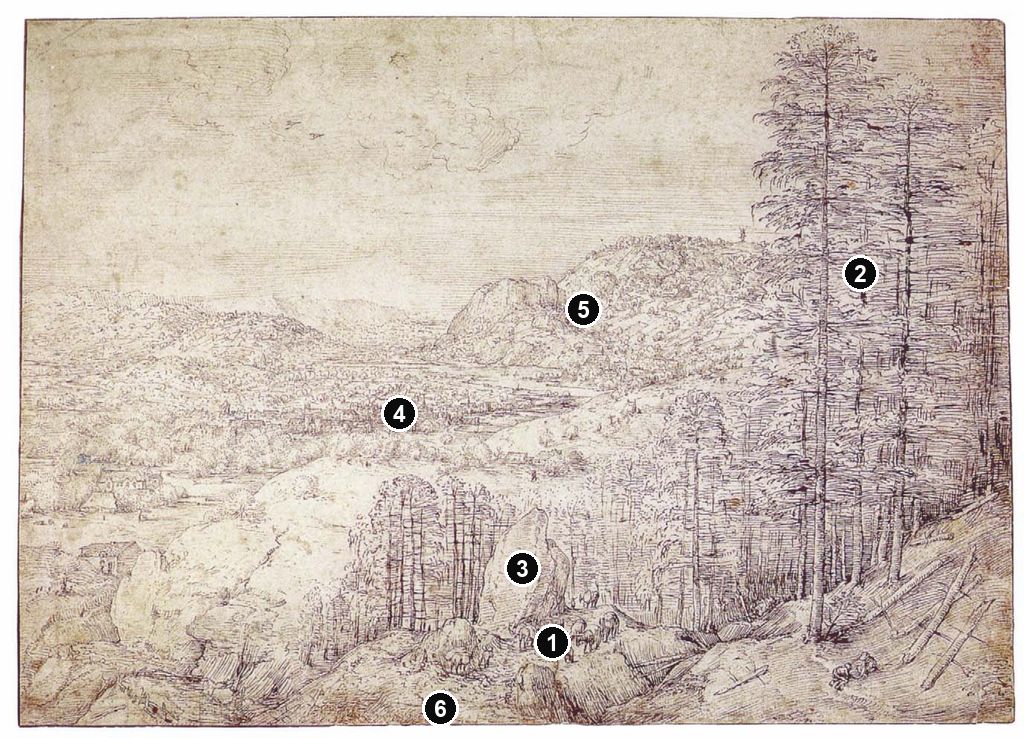
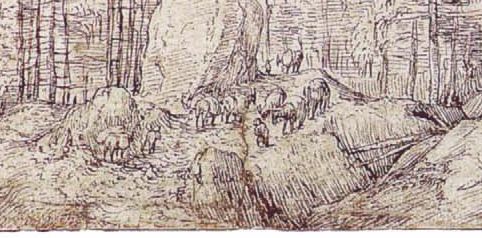
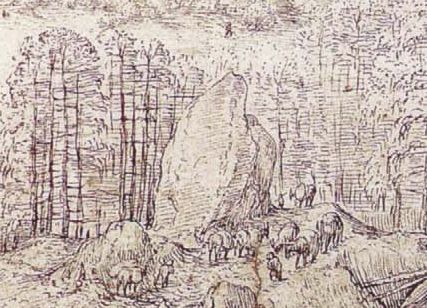
Start below the taller pines at the right and look towards the lower centre, where the bank opens around several small animals. Rounded backs and packs can be picked out against the lighter paper. Below their bodies there are short lines for legs and a few extra strokes where the ground is uneven. The animals are close enough to measure the slope against their bodies. The group still takes up only a small part of the drawing, and on a first look it can disappear among the rocks and vegetation [1] [2].
The route is easier to see when you follow the edges of the ground around it. Bruegel has drawn a succession of banks, some darkened with narrow lines and others left comparatively open. The little party passes below a light outcrop beside a group of trees. Beyond it the route is partly concealed. The country towards the town can nevertheless be read as a continuation of the journey. Seeing several small parts of the terrain in relation to the caravan makes the valley seem much wider than the path visible beside the animals.
Near the lower right, separate short lines gather where the hillside climbs to the edge. They have a different direction from the upright trunks above. The eye can follow the paths of the strokes like small changes of level. At the next rise the marks change again. The sloping bank provides a way to move across the foreground while the vertical lines of the trees keep a substantial part of the right side in view.
Annotated Details from Mule Caravan on Hillside
Find the caravan below the pines, then look across the valley towards the town.
Details from MULE CARAVAN ON HILLSIDE
Six details show the route, the trees and the faint inscription area.
The caravan
Small pack animals follow the slope beside the light outcrop.
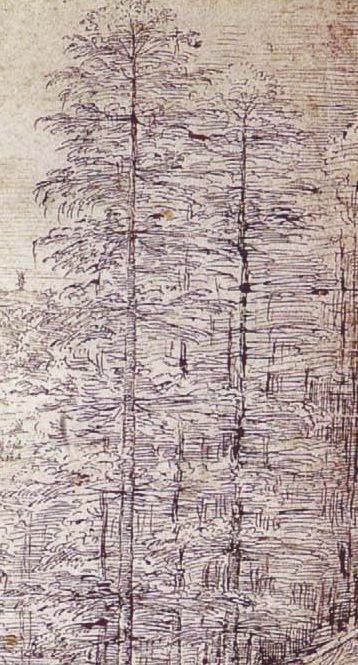
The tall pines
Long trunks and spreading branches occupy the right side.
The near outcrop
Light paper separates the rock from trees and shaded banks.
The town in the valley
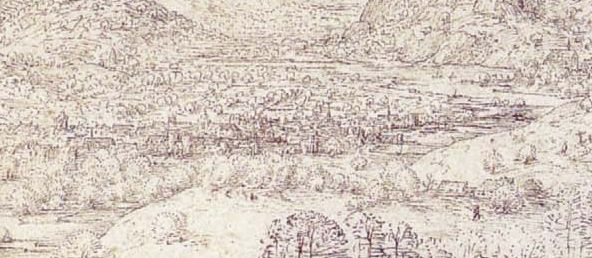
Small roofs and upright forms interrupt the wooded valley.
The distant ridge
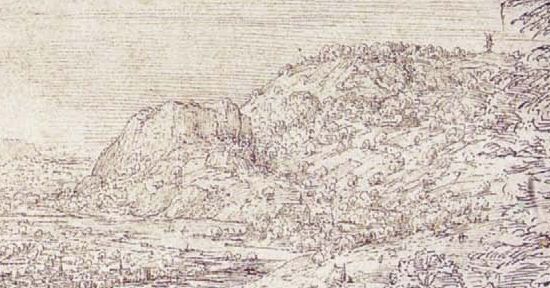
Short lines follow changes in the outline of the hills.
The lower inscription area
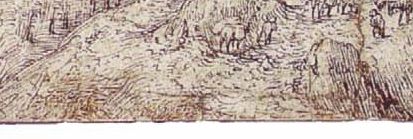
The museum records a partly legible signature near the lower centre.
Pieter Bruegel the Elder, Mountain Landscape with a Mule Caravan, about 1552–55. Museum Boijmans Van Beuningen, N 146 (PK), on loan from Stichting Museum Boijmans Van Beuningen. 2001 catalogue reproduction via Wikimedia Commons. Public domain.
Pines, Rocks and the Town
The tallest tree nearly reaches the top of the sheet. Some of its branches turn down and spread out over lighter areas. The pen runs farther to either side in the foliage than it does along most of the thinner trunks in the middle distance. The long, open lines of the tall pine make it distinct from the closely packed trees beneath it. Bruegel uses this difference to let a viewer see past one part of the wood into the next [2].
To the left of the nearest trees, pale slopes interrupt the more densely drawn vegetation. Look at the tops of the rocks and then down towards the town. Small changes in the outline of a mountain indicate where a slope turns or falls away. The buildings occupy a narrow strip among trees. Their horizontal lines are so small that the town initially looks like a band of texture. At closer range there are clear differences between the shapes of several roofs and taller structures. The detail helps give recognisable size to the valley below the mountains [2].
Much of the sky is lightly worked, allowing the more emphatic tree forms to stand apart. Some marks run in long, nearly horizontal groups and others are interrupted by small changes in the edge of a cloud. Behind the central hills, the light area of sky helps separate one ridge from another even where the distant ground is made with very brief strokes. The emptier spaces are as important to the layout as the dense near trees. They determine how far the eye can continue past the path.
The Faint Date and the Munich Copy
The Rotterdam museum records a partly legible signature near the lower centre. The exhibition catalogue describes writing that was hatched over and gives an early reading of the date. The museum entry reports different readings by Hans Mielke and Manfred Sellink, who interpreted the date as 1555 and 1553 respectively. The approximate range used here follows the museum. Where a few marks can support different readings, stylistic comparison and the history of the drawing have to bear more of the weight [1] [2].
The Staatliche Graphische Sammlung in Munich holds a separate version, inventory 1097, inscribed 1603. The exhibition catalogue assigns it to an anonymous copyist after Bruegel. It observes that the copy follows delicate details of the original, including the appearance of the partly obscured inscription. The 1603 date was written in a prominent place. The two sheets therefore preserve related compositions made at different times, and the date on the Munich copy belongs to that sheet [2].
Orenstein compares the mountains and buildings to explain why the Rotterdam drawing is accepted as Bruegel’s. In the copy some of the mountain contours are more generalised, while in the Rotterdam original small changes of contour articulate individual slopes. The same distinction can be followed among the little buildings. The Rotterdam catalogue also traces the original through the former Koenigs collection. That history belongs to the particular piece of paper, while the close agreement with the Munich image shows that the composition itself circulated beyond that original [1] [2].
The museum lists traces of red chalk and blue ink alongside the dark brown penwork. It also records brown framing lines. These details concern the physical sheet, and they complement the comparative evidence supplied by the shapes of trees, mountains and houses [1].
Comparing Bruegel’s Early Landscapes
In Mountain Landscape with a River, shown below, small travelling groups again give a sense of how people move through a large valley. The British Museum drawing leads the view past a tree on the left towards a rocky height, while the Rotterdam sheet sends it past taller pines at the right and down towards the town. Orenstein also compares the dotted and dashed foliage of their middle grounds. The correspondence is easiest to see after looking at the nearest branches. The marks for trees farther away are shorter and fewer, but they make the scenery on the other side of the valley legible [3] [2].
Discussion
Which detail in this work most changes how you read it?
Frequently Asked Questions
The tallest tree nearly reaches the top of the sheet. Some of its branches turn down and spread out over lighter areas. [2]
References
- Museum Boijmans Van Beuningen, Mountain Landscape with a Mule Caravan, N 146 (PK), View source.
- Nadine M. Orenstein, ed., Pieter Bruegel the Elder, Drawings and Prints, 2001, cat. nos. 6, 7 and 9, View source.
- Metropolitan Museum of Art, Pieter Bruegel the Elder, Drawings and Prints, exhibition image gallery, View source.








