


 by Tom Gurney
Tom Gurney BSc (Hons) is an art history expert with over 20 years experience
Published on June 19, 2020 / Updated on October 14, 2023
Email: tomgurney1@gmail.com / Phone: +44 7429 011000
The Penitent Magdalene: Introduction
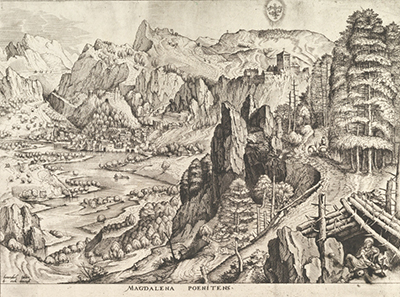
Mary Magdalene rests under a shelter of logs in the lower right of The Penitent Magdalene. High above her, angels lift her in a small opening of light. Between these two appearances stretches a river valley enclosed by mountains. Johannes and Lucas van Doetecum made the etching and engraving after Pieter Bruegel the Elder, and Hieronymus Cock published it in the Large Landscapes around 1555–56. The main reproduction is the National Gallery of Art’s first-state impression, 1943.3.2121, which preserves the Latin title Magdalena Poenitens below the image [1] [2] [4].
This work across Bruegel’s career
Tower of Babel
1563The Harvesters
1565Peasant Wedding
1568Children's Games
1560Triumph of Death
1562–1563The Penitent Magdalene
This artworkContents
- Introduction
- The Shelter on the Hillside
- The Roads and the River
- First and Second States
- A Sacred Scene within the Large Landscapes
- Annotated Details
The Shelter on the Hillside
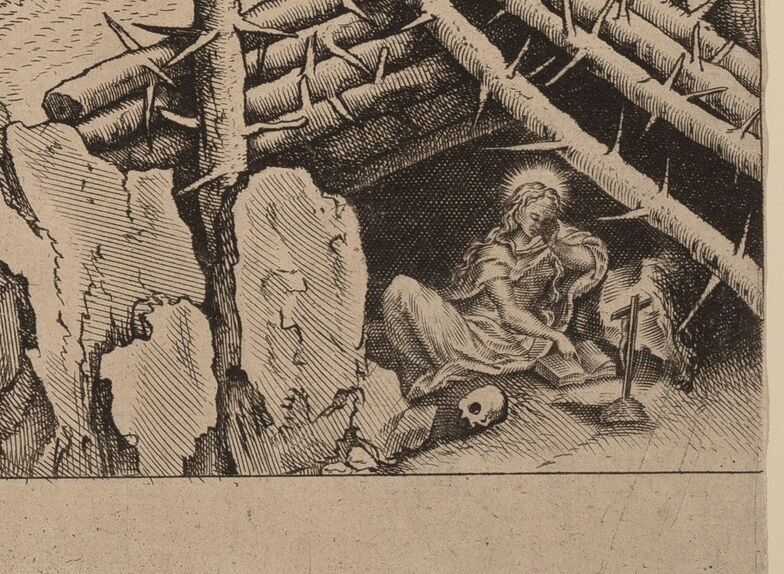
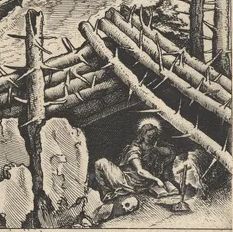
Begin at the lower right, where logs are laid diagonally against a rough framework. The opening beneath them is shaded, and the sloping lines of the roof lead down towards Magdalene. She reclines close to the ground. A skull is visible nearby, and the print puts it where the light paper makes its outline relatively easy to see. It gives a point of focus to the small area of retirement. The worked lines of the logs and the quiet figure beneath them distinguish this place from the open roads above it [3] [4].
The hollow under the roof also marks a change of scale. The logs are substantial next to the figure and recognisable individually. At the centre of the picture, in contrast, a whole stand of trees can be described by short repeated marks. A viewer can look from the details of the roof to the dark trunk forms along the far reaches of the path and gain a sense of the depth of the hillside. The shelter is wedged between the edge of the picture, a group of rocks and the open track, so it seems both accessible and protected.
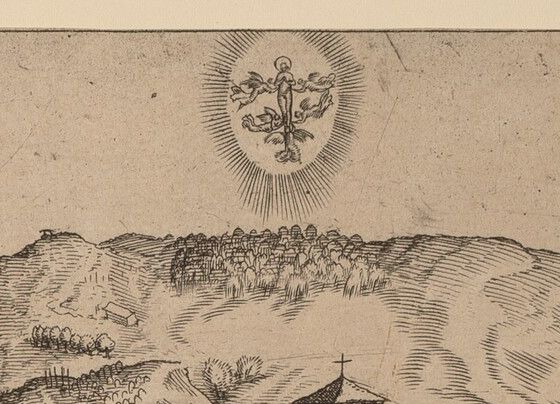
Once you have found the reclining figure, look up towards the pale oval above the mountains. The Städel identifies the group within it as angels lifting Magdalene. The exhibition catalogue relates the two appearances to the legend of her years of penance, during which angels repeatedly carried her up to heaven. The figure in the shelter and the little group in the sky belong to that same story. The space between them is occupied by ordinary inhabited country, with paths, towers and roofs that have their own scale and direction [3] [4].
Annotated Details from The Penitent Magdalene
Find Magdalene in the shelter and again above the ridge.
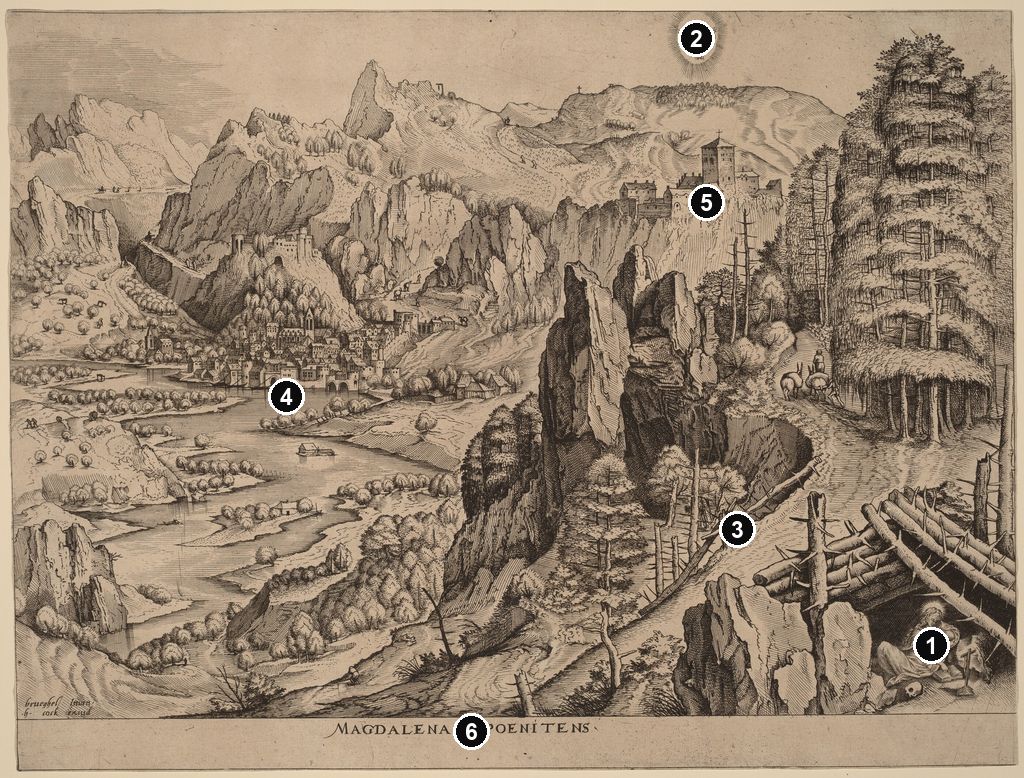
Details from THE PENITENT MAGDALENE
Six details connect the two appearances of Magdalene with the river valley and printed title.
Magdalene in the shelter
Magdalene reclines below the logs, with a skull nearby.
The angels above the ridge
Angels lift Magdalene in a small light oval above the mountains.
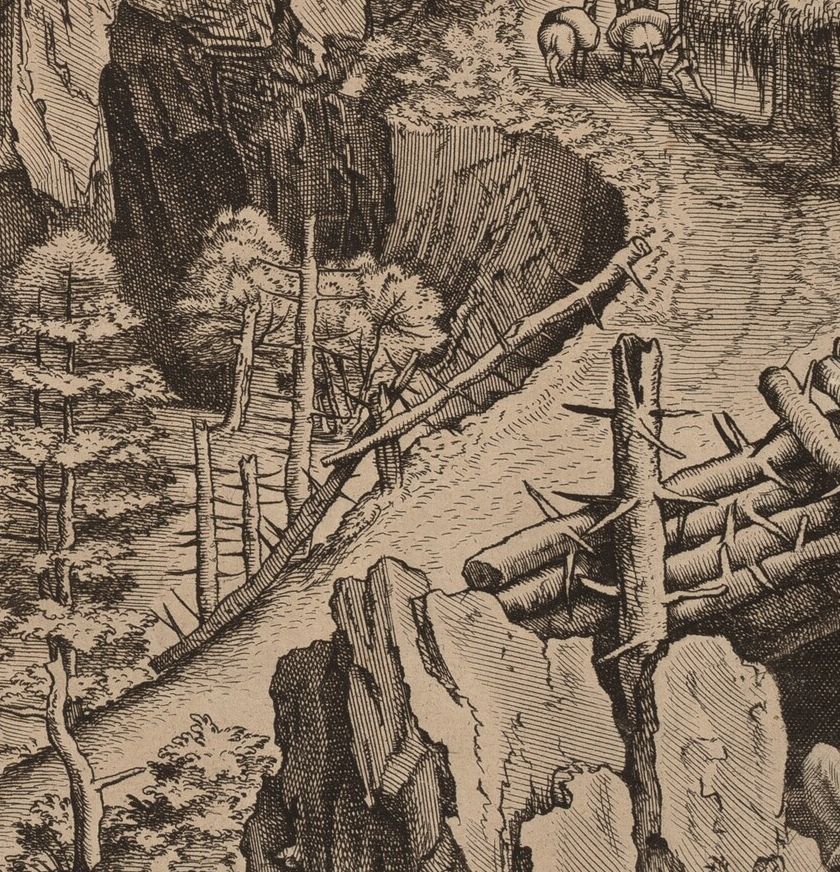
The track and fence
The road bends uphill past rocks and a rough fence.
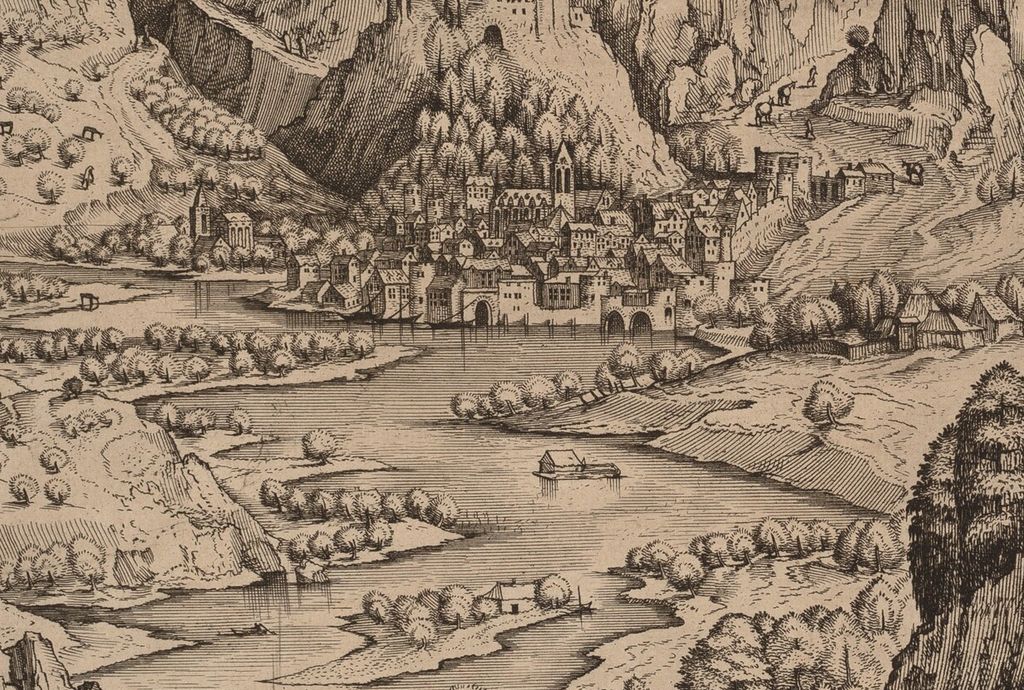
The river and settlement
Roofs and small craft give a sense of the river’s width.
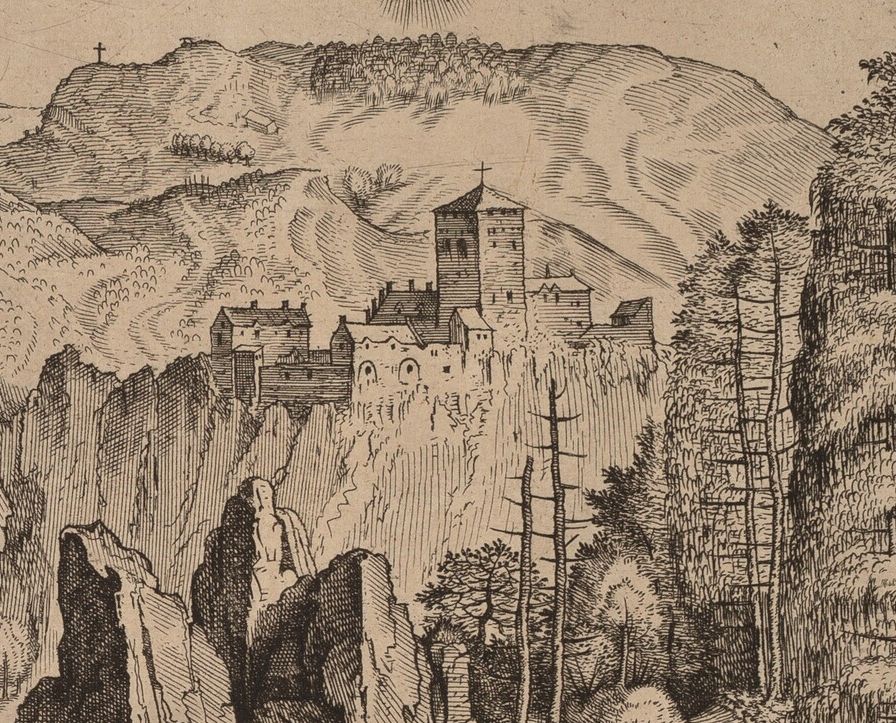
The castle above the rock
A tower extends the vertical lines of the cliff below it.
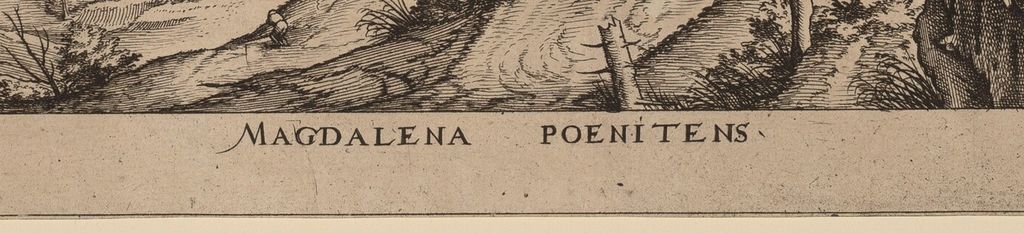
The Latin title
The inscription identifies the figure at the lower right.
Johannes and Lucas van Doetecum, after Pieter Bruegel the Elder, The Penitent Magdalene. Published by Hieronymus Cock. Rosenwald Collection, National Gallery of Art, 1943.3.2121. First state. Public domain.
The Roads and the River
A track passes above the roof and turns uphill at the right. Its edge is marked in places by a rough fence. Higher up, the road passes animals on the approach to the trees. Near the shelter the surface is worked closely enough to suggest a particular slope underfoot. Farther away its bends are easier to follow than its surface. The path supplies a way to imagine crossing ground that otherwise looks difficult to traverse. Its turns also reveal how the viewer’s position changes relative to the outward faces of the rocks.
At the centre a tall cluster of rock separates the track from the river. One face is comparatively light and another is heavily darkened with close lines. The water to the left opens into broader, lighter bands and winds around low strips of land. Small craft and buildings bring out its width. Roofs cluster against the far bank, under another sequence of steep faces. The contrast between the flat interval of water and the sudden height of the rocks gives the valley definition even at reduced size.
Look up from the settlement to the building high at the right of centre. Its tower has a vertical edge that extends the lines of the rock below. The lower buildings have similarly legible roofs, but here there is less open ground around them. Across the print, the relative scale of roads, buildings and wooded slopes tells the viewer how different kinds of ground can be occupied. The isolated shelter at the bottom is one of several forms of habitation, and its rudimentary construction is particularly visible beside the more substantial walls elsewhere in the landscape.
The mountain ridge behind the tower makes another route visible in fragments. Small marks run across the open face below the summit and disappear behind nearer crags. Where this distant route meets a building, the structure is scarcely more than an outline. Compare it with the logs beside Magdalene. Both passages depend on short straight lines, but their spacing gives each a different place in the depth of the print.
First and Second States
The National Gallery of Art identifies its impression as the first of two states. The Städel has a second-state impression, 9208 D. Orenstein notes that diagonal hatching was added across Magdalene’s face after the first state. This is a change in the plate, so its effect can be seen by enlarging the figure in impressions of both states. The comparison below shows the corresponding corner of the Städel sheet. Most of the composition is shared, and even the two appearances of Magdalene occupy very small areas. The small addition helps distinguish the states when the printed face can be seen clearly [1] [3] [4].
The Latin title and the credits can be read in the Washington impression. The title occupies the lower margin and gives the viewer the name of the figure hidden beneath the shelter. The credits inside the image name Bruegel for the design and Cock for publication. The museum records identify the Doetecums as the printmakers. Those distinctions help explain why the sheet can be described as a work after Bruegel while preserving evidence of the work of several people. The legacy reproduction shows the same shelter, road and valley, but the resolution leaves its precise state and specific impression open [1] [2].
A Sacred Scene within the Large Landscapes
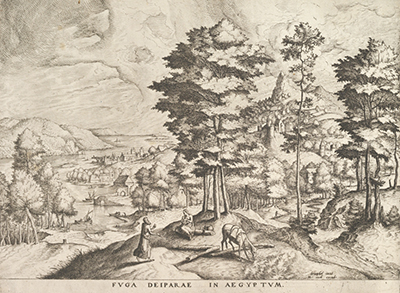
The Magdalene’s retreat can be compared with another religious subject in the series, The Flight into Egypt. In that work the seated figures are grouped beneath living trees and draw the eye towards a view of water. The Magdalene’s shelter sits low at the edge, and her appearance in the sky extends the subject beyond the corner she occupies on the ground. Both compositions allow the viewer to spend time with the terrain and then return to a small figure. The printed title here makes that return particularly precise. It tells viewers which person to find even when the road and the settlements initially seem to command more of the view [2] [4].
Discussion
Which detail in this work most changes how you read it?
Frequently Asked Questions
References
- National Gallery of Art, Magdalena Poenitens, first state, 1943.3.2121, View source.
- Metropolitan Museum of Art, The Penitent Magdalene, from The Large Landscapes, View source.
- Städel Museum, The Penitent Magdalene, second state, 9208 D, View source.
- Nadine M. Orenstein, ed., Pieter Bruegel the Elder, Drawings and Prints, 2001, cat. nos. 26 and 33, View source.







