


 by Tom Gurney
Tom Gurney BSc (Hons) is an art history expert with over 20 years experience
Published on June 19, 2020 / Updated on October 14, 2023
Email: tomgurney1@gmail.com / Phone: +44 7429 011000
Rustic Market: Introduction
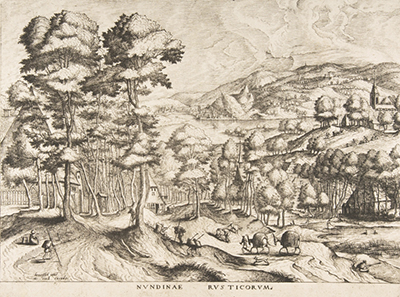
Two loaded animals move along a road below a wooded village in Rustic Market. Other people travel on foot or work nearby, and a broad reach of water and mountains opens behind the trees. The National Gallery of Art identifies the print as the work of Johannes and Lucas van Doetecum after Pieter Bruegel the Elder, published by Hieronymus Cock in the Large Landscapes. The reproduction here is Washington’s impression 1941.1.149. It shows both Bruegel’s name and the Latin title Nundinae Rusticorum. The exhibition catalogue published in 2001 dates the print to about 1555–56 and questions who supplied its design [1] [3].
This work across Bruegel’s career
Tower of Babel
1563The Harvesters
1565Peasant Wedding
1568Children's Games
1560Triumph of Death
1562–1563Rustic Market
This artworkContents
- Introduction
- Loads and Roads
- A Village behind Trees
- Water and Mountains beyond the Village
- The Title, the States and the Design
- Annotated Details
Loads and Roads
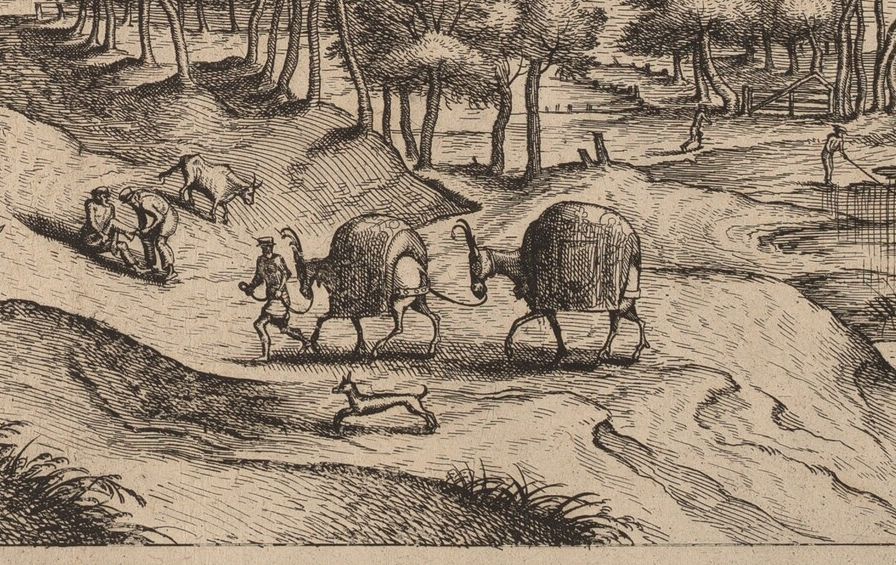
Begin below the centre, where a path bends behind the two pack animals. The rounded loads rise conspicuously above their legs. A small figure leads the way. In this part of the print the road is relatively open, so the loads can be read as solid dark shapes even when the surrounding lines are too small to distinguish. Beyond them, a series of upright figures occupies the shallow rise towards the village. The distance between the people and the animals gives the route a sense of movement, as if parts of a group are passing out of view.
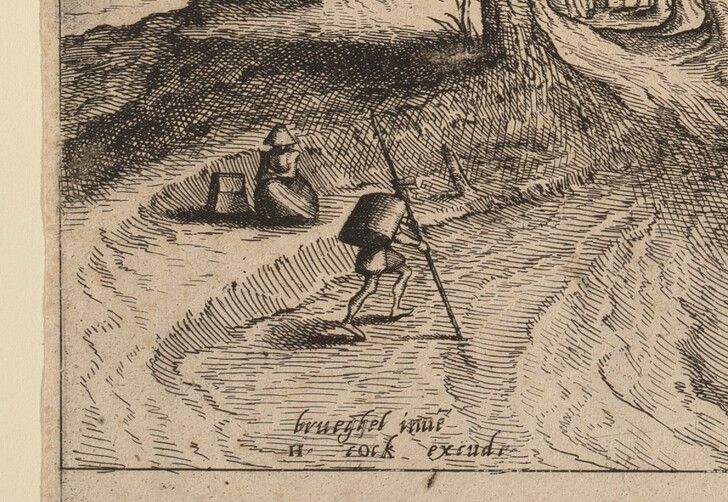
There is also a lane at the lower left. A figure carrying a long stick stands out against the light ground, and two smaller figures are visible further back. This lane leads towards the buildings screened by trunks on the left. The two routes share the foreground without becoming a single clear road across the sheet. To follow either one, the eye has to pass behind a tree, a bank or a building. The print distributes travel and exchange across several paths rather than concentrating them around a conspicuous stall.
The title gives those scattered details a context. A market requires people and goods to arrive from elsewhere. It can be evoked here by routes and loads as well as by the gathering of people. The print offers enough to imagine a destination in the village, where houses and tracks meet. At the same time, the title leaves the goods, the habits of the merchants and the exact place of exchange open. The evidence for trade is dispersed across a landscape that also shows ordinary movement and work [1] [3].
Annotated Details from Rustic Market
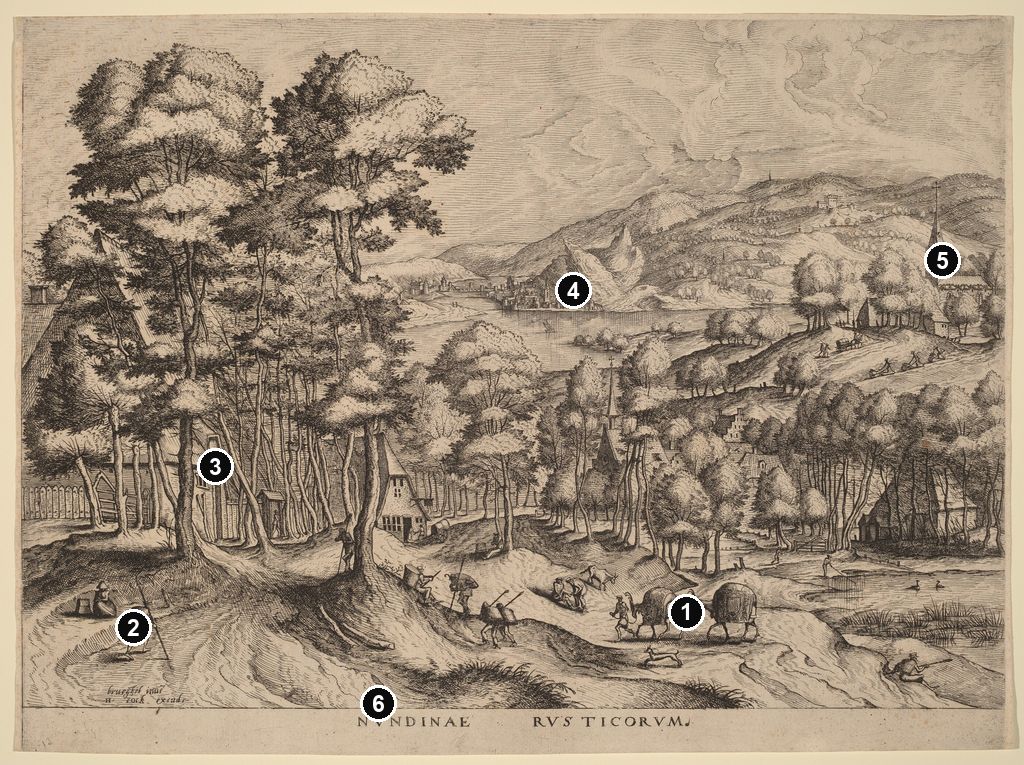
Follow the animals and pedestrians towards the village behind the trees.
Details from RUSTIC MARKET
Six details show the roads, buildings, distant slopes and printed lettering.
The pack animals
Bulky loads stand out on the curved foreground track.
The left-hand lane
Figures and a long staff mark the open lane beside the trees.
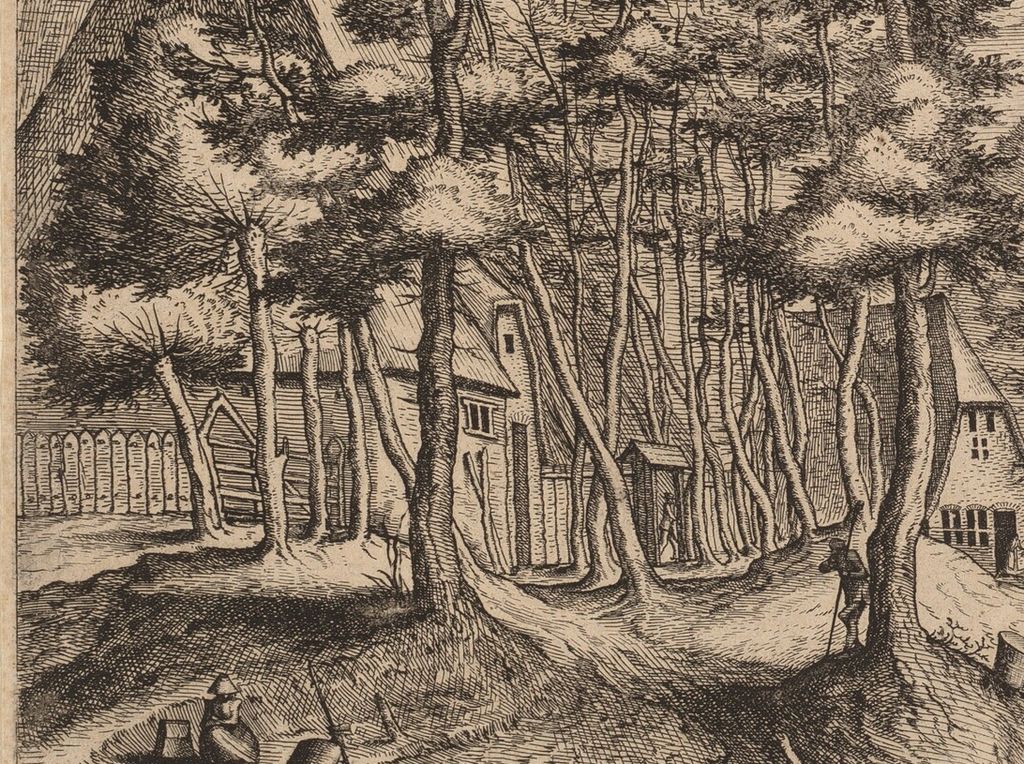
Houses among the trees
Tall trunks interrupt the rooflines of the village.
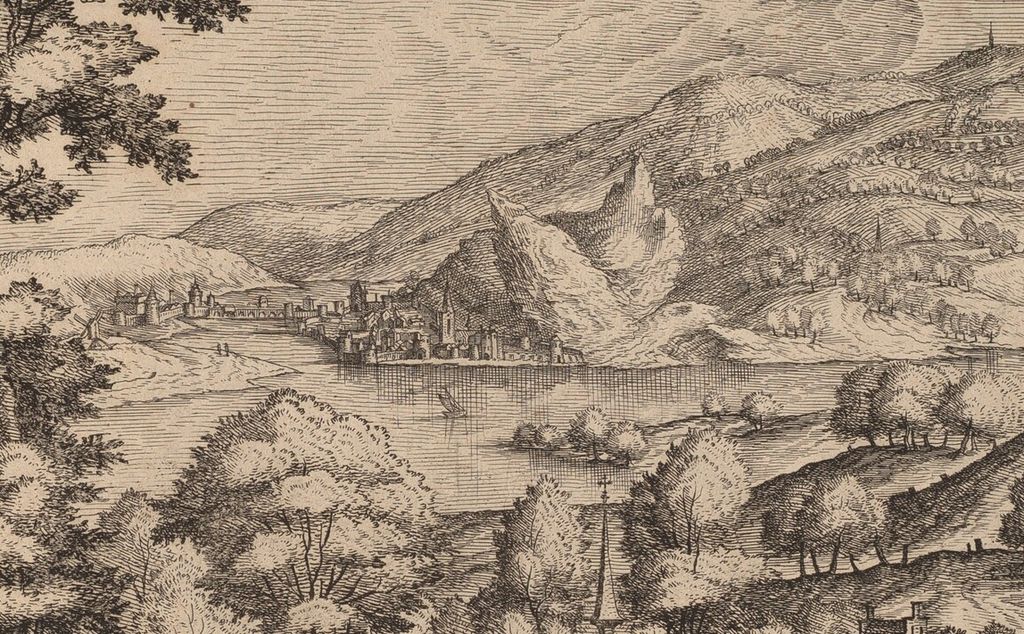
Water and distant rocks
A pale band of water separates the slopes and projecting rock forms.
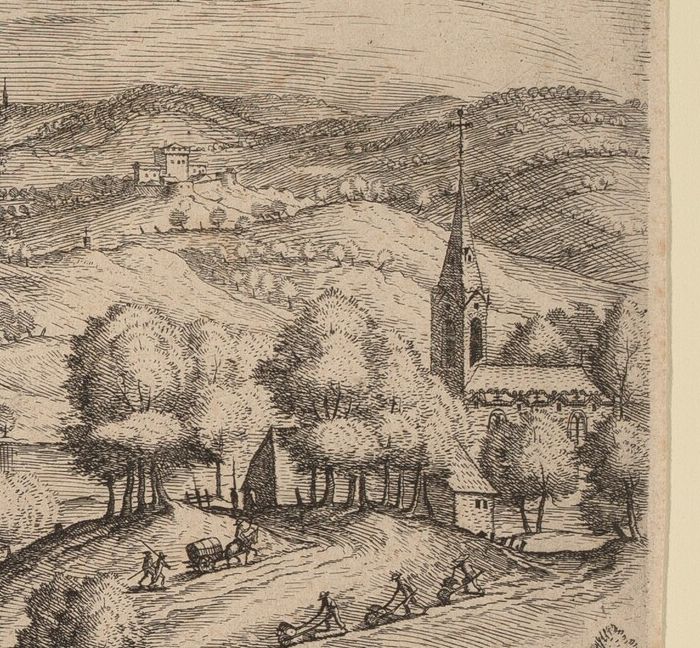
Church above the slope
The spire rises above the crowns near the right edge.
The credits and title
The designer and publisher credits sit inside the image, with the Latin title beneath it.

Johannes and Lucas van Doetecum, after Pieter Bruegel the Elder in the NGA catalogue, Rustic Market. Published by Hieronymus Cock. National Gallery of Art, 1941.1.149. Public domain.
A Village behind Trees
Some of the roofs at the left can only be seen in intervals between the trees. Compare the slope of a roof with the direction of the trunks that hide it. The built forms give a measure of how far apart the trees stand, and their interruptions make the line of houses seem to extend deeper into the image. The largest crowns hang high above them. Where the branches spread, fine strokes and dark patches give the foliage a denser texture than the open road below.
Near the centre, the size of the trees diminishes in stages. First there are trunks with relatively distinct branches. Behind them are groups of smaller rounded shapes. Patches of bare ground appear between them and draw attention to the different heights of their roots. At the far right, a church spire marks another settlement above the slope. It is tall enough to rise over the neighbouring crowns. The few clear vertical lines at that spot help the eye locate inhabited ground after leaving the more closely worked village in the foreground.
Water and Mountains beyond the Village
A light band of water crosses the middle of the image. Its surface can be seen between the nearer branches and below several rocky forms. The water opens a long interval in which the eye can move sideways, while the tracks in the foreground repeatedly lead towards or away from the viewer. Beyond the shore, darker forms jut out from the mountains. Their scale makes it possible to see how much land stretches behind the relatively modest hill with the church.
Orenstein characterises the ground in front as Flemish and draws attention to the incongruity of the distant mountains behind it. The two kinds of terrain are connected visually by the succession of banks, the water and the long bands of hatching in the hills. The print can look continuous even though the mountains are unlike the country suggested by the nearer village. A viewer can see the difference by tracing the gentle curves of the roads and then looking at the abrupt slopes above the far shore [3].
The Title, the States and the Design
The Latin title runs across the strip below the image, while the credits are printed inside it at the lower left. The Albertina records a first-state impression, DG1955/52, with Cock’s name in that corner. Orenstein describes Bruegel’s credit as an addition to the plate in the second state and illustrates the Met impression 26.72.54. The name is just above Cock’s in the Washington reproduction used here. The legacy image shows the same plate with the same placement of the title and credits. Its specific impression remains unidentified [1] [2] [3].
The revised lettering is part of the grounds for the attribution discussion. Orenstein observes that the first state already carried the name of Cock and compares the addition of Bruegel’s credit with a similar change to The Flight into Egypt. She also finds the small figures, the way that clumps of land are distributed and the spindly trees unlike more securely attributed designs by Bruegel. On that basis she questions the traditional attribution for both prints. The National Gallery of Art retains the attribution to Bruegel as designer in its collection record [1] [4] [3].
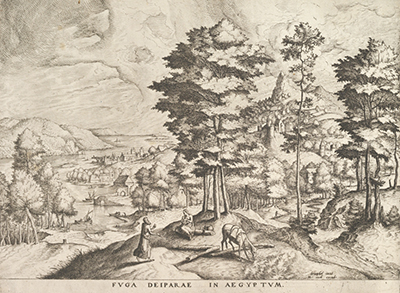
The first-state Flight into Egypt, shown below, provides a way to look at the two compositions together. In that print, taller trees shelter the seated family above the river. In Rustic Market, a large stand of trees screens a village, and the foremost figures cross the ground in several directions. Both images use trees to create a tall near plane in front of lighter distant water. Their subjects and arrangements remain distinct. The comparisons of design and lettering ask different questions of the same objects. One concerns how the images were made, and the other concerns how the publisher presented them to readers [4] [3].
Discussion
Which detail in this work most changes how you read it?
Frequently Asked Questions
Orenstein characterises the ground in front as Flemish and draws attention to the incongruity of the distant mountains behind it. The two kinds of terrain are connected visually by the succession of banks, the water and the long bands of hatching in the hills. [3]
References
- National Gallery of Art, Nundinae Rusticorum, 1941.1.149, View source.
- Albertina, Nundinae Rusticorum, first state, DG1955/52, View source.
- Nadine M. Orenstein, ed., Pieter Bruegel the Elder, Drawings and Prints, 2001, cat. nos. 33–34 and fig. 85, View source.
- National Gallery of Art, Fuga Deiparae in Aegyptum, 1964.8.6, View source.







