


 by Tom Gurney
Tom Gurney BSc (Hons) is an art history expert with over 20 years experience
Published on June 19, 2020 / Updated on October 14, 2023
Email: tomgurney1@gmail.com / Phone: +44 7429 011000
Rustic Solicitude: Introduction
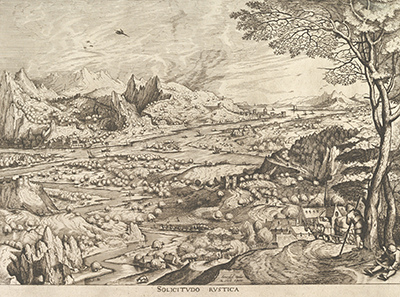
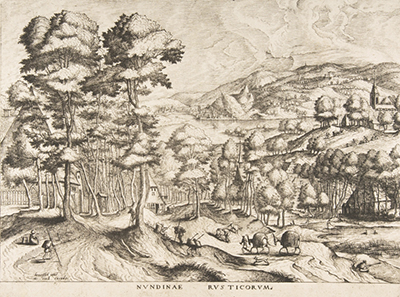
A seated man works on a scythe beneath a large tree at the right of Rustic Solicitude. A second man stands nearby and looks across a river valley that takes up nearly the whole print. Johannes and Lucas van Doetecum made the etching and engraving after Pieter Bruegel the Elder, and Hieronymus Cock published it in the Large Landscapes. The 2001 exhibition catalogue dates the print to about 1555–56. The impression reproduced here is 1964.8.415 in the National Gallery of Art’s Rosenwald Collection. Its lower margin bears the Latin title Solicitudo Rustica [1] [7].
This work across Bruegel’s career
Tower of Babel
1563The Harvesters
1565Peasant Wedding
1568Children's Games
1560Triumph of Death
1562–1563Rustic Solicitude
This artworkContents
- Introduction
- Two Men beneath the Tree
- Looking across the Valley
- The Printed Title and the Related Drawing
- Comparison with Rustic Market
- Annotated Details
Two Men beneath the Tree
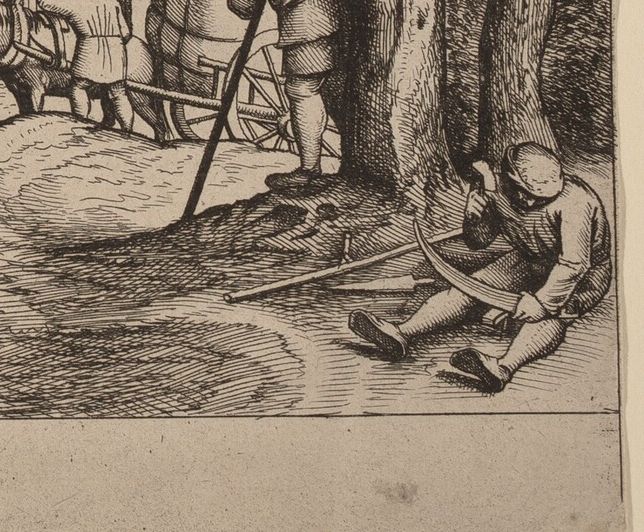
Start at the lower right, where the seated man bends over his work. Orenstein identifies the action as hammering the blade of a scythe. The man’s body is close to the side of the image, and a curved blade and the small movement of his hands are easiest to make out in an enlargement. The standing figure is partly framed by the trunk. He leans on a long pole and looks outwards, giving the viewer another way into the landscape. The two figures are close together and direct their attention towards entirely different distances [7].
The tree gives the small foreground its height. Its trunk begins beside the worker and rises nearly the full height of the print. The branches then stretch left across the sky. Down near the roots, closely spaced lines describe the slope and interrupt the light patches on the road. Farther up, finer marks leave small intervals in the foliage. The branches make an edge to the open sky without closing off the view across the land. Looking from the highest branch back down to the scythe gives a sense of just how little of the sheet the men occupy.
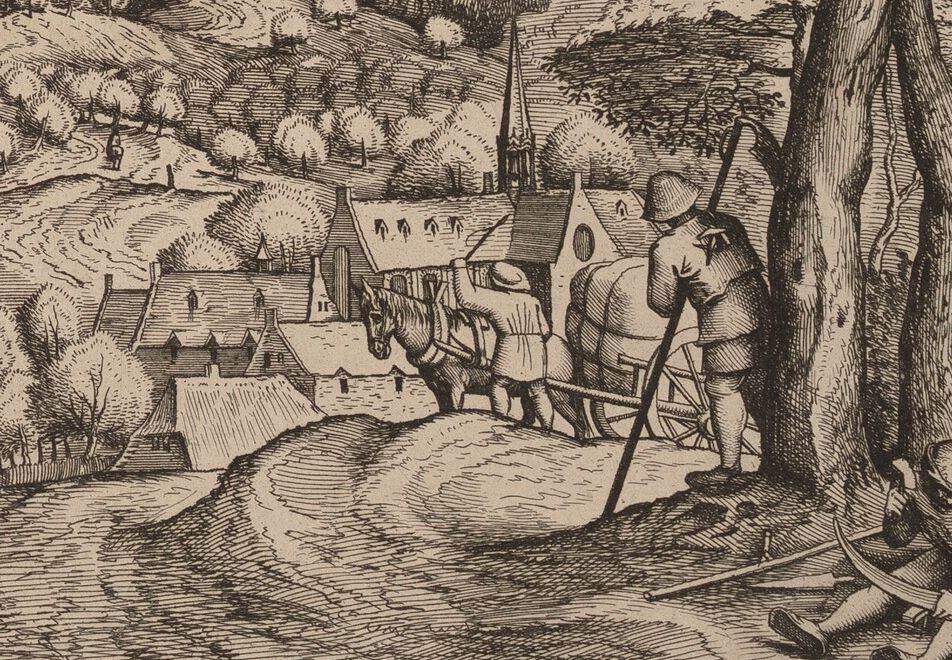
Follow the road left and down from the tree towards the roofs. A wagon stands near the buildings, which partly disappear behind the rise. The road appears wider close to the workers and narrows as it runs into the settlement. A steeple marks the cluster, directing the eye briefly upwards again before the view opens over the water. A viewer can begin with the worker’s immediate surroundings and reach inhabited country some distance away without a single sharp break between the two.
Annotated Details from Rustic Solicitude
Begin with the figures below the tree and follow the water towards the distant peaks.
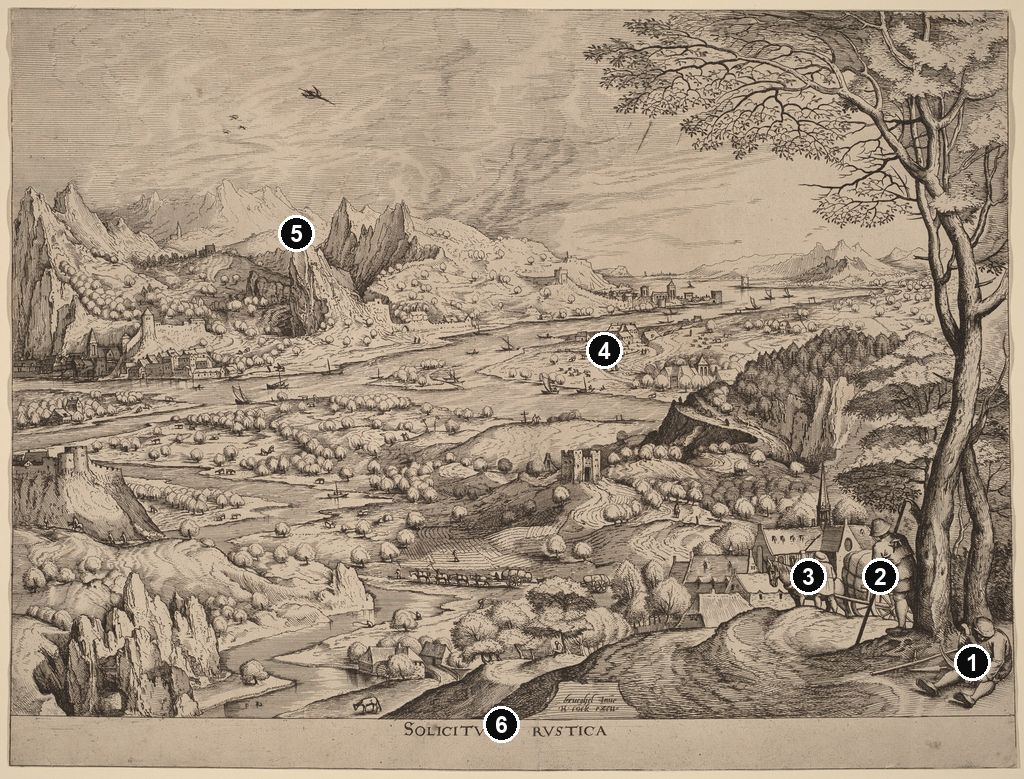
Details from RUSTIC SOLICITUDE
Six details show the rural work, the changing scale of the landscape and the title.
The seated worker
The man works on the blade of a scythe beneath the tree.
The standing figure
The second man looks out over the valley.
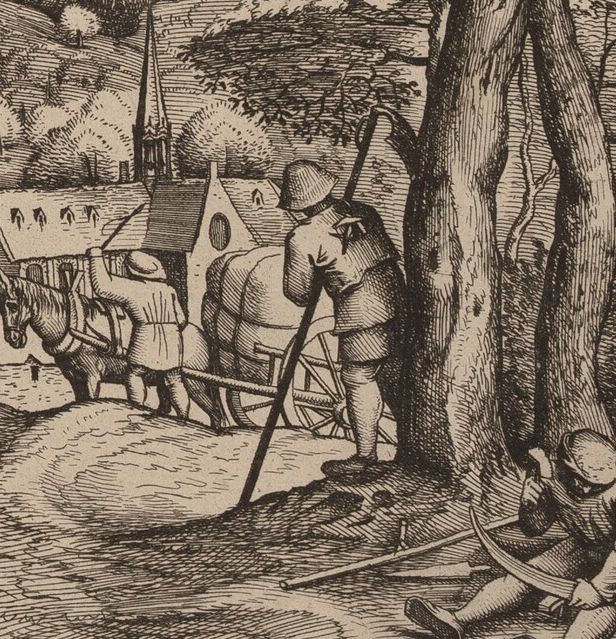
The road and wagon
A wagon and steep roofs mark the nearer part of the settlement.
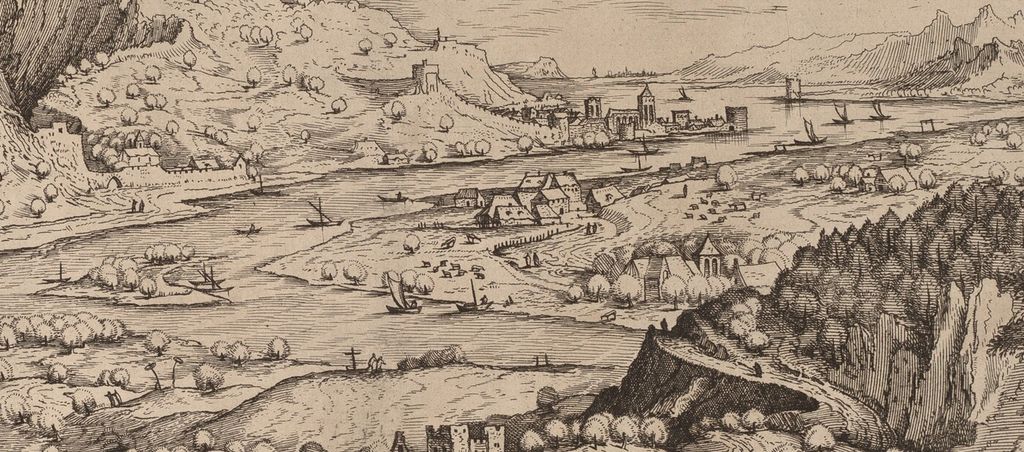
The river and sails
Small sails appear against the light surface of the broad river.
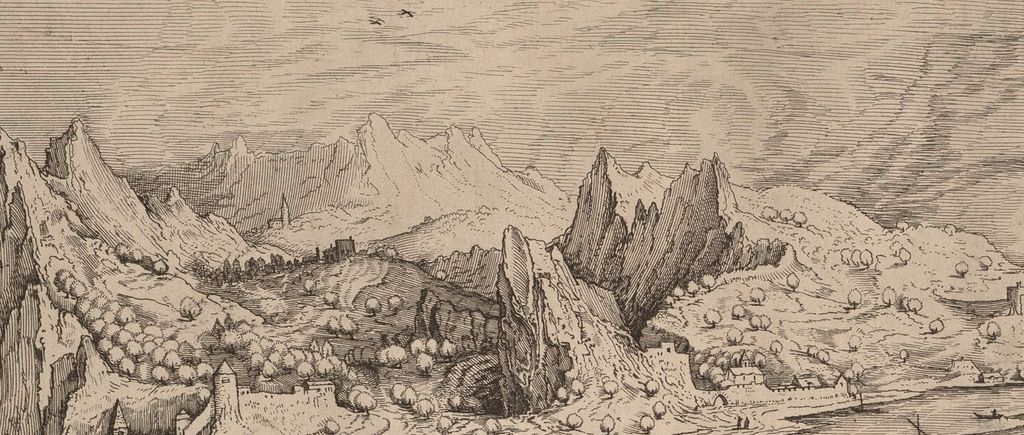
The mountain peaks
Jagged peaks rise beyond the scattered trees and low banks.
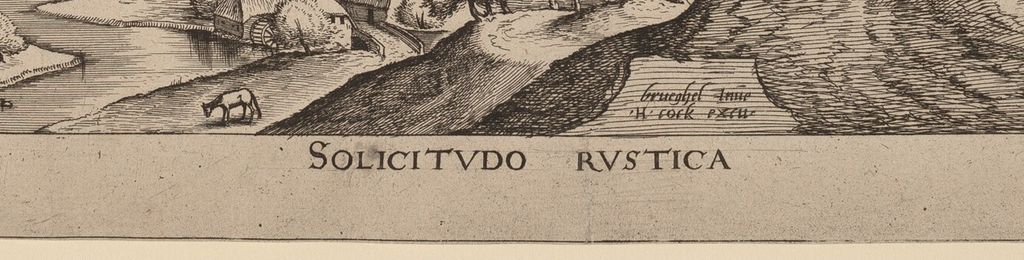
The credits and title
The Latin title is below the picture, with the credits just above it.
Johannes and Lucas van Doetecum, after Pieter Bruegel the Elder, Rustic Solicitude. Published by Hieronymus Cock. Rosenwald Collection, National Gallery of Art, 1964.8.415. Public domain.
Looking across the Valley
At the lower left, rocks provide a second foreground edge. Their steep faces partly conceal a curve of water. The bending channel exposes a new strip of ground each time it changes direction, and shorter marks along those strips suggest more trees and buildings. Farther away the river widens, and small sails become visible against a relatively clear surface. These different scales of water help connect the nearby rocks with the long, pale opening towards the horizon.
Near the centre, rows of cultivation follow the contours of gently sloping ground. Rounded crowns punctuate the field edges, and towers rise from a darker patch among them. Across the valley, sharp peaks stand over low banks and settlements. Cleveland’s museum describes the landscape as a composite of Alpine crags and country reminiscent of the Low Countries. The print makes those forms work together through the path of the river. Its banks accommodate both the relatively flat stretches and the more abrupt rock formations [2].
Orenstein emphasises how little of the composition has been reserved for the immediate foreground. The contrast becomes evident if you cover the right edge. Without the trunk and the pair of men, the distant view seems to have fewer clues to the height from which it is seen. Uncovering that corner brings the nearest ground forward and gives the river and mountains more depth. The standing man follows that depth with his gaze, while the seated man remains absorbed in an action close to the ground [7].
The birds at the upper left offer a small clue to the reach of the sky. One has wings clear enough to make out, while the others are almost lost among the strokes. Look down from the birds to the mountain ridge and the intervening paper becomes as important to the sense of distance as the ridges themselves.
The Printed Title and the Related Drawing
The Latin title is legible below the picture, with credits for Bruegel and Cock printed above it inside the image. Tokyo and the Met use Rustic Solicitude, while the National Gallery of Art uses Rustic Concerns. The Albertina raises the possibility that the intended title was Solitudo Rustica, meaning rustic solitude, even though the impression reads Solicitudo. The visible spelling is the basis of the title used here. The figure at his scythe supplies a concrete rural care, while the broad valley occupied by small, scattered figures makes the alternative reading understandable [1] [3] [4] [5] [7].
A related drawing in London has the landscape in reverse and leaves out the prominent foreground figures. It was once thought to be Bruegel’s design for the print, and its omissions prompted the suggestion that the engravers added the men themselves. The 2001 catalogue assigns the sheet to the Master of the Mountain Landscapes and discusses its possible relationship to a lost design. Orenstein sees the figures on the print as characteristic of Bruegel. The question of who drew the surviving sheet and the question of who devised the figures in the print therefore need separate evidence [7].
Comparison with Rustic Market
The legacy image shows the same plate, including the foreground tree and the two title words. Its individual impression remains unidentified. The Washington sheet used here gives readers a documented image of the lower strip and the credits. The National Gallery of Art records the paper as trimmed to the plate. The inscription lies well inside the retained edges, with the long reach of sky above it and enough of the margin below it to see the title as a separate part of the print [1].
In Rustic Market, shown below, a group of trunks at the left screens houses and roads, and the loaded animals draw the eye along one of the nearer paths. In Rustic Solicitude, the large tree is at the right and nearly all of the country between it and the mountains stays open to view. The actions of the men have their closest counterpart in the other print’s small incidents of rural work and travel. Comparing the foregrounds makes it easier to see how much room each composition grants to the people suggested by its title [6] [7].
Discussion
Which detail in this work most changes how you read it?
Frequently Asked Questions
Start at the lower right, where the seated man bends over his work. Orenstein identifies the action as hammering the blade of a scythe. [7]
Near the centre, rows of cultivation follow the contours of gently sloping ground. Rounded crowns punctuate the field edges, and towers rise from a darker patch among them. [2]
References
- National Gallery of Art, Solicitudo Rustica, 1964.8.415, View source.
- Cleveland Museum of Art, Solicitudo Rustica, 1980.104, View source.
- National Museum of Western Art, Rustic Solicitude, G.2010-0008, View source.
- Metropolitan Museum of Art, Rustic Solicitude, View source.
- Albertina, Solicitudo Rustica, View source.
- National Gallery of Art, Rustic Market, 1941.1.149, View source.
- Nadine M. Orenstein, ed., Pieter Bruegel the Elder, Drawings and Prints, 2001, cat. nos. 28, 34 and 125, View source.







