


 by Tom Gurney
Tom Gurney BSc (Hons) is an art history expert with over 20 years experience
Published on June 19, 2020 / Updated on October 14, 2023
Email: tomgurney1@gmail.com / Phone: +44 7429 011000
Soldiers at Rest: Introduction
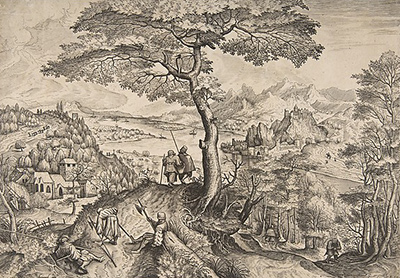
Soldiers at Rest, or Milites Requiescentes, is an etching with engraving from the Large Landscapes. Johannes and Lucas van Doetecum made it after Pieter Bruegel the Elder, and Hieronymus Cock published it around the middle of the 1550s. The title points to men resting on a slope beneath a spreading tree. Nearby figures are still on the move. Beyond them, the view opens onto a river valley, settlements and mountains. The print places several kinds of movement around the resting group, giving the title an unusually active setting [1] [2] [3].
This work across Bruegel’s career
Tower of Babel
1563The Harvesters
1565Peasant Wedding
1568Children's Games
1560Triumph of Death
1562–1563Soldiers at Rest
This artworkContents
- Introduction
- The Figures on the Slope
- A Tree Between Two Routes
- From the Near Bank to the Mountains
- The Plate and Its Impressions
- The Soldiers in a Different Medium
- Annotated Details
The Figures on the Slope
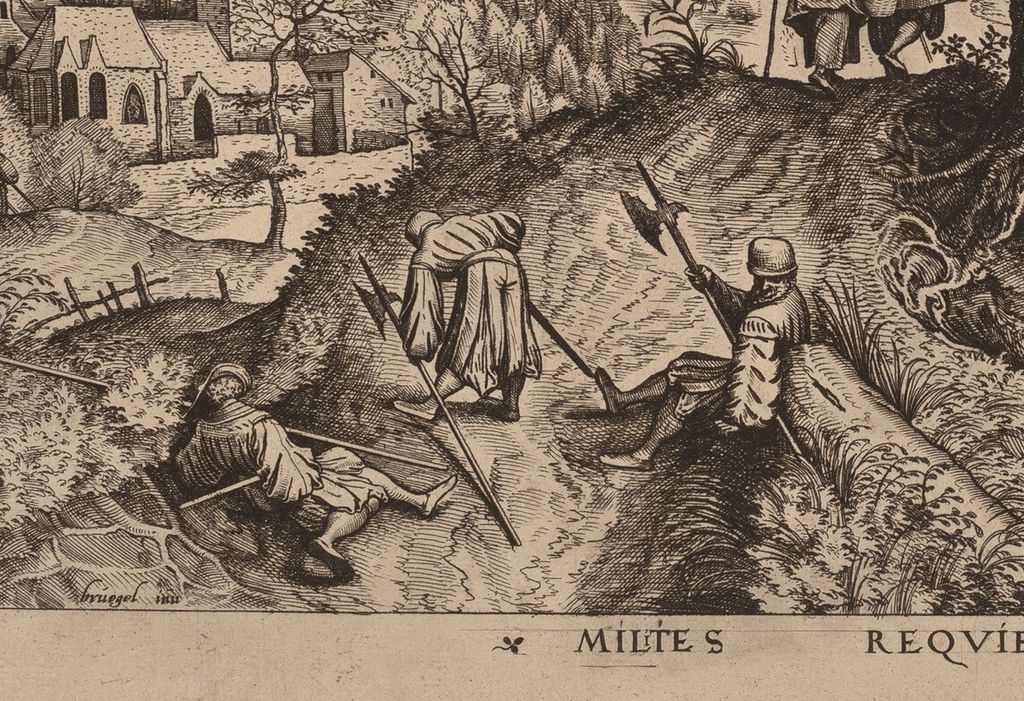
Begin near the lower left, where one man sits low against the bank. His body follows the direction of the slope. Farther up, another bends forward, showing a broad expanse of clothing above his legs. The exhibition catalogue leaves it open whether this man is rising or about to sit. At the right of the group a seated figure holds a long weapon up from the ground. Its diagonal is visible even at a distance. Taken together, the positions describe a pause in travel during which each person is doing something slightly different [3].
The slope itself gives the group a shape. Look where the grass is drawn in small upright strokes along the edge, then see how the pale open ground carries the bent figure towards the man above him. The seated men occupy places where the bank can support them. The long shafts extend across the bare patches and help a viewer distinguish the figures from the foliage. Bruegel could make a few people comparatively substantial while leaving much of the hillside exposed around them.
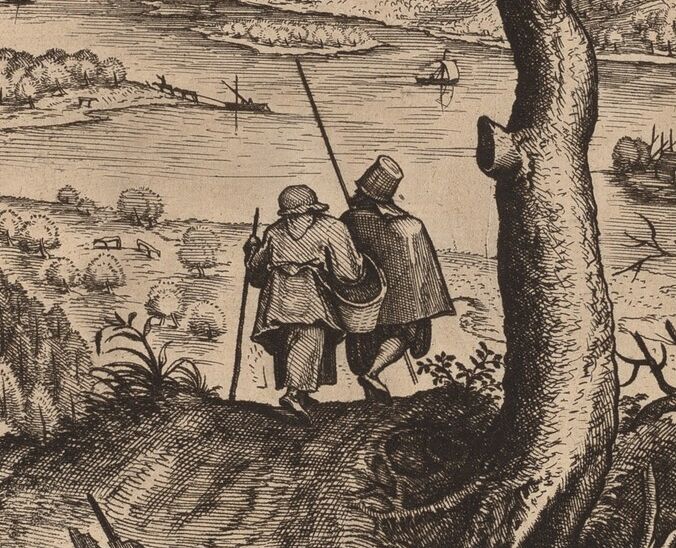
Two people have reached the crest just left of the big trunk. The pair stand upright against the lighter country behind them, and one carries a long staff. Its tilt resembles the angles of the weapons lower down. Orenstein distinguishes this pair of travellers from the soldiers. The similarity of the slanting lines helps connect the groups without making their activity the same. The resting men occupy the foreground and the two travellers help carry the eye out beyond them [3].
Annotated Details from Soldiers at Rest
Find the resting figures, then follow the routes over the crest and down through the trees.
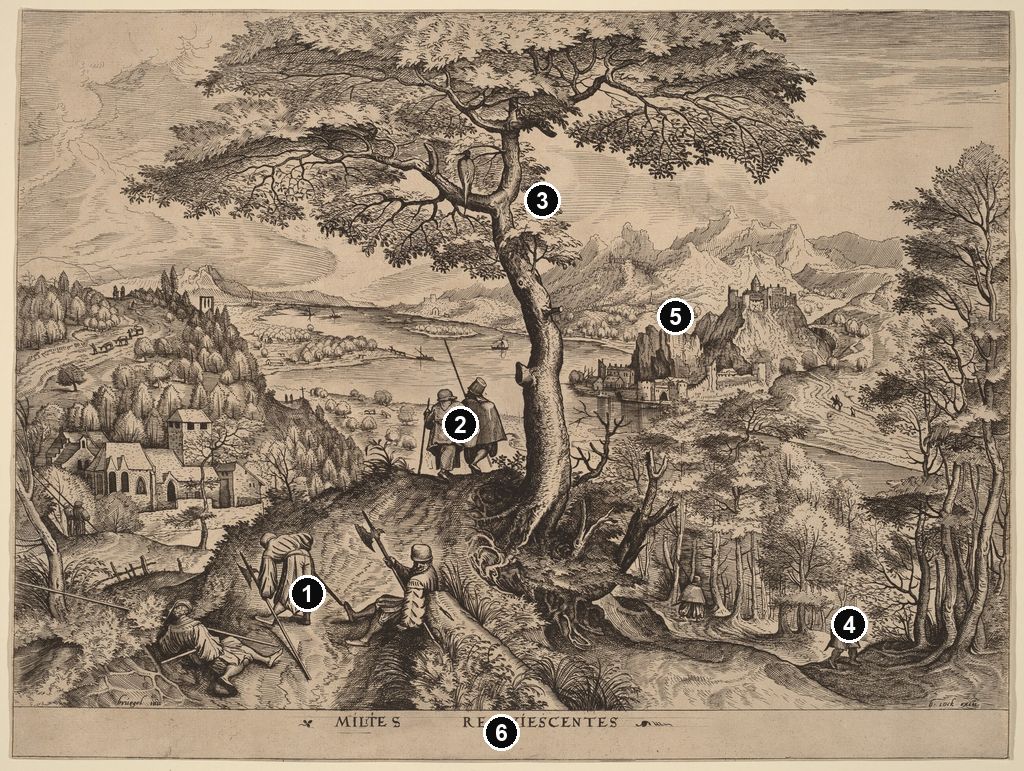
Details from SOLDIERS AT REST
Six details trace the figures and the distances around them.
The resting soldiers
The three figures occupy different heights on the slope, with their long weapons crossing the lighter ground.
The travellers at the crest
A long staff tilts above the pair, repeating the slant of the soldiers’ equipment below.
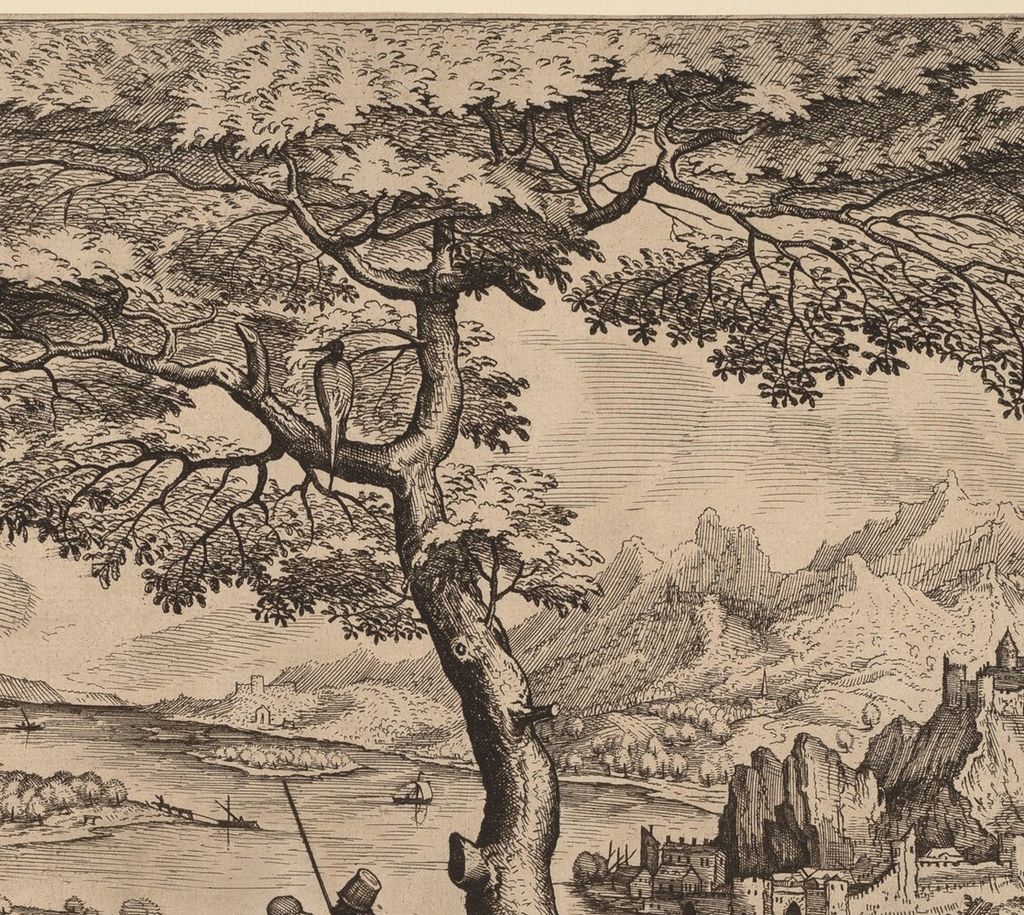
The spreading tree
The trunk bends and divides into branches that frame the distant country.
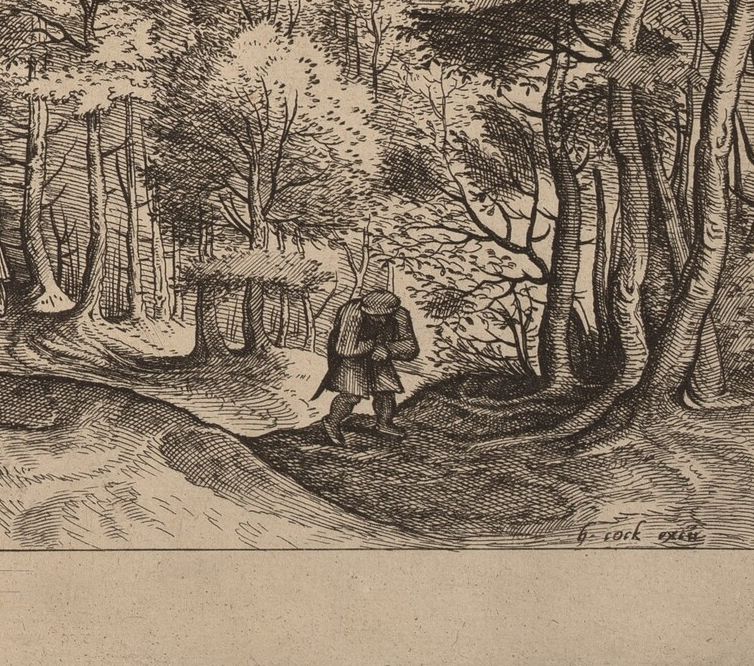
The descending path
The cloaked figure is partly enclosed by the smaller trees near the lower edge.
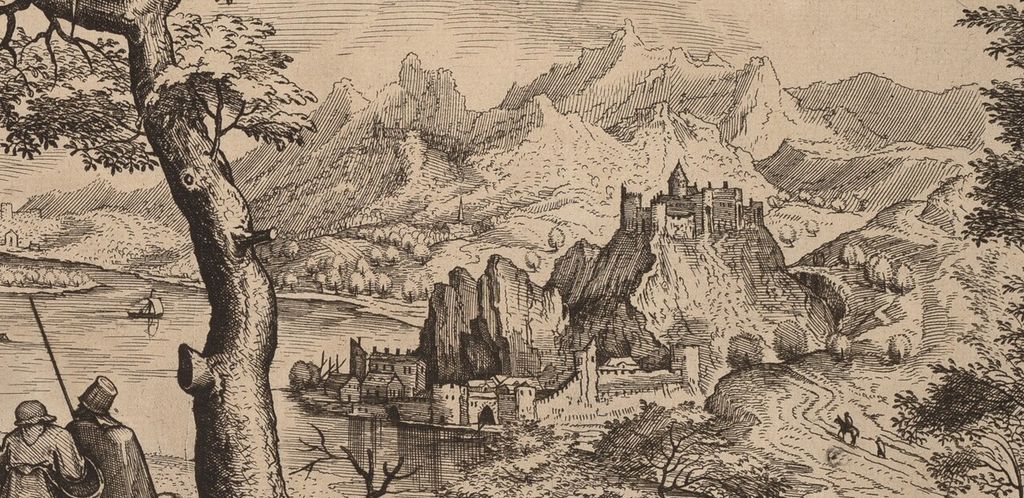
The valley and mountains
Settlements sit at different levels among the cliffs, while the lighter river passes towards the mountains.
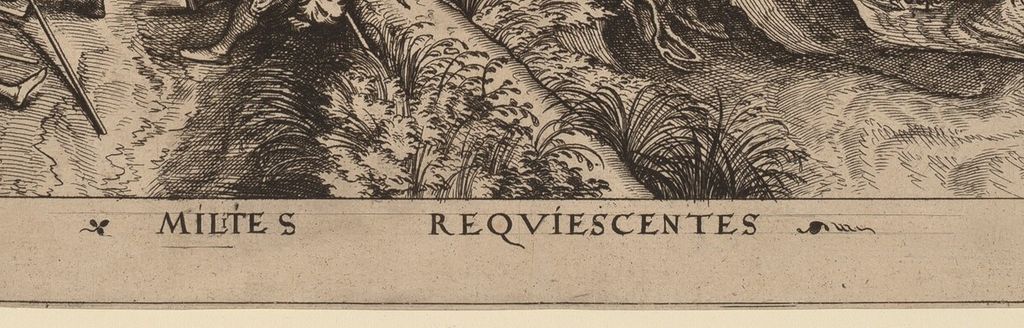
The Latin title
The inscription beneath the scene identifies the soldiers as resting.
Johannes and Lucas van Doetecum, after Pieter Bruegel the Elder, Milites Requiescentes. Published by Hieronymus Cock. Rosenwald Collection, National Gallery of Art, 1943.3.2122. Public domain.
A Tree Between Two Routes
The trunk stands a little right of centre. It rises from exposed roots near the edge of the path, curves, then divides into branches that extend well beyond the people below. Where the silhouette overlaps the sky, it is possible to follow the forks in individual branches. Nearer the centre, leaves overlap and make a much denser surface. The canopy is broad enough to frame both the lighter valley and part of the mountain range beyond it. Its position sets the distance of the scene without closing off the view.
At the right, the descent takes a different course. The ground drops towards smaller trees and a figure in a cloak near the lower edge. Orenstein identifies this figure as another soldier and notes other soldiers walking at the left. These figures show that the title applies most directly to the group in front. Elsewhere the print gives the viewer glimpses of people moving around the slope, some so small that their location matters almost as much as their pose [3].
Try following the routes from opposite directions. On the hilltop, the pale space behind the standing travellers helps separate their bodies from the bank. On the right, the descending path is hemmed in by branches. The eye has to pick up successive gaps before finding the walker. The different amounts of open space give briskness to one part of the view and slow the passage through another. The tree holds both routes together.
From the Near Bank to the Mountains
Beyond the soldiers, the river passes through the centre of the lower country. Buildings appear among trees at the left and at the foot of the rough cliffs on the right. A fortified site occupies higher ground farther back. From the soldiers’ bank, the built areas appear at different heights and in groups of very different scale. They make the distance between the resting men and the mountain horizon measurable in stages. The river’s lighter surface helps link some of those stages [2] [3].
The printmakers changed the spacing and direction of the lines to distinguish each part of the view. The bark of the large tree gathers dark strokes close together. Across the open country, short and much lighter marks indicate distant objects and the lay of the land. High ridges need relatively little dark work to stand against the sky. The near ground and the far mountains therefore remain readable even when masses of foliage overlap them. This also leaves room for upright silhouettes such as the travellers to hold their place between foreground and distance.
The Plate and Its Impressions
The Washington impression, NGA 1943.3.2122, comes from the Rosenwald Collection. The margins show the Latin title and credit Cock as publisher. Orenstein’s catalogue illustrates a Boston impression and records Bruegel’s role as inventor of the design from the inscription. The plate combines etching and engraving. These records preserve the distinction between the person who devised the scene, the printmakers who worked on the plate and the publisher who issued the printed sheets [1] [3].
The usual dating places the design around 1555–56. Orenstein discusses suggestions that this was among the later designs in the series. The catalogue points to the central overlook and abrupt drop in the path, as well as the weight and variety of the poses. It also notes that the spelling of Bruegel’s name in the margin cannot establish a date on its own. The design can be studied in relation to the series without assigning it an exact year on the evidence of a name [3].
The Soldiers in a Different Medium
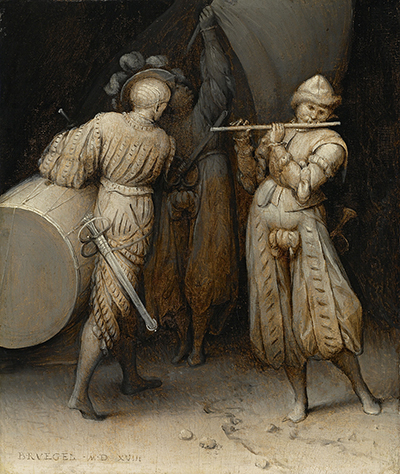
The painting The Three Soldiers, shown below for comparison, gives soldiers almost the whole surface. Bruegel signed and dated that small oil panel in 1568. Its drummer, fifer and standard-bearer are seen close enough for the shapes of clothes and instruments to take over from the setting. In the print, the men are substantial for their place in a landscape, and the eye keeps finding things beyond them. The comparison brings out a choice about scale that is easy to overlook in a reproduction. The print lets the viewer spend time with the resting group or pass it by on the way into the valley [4] [2] [3].
Return to the nearest man before leaving the print. His stretched legs take up more room than the distant roofs, and the ground around him is tilted so that the viewer can see past him. Over the ridge, the people walking away begin to be measured against the space they are entering. The tree divides the routes without cutting either one off. That arrangement makes the halt feel temporary, part of a journey through a country that continues beyond the hill.
Discussion
Which detail in this work most changes how you read it?
Frequently Asked Questions
Begin near the lower left, where one man sits low against the bank. His body follows the direction of the slope. [3]
At the right, the descent takes a different course. The ground drops towards smaller trees and a figure in a cloak near the lower edge. [3]
References
- National Gallery of Art, Milites Requiescentes (Soldiers at Rest), 1943.3.2122, View source.
- The Metropolitan Museum of Art, Soldiers at Rest, from The Large Landscapes, View source.
- Nadine M. Orenstein, ed., Pieter Bruegel the Elder, Drawings and Prints, 2001, no. 31, View source.
- The Frick Collection, The Three Soldiers, 1965.1.163, View source.







