


 by Tom Gurney
Tom Gurney BSc (Hons) is an art history expert with over 20 years experience
Published on June 19, 2020 / Updated on October 14, 2023
Email: tomgurney1@gmail.com / Phone: +44 7429 011000
Southern Cloister in a Valley: Introduction
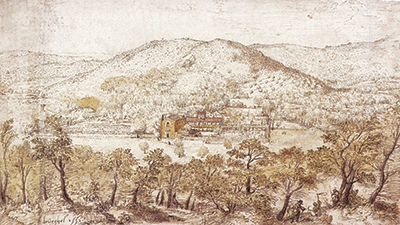
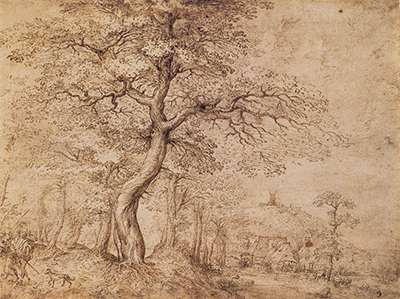
Pieter Bruegel the Elder dated Southern Cloister in a Valley to 1552. Trees rise across the lower part of the drawing, above a group of hunters barely visible near the right edge. Beyond them, a religious complex stands in open ground below a rounded hill. The Berlin Kupferstichkabinett keeps the sheet under inventory number KdZ 5537. It catalogues Bruegel’s work in brown pen on laid paper and identifies both the light watercolour and the further grey brushwork as additions by a later hand. The drawing preserves an early landscape by Bruegel and shows how another person subsequently changed the way its light and distance are perceived [1] [2].
This work across Bruegel’s career
Tower of Babel
1563The Harvesters
1565Peasant Wedding
1568Children's Games
1560Triumph of Death
1562–1563Southern Cloister in a Valley
This artworkContents
- Introduction
- Across the Foreground Trees
- The Cloister and the Hill
- Ink, Wash and the Date
- Comparison with Bruegel’s Other Landscapes
- Annotated Details
Across the Foreground Trees
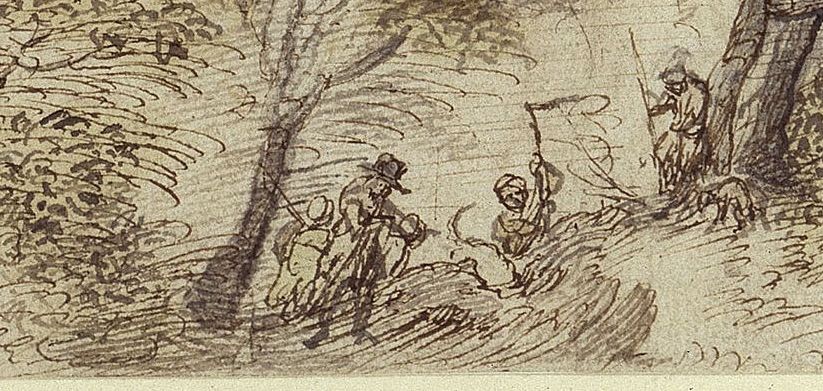
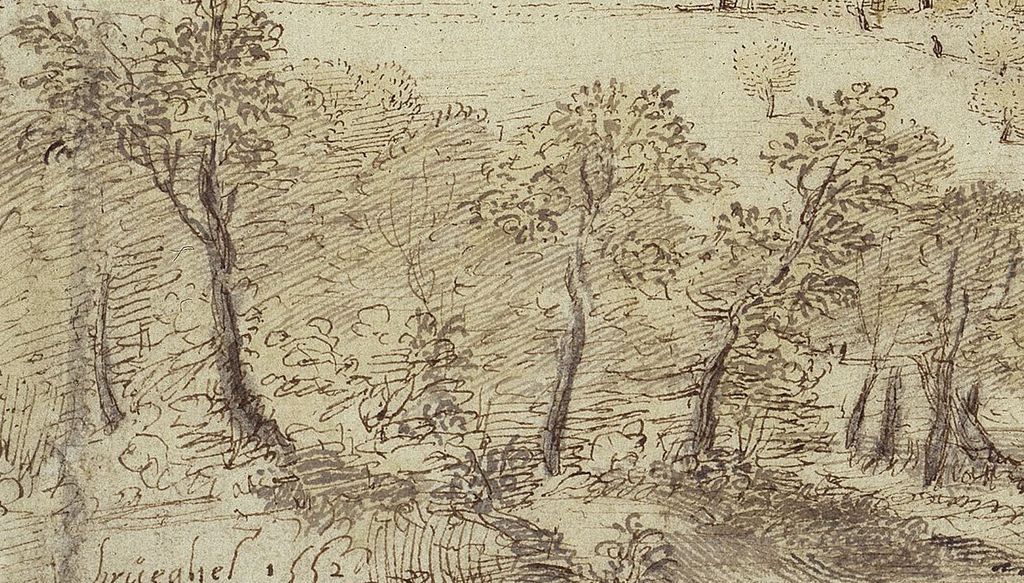
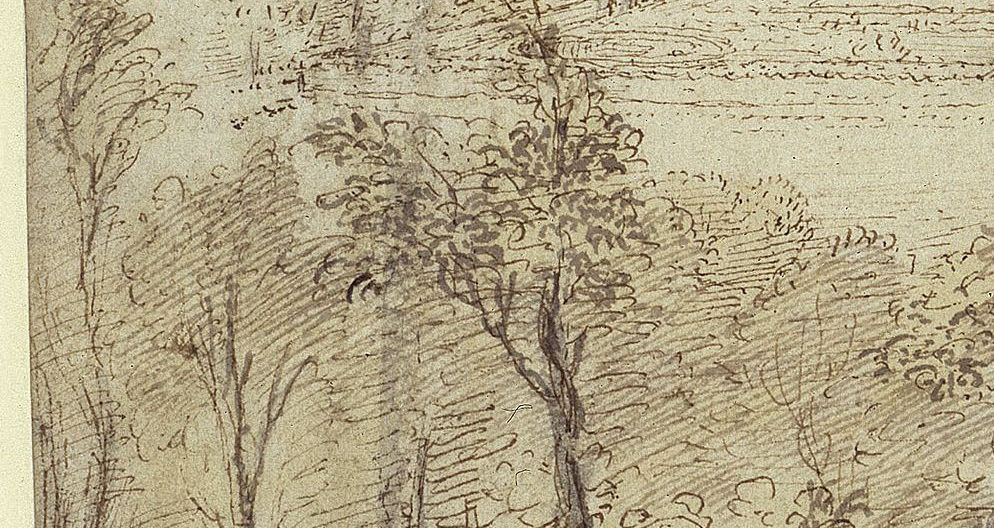
Begin at the bottom right, where the hunters stand on ground marked by sloping strokes. The rise is low on the sheet, though the people and dogs are still small beside the adjacent trunks. A tree leaning over the group provides a way up into the drawing. Its branches spread into a screen of foliage that lasts, with intervals of open paper, almost the whole width of the foreground. The trees at the left lean at different angles and are set at visibly different depths. The foreground acts like an uneven bank through which, and then over which, you look [2].
The hunt can be missed on an initial view. A closer look picks out the upright shapes among the strokes of the slope. Once located, the group makes the surrounding foliage appear taller and helps establish the height of the viewpoint above the open valley. The figures have no architectural setting of their own, and the cloister has no comparably legible group outside its doors. Bruegel distributes the human presence between two very different pieces of evidence, moving figures close to the viewer and a large building set well beyond them.
The drawing crosses that interval quickly. There is little in the way of a road to follow continuously from the bottom edge towards the building. Instead, the foliage makes the eye leap across the opening, as Nadine Orenstein observes. The foreground can be inspected tree by tree, but the far slope reads first as a single shape and only then breaks into its small marks. That sequence is one of the rewards of looking at the drawing first at page size and then enlarging it. The same areas offer different amounts of information at each scale [2].
Annotated Details from Southern Cloister in a Valley
Follow the bank of trees from the hunting party to the opening below the cloister.
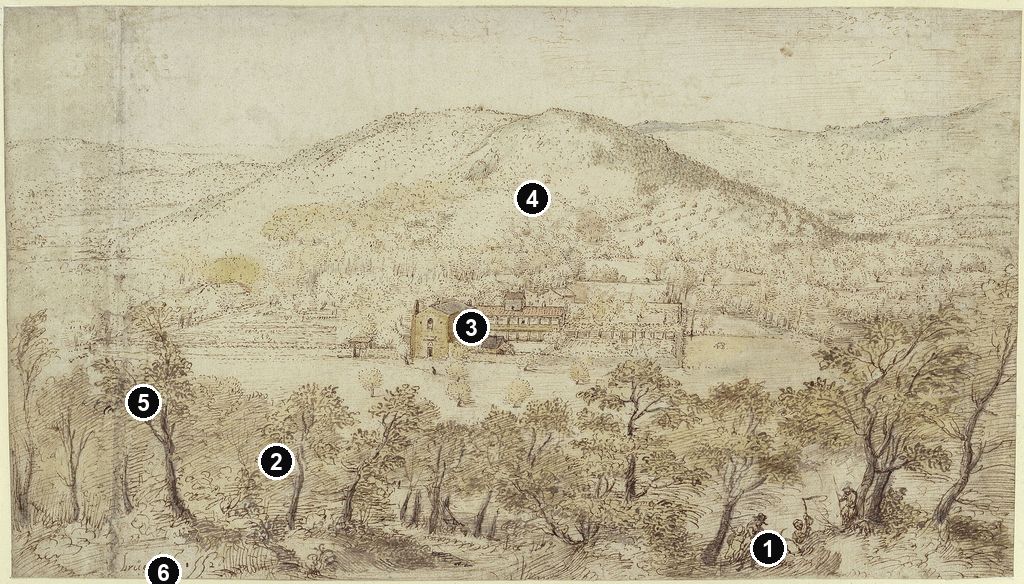
Details from SOUTHERN CLOISTER IN A VALLEY
Six details show how the pen drawing, later washes and inscription share the sheet.
The hunting party
The figures are tucked into the foreground slope beside the trees.
The bank of trees
Intermittent gaps between trunks open onto the valley.
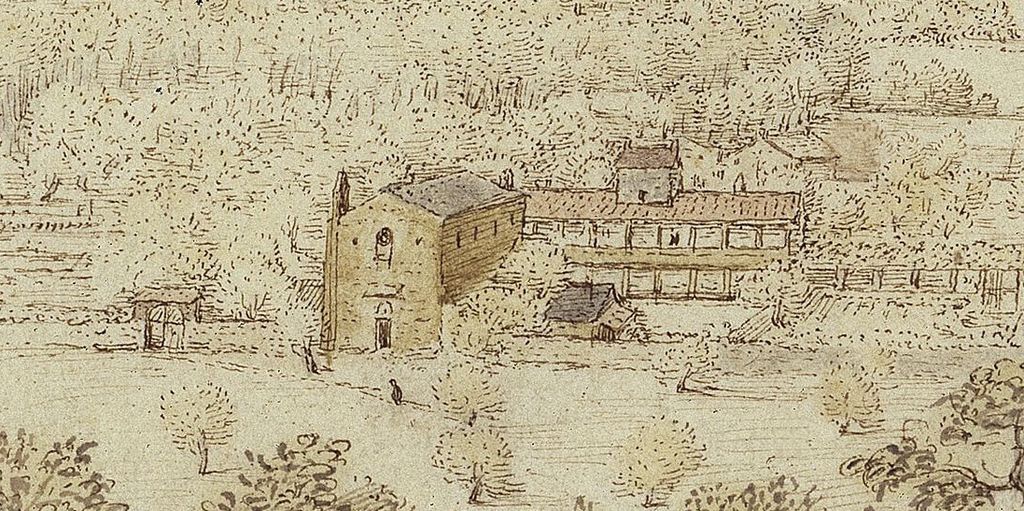
The church and adjacent buildings
Walls and rooflines interrupt the light open ground around the cloister.
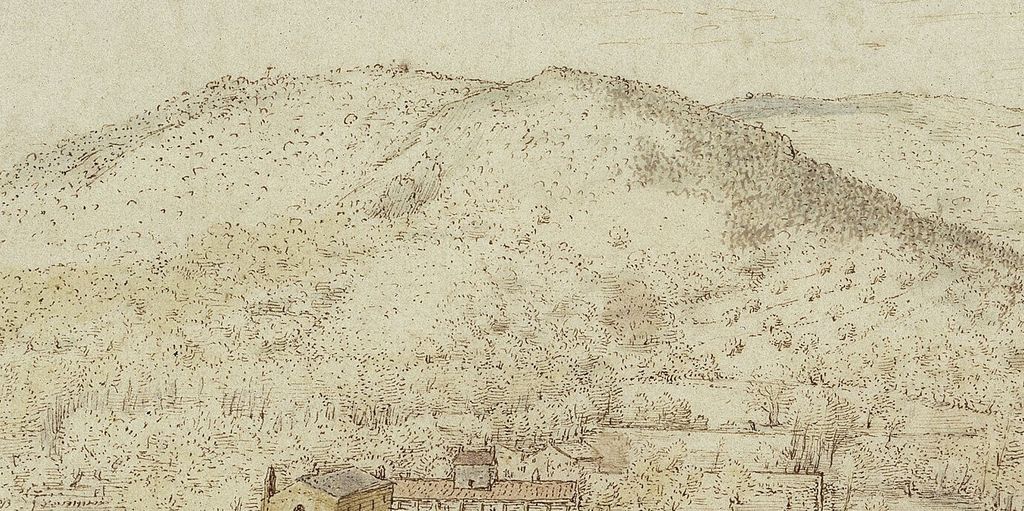
The distant hillside
Small loops and dashes give texture to the long rise.
Ink and wash
Broad areas of tone cross the more sharply defined strokes of the pen.
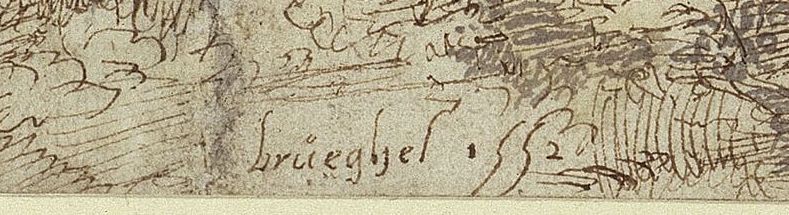
The name and date
The inscription sits in an interval between the foreground strokes.
Pieter Bruegel the Elder, Southern Cloister in a Valley, Kupferstichkabinett, Staatliche Museen zu Berlin, KdZ 5537. Photograph by Jörg P. Anders. Public domain.
The Cloister and the Hill
The cluster of buildings sits just left of centre. Its squat church fronts the clearing and a row of lower structures extends beside it. Compare their relatively firm horizontals with the irregular treetops in front. The change in line is enough to let the building hold a position in a large area of fairly pale ground. The roofline also gives a horizontal measure against which to see the rise behind it. The hill is high enough to take up much of the sheet, yet its edges run at a gentler angle than the nearby trunks.
Orenstein described the cloister as Italian in appearance and considered the possibility that Bruegel used French paper in Italy. Katrien Lichtert subsequently compared the church with Romanesque buildings in Provence, including the chapel of Saint Blaise at Les Baux, and argued that the architectural and landscape parallels make southern France plausible. These are readings of the architecture and the circumstances of Bruegel’s journey. The drawing gives enough information to compare the church with buildings in those regions, while neighbouring buildings, ground and trees matter as much to its composition as an exact place name would [2] [3].
The pen strokes on the distant hill are often very short. Marks that might read as loops or dashes at close range become trees once the full hillside is in view. In the foreground the pen has room to describe a trunk, a bend and the way several boughs meet. The scale changes so gradually across the sheet that the distant marks are legible even though they carry very little detail. The drawing makes remoteness visible through the amount of work assigned to each shape [2].
Ink, Wash and the Date
The different materials can be seen most readily at the wooded bank. Some pen lines still cut distinctly through the broad grey passages. Other strokes remain clear in the pale land behind the trees. Orenstein identifies later washes in the foreground, on the nearer foliage, over parts of the hill and at the cloister. Earlier scholars including Tolnay and Münz accepted the washes as Bruegel’s own. Berlin’s current record and the 2001 exhibition catalogue distinguish the original pen drawing from the later additions [1] [2].
At the lower left, within a small open area, Bruegel’s name appears with the date. It helps establish the drawing’s place among his earliest surviving landscapes. The catalogue also notes a watermark formed by the letters ‘dg’. Watermark evidence concerns the manufacture of the paper. Ownership concerns a later part of its history. The museum records that the sheet entered its collection in 1902 with that of Adolf von Beckerath. The dated inscription, the paper evidence and the acquisition record therefore answer three different questions about the same object [1] [2].
The signature also gives a reason to look closely at the bottom margin. Here Bruegel allows a gap in the angled ground strokes and gives the writing enough space to be read. Orenstein suggested that the thought given to the signature and its placement makes sense for a finished drawing, even if some passages record direct observation outdoors. A drawing can retain the pace of a quick pen study and still be prepared for another viewer to see [2].
Comparison with Bruegel’s Other Landscapes
Bruegel gives the foreground a more directional role in Wooded Landscape with Mills, which the same catalogue also dates to 1552. There, a marked corner of land leads into a distant valley opening towards the opposite side. In the Berlin cloister sheet the bank extends across the view and the light ground behind it becomes visible in several places at once. The two works show how much the angle and continuity of a strip of trees can change the way a reader enters a landscape [2].
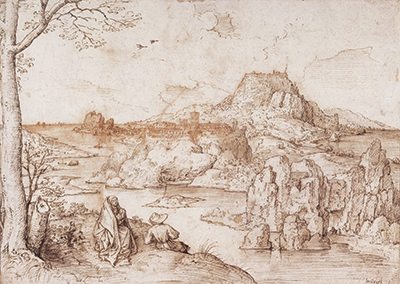
Bruegel returned to the motif of a religious building far from a wooded foreground in Rest on the Flight into Egypt, another drawing in Berlin. There the people in front are the family named in the title, and an open body of water separates them from an isolated building. In the 1552 sheet the hunt is tucked into the wooded margin and the complex stands on open land. The difference is easy to see by tracing the clear ground around each building and following it back towards the nearest tree [2] [4].
Discussion
Which detail in this work most changes how you read it?
Frequently Asked Questions
Begin at the bottom right, where the hunters stand on ground marked by sloping strokes. The rise is low on the sheet, though the people and dogs are still small beside the adjacent trunks. [2]
Orenstein described the cloister as Italian in appearance and considered the possibility that Bruegel used French paper in Italy. Katrien Lichtert subsequently compared the church with Romanesque buildings in Provence, including the chapel of Saint Blaise at Les Baux, and argued that the architectural and landscape parallels make southern France plausible. [2][3]
References
- Staatliche Museen zu Berlin, Südliche Hügellandschaft mit Klosteranlage, KdZ 5537, View source.
- Nadine M. Orenstein, ed., Pieter Bruegel the Elder, Drawings and Prints, 2001, cat. nos. 1, 2 and 20, View source.
- Katrien Lichtert, New Perspectives on Pieter Bruegel the Elder’s Journey to Italy, Oud Holland 128(1), 2015, pp. 39–54, View source.
- Staatliche Museen zu Berlin, Ruhe auf der Flucht nach Ägypten, KdZ 5730, View source.







