


 by Tom Gurney
Tom Gurney BSc (Hons) is an art history expert with over 20 years experience
Published on June 19, 2020 / Updated on October 14, 2023
Email: tomgurney1@gmail.com / Phone: +44 7429 011000
Wooded Landscape with Mills: Introduction
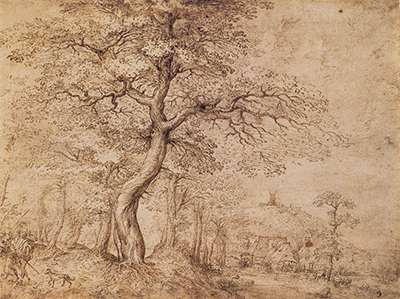
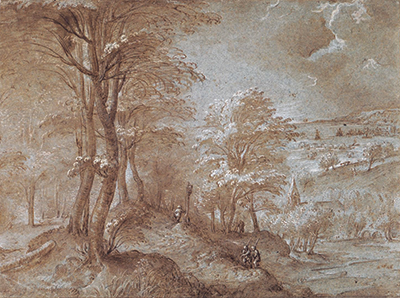
Pieter Bruegel the Elder drew Wooded Landscape with Mills in pen and brown ink in 1552. The sheet measures 21.3 by 28.1 centimetres and is kept at the Biblioteca Ambrosiana in Milan, under the shelfmark F. 245, INF. N. 9. The mills are small enough to miss on a first look. A winding trunk occupies the middle of the foreground, its branches reaching into the open paper above the buildings. The windmill and watermill appear on the right, where Bruegel makes just enough room between the trees for a glimpse of working countryside [1].
This work across Bruegel’s career
Tower of Babel
1563The Harvesters
1565Peasant Wedding
1568Children's Games
1560Triumph of Death
1562–1563Wooded Landscape with Mills
This artworkContents
- Introduction
- The Tree and the Path
- A Windmill, a Watermill and the River
- A Venetian Model and a Netherlandish Setting
- Reading the Signature and the View
- Annotated Details
The Tree and the Path
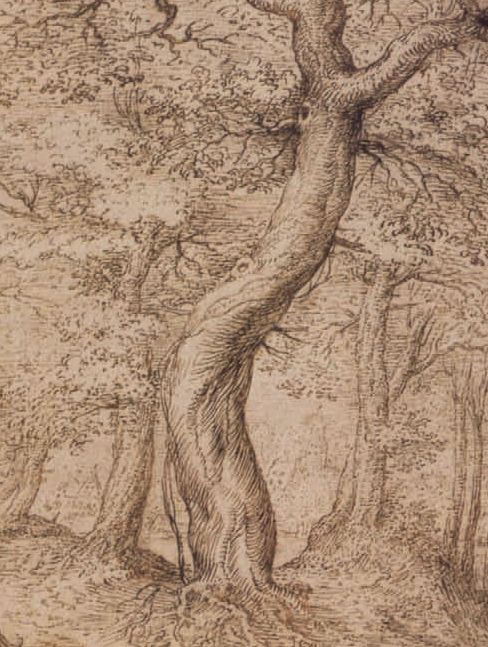
Start where the great tree comes out of the foreground bank. The trunk curves one way near the ground and then changes direction as it rises. At its broadest point, many short lines follow the turn of the wood. Near the branches, the same marks tighten into dark patches where one part of the tree meets another. The result is a trunk that seems to turn in space as well as bend across the paper. Bruegel carries that movement into the much thinner branches, especially the long one that reaches above the right-hand opening [1].
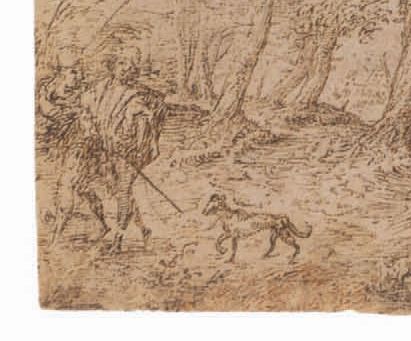
Below the tree at the left, two men walk with a dog on a lead. The group is set among loose marks in the grass and along the path. Look for the animal first, then follow the lead back towards the figures. Its body is easier to separate from the ground than the men are from the wooded edge. The figures give the viewer a measure for the trunk. Their walk also suggests that the space behind the great tree can be traversed, even where it is difficult to find a clear opening between the smaller stems [1].
Those smaller trees matter because they give the large one company and put a distance between it and the mills. Several thin trunks gather to the right of its base. They stop short of the broad upper branches and make a narrow screen near the edge of the clearing. The branches overhead and the stems below therefore help direct the view in different ways. One draws the eye upward through the canopy, while the other brings it back towards the ground near the water.
Annotated Details from Wooded Landscape with Mills
Follow the curve of the large trunk, then find the two mills at different heights beyond it.
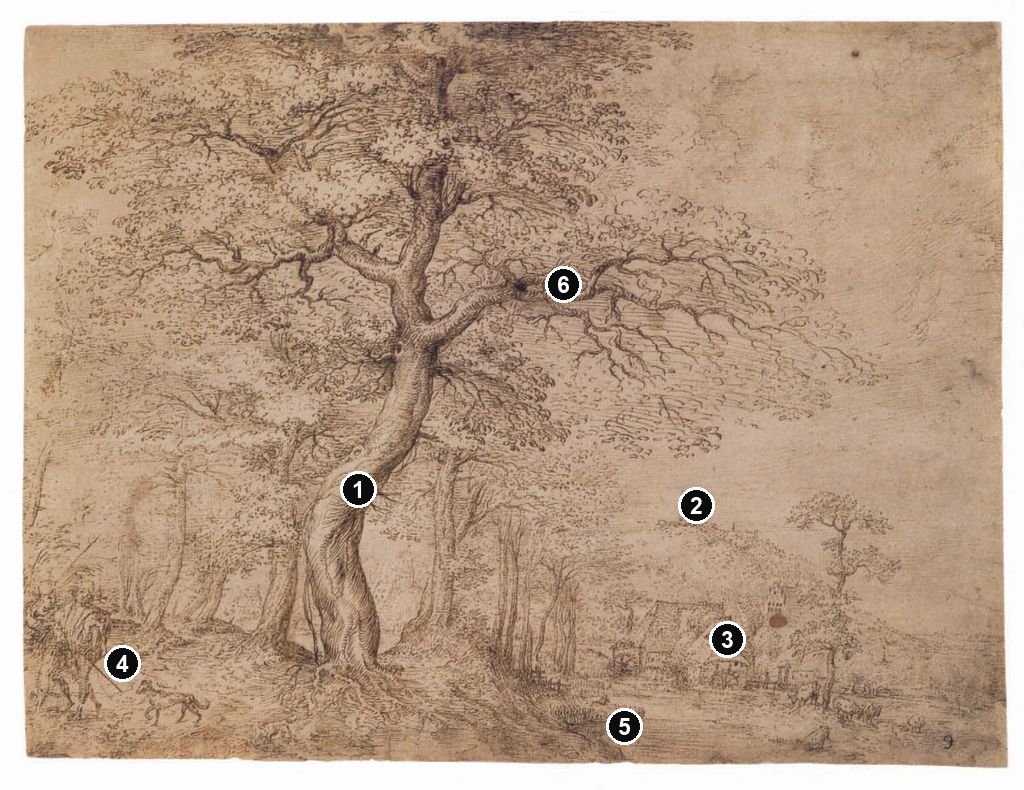
Details from WOODED LANDSCAPE WITH MILLS
Six details trace the route from the woodland path to the buildings and river.
The twisting trunk
Curved pen strokes follow the turning wood and gather into dark patches at its bends.
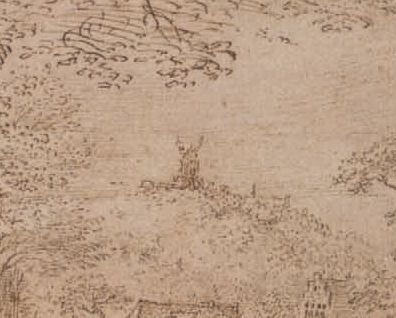
The hilltop windmill
The tiny sails stand against open paper at the top of the ridge.
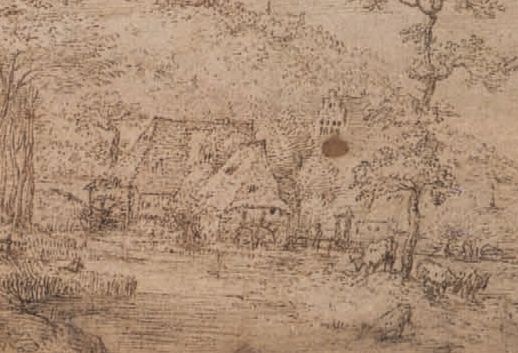
The watermill buildings
Gabled roofs sit below the hill among the banks and pasture beside the river.
The walkers and dog
Two people and a dog on a lead pass along the edge of the woods.
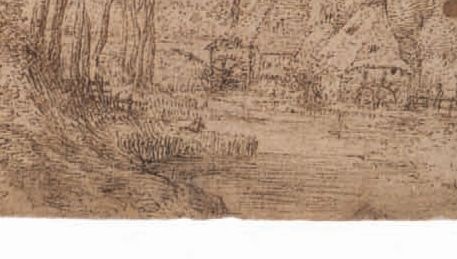
The river
Fine horizontal strokes in the lower right pass beneath darker marks for the edge of the bank.
The spread of the canopy
Loosely drawn leaves run along the branch that reaches over the opening in the woods.
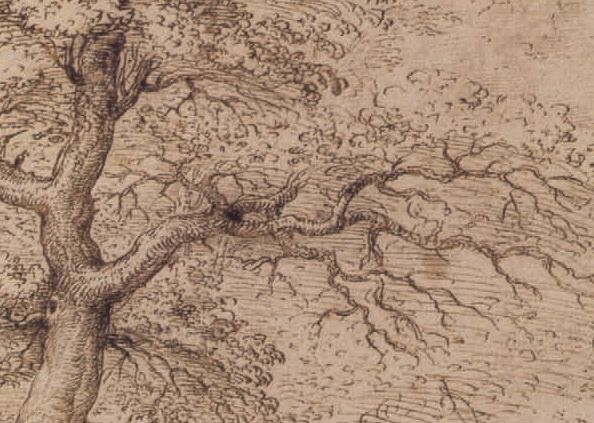
Pieter Bruegel the Elder, Wooded Landscape with Mills, 1552, pen and brown ink. Biblioteca Ambrosiana, Milan, F. 245, INF. N. 9. Reproduction from the Metropolitan Museum exhibition catalogue, no. 2.
A Windmill, a Watermill and the River
The windmill stands on the ridge at the right. Its sails are a few dark strokes silhouetted against the pale paper. Look below it for a group of buildings near the water. The gabled roof is one of the strongest shapes in that part of the sheet and helps to locate the watermill. Bruegel places the two mills at different heights. The upper one needs a clear outline against the open air. The lower one belongs among roofs, banks and the horizontal strokes that carry the river through the foreground [1].
The catalogue also identifies grazing cows near the watermill. Their presence brings the lower right down to the scale of work and pasture, just as the dog and walkers bring the forest path to a human scale. There is some bare space around the high mill, but very little around the lower buildings. To find the river, follow the fine horizontal marks past the darker grasses near the bank. The space opens across the paper, then closes again against the slope behind the mills [1].
Bruegel uses relatively small changes in the strength and spacing of his strokes to make that progression. The open loops of leaves are especially clear near the canopy. Dots and quick pen marks cover the hill and leave enough of the sheet bare to separate it from the foreground trunk. The hill is close enough to interrupt any view beyond it. The light patch above the buildings thus changes the density of the drawing without promising a long view to the horizon [1].
A Venetian Model and a Netherlandish Setting
The Metropolitan Museum exhibition catalogue relates the great tree to the Italian chiaroscuro woodcut known as Two Goats at the Foot of a Tree, a design associated with Titian and Domenico Campagnola. The tree in Bruegel’s drawing twists in the opposite direction in its lower section, though the shading follows a similar pattern. The catalogue raises the possibility of an intermediate model in reverse. The comparison identifies a form Bruegel could have adapted, while the precise route by which he encountered it remains open [1].
The Fondazione Giorgio Cini discusses the woodcut under the title Tree with Two Goats in its account of Nicolò Boldrini’s chiaroscuro prints. The comparison is clearest at the level of the tree rather than the whole setting. In a woodcut the dark ridges and lighter passages are printed, while Bruegel had to build the dark curves of his trunk by drawing successive lines with the pen. The marks perform a similar task in two different media [3] [1].
The scene around that form has a character of its own. The catalogue places the drawing in the context of Bruegel’s Italian journey and identifies the gabled building and the two mills as elements familiar from Netherlandish landscape. Bruegel made the foreground woods and the working ground at the right meet in a single small sheet. The comparison with the woodcut is clearest if the viewer follows the shading along the trunk first, then notices how Bruegel has extended the composition along the river and up to the mill on the ridge [1].
Reading the Signature and the View
The catalogue records the artist’s name and date beneath diagonal red-brown hatching in the lower left, below the dog. The date has become difficult to read in reproduction. That small area carries two types of information at once. The lines first appear as part of the uneven surface at the side of the path. On close examination the catalogue’s authors could also read surviving traces of an inscription. The identification of the drawing as a work of 1552 rests on evidence at a point the eye is likely to pass over while following the figures [1].
Compare the opening beside the tree with Bruegel’s later Wooded Landscape with a Distant View toward the Sea. There, a church and pale foliage lead to water and ships much farther away. In the Milan sheet, the windmill stands at the edge of what can be seen over the hill, while the river and buildings remain in nearer country. Bruegel could use a similar movement from dense foliage to a pale opening to give the viewer quite different amounts of space [2] [1].
On a final look, begin with the windmill and come back towards the tree. The path of the eye takes in repeated marks for leaves, the fine stems at the edge of the clearing and then broad curves of shaded bark. The two mills lead the viewer into the woods just as the woods initially lead the viewer to the mills. The small sheet rewards that change of direction.
Discussion
Which detail in this work most changes how you read it?
Frequently Asked Questions
Pieter Bruegel the Elder drew Wooded Landscape with Mills in pen and brown ink in 1552. The sheet measures 21.3 by 28.1 centimetres and is kept at the Biblioteca Ambrosiana in Milan, under the shelfmark F. 245, INF. [1]
Start where the great tree comes out of the foreground bank. The trunk curves one way near the ground and then changes direction as it rises. [1]
The windmill stands on the ridge at the right. Its sails are a few dark strokes silhouetted against the pale paper. [1]
The Metropolitan Museum exhibition catalogue relates the great tree to the Italian chiaroscuro woodcut known as Two Goats at the Foot of a Tree , a design associated with Titian and Domenico Campagnola. The tree in Bruegel’s drawing twists in the opposite direction in its lower section, though the shading follows a similar pattern. [1]
References
- Nadine M. Orenstein, ed., Pieter Bruegel the Elder, Drawings and Prints, Metropolitan Museum of Art, 2001, no. 2 and fig. 79, View source.
- Harvard Art Museums, Wooded Landscape with a Distant View toward the Sea, 1999.132, View source.
- Fondazione Giorgio Cini, digital archive record 8929, discussion of Boldrini’s chiaroscuro prints and Tree with Two Goats, View source.







