


 by Tom Gurney
Tom Gurney BSc (Hons) is an art history expert with over 20 years experience
Published on June 19, 2020 / Updated on October 14, 2023
Email: tomgurney1@gmail.com / Phone: +44 7429 011000
Wooded Landscape with a Distant View toward the Sea: Introduction
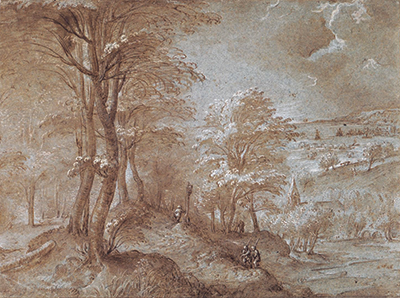
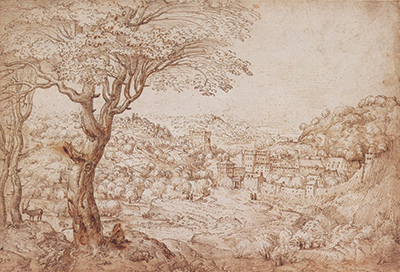
Pieter Bruegel the Elder drew Wooded Landscape with a Distant View toward the Sea in 1554. The sheet belongs to the Maida and George Abrams Collection at the Fogg Museum, Harvard Art Museums, where it is catalogued as 1999.132. Two large foreground trees stand above a path. The branches give way at the right to a much smaller church, fields and open water. Bruegel used the blue paper itself as a middle tone. Brown ink and wash deepen the woods, and opaque white watercolor brings out branches, leaves and stretches of ground [1] [2].
This work across Bruegel’s career
Tower of Babel
1563The Harvesters
1565Peasant Wedding
1568Children's Games
1560Triumph of Death
1562–1563Contents
- Introduction
- From the Trees to the Coast
- What the Blue Paper Does
- A Signature and a Date
- Looking Across the Sheet
- Annotated Details
From the Trees to the Coast
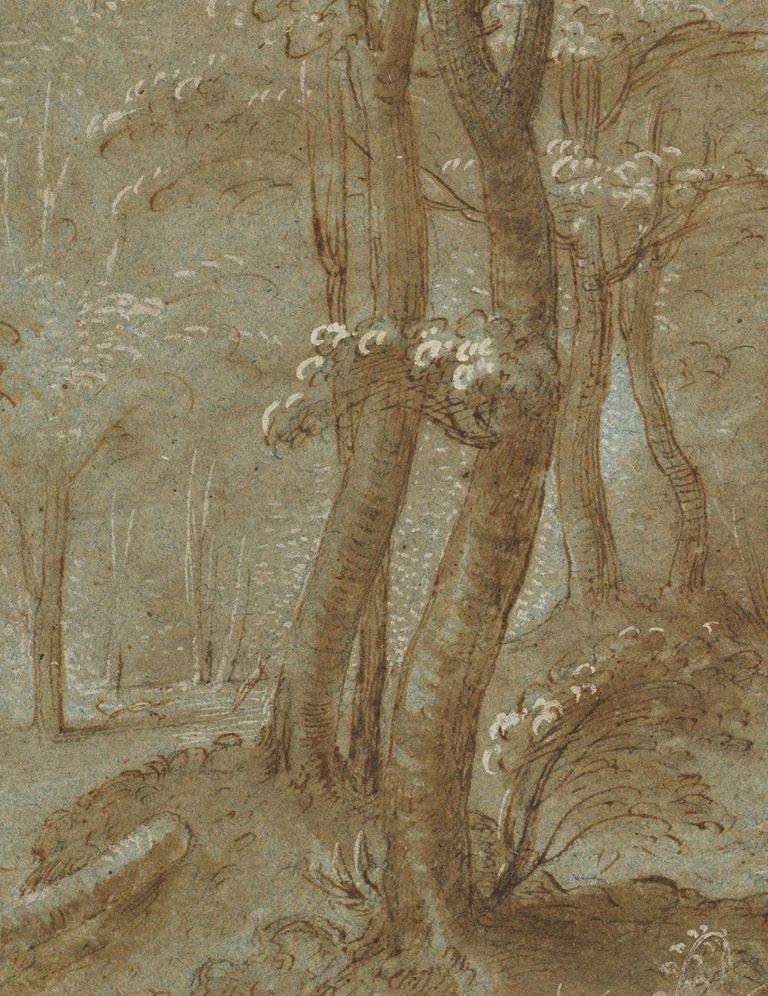
Begin at the foot of the two large trees, just left of centre. Both trunks rise from the same uneven bank, though each bends differently. Their upper branches spread to cover much of the sheet. Lines of brown ink separate one stem from another, then break into shorter marks where the branches carry foliage. The eye can follow a long, continuous form from the ground before losing its outline among the smaller loops and strokes. The trees work as a measure of distance. A whole group of people can fit into the space occupied by the base of a single trunk.
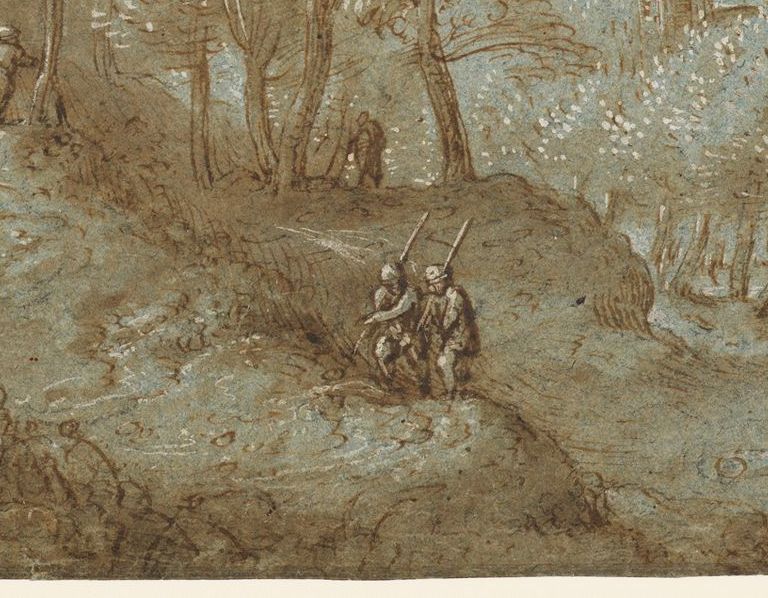
Below them, the near ground dips and rises again at the right. Small figures along the slope make the relation between the two sides easier to follow. At left, the Met exhibition catalogue identifies a hunt in a clearing, with hunters pursuing a rabbit. The group is a small part of the drawing. The path and intervening trees have enough space to suggest a much larger terrain through which people and animals can move [2].
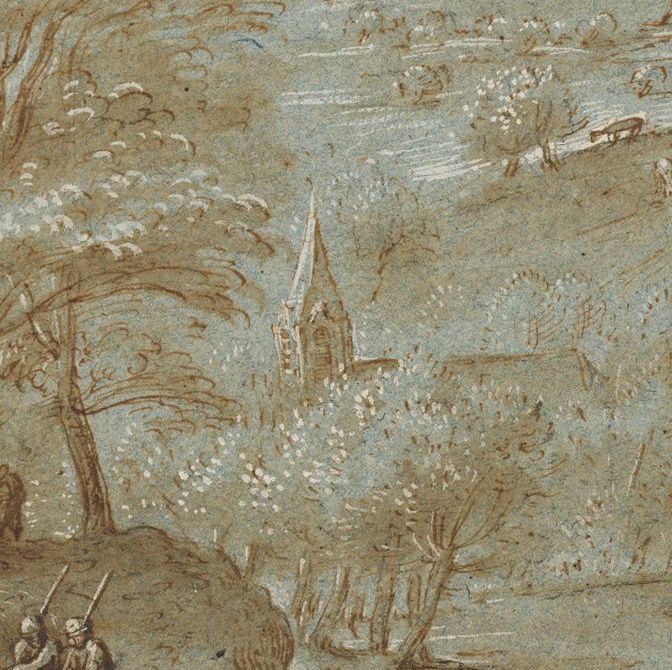
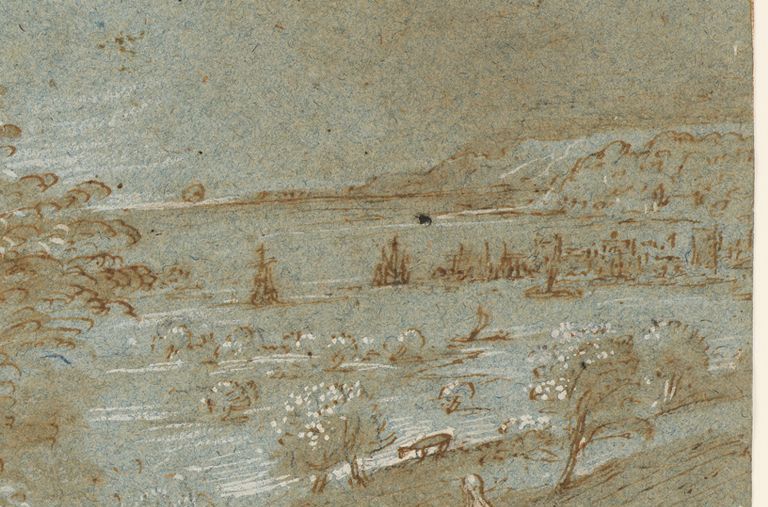
At the right, find the church by its pointed tower. It stands among trees just before the broad opening towards the shore. Small marks in the water suggest ships, and the catalogue identifies a port in the distance. The longest lines at the coast take up less height than a short section of either foreground trunk. That change in scale allows the water to read as a distant space even though it lies close to the forest on the paper. The church provides a step between the two [2].
The foliage remains visible as the spaces between the hills and the sea become more difficult to distinguish. Follow the marks just above the church before looking out to the water. Several branches are picked out in white. They interrupt the view and make the coast something seen through and beyond a foreground. The openness at the right feels earned because half the sheet has been spent showing how much ground the woods can occupy.
Annotated Details from Wooded Landscape with a Distant View toward the Sea
Start with the trees at the left, then use the church and the ships to follow the view into the distance.
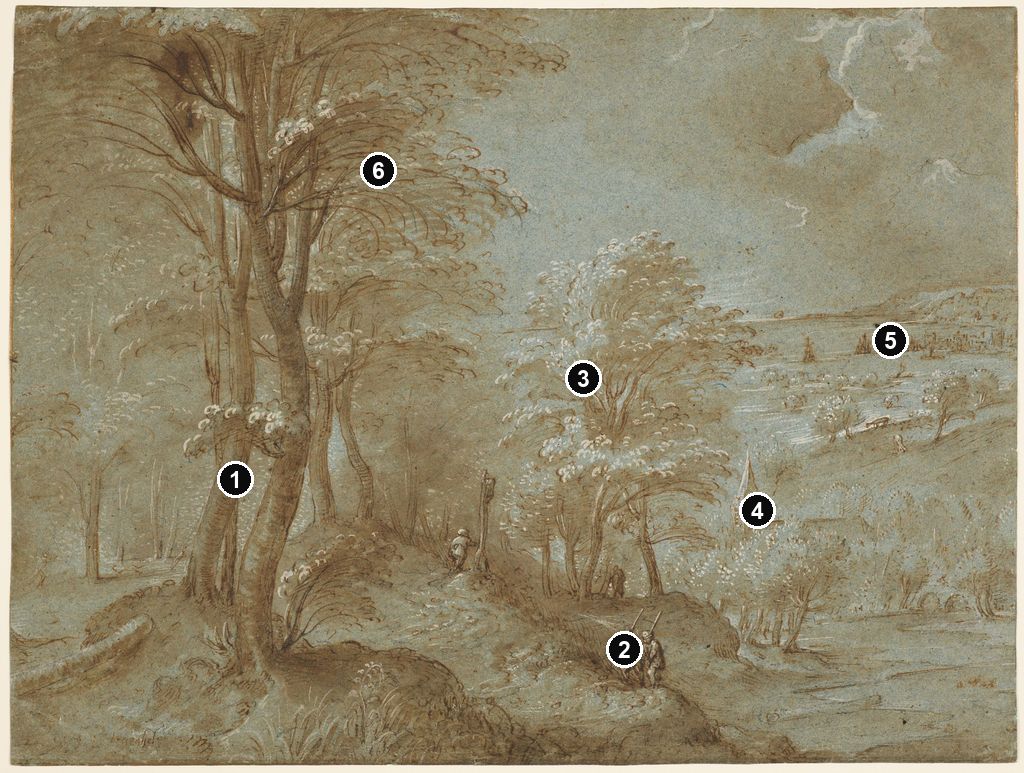
Details from WOODED LANDSCAPE WITH A DISTANT VIEW TOWARD THE SEA
Six details show how Bruegel used the blue sheet, brown ink and opaque white to connect forest and shore.
The paired trunks
The trunks rise from the same bank and bend apart. Fine dark strokes divide the branches above.
The near path
The people on the slope give the rise and fall of the ground a human scale.
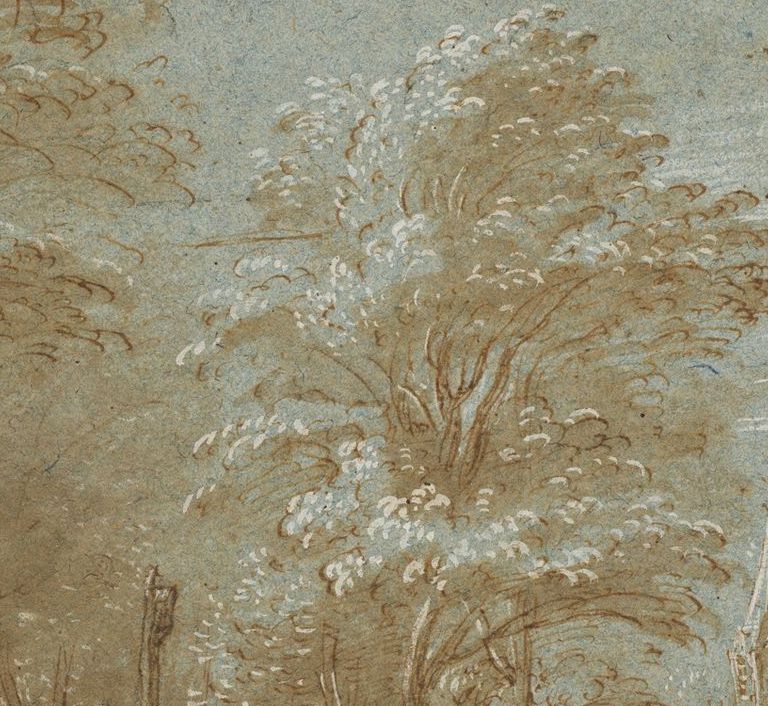
The white foliage
Small strokes of opaque white stand out against the blue paper. They build up the foliage in front of the church.
The church
The pointed tower marks a stage between the densely drawn woods and the coast.
Ships and shore
Upright touches suggest sails against long, pale stretches of water and shore.
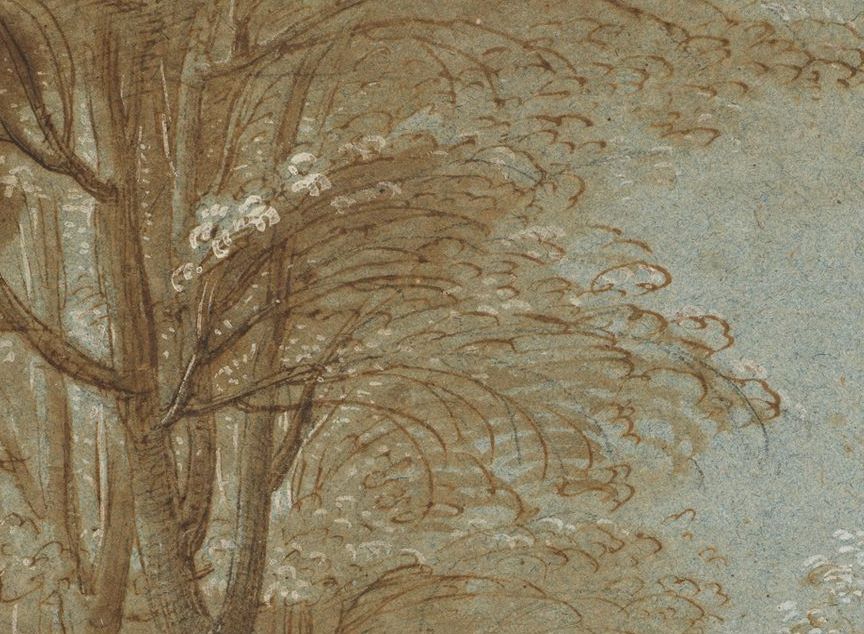
The strokes of the canopy
Thin branches taper into short hooks and loops in brown ink, with open paper visible between them.
Pieter Bruegel the Elder, Wooded Landscape with a Distant View toward the Sea, 1554. The Maida and George Abrams Collection, Fogg Museum, Harvard Art Museums, 1999.132. Photograph credited to the President and Fellows of Harvard College. Harvard’s object record includes an infrared view of the preliminary chalk drawing.
What the Blue Paper Does
On a white sheet, the lightest areas of a brown-ink drawing can often be carried by paper left bare. Here the blue sheet offers Bruegel a tone between the deepest shadows and the strongest highlights from the outset. Clear patches of it remain visible between brown strokes and touches of white. You can see this particularly well around the pale trees at the far left and the foliage in front of the church. The white is an active part of the drawing, in places carrying the form of a tree that would otherwise be scarcely marked [1].
Bruegel used both fine lines and larger shapes of wash. The lines divide bark, branches and leaves into particulars. The wash gathers many of those particulars into a single shadow crossing a slope or running along a trunk. At the left, many of the small white strokes are spaced far enough apart to let the underlying paper show through. Elsewhere they collect into larger patches. The combination makes the passage from a dark stand of trees to a light opening visible without drawing a rigid boundary across the hillside [1] [2].
The fainter material came first. Infrared reflectography revealed a preliminary drawing in black chalk that places some of the trunks and figures before the more elaborate work in brown and white. Microscopic examination established that ink runs over the opaque watercolor in a few passages, even though the white more often lies over the pen work. This evidence helped Harvard’s researchers conclude that Bruegel used the white himself. He could put a light into the foliage and then come back to it with the pen [1] [2].
A Signature and a Date
The drawing went through several attributions after surfacing at auction in 1991. It was offered there under Jan Brueghel the Elder’s name and entered the Abrams collection the following year as the work of an unidentified sixteenth-century Flemish artist. Hans Mielke recognised Pieter Bruegel the Elder’s hand in 1994. He connected the tapering foliage strokes and the shorthand for distant treetops with the handling of other sheets and accepted the lower-left signature as autograph [1] [2].
Mielke initially placed the drawing in 1553, close to landscapes such as the Washington Landscape with Saint Jerome. Further examination disclosed the date 1554 beside the signature. The comparison remains useful for seeing how Bruegel handled branches in both works. The date, recovered from the sheet itself, supplies more precise evidence of when the blue-paper landscape was made. Harvard also relates the choice of paper to Italian practice and the white heightening to uses known among Netherlandish draftsmen [1] [2].
The scale of the sheet also shapes this encounter. Harvard measures it at 26 by 34.4 centimetres. A viewer holding a reproduction at roughly that size can take in both the trunks and the distant port at one glance, but has to come closer to see where a branch breaks into small pen strokes. The expanded views of the black-chalk sketch in Harvard’s record make possible another kind of close looking. They isolate the early placement of the trees from the fuller marks that now define their surfaces [1].
Looking Across the Sheet
The sea occupies only the farthest part of this drawing. In the middle ground, the church brings a sharply pointed shape into a stretch of field and trees, and the pale foliage in front of it makes it seem a little harder to reach. At the left, the rabbit and hunters use an entirely different pocket of the same terrain. A viewer can follow these two areas in either order and still return to the large trunks as the place from which the distances make sense.
Look once more at the pale tree just left of the church. Its crown stretches over both the dark rising ground and the space that opens towards the coast. The small strokes in the crown can be examined one at a time, while the blue among them belongs to the broader light of the landscape. This is a passage in which the material explains part of the composition. Bruegel could use the same coloured paper to hold together the closest stems and the farthest water.
Discussion
Which detail in this work most changes how you read it?
Frequently Asked Questions
Below them, the near ground dips and rises again at the right. Small figures along the slope make the relation between the two sides easier to follow. [2]
On a white sheet, the lightest areas of a brown-ink drawing can often be carried by paper left bare. Here the blue sheet offers Bruegel a tone between the deepest shadows and the strongest highlights from the outset. [1]
References
- Harvard Art Museums, Wooded Landscape with a Distant View toward the Sea, 1999.132, object and technical notes, View source.
- Nadine M. Orenstein, ed., Pieter Bruegel the Elder, Drawings and Prints, Metropolitan Museum of Art, 2001, no. 14, View source.







