


 by Tom Gurney
Tom Gurney BSc (Hons) is an art history expert with over 20 years experience
Published on June 19, 2020 / Updated on October 14, 2023
Email: tomgurney1@gmail.com / Phone: +44 7429 011000
Landscape with Saint Jerome: Introduction
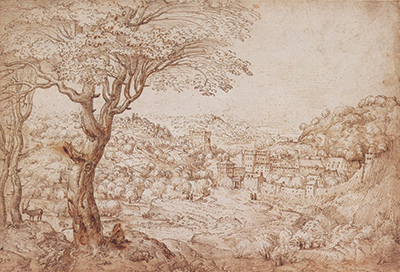
Pieter Bruegel the Elder’s Landscape with Saint Jerome is a pen-and-brown-ink drawing of 1553 in the National Gallery of Art, Washington. The museum calls it Landscape with the Penitence of Saint Jerome. The saint occupies a small patch of foreground at the foot of a tall tree. Across the valley stand walls, buildings and a road. Bruegel offers a view of considerable breadth, then asks the eye to find a single person within it. A separate print of Jerome in the wilderness uses another composition [1] [2] [3].
This work across Bruegel’s career
Tower of Babel
1563The Harvesters
1565Peasant Wedding
1568Children's Games
1560Triumph of Death
1562–1563Landscape with Saint Jerome
This artworkContents
- Introduction
- Finding the Saint
- What Is Visible across the Valley
- A Signed Drawing and a Separate Print
- Looking from the Trees to the Road
- Annotated Details
Finding the Saint
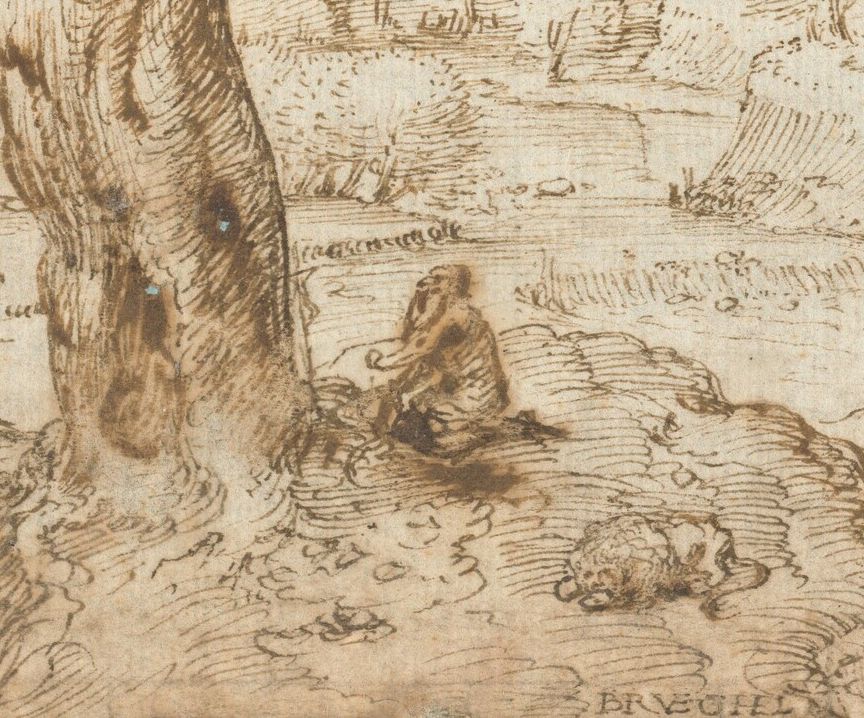
Begin with the large trunk at the left, where the lines are dark enough to follow from the ground into the branching crown. A small figure appears near the base, between the trunk and the open valley. The drawing offers little room for a face or a broad gesture. The bent posture and the placement of the head are more useful signs. Once you can see where the figure kneels, the foreground begins to look like a place with room for an individual to stop before the terrain falls away [1].
Look at the margin of ground around him. A few irregular marks and small shapes are stronger than the lines used for the distant fields. They form a rough setting quite close to the viewer. The most visible person may still be somebody far away on the road if you look only at the open middle of the sheet. The trunk gives you a dependable route back to Jerome, whose position is quite precise even though there are relatively few lines to describe him.
The drawing is on laid paper. Brown ink and the pale support offer several degrees of visibility without the use of colour to make the saint conspicuous. Follow one of the low branches and compare its outline with the marks around the figure. We see the tree as a single upright mass and the saint as one of the small forms at its foot. That difference in scale makes him part of the terrain around the town. It also gives the viewer an approximate measure for the height of the tree [1].
Annotated Details from Landscape with Saint Jerome
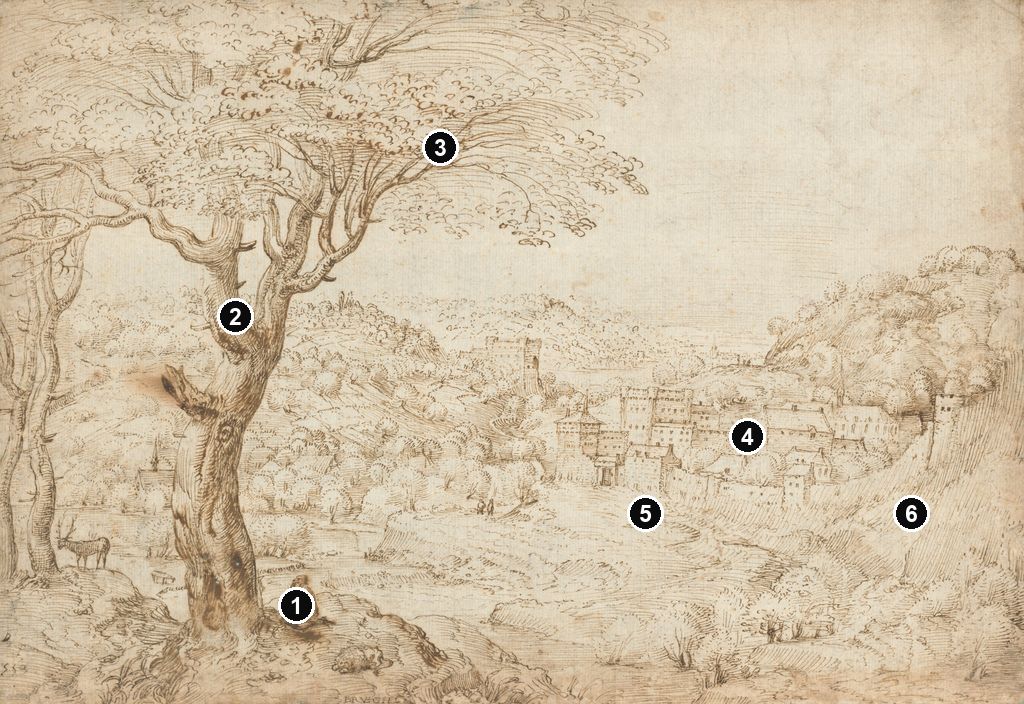
Find Jerome beneath the tree and follow the lines of the valley towards the town.
Details from LANDSCAPE WITH SAINT JEROME
Six details connect the near figure to the landscape around him.
Jerome beneath the tree
The kneeling figure is low against the dark trunk. Find where his head and hands separate from the rough ground.
The bending trunk
Parallel strokes give the trunk volume. The dark line of the bark is a guide between the canopy and the saint.
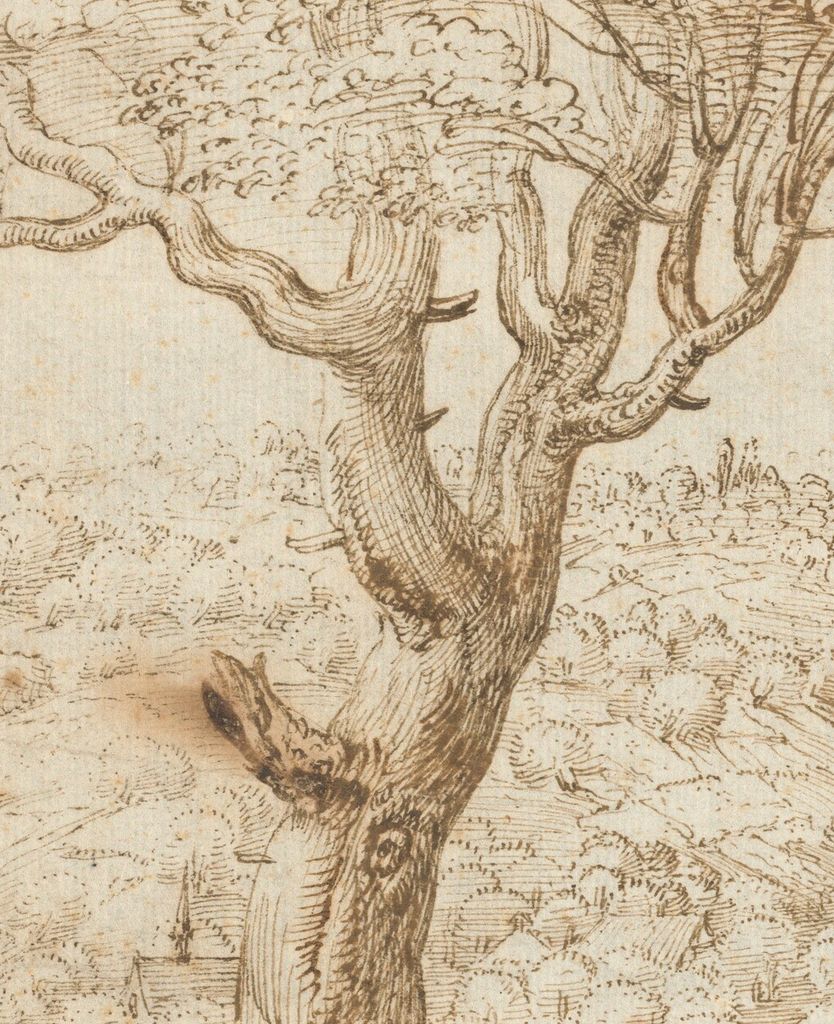
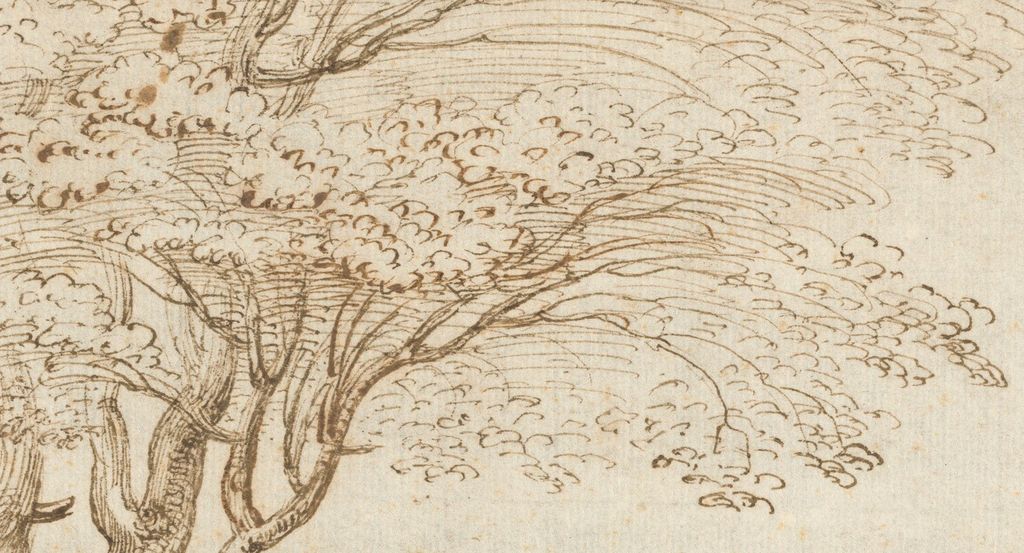
The spreading foliage
Small curved marks set the crown against the pale paper. Branches carry the eye out towards the open valley.
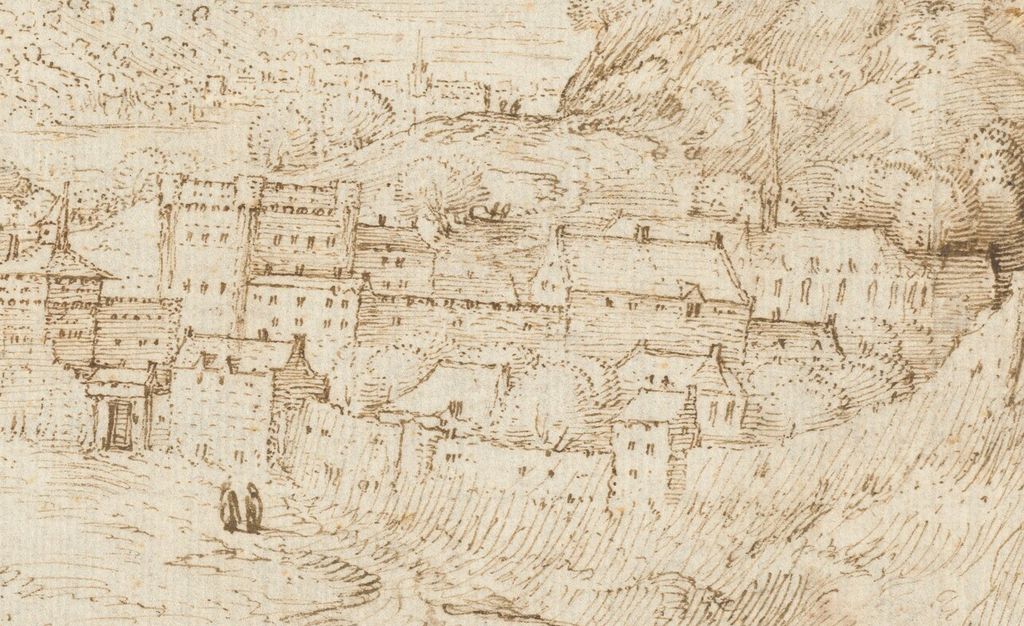
The wall and buildings
Repeated vertical marks give the settlement a recognisable shape among irregular hills.
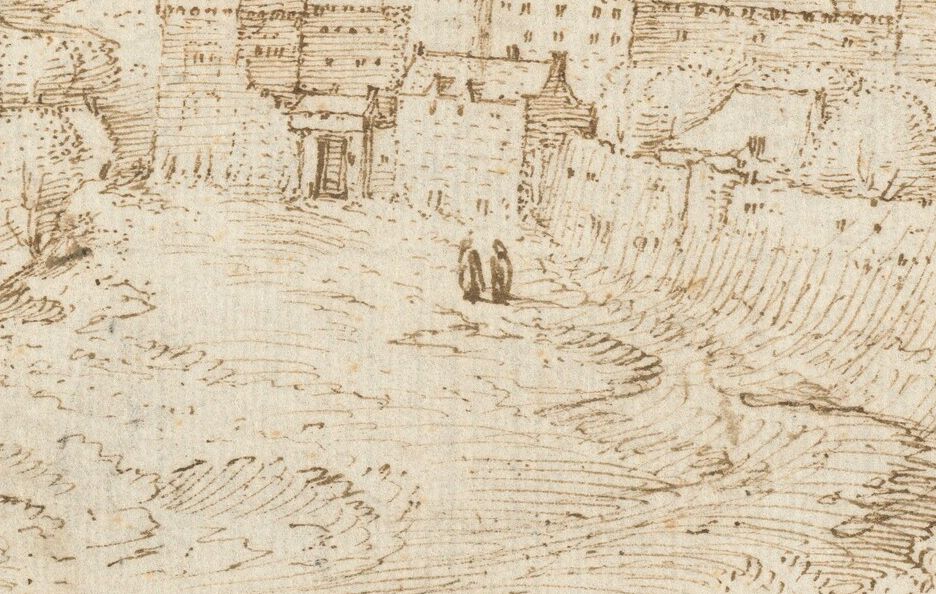
Travellers on the road
The upright marks in front of the wall suggest people. Their scale draws attention to the visible stretch of the road.
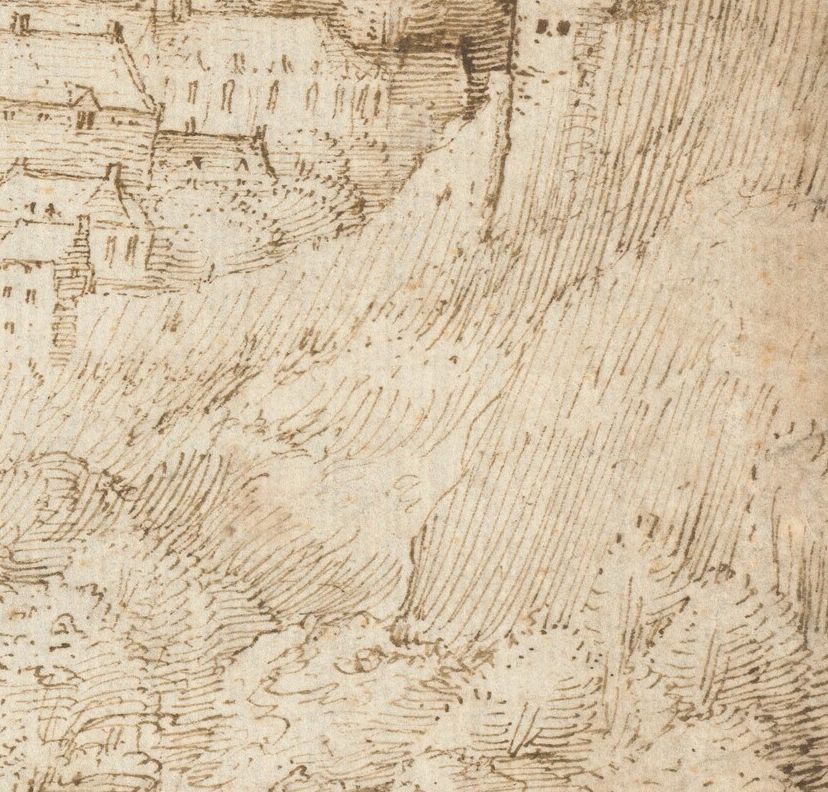
The slope below the town
Closely set strokes describe the steep ground between the buildings and lower terrain.
Drawing source for the main image and annotated details: National Gallery of Art, Ailsa Mellon Bruce Fund, 1972.47.1. Public Domain.
What Is Visible across the Valley
Find the buildings at the right. Their upright walls and small openings distinguish them from the irregular marks near the edge of the hills. A viewer can follow the outside of the settlement before trying to read any individual building. The clustered shapes create a clear block in the middle distance, leaving open ground between the town and the foreground. The road extends through that interval. A few vertical marks on it give the impression of people in motion.
On the nearer side, the ground is less orderly. Look for short lines on the slopes and for marks that recur at intervals, as if vegetation occupies one manageable piece of ground after another. Those patches allow the eye to judge depth without a single continuous road having to explain it. The walls at the right stay visible while the landscape around them divides into smaller slopes and descents. The effect is of a town embedded in a terrain that can be entered by more than one route.
The two kinds of scale become especially clear if you move from the saint to the buildings and then look back. The nearest figure is small in relation to the trunk, and the farthest people are small in relation to the walls. The drawing gives a reader several recognizable sizes with which to judge the intervening ground. The subject of penitence is at the edge of a view that also includes a settlement and a working landscape. Bruegel leaves enough of both visible for the eye to travel between them.
A Signed Drawing and a Separate Print
The National Gallery of Art records accession 1972.47.1 as 23.2 by 33.6 centimetres, with its dimensions specified separately from the support. It lists a date at the lower left and Bruegel’s name near the lower centre. People who know the subject from other pictures can begin with Jerome’s place in the landscape. People comparing drawings and prints have more exact evidence in the date, medium and location of the markings on the object. The museum acquired the drawing in 1972 [1].
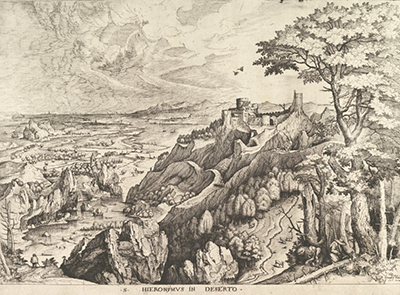
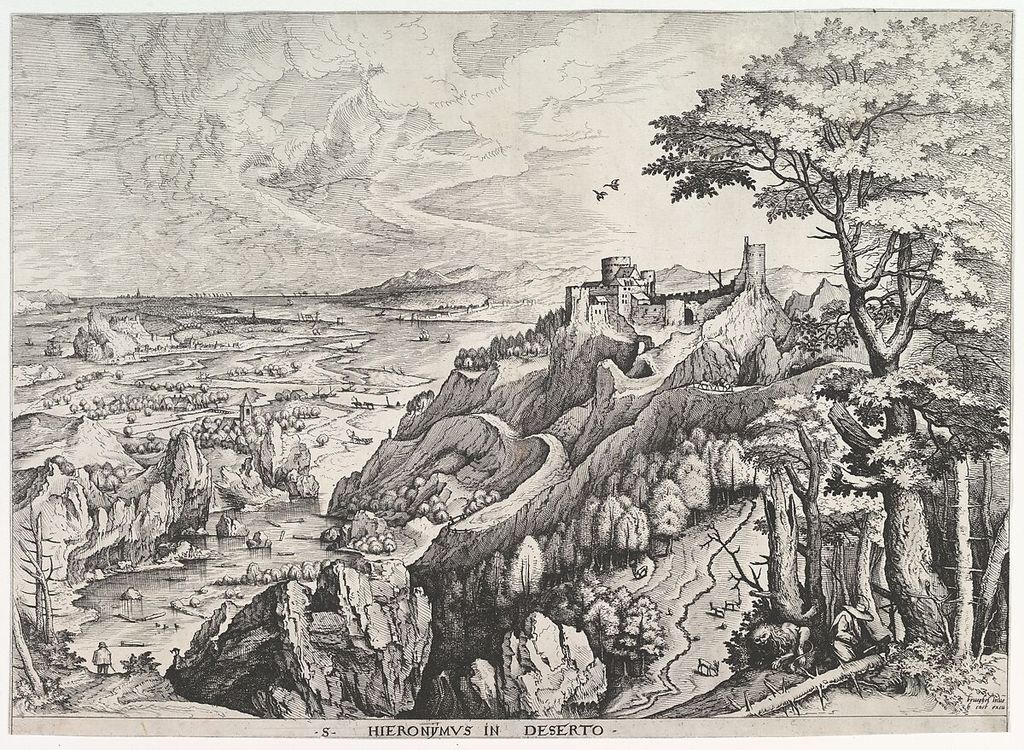
A different work, Saint Jerome in the Wilderness, belongs to the printed series known as the Large Landscapes. The Metropolitan Museum’s record credits Johannes and Lucas van Doetecum as printmakers after Bruegel and Hieronymus Cock as publisher. The Latin inscription identifies Jerome in the wilderness. In that image a tree rises at the right and the saint reads under cover in the lower-right foreground. The Washington drawing has its most prominent trunk at the left and a distinct arrangement of buildings and open ground. Compare those parts before attempting to identify the scene by its title alone [3] [1].
The printed series allowed a landscape design to circulate in multiple impressions. The Met points to the Doetecums’ etched lines, which can resemble engraved ones. In the drawing, pen marks on the paper make the scene directly. Looking at the nearest trunk in each work is one way to see what medium has to do with the encounter. Dark groups of lines can give bark or shadow a firm shape, but the two works set those lines in different parts of the terrain and lead the viewer through different compositions [3] [2].
Looking from the Trees to the Road
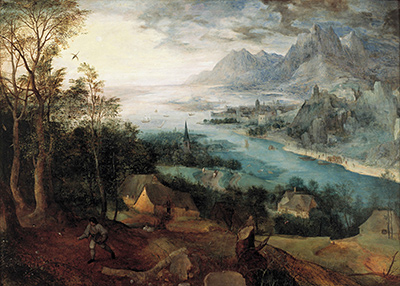
Bruegel’s interest in a large view can also be followed in Landscape with the Parable of the Sower, a panel of 1557. In that painting, a small figure under the trees helps the viewer locate an agricultural task that belongs to a biblical story. In the Washington drawing, the tree helps you find a kneeling person, and the far settlement gives his situation a wider setting. The two works give different reasons to move between a conspicuous part of the foreground and a much larger space beyond it [1] [4].
Look once more along the trunk, locate the saint and then move towards the walls. The landscape is broad enough to be read as a subject in its own right. Finding Jerome changes the order in which its features can be seen. The ground beneath the tree becomes a place set apart, while the road and town remain within sight. That is part of how Bruegel makes a scene of withdrawal visible without closing it off from the rest of the world.
Discussion
Which detail in this work most changes how you read it?
Frequently Asked Questions
Begin with the large trunk at the left, where the lines are dark enough to follow from the ground into the branching crown. A small figure appears near the base, between the trunk and the open valley. [1]
The National Gallery of Art records accession 1972.47.1 as 23.2 by 33.6 centimetres, with its dimensions specified separately from the support. It lists a date at the lower left and Bruegel’s name near the lower centre. [1]
References
- National Gallery of Art, Landscape with the Penitence of Saint Jerome, drawing 1972.47.1, View source.
- Nadine M. Orenstein, ed., Pieter Bruegel the Elder, Drawings and Prints, Metropolitan Museum of Art, 2001, nos. 11 and 25, View source.
- The Metropolitan Museum of Art, St. Jerome in the Wilderness, from The Large Landscapes, View source.
- Timken Museum of Art, Parable of the Sower, painting 1957:002, View source.







