


 by Tom Gurney
Tom Gurney BSc (Hons) is an art history expert with over 20 years experience
Published on June 19, 2020 / Updated on October 14, 2023
Email: tomgurney1@gmail.com / Phone: +44 7429 011000
Saint Jerome in the Wilderness: Introduction
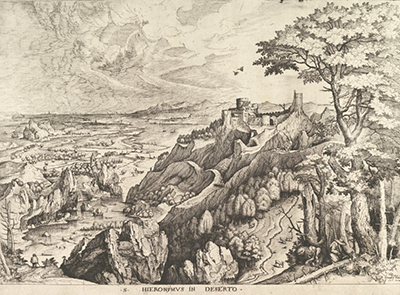
Saint Jerome in the Wilderness is an etching with engraving made around 1555–56 after a design by Pieter Bruegel the Elder. Johannes and Lucas van Doetecum made the print, and Hieronymus Cock published it in Antwerp as part of the Large Landscapes. Jerome reads near the lower right with his lion. He occupies little space beside a winding road, a fortress above the rocks and a river plain extending towards the horizon. The inscription names the saint, while the composition gives the viewer much more ground than he needs for his retreat [1] [2] [3].
This work across Bruegel’s career
Tower of Babel
1563The Harvesters
1565Peasant Wedding
1568Children's Games
1560Triumph of Death
1562–1563St Jerome in the Wilderness
This artworkContents
- Introduction
- The Reader under the Trees
- A Road up to the Fortress
- Etched Lines and the Printed Series
- A Different Jerome Drawing
- Annotated Details
The Reader under the Trees
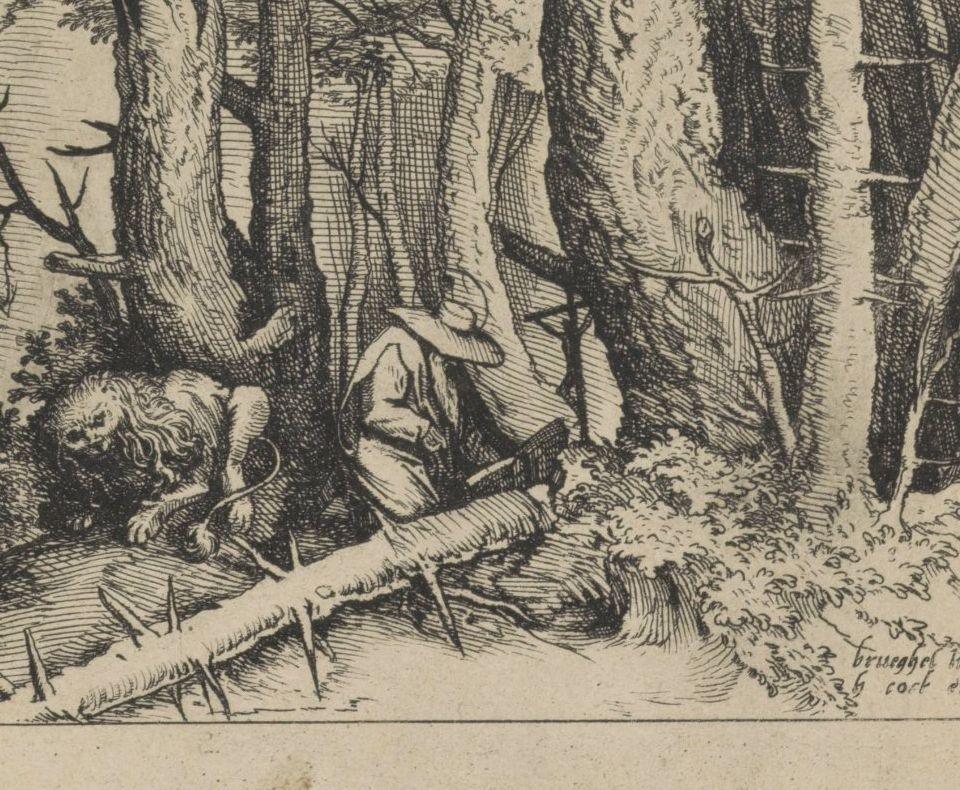
Begin at the right and look below the crown of the large tree. The foliage gives way to several narrower trunks and lower branches. In their shade, near the bottom of the image, a seated figure bends over a book. The lion lies close by. The Metropolitan Museum and Rijksmuseum both locate Jerome in the right foreground. His position is easier to trace from the tree and the lower edge than it is to discover by scanning the open country. He sits apart from the road that occupies more of the centre [1] [2].
The book gives the posture a direction. Jerome’s head and upper body bend towards something within reach. Beyond him the land opens into a much wider view, where it takes a longer movement of the eye to get from one recognizable object to the next. The figure does not turn towards that view. The lion also stays underneath the trees. Once you identify the pair, their small place in the print offers a still point from which to measure the movement across the rest of the scene [1] [3].
It helps to look at the lower margin before trying to make out the saint in a small reproduction. The title in Latin identifies Jerome in the wilderness. A reader who has already seen the words can return to the margin of the wood and look for a scholar, a book and a lion. The inscription gives the eye a reason to concentrate on a relatively dark area. The widest, brightest part of the landscape would otherwise be an easier place to begin [1] [3].
Annotated Details from Saint Jerome in the Wilderness
Find the reader near the trees, then follow the road uphill and the water into the distance.
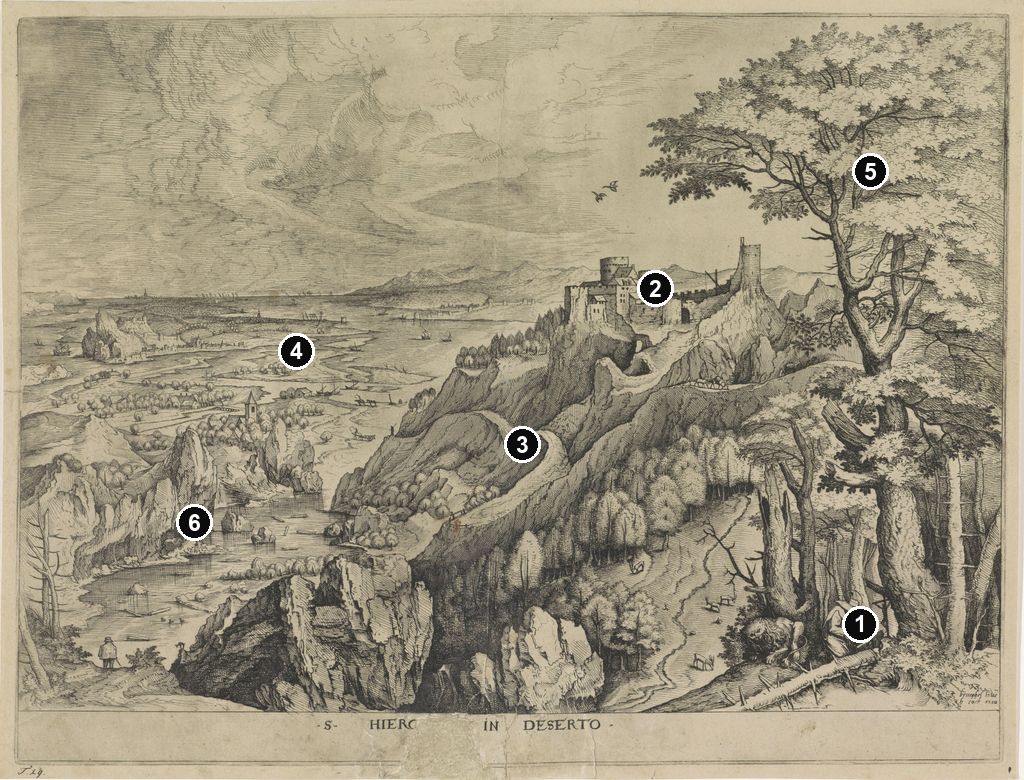
Details from SAINT JEROME IN THE WILDERNESS
Six details show the scale of Jerome’s retreat within the printed landscape.
Jerome reads beneath the trees
The book and bowed figure are low in the wooded foreground. The lion rests beside him.
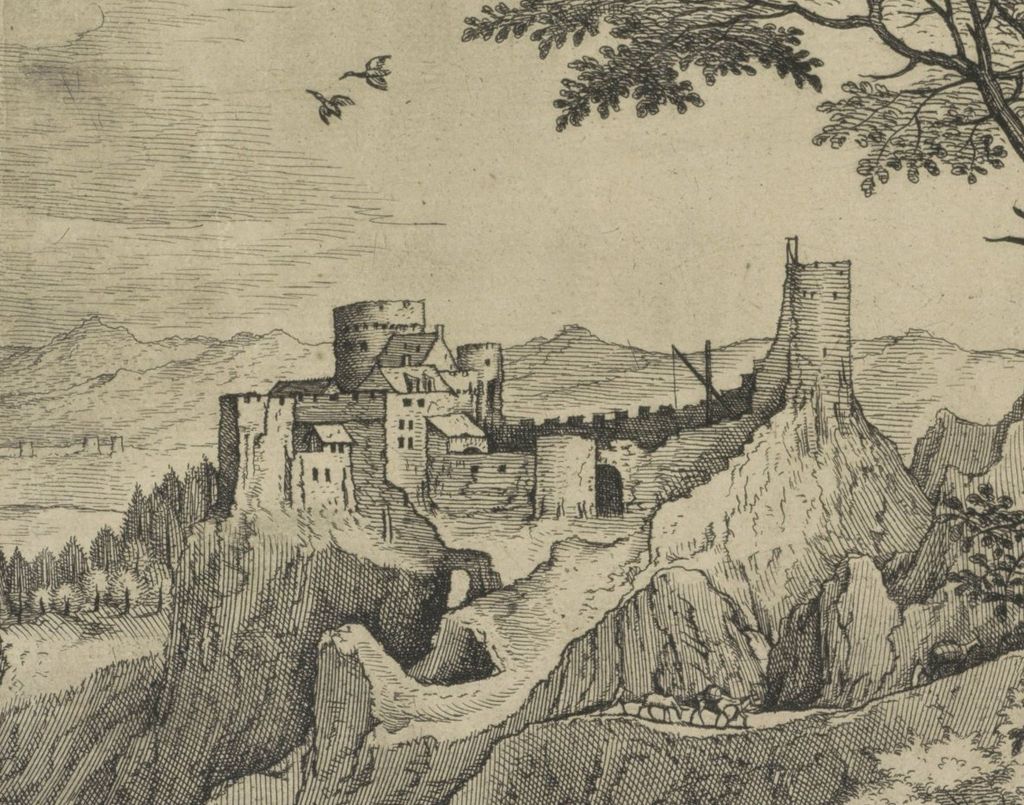
The fortress on the ridge
Upright walls and towers interrupt the outline of the rocky crest.
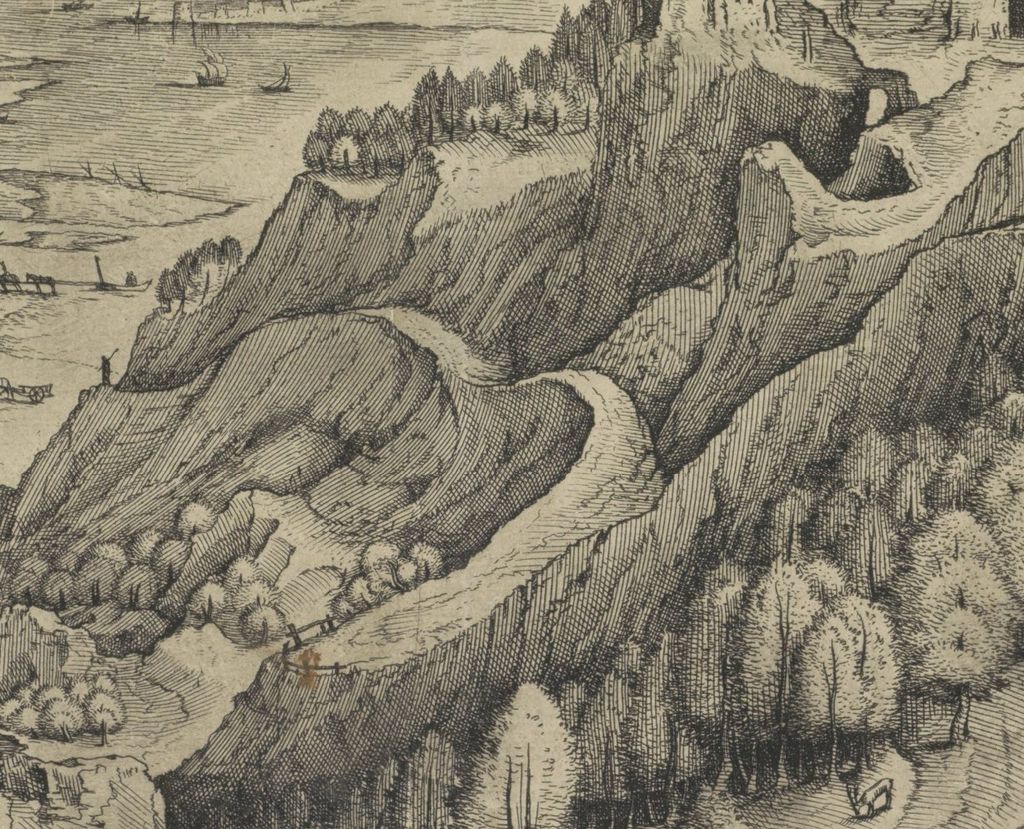
A road across the slope
Pale sections of path reappear on the steep ground. Follow the bends towards the fortress.
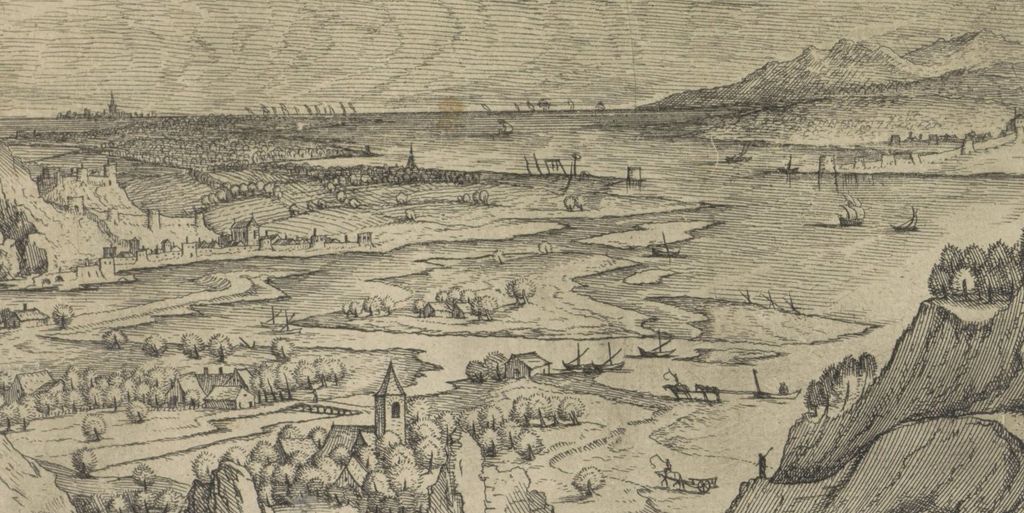
Waterways in the distance
Narrow stretches of open water lead from the hills towards the low horizon.
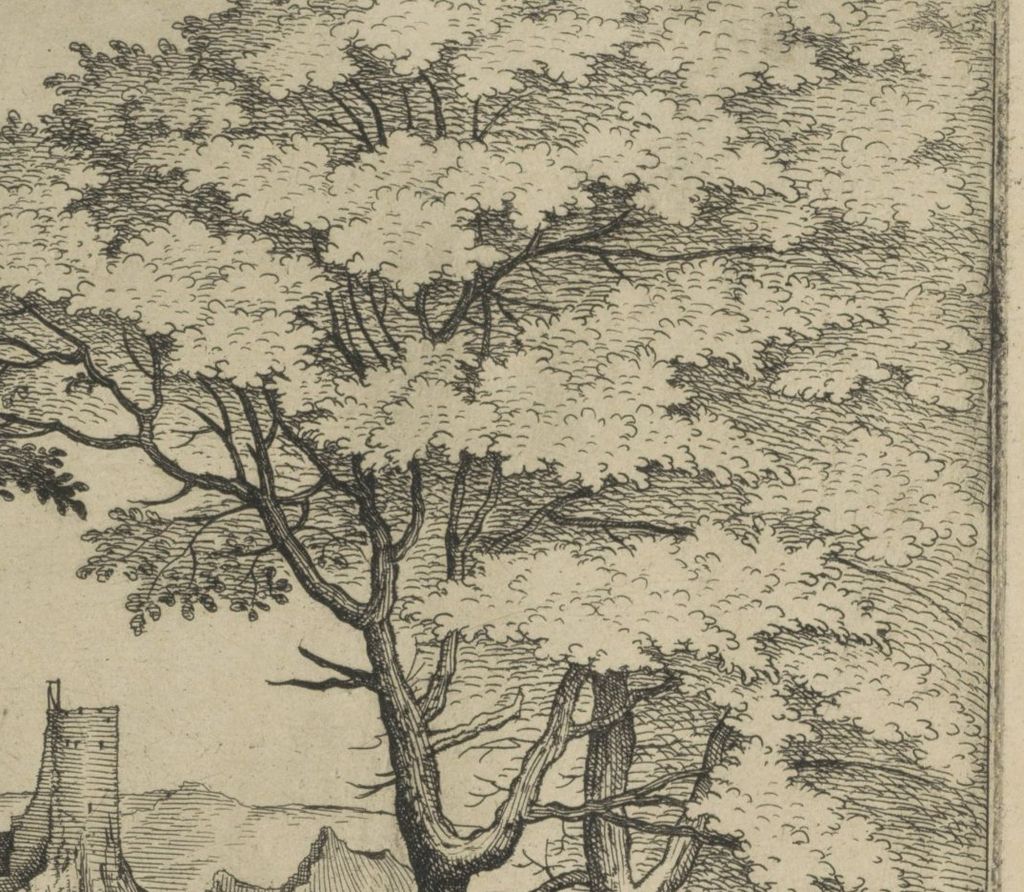
Lines in the canopy
Closely spaced marks produce the darker boughs. Pale spaces between them keep the air visible.
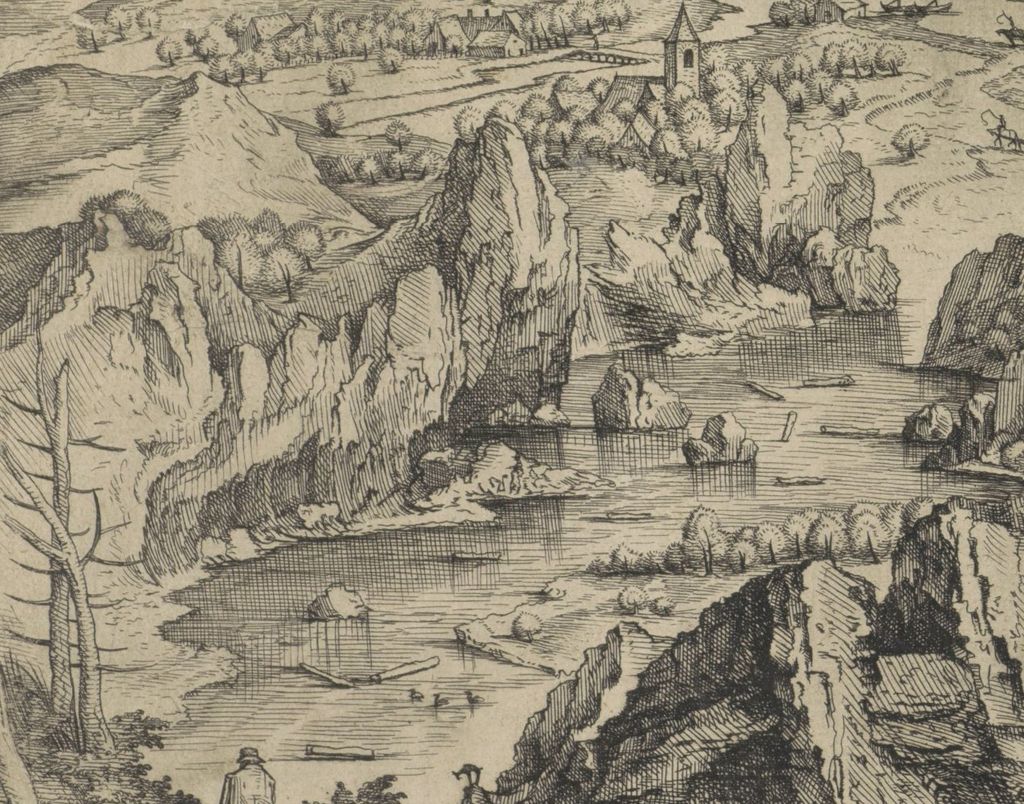
Light along the rocky riverbank
Broken outlines and dark areas show how the near rocks rise above the water.
Main image: The Metropolitan Museum of Art, Harris Brisbane Dick Fund, 1926, 26.72.13. Annotated image and detail crops: Rijksmuseum, on loan from the City of Amsterdam, RP-P-H-T-29. Both in the Public Domain.
A Road up to the Fortress
The strongest diagonal runs along the mountainous ground. The road bends several times before it reaches the fortress. The light surface of one stretch can be seen against close-set dark lines, then the next stretch disappears behind high ground. Follow those sections upward to see how the building occupies the crest. Its vertical walls interrupt the shapes of the rock and give the eye a familiar height to compare with the slopes below [1].
One can also start with the fortress and work down. Parts of the mountainside have distinct surfaces, with crags rising from smaller patches of vegetation. Elsewhere, the line of a path or a pale opening separates two dark slopes. The road has to accommodate these changes. A viewer experiences them at the scale of whole hills, while the travellers on the paths occupy little more than a few marks. That change in scale is one reason the fortress looks so exposed above the valley.
The sheet gives nearly as much attention to the broad country on the left. Look for the waterways and the vessels they carry. Orenstein’s exhibition catalogue notes travellers, carts and a ferry drawn by horses among the details of the larger scene. It takes patience to identify such things among rocks and trees. Their presence makes the broad view a place where people do business and travel. The place of retreat at the right holds its own against a substantial picture of life elsewhere [3].
Etched Lines and the Printed Series
Met accession 26.72.13 is one impression of the design, and Rijksmuseum RP-P-H-T-29 is another. The catalogue illustrations establish the same layout. The source of a legacy reproduction can be harder to identify than the composition, particularly when the margins are cropped. The tree, fortress and title identify the plate design here. A museum accession identifies an actual sheet with a record of its own [1] [2] [3].
The two records also show what a museum means by an impression. The Rijksmuseum describes a collector’s mark and a handwritten number on its sheet. Those details belong to that particular piece of paper. The lines of the fortress can be compared across copies, while a manuscript number can help trace the history of only one of them. The Metropolitan Museum’s impression carries a clearly readable title beneath the scene, and it is the reproduction used for the main image here [1] [2].
The Met describes the Large Landscapes as a group of twelve prints and emphasizes etched lines that can resemble engraved ones. In this work lines run together across a dark hillside and stand wide apart in relatively pale ground. Look at the clouds above the river plain and then at the nearest foliage. The lines curve and change direction in both, but their density allows one part of the sheet to suggest air and the other to represent leaves or shade. The makers used etching and engraving to spread a consistent image across separate impressions [1] [2].
The Met also raises the possibility that Cock added the saint and the title, since the landscape is developed at a scale that would make sense independently of the tiny devotional incident. That remains a proposal about how the design reached its printed form. The inscription and the saint are both present on the surviving impression. A viewer can see what prompts the proposal by covering the lower-right corner and considering how much of the road, fortress and valley remains available [1] [3].
A Different Jerome Drawing
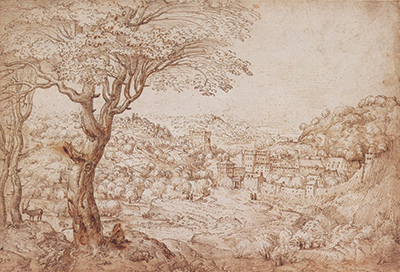
Bruegel’s Landscape with Saint Jerome in Washington is a drawing of 1553. There the main tree stands at the left and the saint kneels at its foot. A town occupies the middle distance. The drawing lets one follow a different foreground and a different route into the larger view. In this print, the tree and reader stand at the right, and the fortified ridge climbs above a plain threaded with water [4] [1].
The different placements also put the viewer in two different relationships with the saint. In the drawing, a person following the largest trunk down the page comes directly to the place where Jerome kneels. In the print, the extent of the river plain can lead the eye far away from the person who gives the work its name. The book and lion reward a separate search through the darker foreground [4] [1].
Return to the book after exploring the road and the open valley. It sits in an area small enough to hold the saint’s attention without commanding the rest of the picture. The title sends the eye to this corner. The extent of the view makes it possible to notice the choice of place he has made.
Discussion
Which detail in this work most changes how you read it?
Frequently Asked Questions
The strongest diagonal runs along the mountainous ground. The road bends several times before it reaches the fortress. [1]
References
- The Metropolitan Museum of Art, St. Jerome in the Wilderness, from The Large Landscapes, 26.72.13, View source.
- Rijksmuseum, Landschap met H. Hieronymus in de woestijn, RP-P-H-T-29, View source.
- Nadine M. Orenstein, ed., Pieter Bruegel the Elder, Drawings and Prints, Metropolitan Museum of Art, 2001, no. 25, View source.
- National Gallery of Art, Landscape with the Penitence of Saint Jerome, 1972.47.1, View source.







