


 by Tom Gurney
Tom Gurney BSc (Hons) is an art history expert with over 20 years experience
Published on June 19, 2020 / Updated on October 14, 2023
Email: tomgurney1@gmail.com / Phone: +44 7429 011000
Sylvan Landscape with Five Bears: Introduction
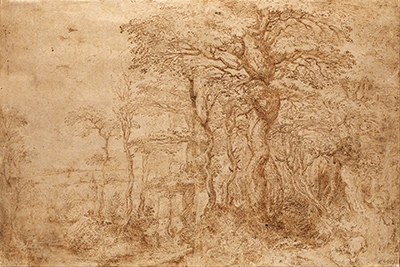
Five bears appear beneath a large stand of trees in Pieter Bruegel the Elder’s Sylvan Landscape with Five Bears. Most of the drawing is given over to trunks, foliage and the gradual opening of the land towards water on the left. The National Gallery Prague holds the sheet under inventory number K 4493. The 2001 exhibition catalogue describes the front as pen and brown ink, dates it to 1554 and identifies a second landscape on the reverse. A print by Hieronymus Cock follows the wooded composition in reverse and gives the corner occupied by the bears a different subject [1] [2] [3].
This work across Bruegel’s career
Tower of Babel
1563The Harvesters
1565Peasant Wedding
1568Children's Games
1560Triumph of Death
1562–1563Sylvan Landscape with Five Bears
This artworkContents
- Introduction
- From the Wood to the Water
- Finding the Five Bears
- The Drawing and Its Reverse
- How Cock Changed the Landscape
- Annotated Details
From the Wood to the Water
Begin with the largest tree, just right of centre. Its trunk bends several times on the climb from the ground to the branches. Longer lines carry the twists of the bark, and shorter ones give the boughs a dense edge where they meet the open paper. The crown spreads left, but the heaviest concentration of near foliage remains above the wooded bank. Looking down from it, you can pick out other trunks and catch glimpses of lighter ground between them. The great tree divides the view and gives the eye several ways to look through it.
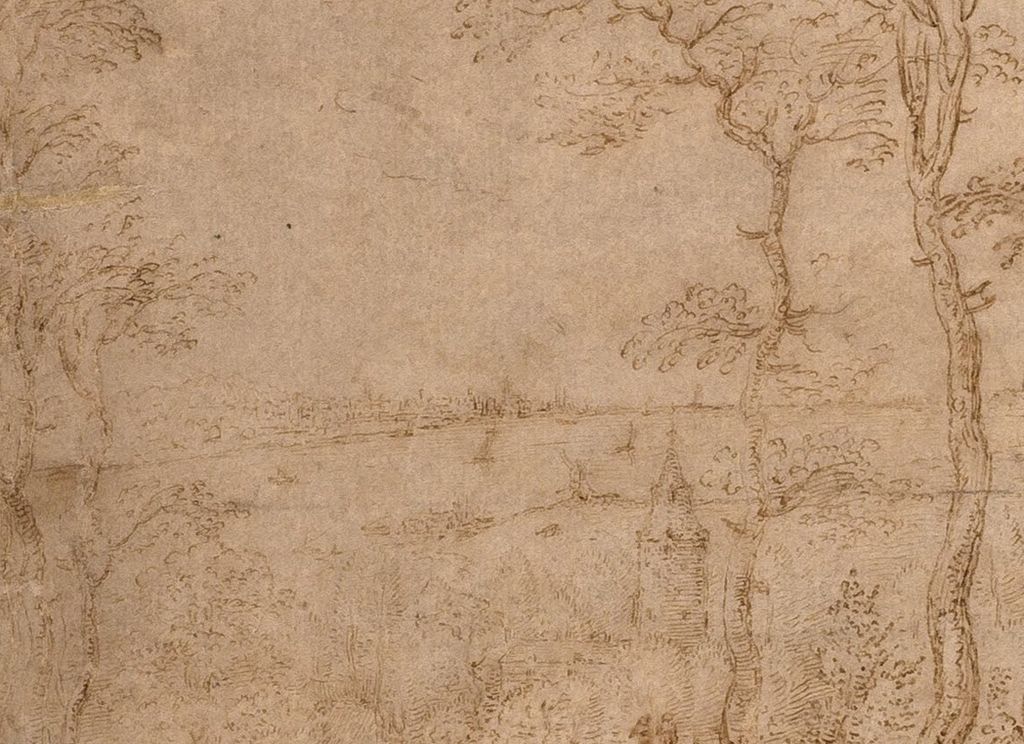
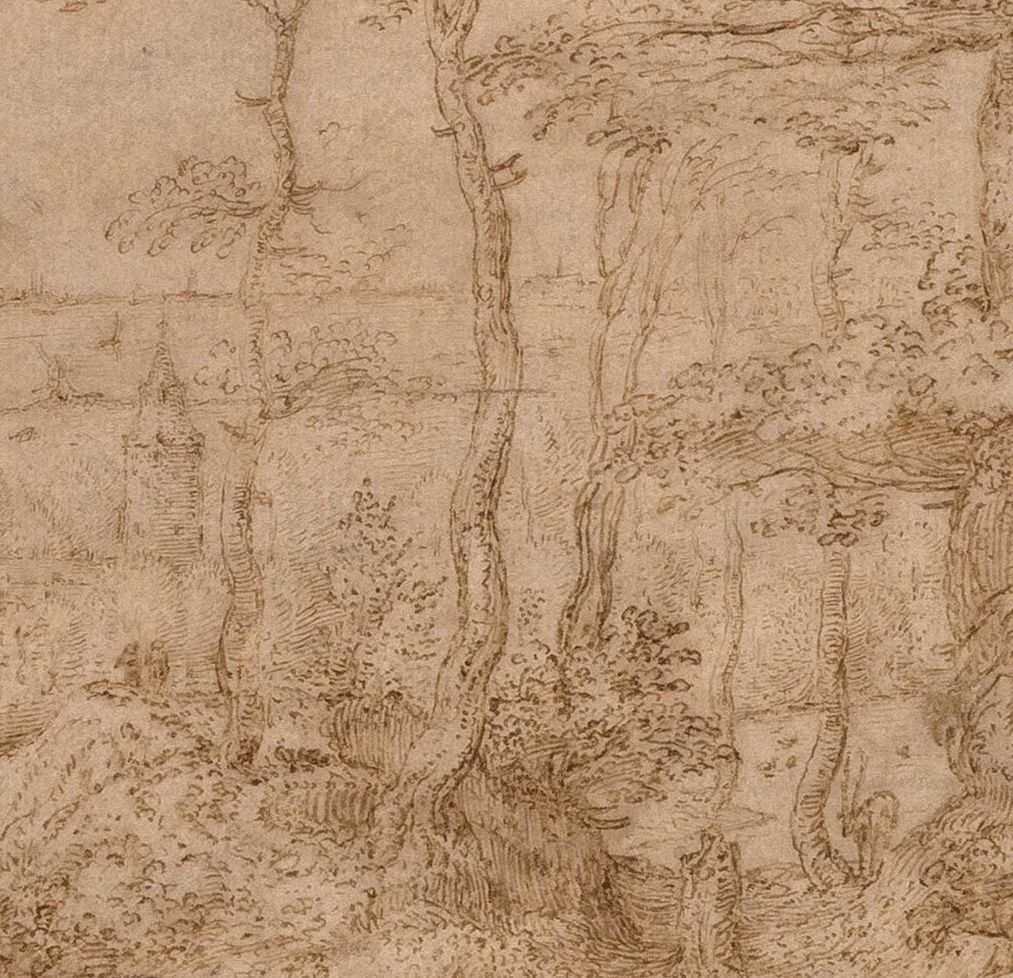
At the left, the trees are smaller and more widely spaced. Some can be recognised by an upright line and a small suggestion of foliage. The lines of water and distant ground run across the spaces between them. Compare the faint outline of the tower at the left with the more emphatic trunks near the middle. Both are upright forms, but the distant building has much less definition and is partly absorbed into the surroundings. The changes in the use of ink help carry the view away from the heavily drawn wood [1].
Orenstein relates the scene to drawings with large, twisting trees and a few animals on the ground. She also compares the woodland and open water with Bruegel’s Wooded Landscape with a Distant View toward the Sea. The connection is easy to see in the contrast between the crowded trunks and the clear intervals towards the horizon. The paper lets the eye rest in those intervals before it returns to the intense linework of the trees. The water has a recurring role in this kind of drawing because it gives the landscape open space beyond the nearest mass of foliage [1].
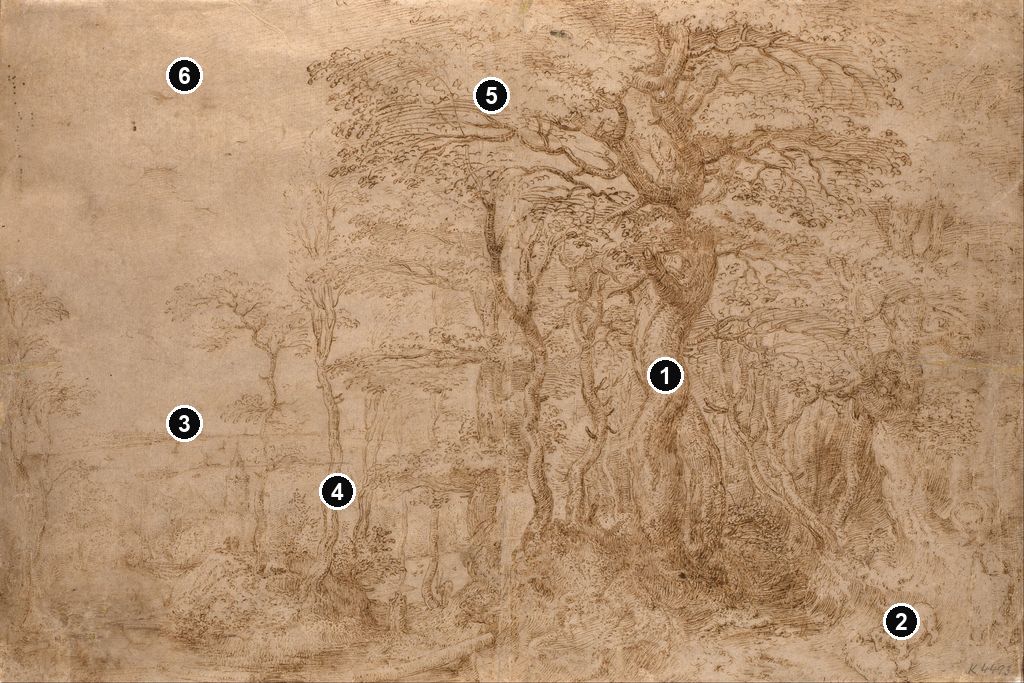
Annotated Details from Sylvan Landscape with Five Bears
Follow the woodland from the open water to the bears at the right.
Details from SYLVAN LANDSCAPE WITH FIVE BEARS
Six details show how the pen describes trees, water and the small animals.
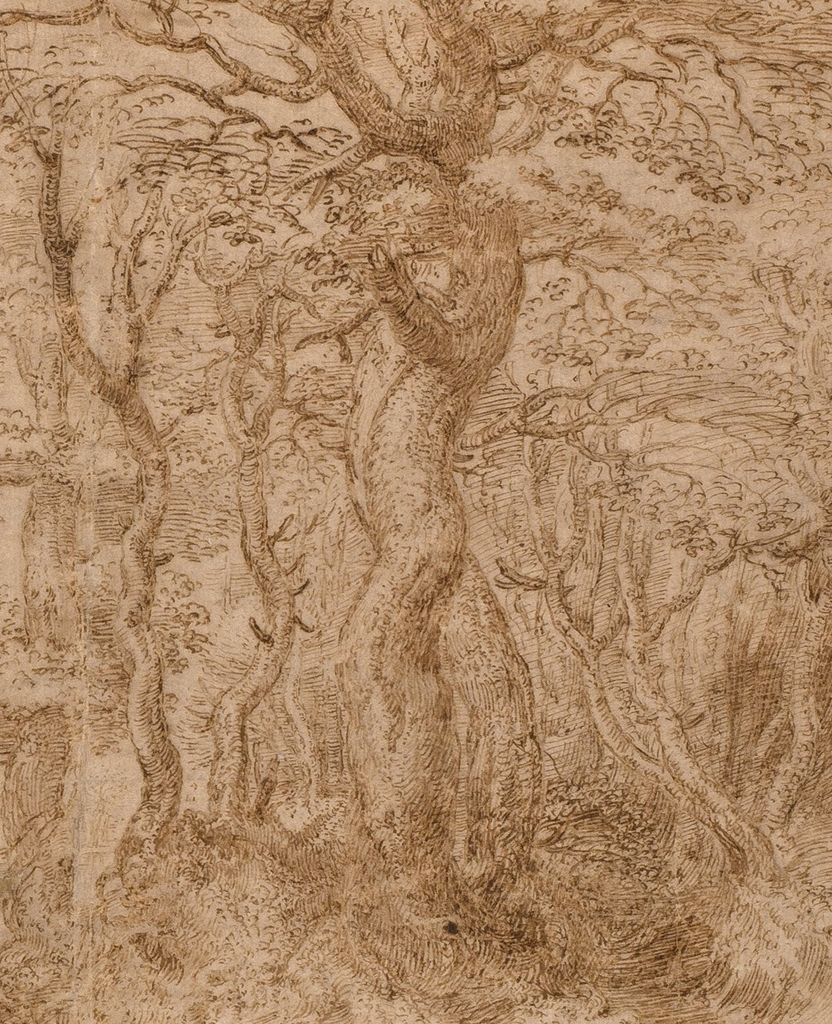
The large twisted trunk
The trunk bends from the shaded bank into the dense crown.
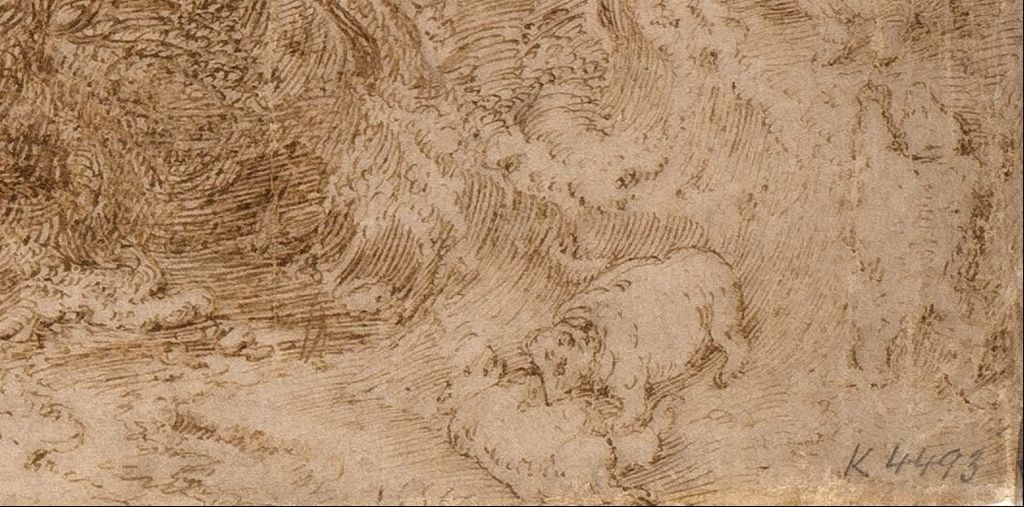
The bear group
The five bears occupy faint ground at the lower right.
The view towards water
Distant ground opens between more widely spaced trees.
The thinner trees
Slender trunks and light branches let the landscape show through.
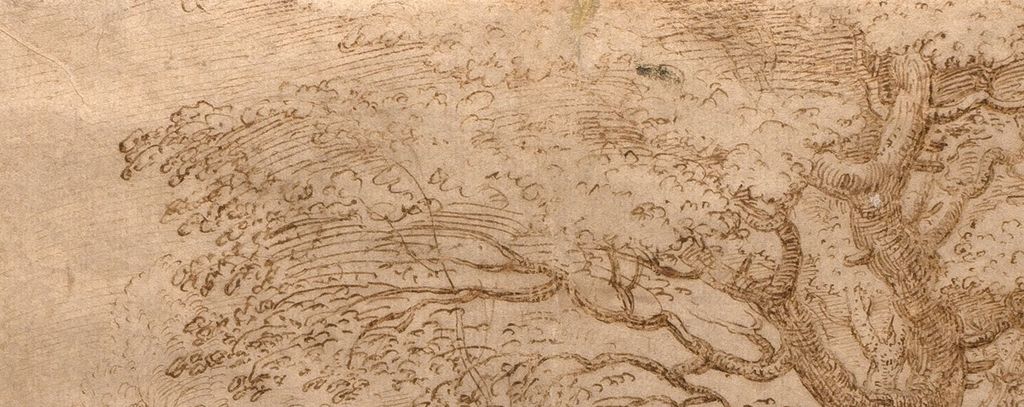
Loops in the foliage
Short irregular curves mark the transition from branches to sky.
A small bird in the sky
A brief dark form can be read against the relatively open sky.
Pieter Bruegel the Elder, Sylvan Landscape with Five Bears, 1554. National Gallery Prague, K 4493 recto. Reproduction via Wikimedia Commons. Public domain.
Finding the Five Bears
Look at the open ground beneath the trees at the lower right. The bears are more difficult to trace than the main trunk, partly because the sheet is damaged and some lines are now faint. The 2001 catalogue identifies five bears in this part of the drawing and describes them as playing. Their rounded forms lie close to the broken outline of the forest floor. They are most easily recognised by looking at the area as a group before trying to separate the individual animals. The tree gives the group a reference point even where the drawing is hard to read [1].
The animals also provide a scale for the space at the right. They are small beside the great trunk, but occupy a distinct opening below it. The woodland therefore contains both dense growth and a place where animals can be seen. Much of the figure drawing in this area is less emphatic than the lines of branches above. Once you find the bears, however, you can see how the open patch below the tree provides room for a subject without interrupting the larger shape of the wood.
The Drawing and Its Reverse
The exhibition catalogue records the date at the lower right and describes the long history of questions about the drawing. It had been treated as a later copy after the etching before Karl Arndt recognised it as a drawing by Bruegel in 1966. Orenstein points to the shape of the birds, the small hooked curves of the foliage and the parallel hatching used to give certain forms volume. These are comparisons at the scale of individual pen strokes, backed by a composition whose arrangement is consistent with other landscapes of the period [1].
The reverse carries a quickly sketched estuary and a city in the distance. The exhibition catalogue titles it Estuary with City in Background and places it about 1554. The Antwerp exhibition guide also lists both sides under the Prague inventory number. The reverse extends the comparison with Bruegel’s river drawings, while the front has the trees and bears that give this page its title. A description of the distant city on the reverse refers to a different view drawn on the same sheet [1] [2].
How Cock Changed the Landscape
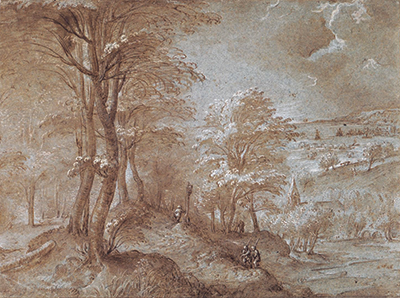
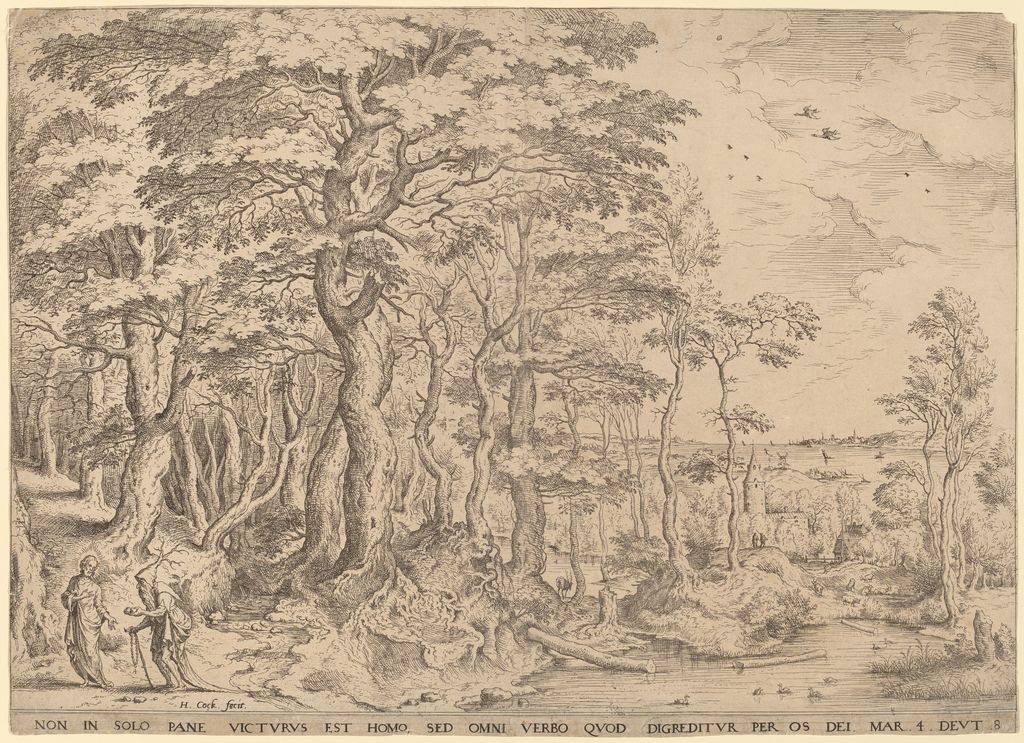
Hieronymus Cock’s Landscape with the Temptation of Christ, reproduced below, presents the great tree on the left. Look from the curve of its trunk towards the thinner trees and then out to the right, where the water and open sky extend beyond the wood. The main organisation of the drawing survives in reverse. In the corner where the bears would appear after that reversal, Cock shows Christ and the tempter. The resulting print takes the landscape of Bruegel’s drawing as a setting for a new episode [3] [1].
The National Gallery of Art records its impression as an etching. The 2001 catalogue describes the print more broadly as etching and engraving, and notes the biblical caption beneath it. In the print, the two figures at the edge gain prominence from the caption as well as their position on a lighter patch of ground. The caption makes the scene a particular encounter. The image still offers a long view out of the forest, so the landscape continues to occupy most of the viewer’s attention [3] [1].
The comparison helps clarify what changed and what remains legible in the Prague sheet. Cock preserved the arrangement of the largest branches and the view through thinner trees to the water. His lines also make some details easier to see than in the damaged drawing. The different foreground subjects are easiest to compare after locating those shared features. Start with the trunk, follow the bank and then look to the place where Bruegel drew the bears and Cock placed his two figures [1] [3].
Discussion
Which detail in this work most changes how you read it?
Frequently Asked Questions
At the left, the trees are smaller and more widely spaced. Some can be recognised by an upright line and a small suggestion of foliage. [1]
Look at the open ground beneath the trees at the lower right. The bears are more difficult to trace than the main trunk, partly because the sheet is damaged and some lines are now faint. [1]
The exhibition catalogue records the date at the lower right and describes the long history of questions about the drawing. It had been treated as a later copy after the etching before Karl Arndt recognised it as a drawing by Bruegel in 1966. [1]
References
- Nadine M. Orenstein, ed., Pieter Bruegel the Elder, Drawings and Prints, 2001, cat. nos. 14–16, View source.
- Snijders&Rockox House, Jan Brueghel exhibition guide, Wooded Landscape with Five Bears, K 4493, View source.
- National Gallery of Art, Hieronymus Cock, Landscape with the Temptation of Christ, 1970.33.1, View source.








