


 by Tom Gurney
Tom Gurney BSc (Hons) is an art history expert with over 20 years experience
Published on June 19, 2020 / Updated on October 14, 2023
Email: tomgurney1@gmail.com / Phone: +44 7429 011000
The Way to Emmaus: Introduction
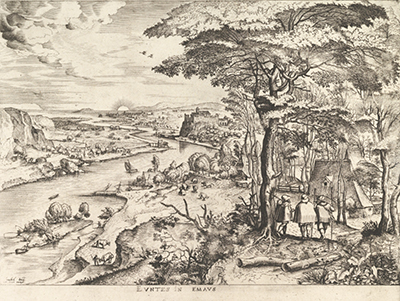
The Way to Emmaus, inscribed Euntes in Emaus, is an etching with engraving in the Large Landscapes series. Johannes and Lucas van Doetecum made it around 1555–56 after Pieter Bruegel the Elder, and Hieronymus Cock published it in Antwerp. Three travellers walk together below a large tree at the right. Beyond them, a river runs past fields, buildings and a fortress. The print gives the encounter from Luke 24 a place within a much longer journey, across a landscape the viewer can explore from the path to the horizon [1] [4] [5].
This work across Bruegel’s career
Tower of Babel
1563The Harvesters
1565Peasant Wedding
1568Children's Games
1560Triumph of Death
1562–1563The Way to Emmaus
This artworkContents
- Introduction
- Three People on the Path
- The River and the Fortress
- What the Drawing and the Print Share
- Reading the Landscape as a Journey
- Annotated Details
Three People on the Path
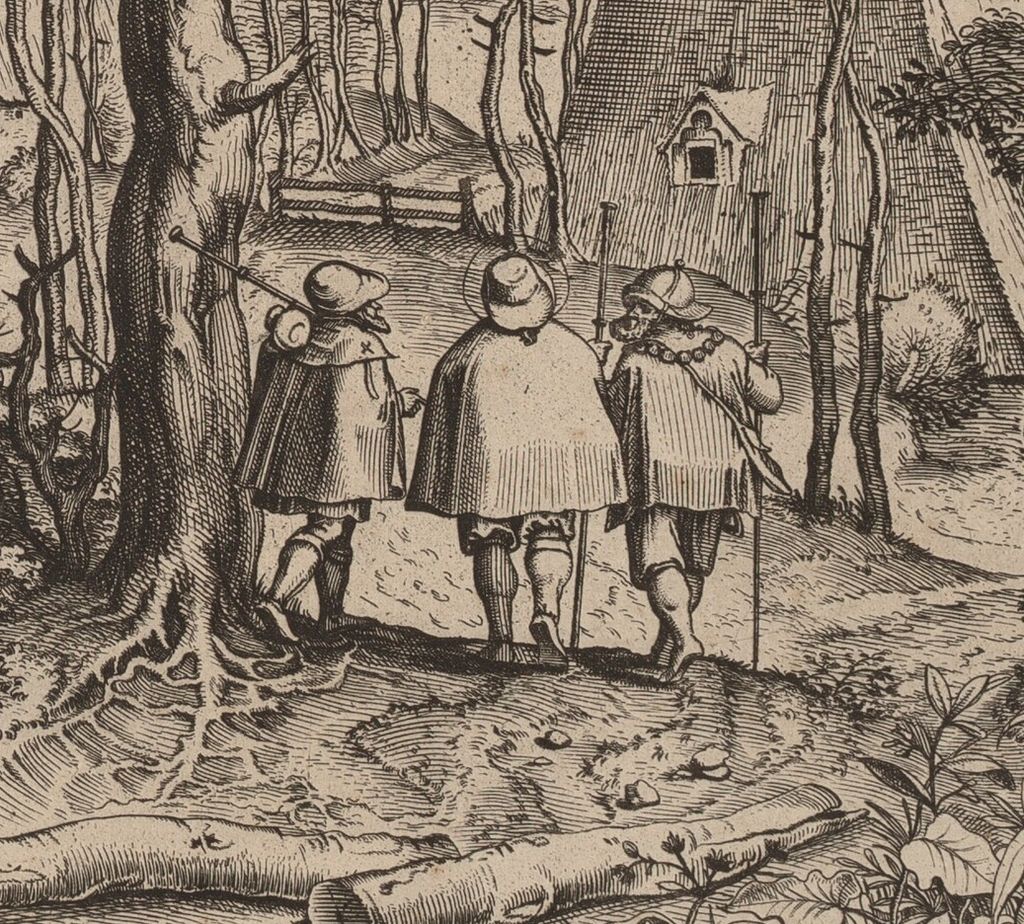
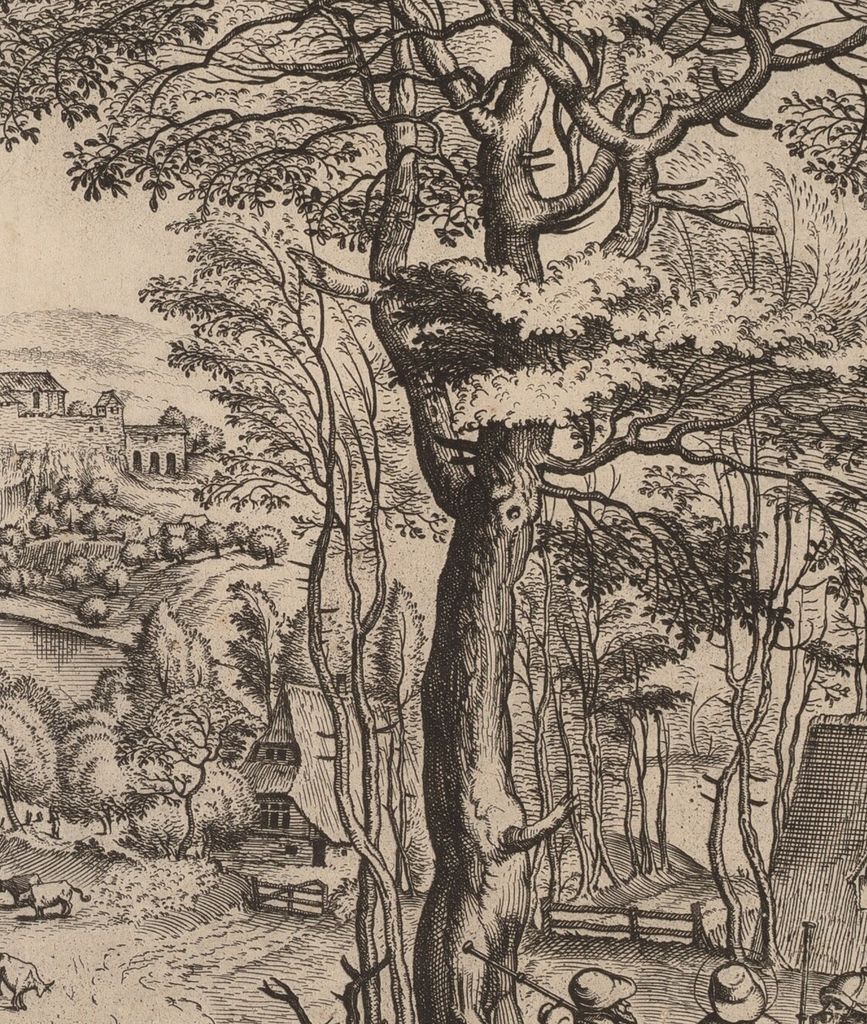
Begin below the canopy at the right. Several darker verticals separate the figures from the open view. The travellers can be found by their upright bodies and the open ground immediately around their feet. Their cloaks make three closely spaced shapes, each about the same height. The narrow interval between them and the tree explains how they can walk together in a view where almost everything else is either much larger or much farther away.
Look for the halo around the middle figure. This is the clue that distinguishes the risen Christ from the two travellers alongside him. The 2001 Metropolitan Museum catalogue notes that the halo belongs to the print and is absent from Bruegel’s surviving drawing. The figures’ proximity and similar scale let the group remain a recognisable gathering of people on foot, while the engraved detail identifies the person who has joined them [4] [3].
In Luke 24, two disciples set out from Jerusalem for Emmaus and talk about what has happened. Jesus joins them and asks about their conversation. They do not recognise him at first. Later, at table, they know him when he breaks bread. The print gives its space to the walk. The encounter takes place outside, among trees and tracks that a person could use without knowing what the conversation would become. The title and halo give the viewer information that the travellers do not yet have [5] [1] [4].
The Gospel also describes the disciples asking their companion to stay because evening is approaching. The encounter in the print has none of the visual signs needed to identify the meal. It gives us instead the space in which the invitation becomes possible. The men are going in the same direction, close enough to speak, and the country ahead is still open. Their later recognition gives a reason to look back at this comparatively ordinary arrangement [5] [4].
Annotated Details from The Way to Emmaus
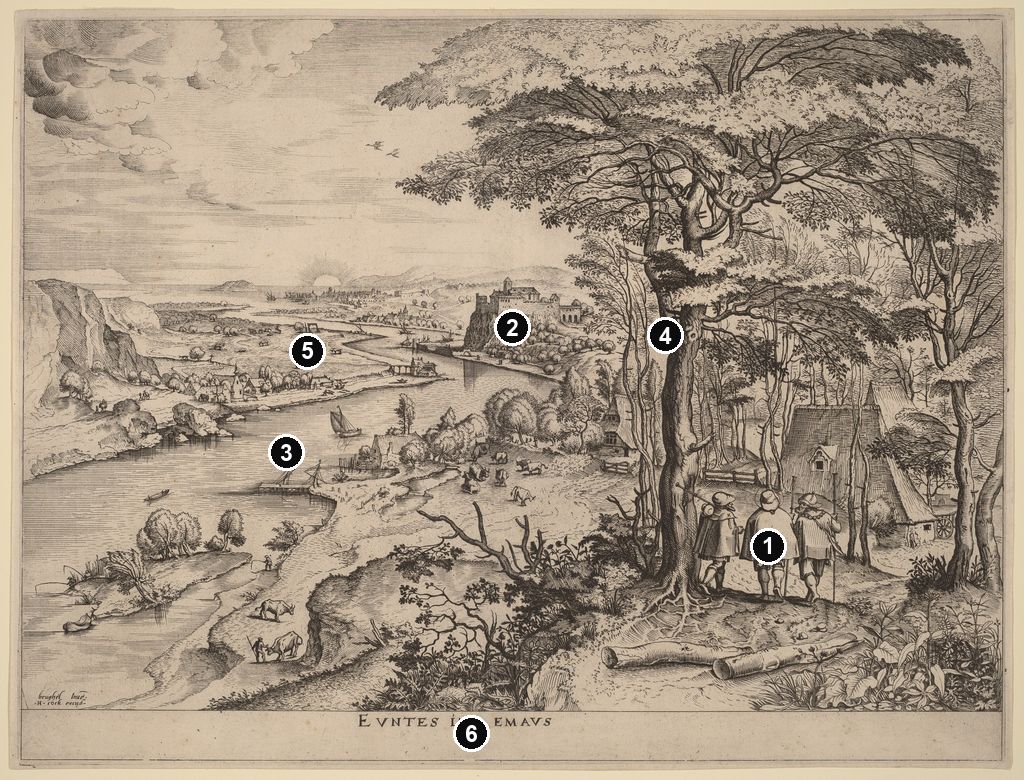
Find the three travellers below the canopy, then follow the river towards the fortress.
Details from THE WAY TO EMMAUS
Six details show the encounter and the landscape through which it takes place.
The three travellers
The travellers walk under the trees. A halo identifies the figure at the centre of the group.
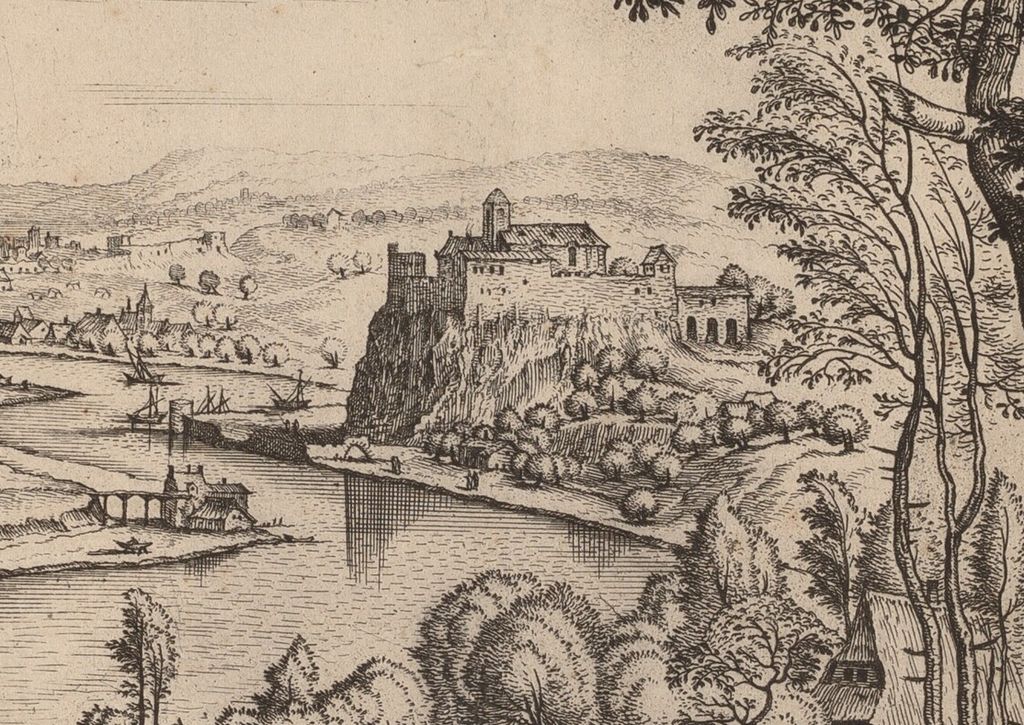
The fortress beyond the river
The upright walls catch the eye beyond the trees. The 2001 Met catalogue reads the fortress as Emmaus.
The river bend
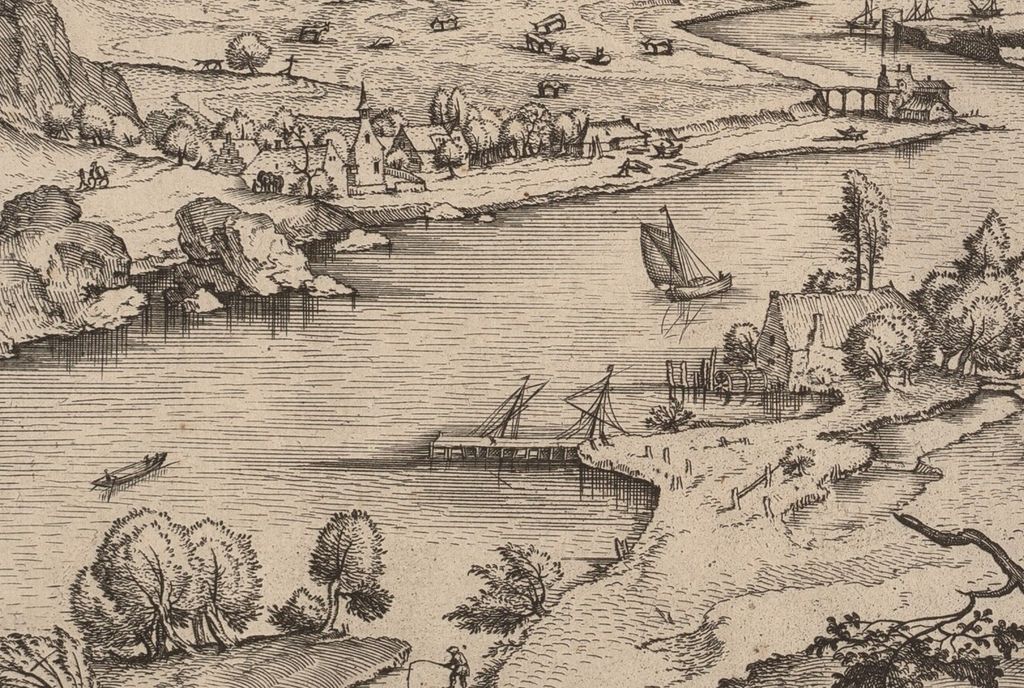
The pale surface makes a path through the view. Small vessels and the marks along the banks keep this stretch of water legible.
The large tree
Closely spaced lines make the trunk much darker than the open ground. Its position helps locate the path.
Fields and distant hills
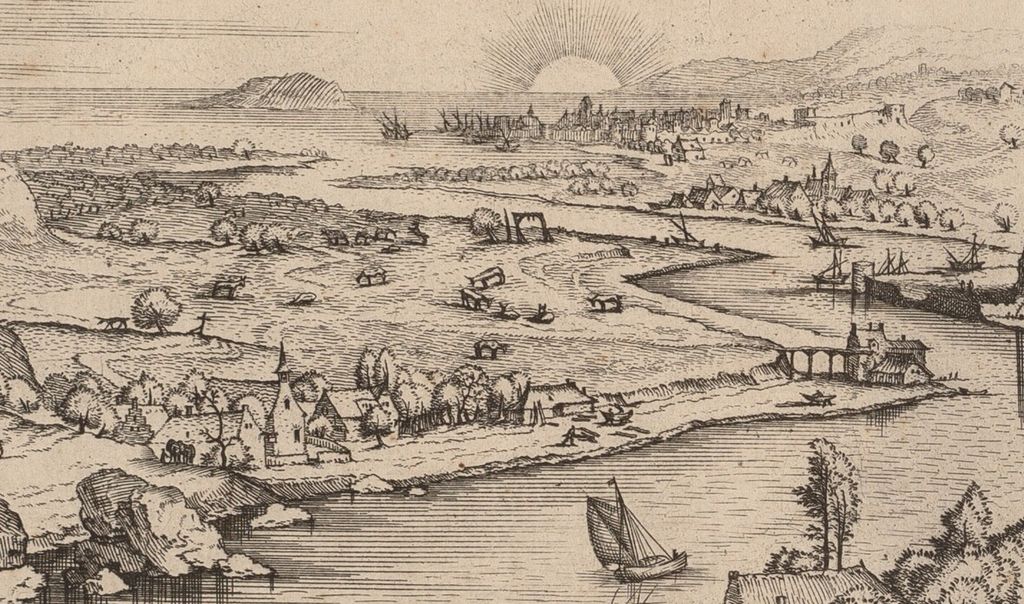
Little groups of marks break up the open ground well beyond the river. Farther off, the hills give way to the pale sky.
The printed title
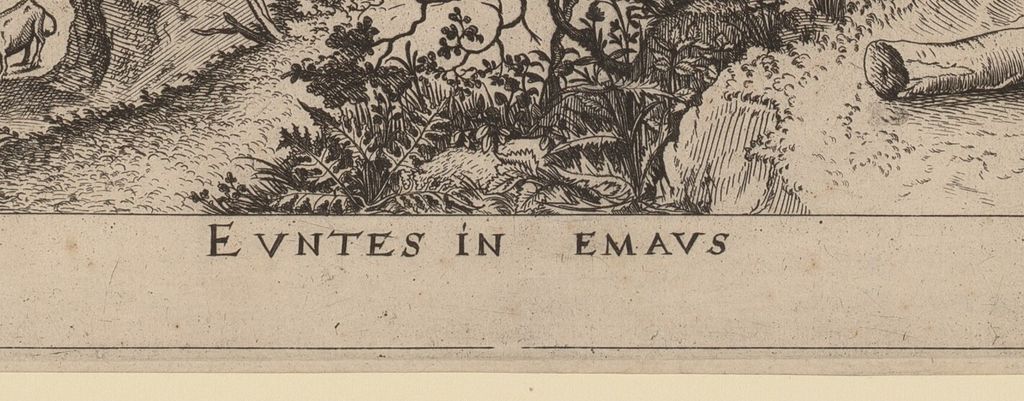
The title beneath the scene names the journey. It belongs to the margin, away from the path and figures it identifies.
Print source for the main image and annotated details: National Gallery of Art, Rosenwald Collection, 1943.3.2124. Public Domain.
The River and the Fortress
The river occupies a broad stretch of the left half of the print. Its pale surface gives the eye a route that does not depend on following the travellers. Start at a near bend, pick out a small vessel and then follow the water towards the bank below the fortress. The lightly worked distance makes the river relatively open against the dark foreground. Several paths and marks on the banks show why the water suits a landscape full of travel even though the central figures are on foot.
The fortress is visible beyond the nearer trees. Its upright walls give the horizon a more particular destination than the remote hills alone. The Met exhibition catalogue interprets the castle as the town of Emmaus, following an established way of picturing that place. This is a proposed reading of the architecture within the image. Its position makes the destination easy to imagine even though the travellers still occupy a small part of the nearer road [4].
Look for the little structures and fields that interrupt the curves of the river. Each one keeps a small space visible. The larger tree works on much the same principle. The foliage, dark bark and openings around the trunk separate the foreground into patches that can be read one at a time. The view stays continuous as those features change size. The travellers are only the people nearest to us in a landscape where water, fields and roads make other journeys possible [2] [4].
What the Drawing and the Print Share
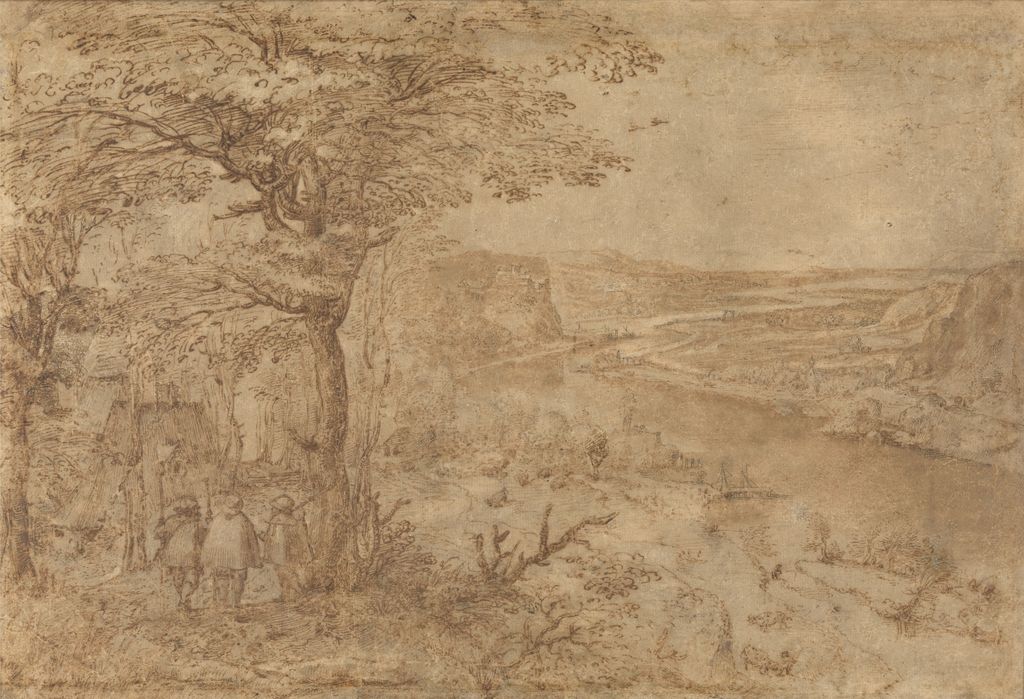
The Royal Museum of Fine Arts Antwerp holds Bruegel’s Landscape with Pilgrims, inventory 5098. It records a sheet of 26 by 41.5 centimetres in brown pen with grey brushwork and brown wash. Orenstein’s catalogue records indented contours and identifies it as a surviving design connected with the Large Landscapes. This gives a comparison for the work done before the print was made. Look for the broad relationship between the wood and river in both, and then notice the smaller detail that names the traveller as Christ in the engraving [3] [4].
The print’s Latin title adds another clue below the image. The Metropolitan Museum and National Gallery of Art identify the Doetecums as the printmakers and Cock as publisher. An impression is an individual sheet printed from the plate. The matching fortress, tree and travellers identify the composition of a small reproduction, while a museum number allows a reader to locate a specific surviving sheet. The Washington impression presented here is 1943.3.2124 [2] [1].
The Antwerp sheet has grey and brown wash alongside lines made with the pen. A wash can join a section of land or foliage into a continuous tone. In the etching, comparable areas depend on the accumulation of lines. The view remains recognizable as a design while those marks change in order to work in another medium [3] [4] [1].
The mark-making also changes with the medium. In the print, dense groups of lines form the darker branches and trunks. Comparatively light areas give the river and the sky room to open out. Compare the dark edge of a branch with the marks along a distant bank. The former needs enough structure to show where the tree hangs over the road. The latter can establish a much larger distance through only a few interruptions of the light surface [1] [2].
Reading the Landscape as a Journey
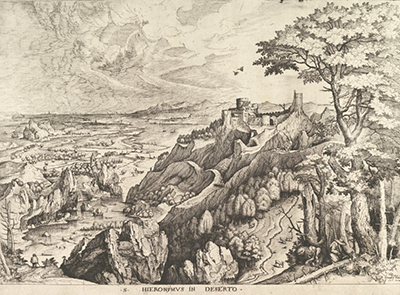
Another of the Large Landscapes, Saint Jerome in the Wilderness, also leaves most of its space to the land and water. In that print the saint sits close to a book and lion. In The Way to Emmaus three standing bodies establish a small stretch of travelled road. Comparing those details gives a sense of what the series can do with a small figure. A book gives a person somewhere to direct their gaze. A path gives a conversation somewhere to go [4] [1].
Return to the three figures after following the river as far as the eye can travel. The view gives the title a sequence of places. The near road accommodates the encounter, a building in the distance helps suggest where it will lead, and the country around both remains visible. Bruegel gives a viewer time to find the people in the landscape before asking what they have yet to discover about the person walking beside them.
Discussion
Which detail in this work most changes how you read it?
Frequently Asked Questions
The fortress is visible beyond the nearer trees. Its upright walls give the horizon a more particular destination than the remote hills alone. [4]
References
- The Metropolitan Museum of Art, Euntes in Emaus, from The Large Landscapes, View source.
- National Gallery of Art, Euntes in Emaus (The Pilgrims to Emmaus), 1943.3.2124, View source.
- Royal Museum of Fine Arts Antwerp, Landscape with Pilgrims, drawing 5098, View source.
- Nadine M. Orenstein, ed., Pieter Bruegel the Elder, Drawings and Prints, Metropolitan Museum of Art, 2001, nos. 22–23, View source.
- United States Conference of Catholic Bishops, Luke 24, View source.







