


 by Tom Gurney
Tom Gurney BSc (Hons) is an art history expert with over 20 years experience
Published on June 19, 2020 / Updated on October 14, 2023
Email: tomgurney1@gmail.com / Phone: +44 7429 011000
Wooded Region: Introduction
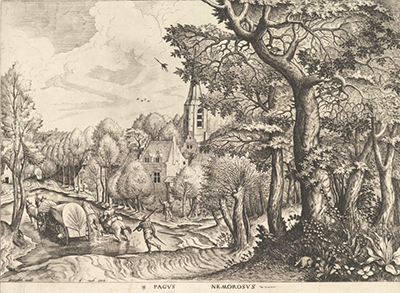
Wooded Region, or Pagus Nemorosus, is an etching with engraving from the Large Landscapes. Johannes and Lucas van Doetecum made the plate after Pieter Bruegel the Elder around 1555–56, and Hieronymus Cock published it. A covered wagon moves through shallow water near a village. Above the crossing, a church stands in a gap in the foliage. One large tree at the right takes up more space than the wagon, the people and the buildings together. The print gives the viewer time to see how a small journey fits into an ordinary stretch of country [3] [1] [2].
This work across Bruegel’s career
Tower of Babel
1563The Harvesters
1565Peasant Wedding
1568Children's Games
1560Triumph of Death
1562–1563Wooded Region
This artworkContents
- Introduction
- Crossing the Water
- The Church and the Wood
- Bruegel, the Printmakers and the Publisher
- A Landscape of the Low Countries
- Annotated Details
Crossing the Water
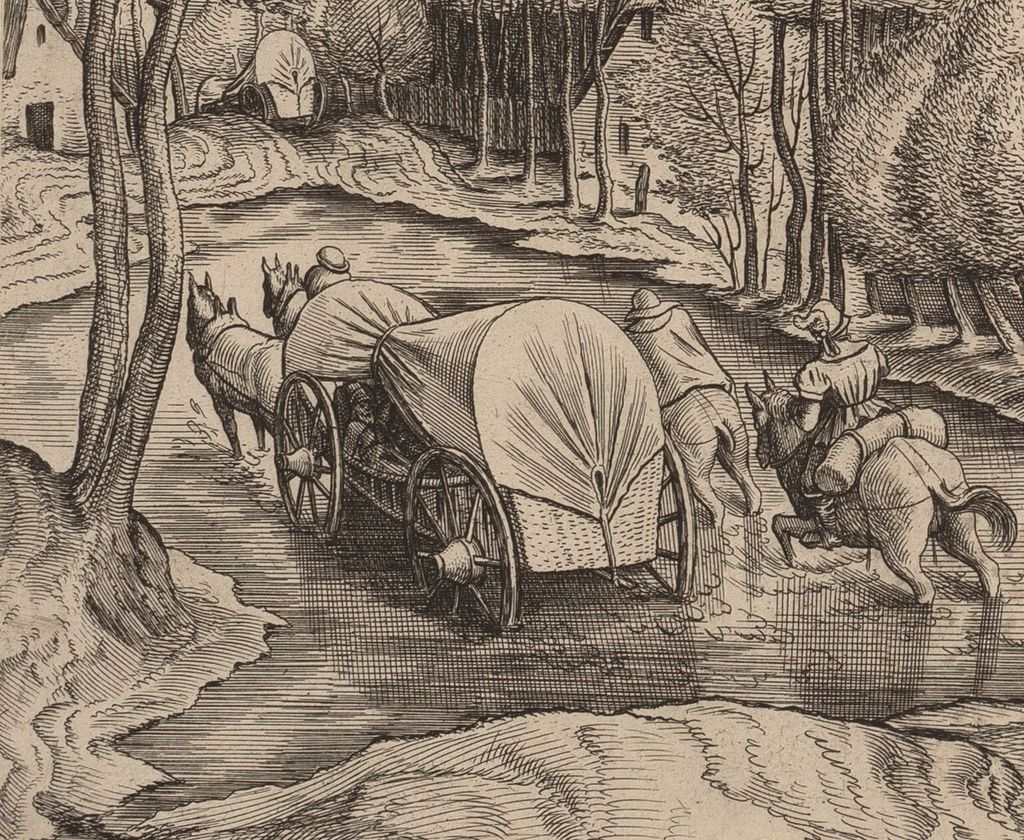
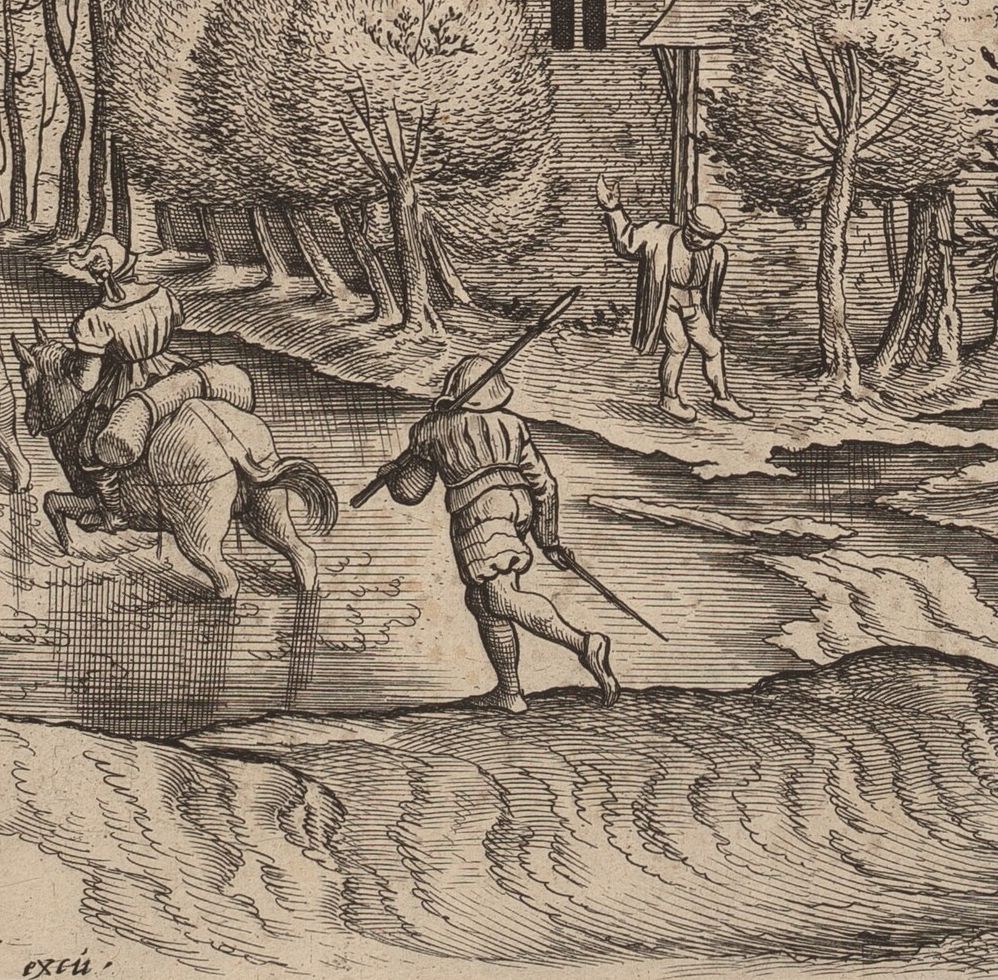
Find the wagon at the lower left by the rounded cloth that covers its passengers. The wheels run through a band of water. A little farther to the right, a man carrying a lance and sword walks towards the crossing. The Metropolitan Museum exhibition catalogue identifies two horsemen accompanying the wagon. Watching the differences between their positions makes sense of the movement. One part of the group has already entered the pool, while a person coming along on foot still has its edge ahead of him [3].
The road is clearest just before it meets the water. Parallel irregular lines describe the ground, and horizontal strokes replace them where the ground gives way to the pool. Some figures overlap both kinds of marks. The near edge of the water curves across the print and gives the viewer a way to judge the distance between the man on foot and the wagon. The cloth over the wagon has its own close folds. They follow the shape of the frame underneath and remain distinct from the longer lines across the water.
The route continues between buildings and trees beyond the pool. On the far bank, a figure stands beside a tree. Farther left, another small covered vehicle appears where the road recedes. The groups occupy different parts of a connected landscape. The approach is easiest to see where pale ground is left open around dark figures and wheel shapes. Farther away, a viewer has to reconstruct the way through breaks in the trees and between the roofs.
Annotated Details from Wooded Region
Find the wagon in the water, then follow the road towards the village and look back into the woods.
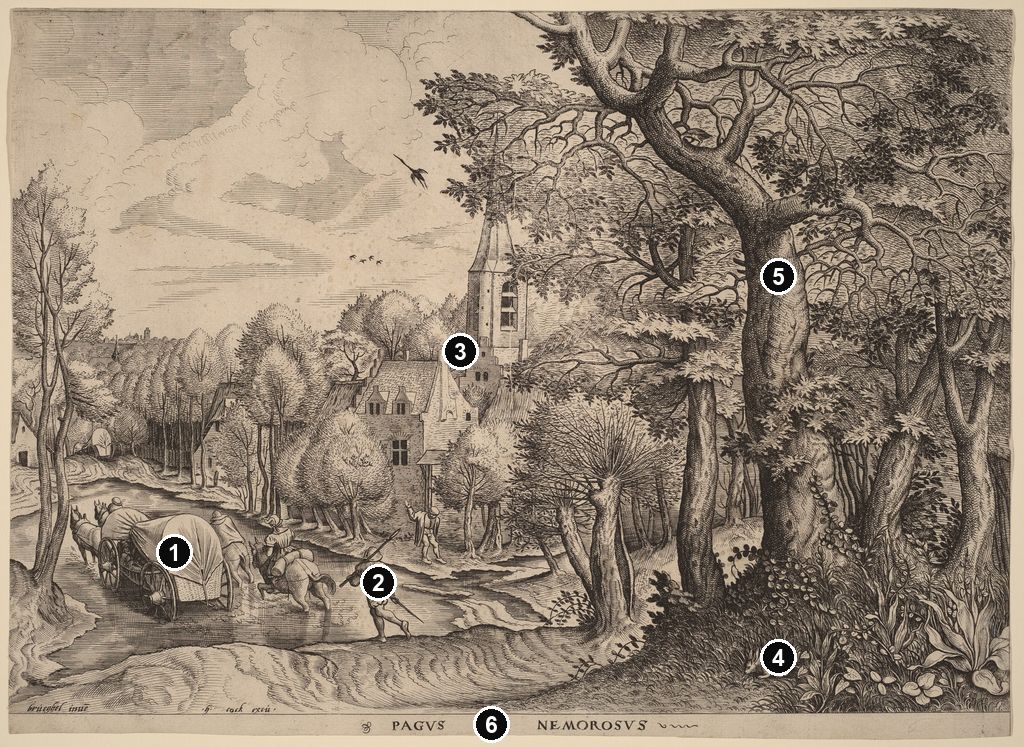
Details from WOODED REGION
Six details show the crossing, the woodland and the printed title.
The covered wagon
The cloth folds over the wagon frame as the wheels pass through the pool.
The man with a lance
The man approaching the water holds a lance at an angle across the route.
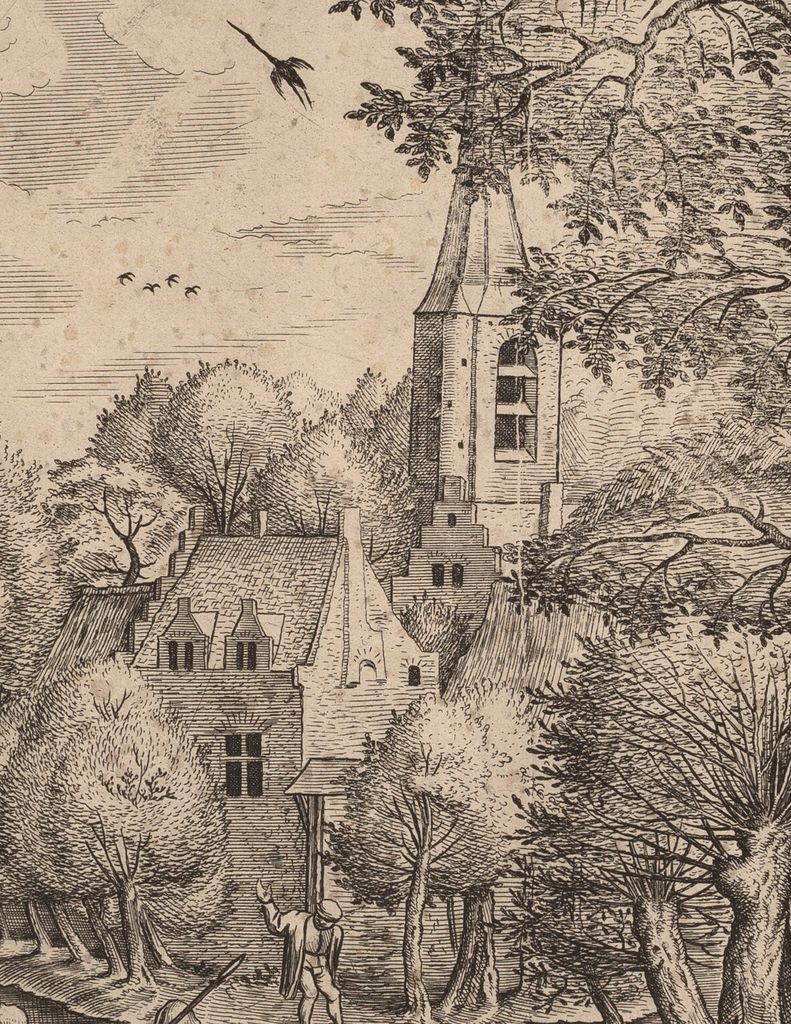
The church and village
A church spire rises above gabled houses. The open ground below them leads back to the crossing.
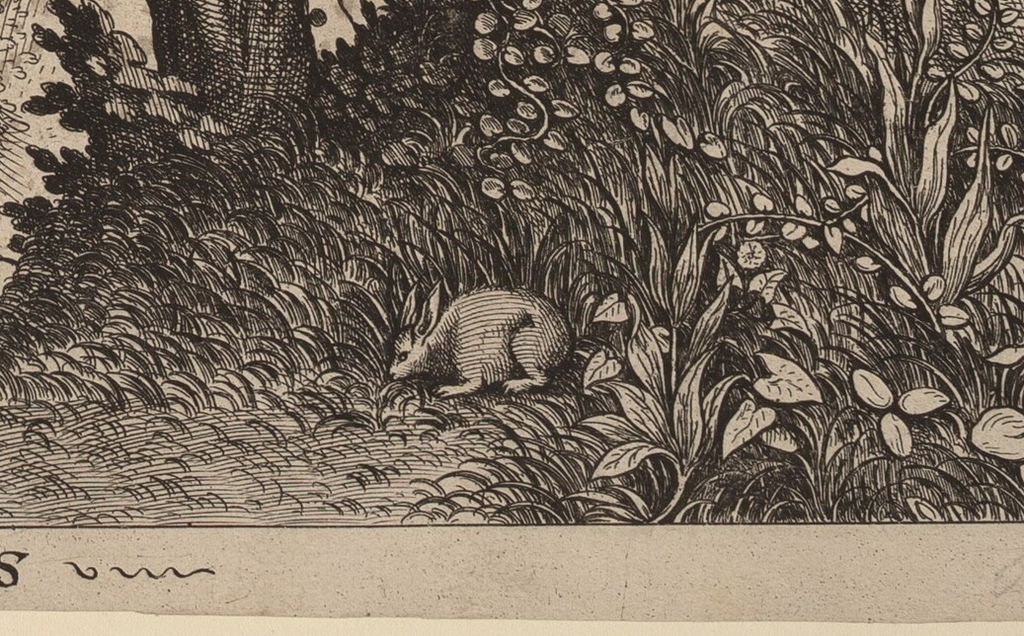
The rabbit in the undergrowth
A small rabbit bends among the leaves at the edge of the wood.
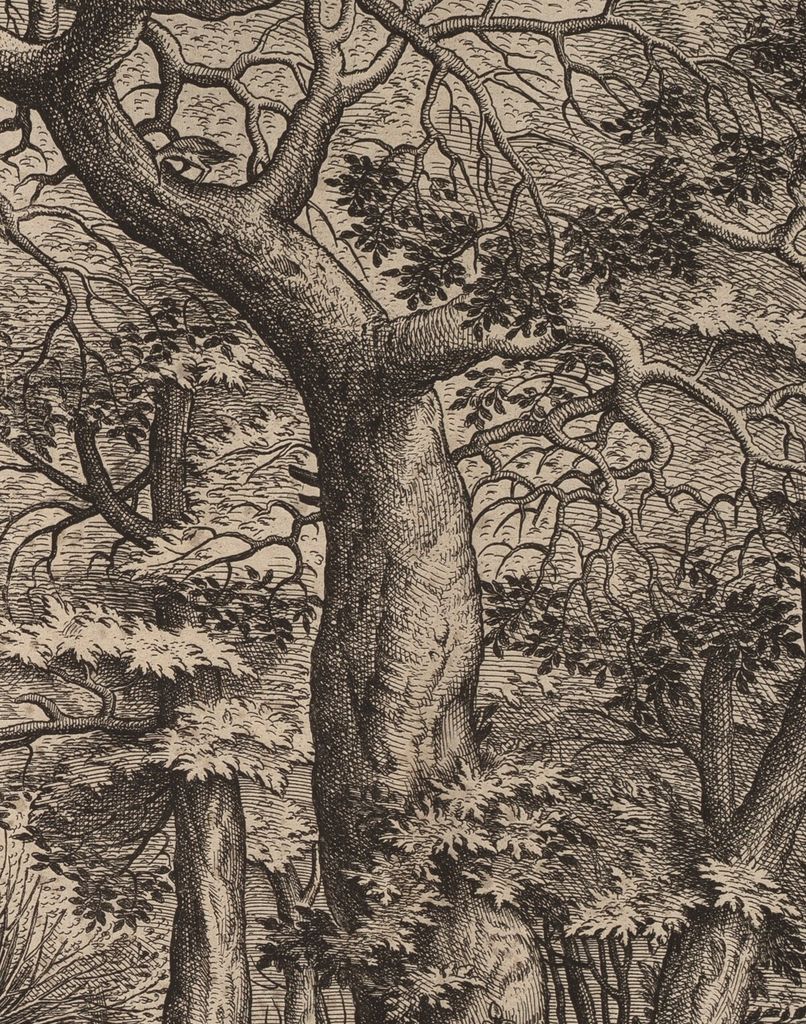
The large tree
Closely spaced lines turn around the trunk, which divides into spreading branches.
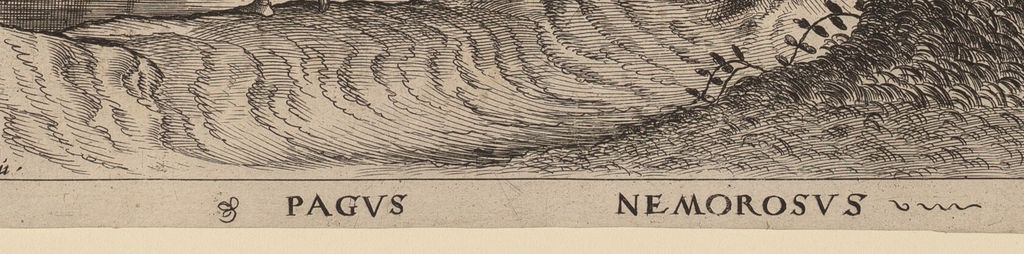
The title in the margin
The words PAGVS NEMOROSVS appear below the scene.
Johannes and Lucas van Doetecum, after Pieter Bruegel the Elder, Pagus Nemorosus. Published by Hieronymus Cock. Rosenwald Collection, National Gallery of Art, 1964.8.419. Public domain.
The Church and the Wood
The church tower rises near the middle of the print, behind the houses. Below it, windows and the edges of the roofs make upright and slanting lines that are quite different from the curved strokes in the surrounding greenery. The tower is a useful fixed point when following the moving group. The wagon travels across the lower part of the view, while the tower fixes the place to which the surrounding paths and buildings belong. On the left horizon the exhibition catalogue identifies a more distant city [3].
The right half is given over to trees and plants. A large trunk bends out of the undergrowth and branches over the upper edge. In the undergrowth near the bottom, a small rabbit bends low among the leaves. The exhibition catalogue points out that the corresponding corner of many other Large Landscapes prints is occupied by people connected with the subject named in the title. Here an animal is enough to reward a closer look. Its small body fits into the grass and ground cover that the larger tree makes easy to overlook [3].
The makers used changes in the direction and density of the lines to make different kinds of distance. Around the trunk, many strokes follow the direction of the bark and sit close enough together to make a substantial shadow. Clouds are treated with much longer stretches of parallel work, interrupted where their lighter edges meet the sky. The distant town is a low group in that lighter part of the composition. The contrast lets the viewer see the space between the far roofs and the nearest plants, even though both have been printed in the same ink.
Bruegel, the Printmakers and the Publisher
In the Washington impression, the inscriptions at the lower left identify Bruegel as the inventor of the design and Cock as the publisher. The National Gallery of Art records the makers as Johannes and Lucas van Doetechum, a spelling also found in modern catalogue records. The Latin title lies below the scene. Washington calls its impression Wooded Village in English, while the Met exhibition catalogue and the Städel use Wooded Region. Both refer to the image with the wagon crossing under the trees [1] [3] [2].
The Washington sheet is catalogued as etching and engraving on laid paper, in the first of two states. A state describes a stage in the working life of the printing plate. An impression is a particular sheet printed from it. The Met exhibition catalogue illustrates a first-state impression from the Museum of Fine Arts, Boston, while the image shown here comes from the Rosenwald Collection in Washington. The Washington record notes that its sheet has been trimmed within the plate. Its dimensions therefore describe that surviving sheet, including the margins it still has [1] [3].
The printed scene fills a sheet about 42 centimetres wide in the Washington impression. At that scale, the lines can be seen by turns as marks and as parts of a larger pattern. The branches at the right carry much finer strokes than the broad riverbank below. Their size helps explain why a viewer can recognise the landscape from across a room and still find small subjects such as the rabbit only on approaching the print [1].
A Landscape of the Low Countries
The Large Landscapes often set travellers or other small figures among steep valleys and distant mountains. Orenstein identifies Wooded Region as the series’ fully Flemish view. A broad ridge or distant rock face could have drawn attention past the village. Here the spire and woods retain much of the emphasis, and the hills give the print just enough height to place a distant town behind the trees. Orenstein also connects this interest in local country with the Small Landscapes, a later and separately issued series that the Van Doetecums worked on for Cock [3].
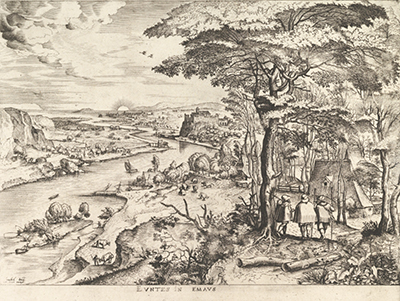
The comparison below shows The Way to Emmaus, another print in the Large Landscapes. The large tree at the right frames three walkers, and a broad river leads towards buildings in the distance. In Wooded Region, the wagon’s crossing brings the water much nearer. The two compositions give familiar elements different jobs. In one, water helps a viewer travel across a wide prospect. In the other, its edge marks the ground the wagon and its companions have immediately ahead of them [4] [3].
Look once more at the path from the pool to the houses. The church remains easy to locate even when the small figures fall away into the trees. At the opposite edge, the rabbit sits within foliage that would be harder to read if the viewer stayed with the wagon. The name Pagus Nemorosus fits both experiences. The village gives the route a setting, and the woods determine how much of that setting a viewer can see at once.
Discussion
Which detail in this work most changes how you read it?
Frequently Asked Questions
Find the wagon at the lower left by the rounded cloth that covers its passengers. The wheels run through a band of water. [3]
The church tower rises near the middle of the print, behind the houses. Below it, windows and the edges of the roofs make upright and slanting lines that are quite different from the curved strokes in the surrounding greenery. [3]
References
- National Gallery of Art, Pagus Nemorosus (Wooded Village), 1964.8.419, View source.
- Städel Museum, Wooded Region, from The Large Landscapes, View source.
- Nadine M. Orenstein, ed., Pieter Bruegel the Elder, Drawings and Prints, Metropolitan Museum of Art, 2001, nos. 23 and 32, View source.
- National Gallery of Art, Euntes in Emaus (The Pilgrims to Emmaus), 1943.3.2124, View source.







