


 by Tom Gurney
Tom Gurney BSc (Hons) is an art history expert with over 20 years experience
Published on June 19, 2020 / Updated on October 14, 2023
Email: tomgurney1@gmail.com / Phone: +44 7429 011000
Spring: Introduction
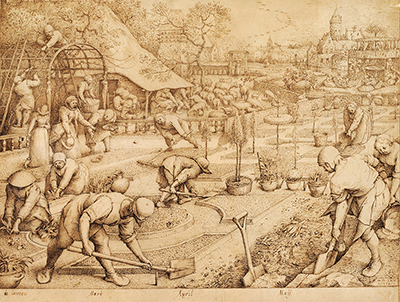
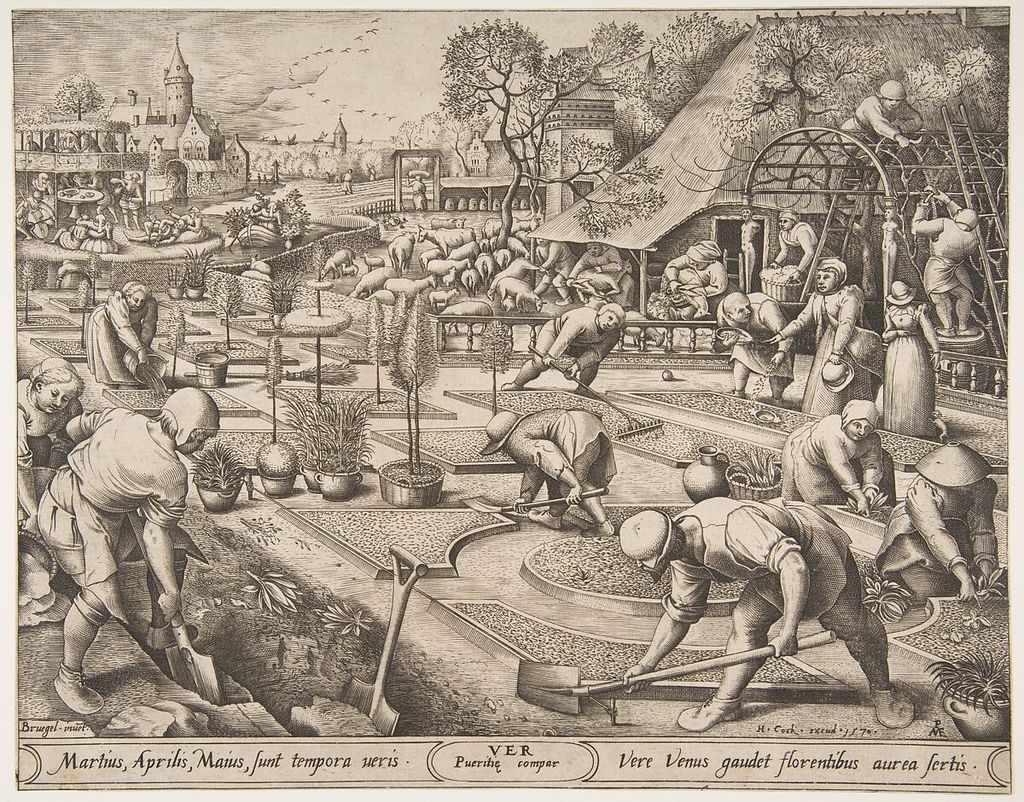
Pieter Bruegel the Elder’s Spring is a signed pen-and-brown-ink drawing of 1565 in the Albertina, Vienna. People dig and plant in a formal garden, shear sheep under a shelter and amuse themselves farther away. The drawing names March, April and May along its lower edge. Pieter van der Heyden engraved the design for Hieronymus Cock’s four-part series of 1570. The drawing above and the printed version show the same main activities, but a viewer will find them on opposite sides [1] [2] [3].
This work across Bruegel’s career
Tower of Babel
1563The Harvesters
1565Peasant Wedding
1568Children's Games
1560Triumph of Death
1562–1563Spring
This artworkContents
- Introduction
- Work in the Garden
- The Sheepfold and the May Garden
- The Pen Lines and the Printed Sheet
- Spring in the Painted Year
- Annotated Details
Work in the Garden
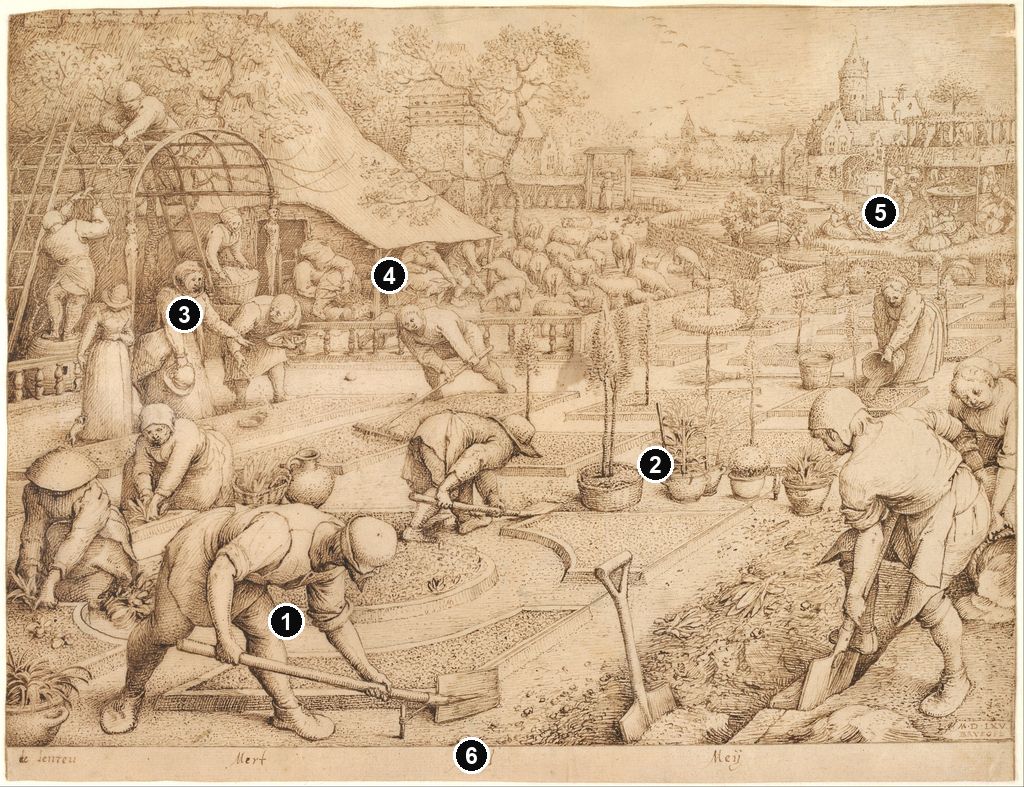
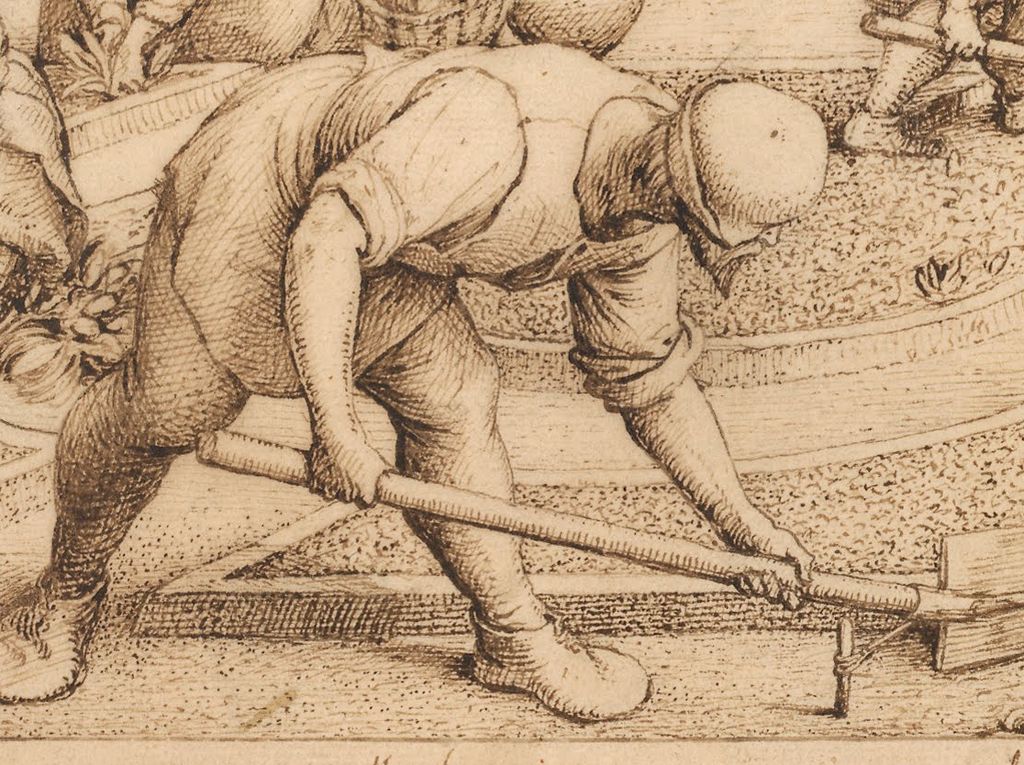
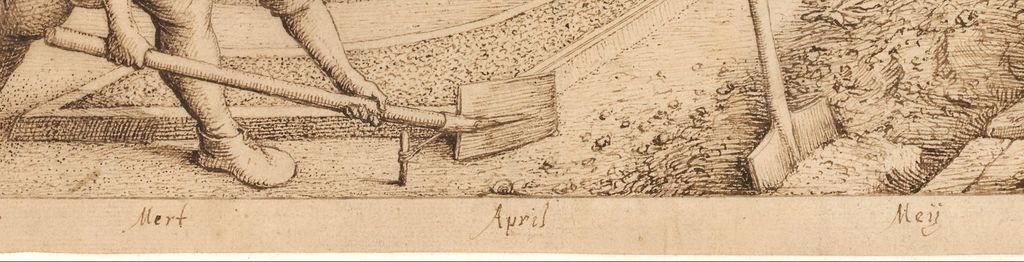
Start with the largest gardeners. Near the lower left, one bends over a spade held at a low angle. A worker on the right uses another tool close to the margin of a garden bed. Look along the shafts to see which part of the ground each person can reach. The shapes of the beds then make more sense. Some have clean borders and others contain rougher ground where the people still have work to do. Straight paths and curved beds both organize the movements in the foreground [1] [2].
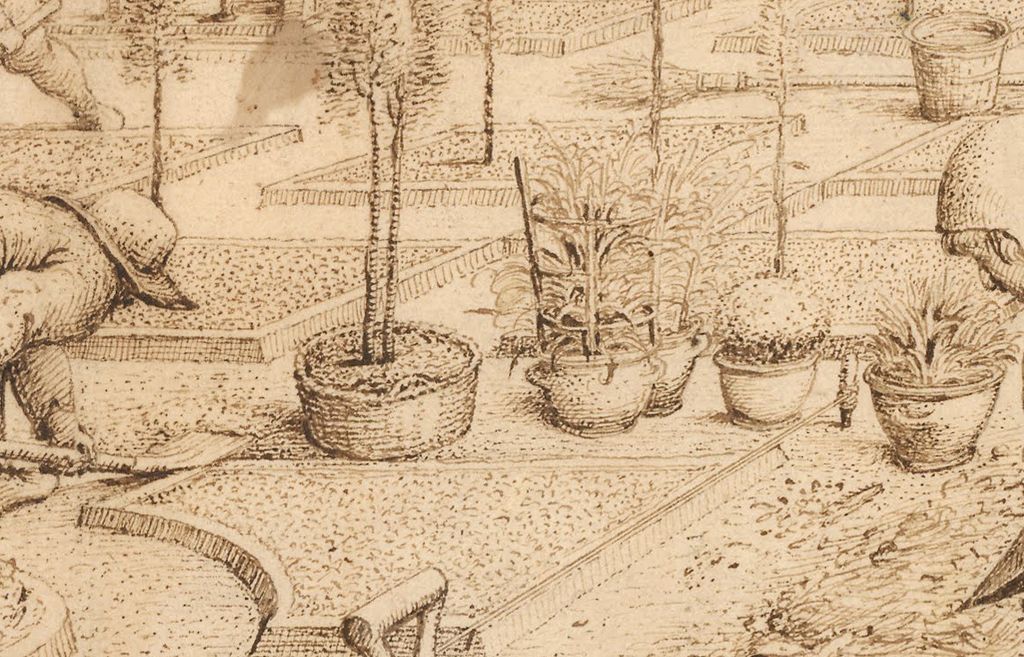
Behind the nearer workers are pots and a set of small trees. Their size and spacing make it easier to see the passage between the beds and the more distant activities. Several of their narrow upright trunks hold their place against a dense background. A viewer can compare the little trees with the tools in the foreground. The handles are carried or set down where someone needs them. The trees mark points in the garden that give the layout some continuity when people move from one place to another.
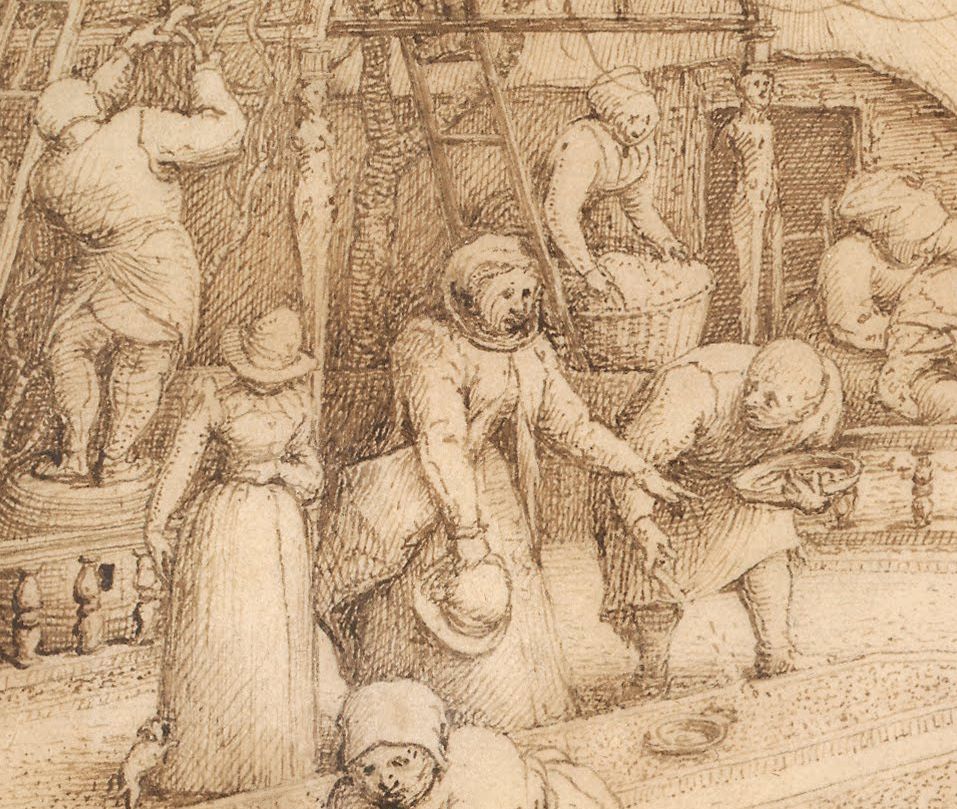
A woman stands nearby and addresses a gardener. One can look along her arm towards the work beside her and then compare it with the longer motions of the people digging. Much of this area is occupied by people who lean into something. The standing figure gives Bruegel another way to show what it takes to make a garden. Its order is visible in the ground plan and in the positions of workers, and also in the possibility that someone can tell a person where to work next [2].
Annotated Details from Spring
Follow the work from the garden beds to the shelter and the farther grounds.
Details from SPRING
Six details bring the separate activities of the spring months into view.
The two spades
Start with the worker at the curved bed and compare the upright tool nearer the middle.
Beds and potted trees
The trees and their pots repeat at intervals between the beds. Their spacing makes the paths easier to follow.
A gardener receives instructions
The standing figures bring another kind of activity to the garden. Follow their gestures towards the work.
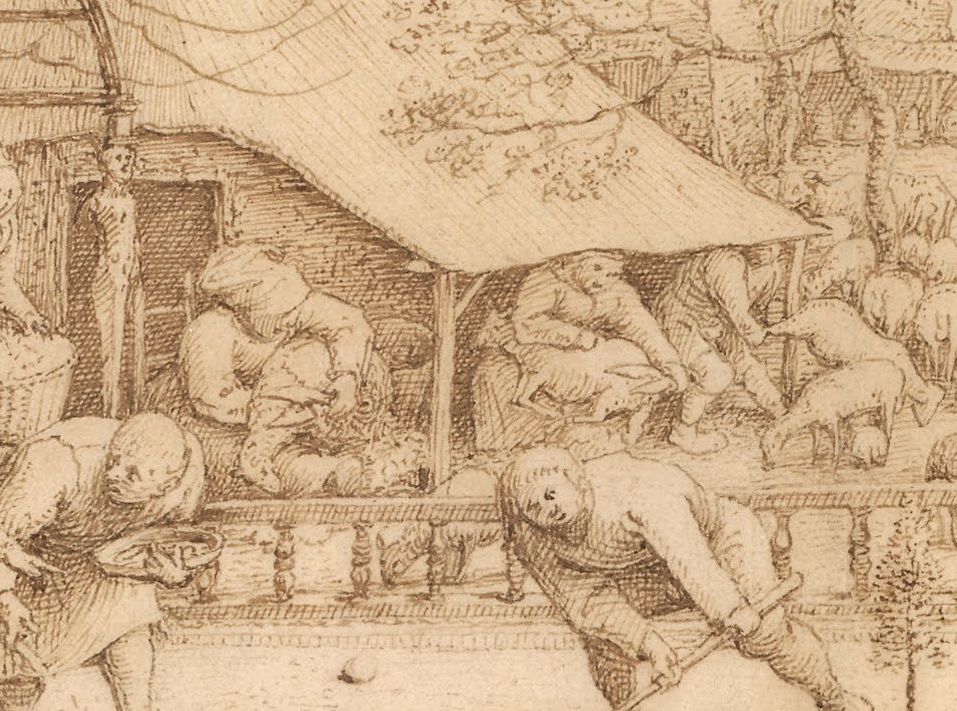
Sheep under cover
The roof shelters the work on the animals. Look past its posts for the bodies grouped together.
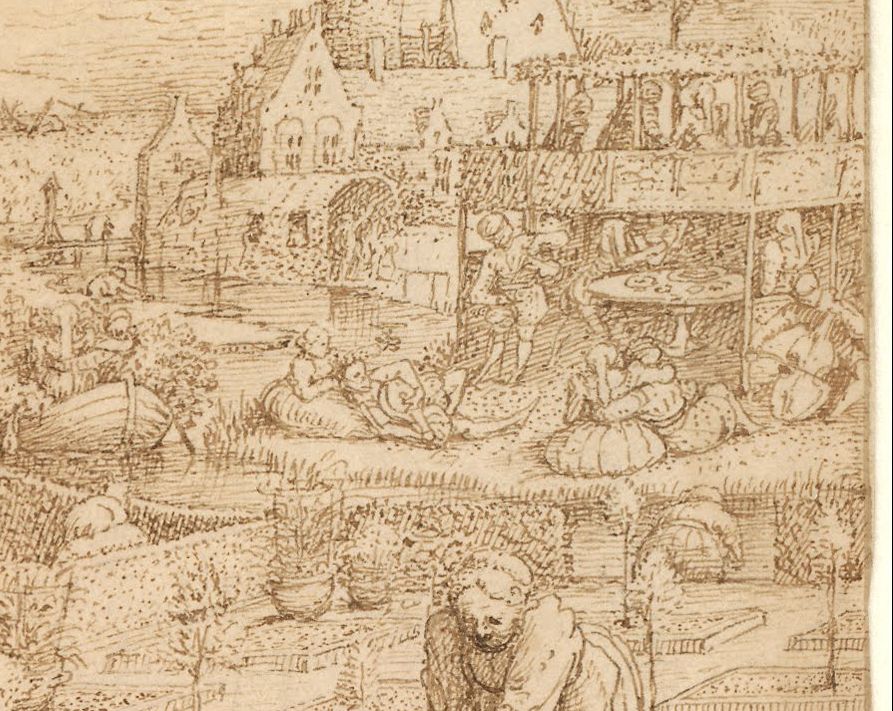
The distant garden
Clumps of small figures gather past the beds. Their scale helps establish the distance to the buildings and entertainments.
Names of the spring months
Read the handwritten names along the lower edge. They give a sequence to the different activities visible in the drawing.
The Sheepfold and the May Garden
Look beyond the formal beds to the sheep under cover. The shelter and the bodies crowded near it give a much less regular outline than the nearest paths. This part of the drawing can still be read as a place set aside for a definite task. Animals need to be brought within reach of the people shearing them, then tended or moved on. Seen from the foreground, the small jostling group occupies one enclosure amid a series of spaces assigned to different uses [1] [2].
Farther away, figures gather in the May garden. The 2001 Met catalogue identifies lovers, boating and music there. These are events a reader has to locate with smaller visual clues than the spades and the nearest pots. The clusters of people and the openings between them can be easier to find than an individual gesture. Bruegel’s use of distance gives the workers the most room to be seen. The distant figures still have enough ground and water for the different kinds of entertainment to remain legible [2].
The three areas correspond to March gardening, April sheep shearing and May festivities in the catalogue’s account. Find the words for the months on the drawing before retracing that sequence into the picture. The order follows a viewer’s movement from the foreground towards the distance. Bruegel gives each part of the season a different use of the ground, and the whole drawing can still be read as a single visit to an estate [1] [2].
The catalogue notes that April was often pictured by driving sheep to pasture. Here the work stays under cover. Look at the change from the open paths among the planting beds to the posts, roof and fence around the animals. The shearing makes the limits of that smaller space especially clear. A seasonal calendar gives the viewer a way to recognise why the sheep are there. Bruegel’s arrangement also lets the viewer see how an enclosure and the tools of a garden make different kinds of work possible [2].
The Pen Lines and the Printed Sheet
The Albertina drawing is accession 23750. It carries Bruegel’s signature and the Roman date at the lower right. The Met exhibition catalogue records contours indented for transfer and describes fine lines, hatching and stippling. Those marks give different kinds of substance to clothes, soil and foliage. They also make it possible for a design of modest size to show both the work of a hand and the parts of a garden well beyond that person’s reach. The catalogue points to reinforced marks on the clothes of the stooping foreground gardener [1] [2].
The engraving was published in 1570, after Bruegel’s death. The Met’s impression, accession 26.72.57, records Van der Heyden as engraver, Bruegel as the artist behind the design and Cock as publisher. The landscape appears reversed, making the large gardeners and the arrangement of the beds visible from the opposite direction. The inscription in Latin below the printed image identifies the season as Ver. It names the months, likens spring to childhood and invokes Venus with flowers. Those lines give a reader associations to consider beyond the work visible in the garden [3] [2].
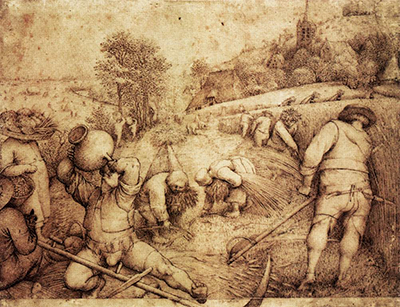
Cock issued four prints as a set. Bruegel made the designs for spring and Summer, and Hans Bol supplied autumn and winter. A reader can compare the age associated with each of Bruegel’s published designs. The spring inscription evokes childhood and the summer inscription evokes youth. The same reader might also notice how different the handling of labour is on the two sheets. The spades and garden beds in Spring keep the work closely arranged, while the mower and the drinker in Summer take up much of a field’s foreground [1] [2].
Spring in the Painted Year
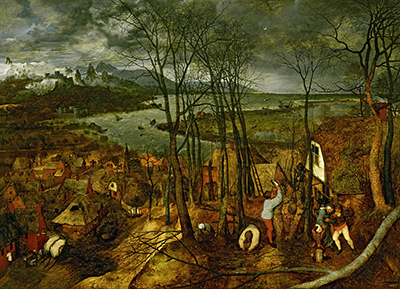
The Albertina relates this drawing to the calendars of the months and distinguishes it from Bruegel’s painted series of 1565. In the painted cycle, spring was divided between two panels. The Gloomy Day depicts early spring with wood cutting, threatening weather and traces of carnival. The panel for late spring is lost. Bruegel’s signed drawing shows a different set of seasonal tasks, and the series for which it was made divides the year into four. The drawing is a surviving design for that separate publication [1] [4].
Look again at the routes through the garden. It is possible to follow one worker and one bed in close detail, then see the place for the sheep and the amusements farther back. Each takes a different amount of space. The months printed below the engraving give the order words. In the drawing, much of that order is already visible in where Bruegel put the people and how far the viewer has to travel to find them.
Discussion
Which detail in this work most changes how you read it?
Frequently Asked Questions
References
- Albertina, Der Frühling, drawing 23750, View source.
- Nadine M. Orenstein, ed., Pieter Bruegel the Elder, Drawings and Prints, Metropolitan Museum of Art, 2001, nos. 105–106, View source.
- The Metropolitan Museum of Art, Spring (Ver), first-state engraving 26.72.57, View source.
- Kunsthistorisches Museum, The seasons à la Bruegel, View source.







