


 by Tom Gurney
Tom Gurney BSc (Hons) is an art history expert with over 20 years experience
Published on June 19, 2020 / Updated on October 14, 2023
Email: tomgurney1@gmail.com / Phone: +44 7429 011000
Avarice (Avaritia): Introduction
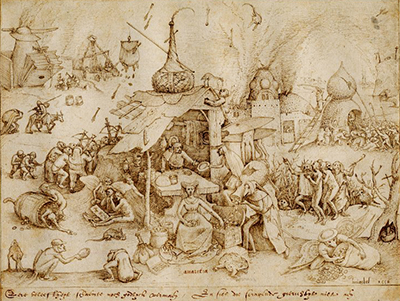
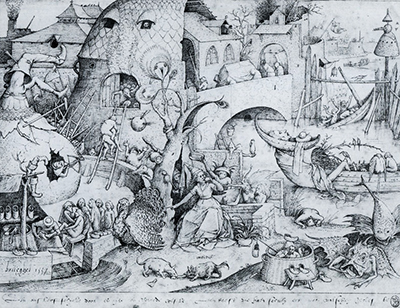
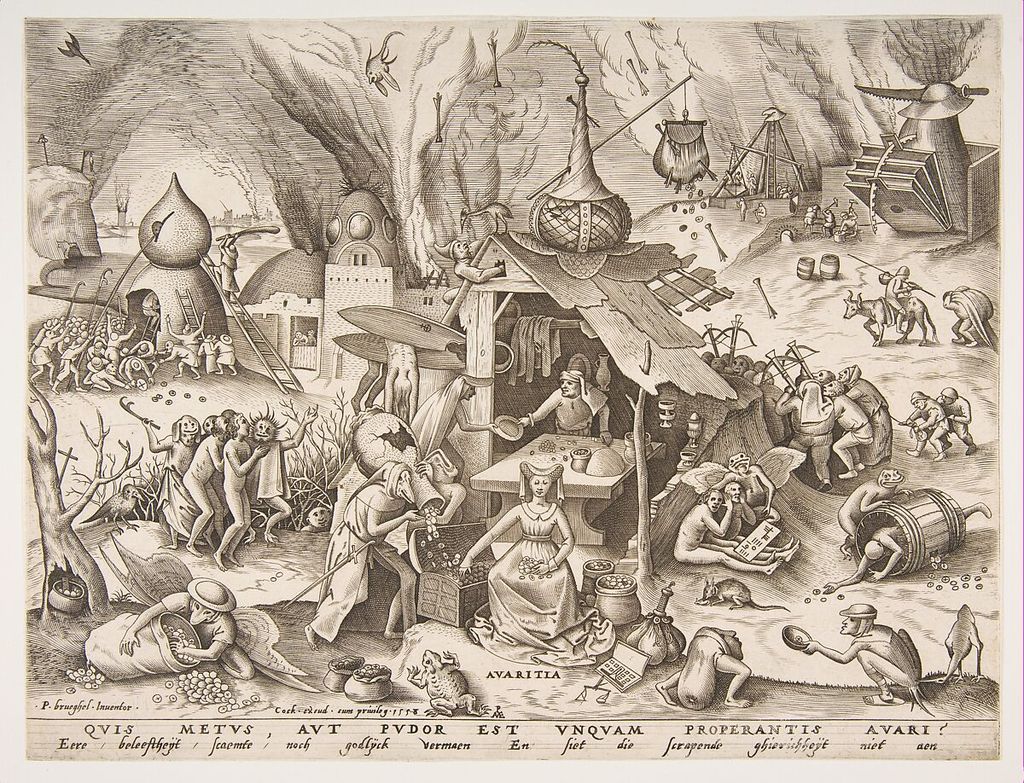
Pieter Bruegel the Elder’s Avarice, or Avaritia, is a signed drawing of 1556 in the British Museum. A woman sits near the centre with coins in her lap, and a toad crouches on the ground before her. The image above shows Bruegel’s drawing. Pieter van der Heyden engraved the design in reverse for Hieronymus Cock’s publication of the Seven Deadly Sins in 1558. Around the woman are people handling objects of their own, in a landscape where a small transaction can be as absorbing as any of the larger disturbances [1] [2] [3].
This work across Bruegel’s career
Tower of Babel
1563The Harvesters
1565Peasant Wedding
1568Children's Games
1560Triumph of Death
1562–1563Avarice
This artworkContents
- Introduction
- The Woman and the Coins
- Around the Store of Goods
- Reading the Drawing and the Print
- Greed alongside the Other Sins
- Annotated Details
The Woman and the Coins
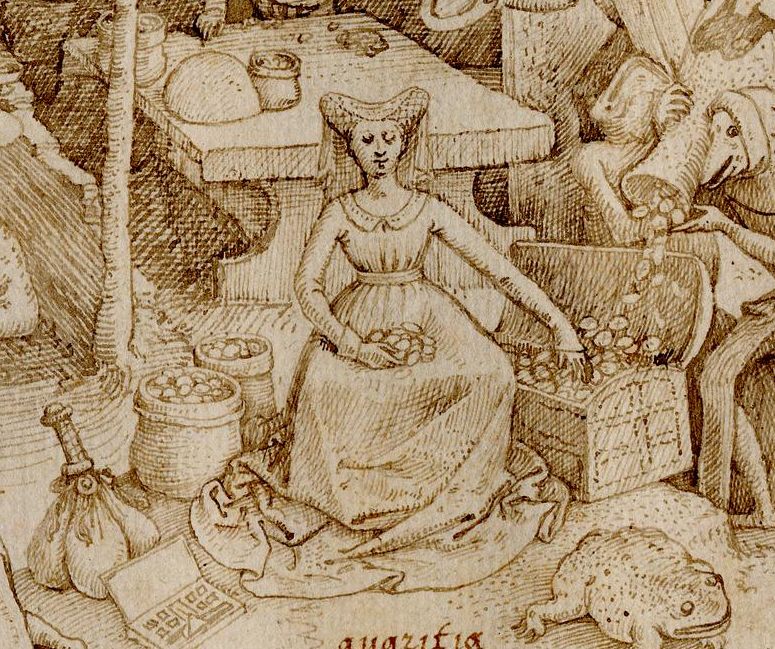
Begin near the foot of the middle structure. The woman sits almost square to the viewer, with her hands disposed around the lap of her dress. The folds form a broad area in which the little pieces can accumulate. The Met identifies them as coins, and her action as gathering them. Her clothes are relatively elaborate, and the position of her body is easy to see even among the nearby containers and people. The figure brings a set of scattered marks into focus through a recognisable gesture [2].
That gesture has a particular scale. A person needs enough room to sit down and collect the coins, and Bruegel leaves enough space between her arms for us to see that she is doing so. At the same time, the woman and her pile take up little of the whole drawing. Once you find what she is handling, look immediately behind her and to either side. The surrounding objects show that the coins are only part of a setting devoted to the storage, examination and movement of things.
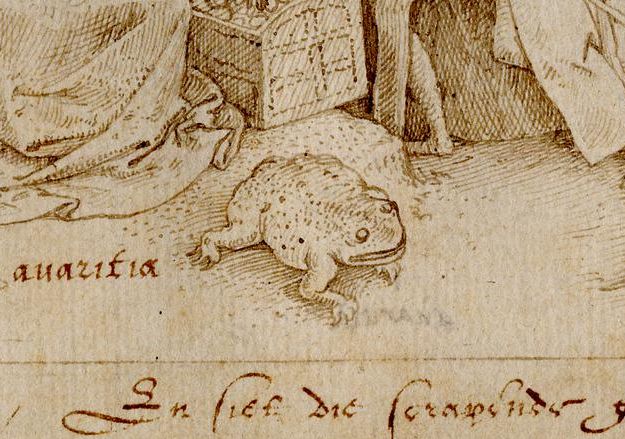
The toad stays low in the foreground. Its broad body is visible on open ground, near the space where the skirt ends. It takes a different kind of attention to see it than to see the person holding the coins. Look along the ground first and follow the flat accumulation of lines until they form an animal. The Met identifies the toad as the creature associated with avarice here. The animal and the objects in the woman’s lap give a viewer two routes back to the subject [2].
Annotated Details from Avarice
Find the seated woman and her toad before exploring the surrounding groups.
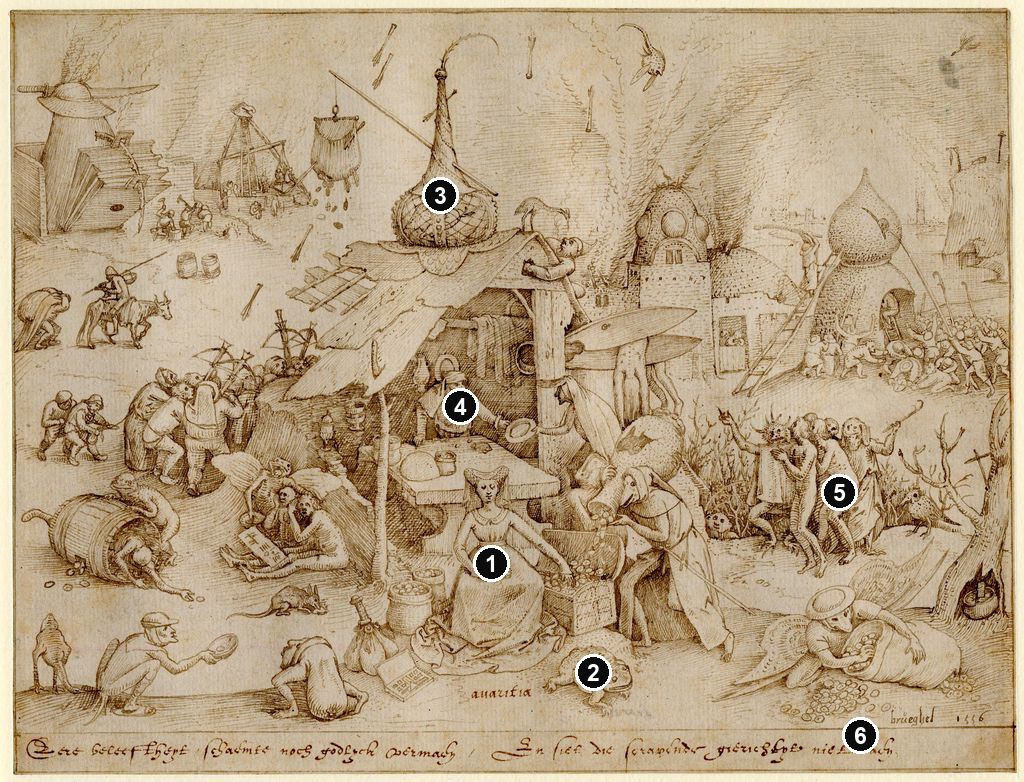
Details from AVARICE
Six details locate the central figure, setting and inscriptions.
The woman gathering coins
The seated woman gathers coins in the folds of her dress.
The toad at her feet
A toad crouches on the open ground beside the skirt.
The roof and the pole
A tall pole and hanging objects rise over the central shelter.
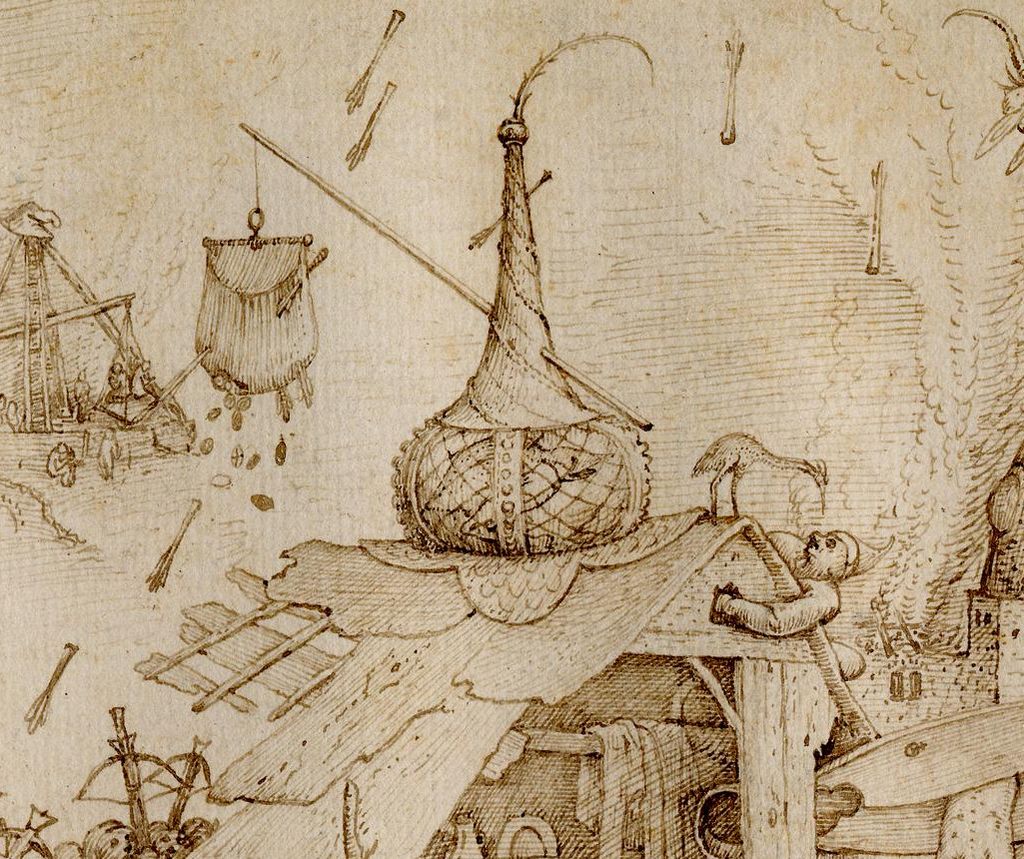
Work around the table
The figure behind the table handles a vessel below the roof.
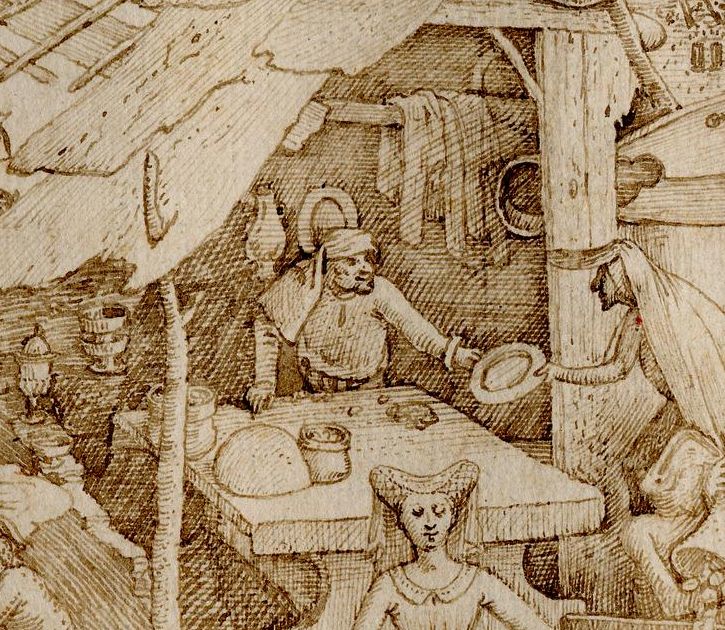
The crowd on the right
Figures lean together on the path beside the buildings.
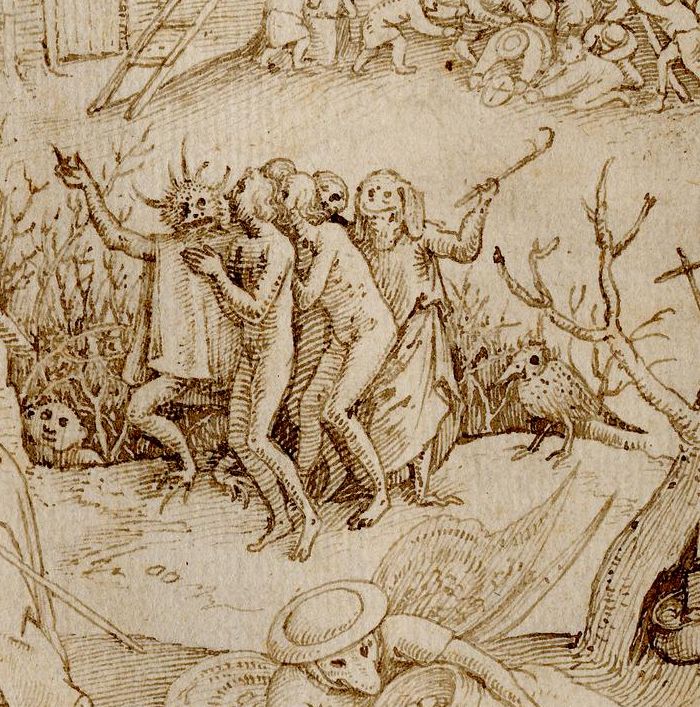
Title and signature
Writing along the lower edge includes the artist’s name and date at the right.
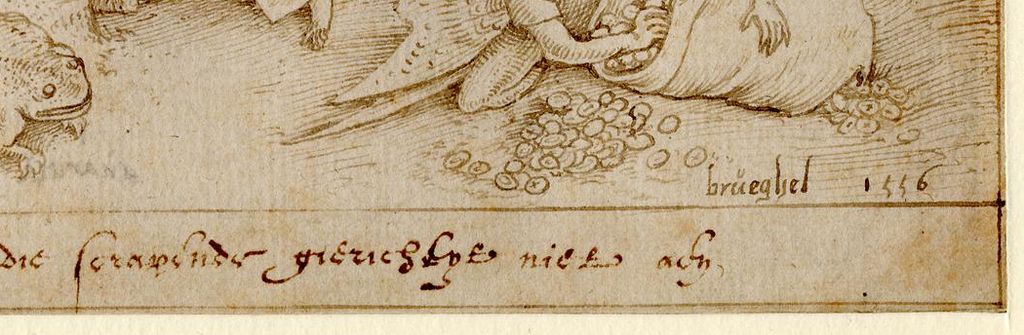
Pieter Bruegel the Elder, Avarice, 1556. British Museum, 1920,0216.4. Reproduction via Wikimedia Commons.
Around the Store of Goods
Behind the seated woman, a table and a covered space organize several figures at different heights. A projecting surface holds small objects, and arms reach towards and around it. The canopy divides this part of the image from the open terrain beyond. Different people can go on with their tasks in close quarters, partly screened by the supports and roof. Bruegel takes the familiar relationships among a table, limbs and a shelter and places them inside a much stranger landscape.
Follow the roof upward to the tall pole and the hanging form near it. The shapes at this height take the eye away from the work done with hands near the ground. Elsewhere a stair, a narrow opening or the line of a bank gives figures a particular route. The side groups sometimes appear tightly compressed although there is open land next to them. They draw attention through accumulation, the concentration the central woman applies to her coins given a larger form in the setting itself.
The people around the edges offer smaller incidents to follow. Near the lower left, a kneeling figure holds out a rounded object. Farther around, a bent body reaches towards the ground. One group can be read through the way the figures hold things, and another through what a viewer can make out of their postures. The image has the crowded, fantastic architecture that the Met associates with Bruegel’s engagement with Bosch. A familiar movement can remain perfectly legible in a setting that has few counterparts in an ordinary street [2].
Reading the Drawing and the Print
The British Museum drawing, accession 1920,0216.4, is recorded in the Met’s 2001 catalogue as pen and gray-brown ink with contours indented for transfer. Its dimensions are 22.8 by 29.8 centimetres. Bruegel’s signature and the date appear at lower right. The catalogue records the title and the line of Dutch writing in another hand. The visible image therefore carries evidence of several activities, including Bruegel’s work with the pen and the preparation of the sheet so that its forms could be repeated [1].
The 1558 engraving makes the maker roles explicit. It names Bruegel as the designer and Cock as the publisher, and the Met identifies Van der Heyden as the engraver. In print, the Latin title sits below the seated woman. A Latin question in the margin asks whether a greedy person in pursuit of gain experiences fear or shame. The Dutch lines describe grasping avarice paying no attention to honour, courtesy, shame or divine admonition. The language asks the reader to return to the woman’s lowered attention and decide what the small act of gathering makes her overlook [2] [1].
The Fitzwilliam records the engraving’s reversal after the drawing. Try matching the toad, the table and the pole before comparing smaller figures. Each gives a recognizable point through which to orient yourself, even as features exchange sides. Then compare the inscriptions. The drawing carries a line of writing along the margin, while the print has both the Latin and Dutch wording in a defined space below its pictorial border. That change makes the text easier to find and gives the printed version a distinct order for reading [3] [1] [2].
Greed alongside the Other Sins
In Invidia a woman with a turkey brings a heart to her mouth, and in Desidia a sleeper lets her weight rest against an ass. The central figure and her animal give each sheet a place to begin. Compare what the women are doing with their hands. Gathering coins, lifting a heart and letting the body settle create three distinct ways of attending to a small part of the world. The surrounding details let readers extend those actions into a larger setting [2] [4] [1].
The series can also show a vice in motion. In the Rijksmuseum’s impression of Ira, an armoured woman leads an attack and a bear appears at her feet. That pair gives a viewer a starting point much as the seated woman and toad do in Avarice. The difference in posture changes how the eye travels. The attack leads outward from its personification, while the gathering of coins brings attention back towards the lap [5] [2].
The companion design Elck offers a related question from outside the series. Several men keep searching among goods or pulling on the same cloth. Avarice puts most of its emphasis on one woman and the things within reach of her lap. Look again from the coin pile to the toad, then beyond the table. The different scales are what make the subject durable across a crowded sheet. The smallest things are the ones the central figure pays most attention to, and they give the viewer a reason to ask what she has ceased to see [1] [2].
 Pieter Bruegel.jpg)
Discussion
Which detail in this work most changes how you read it?
Frequently Asked Questions
Begin near the foot of the middle structure. The woman sits almost square to the viewer, with her hands disposed around the lap of her dress. [2]
The people around the edges offer smaller incidents to follow. Near the lower left, a kneeling figure holds out a rounded object. [2]
The British Museum drawing, accession 1920,0216.4, is recorded in the Met’s 2001 catalogue as pen and gray-brown ink with contours indented for transfer. Its dimensions are 22.8 by 29.8 centimetres. [1]
References
- Nadine M. Orenstein, ed., Pieter Bruegel the Elder, Drawings and Prints, Metropolitan Museum of Art, 2001, nos. 42–43 and 58–59, View source.
- The Metropolitan Museum of Art, Avarice (Avaritia), engraving 26.72.37, View source.
- Fitzwilliam Museum, Avaritia, engraving 23.I.8-89, View source.
- The Metropolitan Museum of Art, Sloth (Desidia), engraving 26.72.34, View source.
- Rijksmuseum, Toorn, engraving RP-P-1887-A-12304, View source.








