 by Tom Gurney
Tom Gurney BSc (Hons) is an art history expert with over 20 years experience
Published on June 19, 2020 / Updated on November 25, 2026
Email: tomgurney1@gmail.com / Phone: +44 7429 011000
An Offering: Introduction
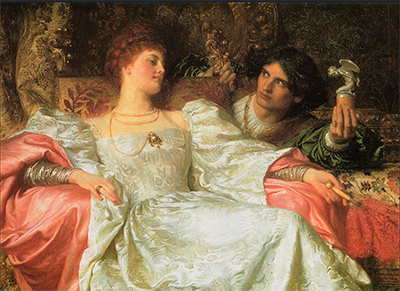
A young man lifts a silver-coloured statuette beside a woman in white brocade. He watches her face as he presents it. She turns towards him, her feather fan still hanging loosely from one hand. Frank Dicksee painted An Offering in 1898 and showed it at that year's Royal Academy exhibition. The title gives the action its name and leaves the woman's answer to our imagination. [1] [2]
At a Glance
- ArtistFrank Dicksee
- Date1898
- MediumOil on canvas
- SubjectA young man presents a kneeling, winged statuette to a woman in Renaissance-style dress.
- ExhibitionRoyal Academy, London, 1898, no. 277
- CollectionCatalogued as private. [1] [2]
This work across Frank Dicksee’s career
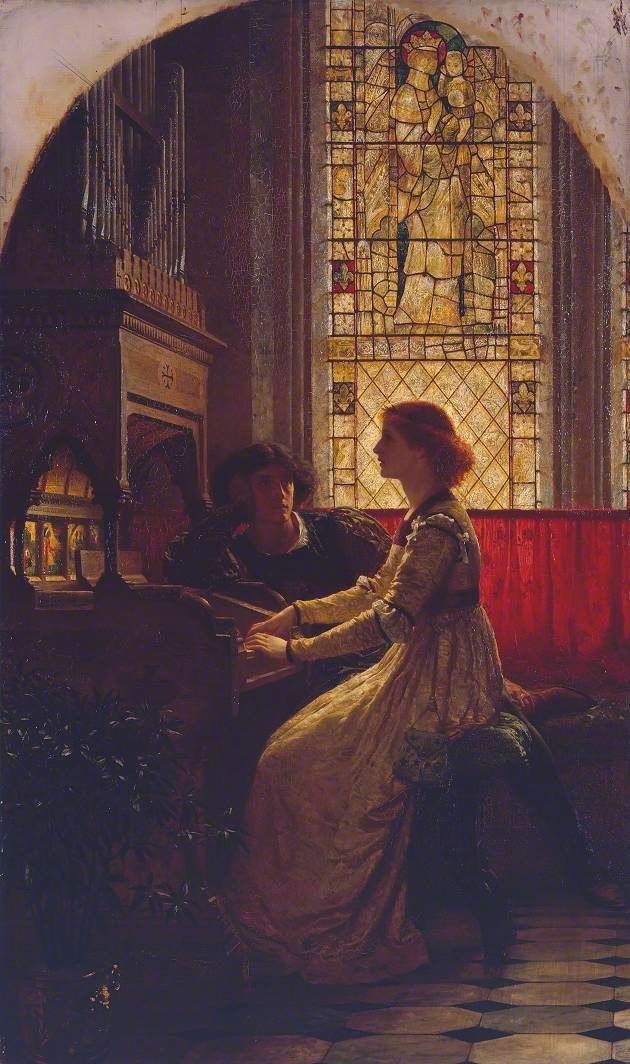
Harmony
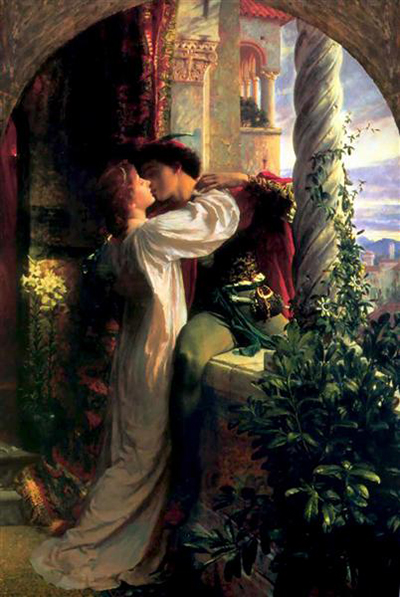
1877Romeo and Juliet
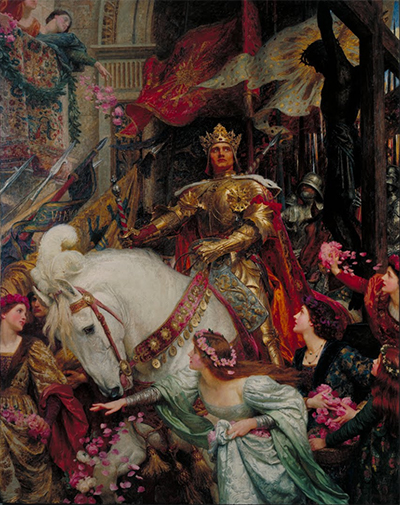
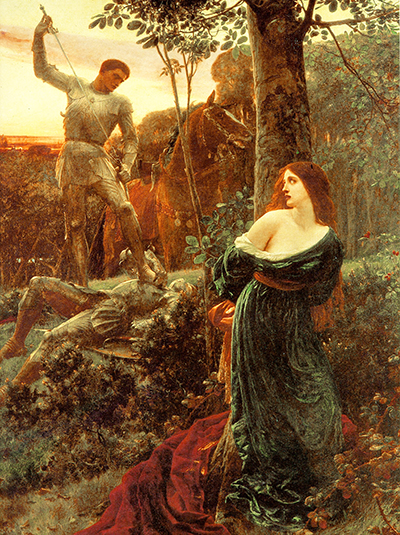
1884Chivalry
1885Startled
1892The Two Crowns
1900Contents
- How Dicksee stages the gift
- Brocade, metal and the painter's studio
- The models and their roles
- What the Academy critics saw
- Exhibition and sale history
- Annotated details
How Dicksee stages the gift
The woman’s dress spreads across her lap to the bottom edge of the canvas. Her shoulders rest against a chair back patterned with red leaves. The man appears behind her on the right, with his face at roughly the height of her shoulder. One of his hands curls over the top of the chair beside a carved upright. The other holds the statuette clear of his body on a short, reddish pedestal. He holds it high enough for her to see. Her right hand rests on the folds of her gown, and her left still holds the fan. [2] [3]
Dicksee puts the gift well to the right of the two faces. The man's eyes direct us back to the woman, while the turn of her head draws us towards the space he occupies. Her lowered eyelids make it hard to tell where exactly she is looking. From across a room the pale gown would be the easiest thing to see. Up close, the flash on a wing brings the gift into focus against the shadowed background. The statuette sits so far to the right that following the exchange takes in nearly the entire width of the canvas. [2]
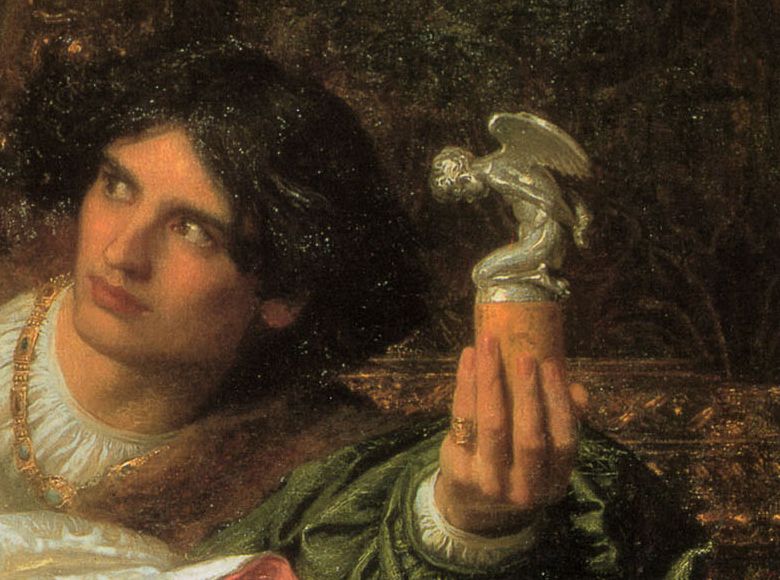
The statuette is a kneeling, winged figure with its head bowed and its arms drawn behind. Writing about the Academy exhibition, A. C. R. Carter read it as a bound Cupid and took it to express the suitor's passion. Frederic George Stephens also identified Cupid in his brief account for The Athenaeum. Read that way, the small figure embodies the lover's surrender. He is upright enough to display it with care, yet his position behind the chair lets the woman occupy the most prominent place in the picture. The kneeling figure acts out a submission he can present to her without kneeling himself. [2] [4] [5]
Brocade, metal and the painter's studio
The gown is pale enough to pick up cool shadows where it folds and warm light where it opens around the neck. The floral pattern lies flat on the bodice beneath the pearls, then breaks and reappears on the sleeves and lap as the fabric turns. Dicksee gives the bracelets a tighter, sharper shine. The pearls catch light in tiny points, and the statuette carries a broader glint across a wing and the curve of a shoulder. The red fan, whose feathers absorb the light, hangs low near the edge of the pink drapery. These changes of texture keep the objects legible even where the pink drapery, the fan and the patterned textile meet at the right edge. [2]
Carter associated Dicksee's skill with rich accessories with the example of Venetian painting. The full sleeves, jewellery and dark, warm interior evoke a Renaissance court. The textiles also bring us closer to the Victorian studio where this effect was made. In 1897 Mary Angela Dickens described Dicksee's studio in The Windsor Magazine. Its quiet, tapestry-like colours were punctuated by the sheen of armour. That observation catches something of the way light works in An Offering, where a pattern may recede almost entirely into shadow and a small bright object can establish depth. [2] [4] [6]
A Sotheby's catalogue for Edmund Blair Leighton's A King and a Beggar Maid identifies a Samarkand carpet as a prop the painters shared. According to the catalogue, Leighton borrowed it from Dicksee, who also painted it in An Offering. Leighton spread the carpet before the throne where his king offers his crown. Both works appeared in the 1898 Academy exhibition. In Dicksee’s much closer view, the patterned textile at the right sets off the young man’s dark sleeve, and the red fan cuts across it. A studio possession could help furnish two quite different settings for courtship. [2] [7]
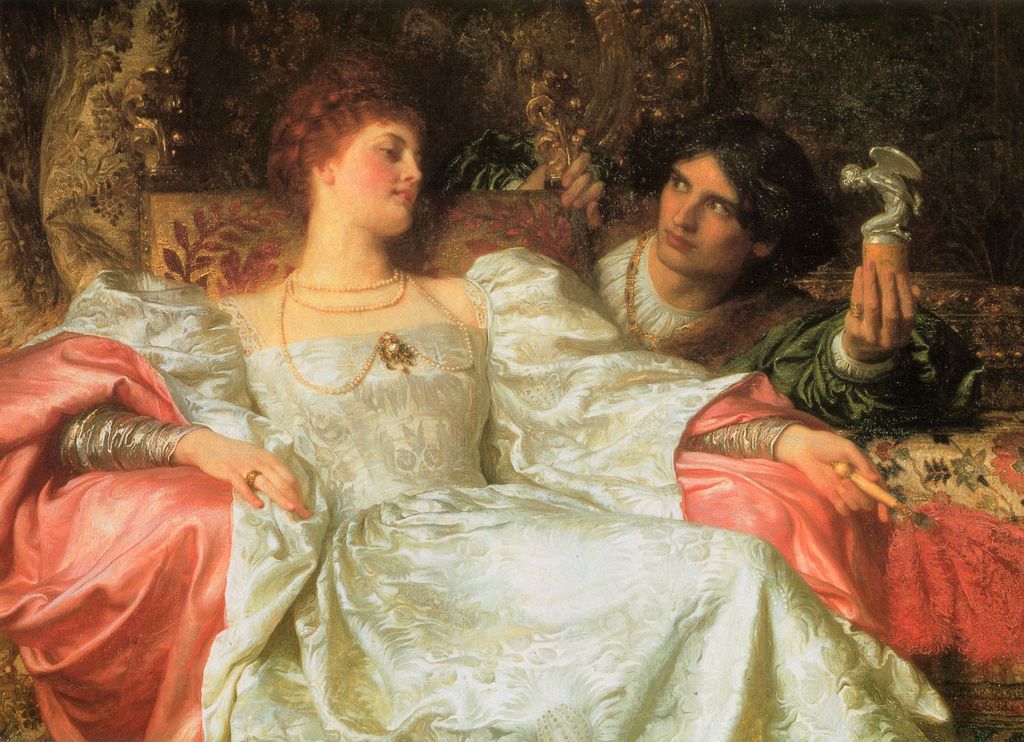
An Offering, 1898. The small object and the pale and red fabrics share the same light. Frank Dicksee, An Offering, 1898. Image source. Public domain.
Annotated Details from An Offering
The numbered points identify visible features discussed in this article. Return from each detail to the numbered overview. The offered object and the two figures in An Offering. Frank Dicksee, An Offering, 1898. Image source. Public domain.
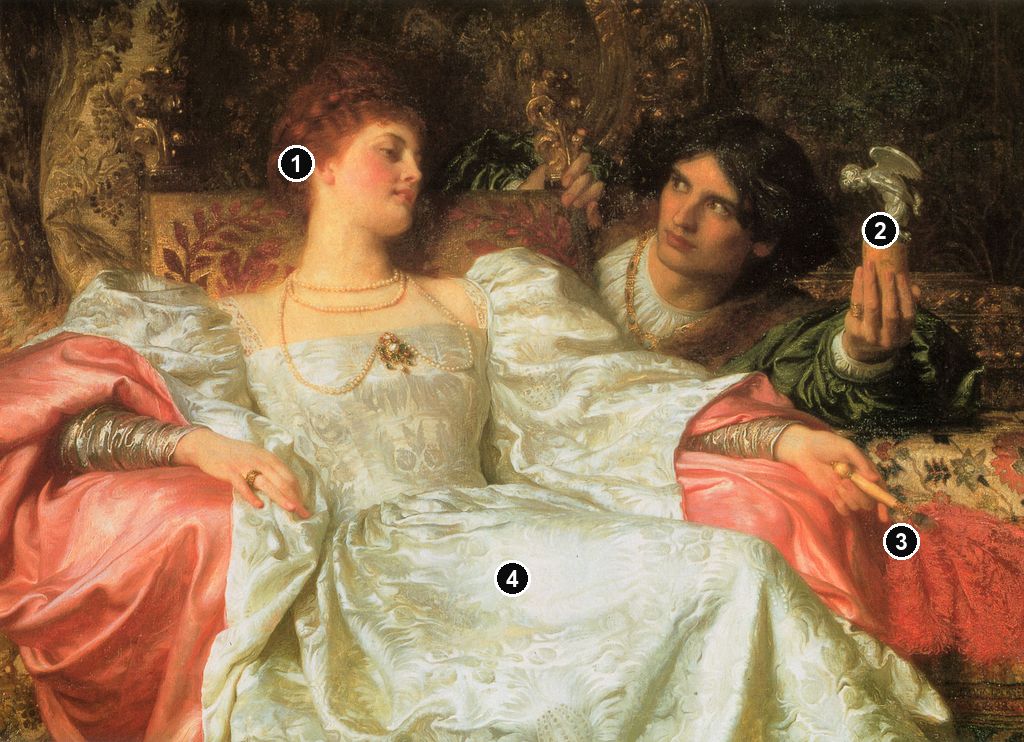
Details from AN OFFERING
Compare the cropped details with the source images above. Notice how their colours, shapes and positions contribute to the larger compositions.
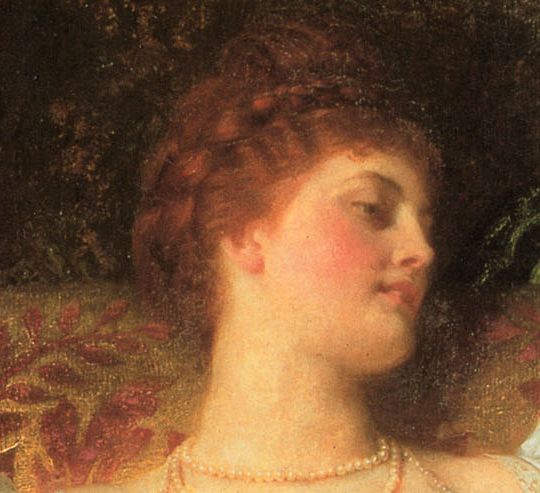
The woman turns her head
The turn of her head gives the exchange its direction. The reclining posture and the face in three-quarter view leave her response open.
The object in the raised hand
The figure he presents is small enough to hold in one hand. The light catches its outline near his face and draws attention to the act of offering.
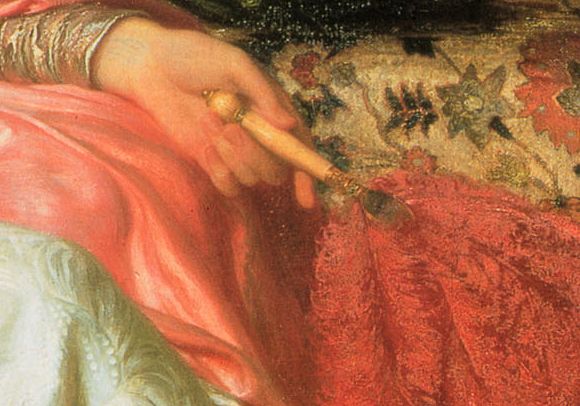
The other hand at rest
The woman’s hand rests on red cloth. Its position leaves a gap between her hand and the offered object.
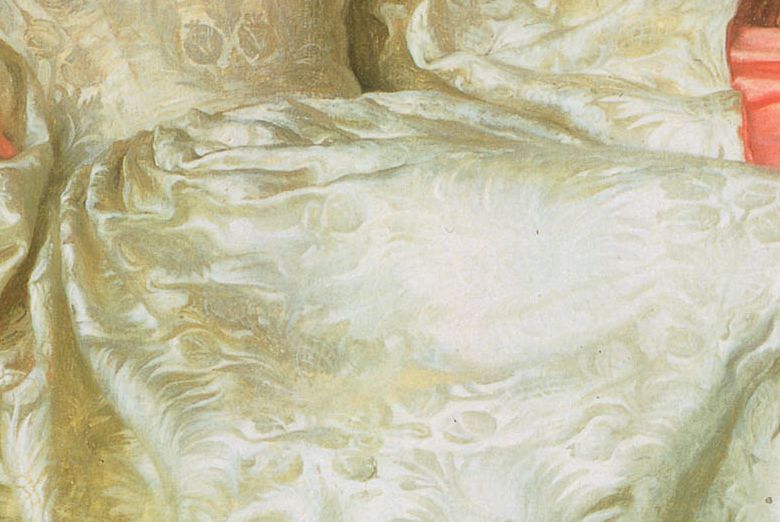
The folds of the dress
Highlights and soft green-grey shadows follow the heavy folds. The dress spreads across the foreground and anchors the figure in her chair.
The models and their roles
The Christie's catalogue for Dicksee's Yseult identifies Rachel Lee as the model who posed for An Offering and Dawn. Both Dawn and Meditation appeared at the Academy in 1897. Dennis T. Lanigan, citing Simon Toll, also associates Lee with Meditation. In Dawn, the model was part of an imaginative subject presented on a long, low canvas. Here, the face is set off by warm colour in the cheeks and a softly lit profile, and the turn of the head makes her an active participant in a scene that otherwise asks for little movement. The reported use of Lee in both works gives a sense of the range Dicksee could ask of the same model, from a figure in a broad allegorical scene to a woman whose smallest gesture matters. [1] [5] [8] [9]
The evidence for the man's model is thinner. Lanigan reports Toll's identification of Antonio Corsi and notes disagreement among specialists. The Academy entry gives the short title, and early reviewers describe the man by his dramatic role as the woman's suitor. The Renaissance dress and the expressive pose belong to those invented roles. [1] [4] [5]
What the Academy critics saw
Carter compared An Offering with Dicksee's recent Academy pictures The Confession, The Mirror and Dawn. He distinguished it from the enigmatic subject of The Confession and the imaginative ambition of Dawn, and rated its success alongside The Mirror. He singled out the woman's pose and the way the white robe intensified the warmth of her skin. For him, a lover offering a captive Cupid gave the composition enough purpose. [1] [4]
The reviewer for The Magazine of Art admired the sweep of Dicksee's lines and the handling of colour and rich fabrics, while finding little interest in the subject. In 1905 E. Rimbault Dibdin, writing for The Art Annual, treated colour, design and detail as the work's central ambition and found the result charming. It is easy to see how the same canvas invited both judgements. Follow the dress across the foreground and it feels like a demonstration of how light moves over fabric. Follow the man's eyes and the set of the woman's fingers and those same folds are part of a pose held during a delicate social encounter. [2] [5] [10]
Exhibition and sale history
The Royal Academy’s summer exhibition ran at Burlington House from 2 May to 1 August 1898. Its catalogue lists An Offering as no. 277 in Gallery III, a room that also housed John Singer Sargent’s Portrait of a Lady and Ernest Crofts’s historical scene of Charles II at Whiteladies. Dicksee also exhibited The Infant Christ that summer. In a room that brought together portraits, landscapes and historical scenes, An Offering had the scale and richness of a display picture, with a subject subtle enough to draw visitors closer. [1] [2] [11] [12]
The documented sale history resumes with Christie’s Fine Victorian Pictures auction in London on 25 October 1991, where the painting was catalogued as lot 44. Bridgeman Images records the canvas in a private collection. The identity of the first patron, the path from exhibition to auction and the identity of the present owner remain open. [2] [5] [13]
Frank Dicksee artworks directory
Browse documented paintings, studies, illustration designs and prints. Where an article is available, the title opens it. Simon Toll’s catalogue
| Name | Date | Medium |
|---|---|---|
| A Love Story | 1882 | Painting |
| A Reverie | 1895 | Painting |
| An Offering | 1898 | Painting |
| Chivalry | 1885 | Painting |
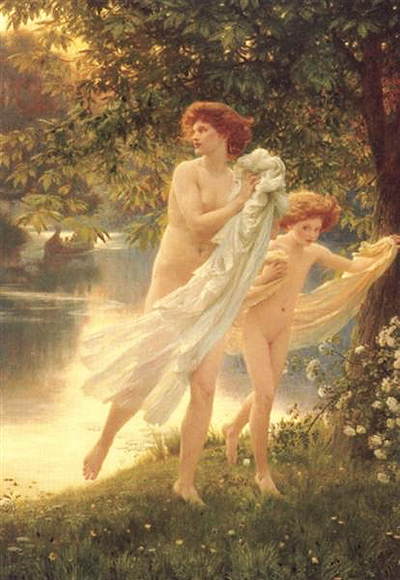
| Dawn | 1897 | Painting |
| Elijah Confronting Ahab and Jezebel in Naboth’s Vineyard | By 1875 | Painting |
| Harmony | 1877 | Painting |
| Harmony, etching by Charles-Albert Waltner after Dicksee | 1880 | |
| Harmony, the smaller Towneley version | Late 1870s | Painting |
| Hesperia | 1887 | Painting |
| Hesperia, watercolour version | Late 1880s | Painting |
| Italian Coast from La Mortola | 1925 | Painting |
| La Belle Dame sans Merci | c. 1901 | Painting |
| Memories | 1886 | Painting |
| Paolo and Francesca | 1894 | Painting |
| Portrait of Camille Sutton Palmer | 1914 | Painting |
| Portrait of Elsa | 1927 | Painting |
| Portrait of the Duchess of Buckingham and Chandos | 1901 | Painting |
| Romeo and Juliet | 1884 | Painting |
| Romeo and Juliet, monochrome design on joined wood | c. 1880s | Painting |
| Sir Edmund William Gosse, collotype after Dicksee | 1912 | |
| Startled | 1892 | Painting |
| Study for Startled | Early 1890s | Drawing |
| The Confession | 1896 | Painting |
| The Crisis | 1891 | Painting |
| The Daughters of Eve | 1925 | Painting |
| The Embarkation | 1879 | Painting |
| The End of the Quest | 1921 | Painting |
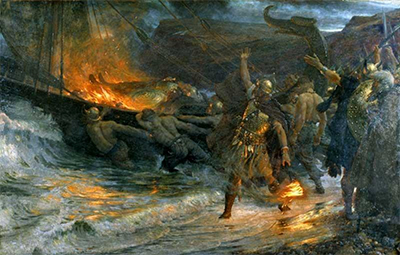
| The Funeral of a Viking | 1893 | Painting |
| The House Builders | 1880 | Painting |
| The Magic Crystal | 1894 | Painting |
| The Passing of Arthur | 1889 | Painting |
| The Redemption of Tannhäuser | 1890 | Painting |
| The Symbol | 1881 | Painting |
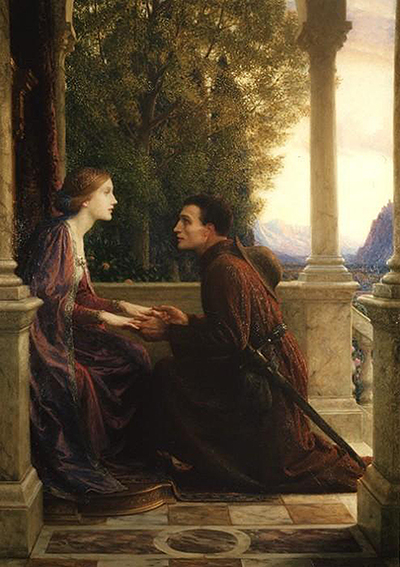
| The Two Crowns | 1900 | Painting |
| Yseult | 1901 | Painting |
Discussion
Look again at the images and ideas explored in An Offering. These editorial prompts invite your observations.
Reader Insights
Where does her gaze seem to fall, and how does that affect your reading of the exchange?
How does Dicksee draw your eye to the statuette after the white gown catches it?
Join the Conversation
Share the detail you would point out first to someone seeing An Offering for the first time.
References
- Algernon Graves, The Royal Academy of Arts: A Complete Dictionary of Contributors and Their Work, vol. II, p. 324, entry for 1898, no. 277. View source.
- Bridgeman Images, An Offering, 1898 (oil on canvas), object photograph and catalogue information, asset XCS7088898. View source.
- Image source, Frank Dicksee, An Offering, Wikimedia Commons reproduction from the Art Renewal Center. View source.
- A. C. R. Carter, ‘The Royal Academy, 1898’, The Art Journal (1898), pp. 166–168. View source.
- Dennis T. Lanigan, ‘An Offering by Sir Frank Dicksee’, The Victorian Web, with excerpts from F. G. Stephens, The Athenaeum, no. 3679, 30 April 1898, p. 572, and E. Rimbault Dibdin, The Art Annual (1905), p. 16. View source.
- Mary Angela Dickens, ‘Mr. Frank Dicksee, R.A.’, The Windsor Magazine (1897), pp. 385–386. View source.
- Sotheby's, Edmund Blair Leighton, A King and a Beggar Maid, 2014 auction, lot 211, catalogue note on the Samarkand carpet. View source.
- Christie's, Frank Dicksee, Yseult, 13 October 2021, lot 8, catalogue essay on Rachel Lee. View source.
- Bradford Corporation, Illustrated Catalogue of the Permanent Collection of Pictures and Other Works of Art, catalogue entry for Dawn. View source.
- The Magazine of Art, ‘The Royal Academy Exhibition – II’, June 1898, pp. 467–468. View source.
- Anne Helmreich, Paul Mellon Centre, ‘1898: Sargent's Apotheosis’, The Royal Academy Summer Exhibition: A Chronicle, 1769–2018. View source.
- Royal Academy of Arts, The Exhibition of the Royal Academy of Arts, the One Hundred and Thirtieth (1898), p. 15, Gallery III, no. 277. View source.
- Artsy, An Offering, auction index entry for Christie's Fine Victorian Pictures, London, 25 October 1991, lot 44. View source.