 by Tom Gurney
Tom Gurney BSc (Hons) is an art history expert with over 20 years experience
Published on June 19, 2020 / Updated on November 25, 2026
Email: tomgurney1@gmail.com / Phone: +44 7429 011000
Hesperia by Frank Dicksee: Introduction
A woman in crimson and gold holds out a golden apple at the edge of a marble terrace. Behind her, the dark eyes of a peacock-feather fan are almost lost in the foliage. The woman is Hesperia, a guardian of the golden apples in Greek myth. Frank Dicksee painted her as if she had stepped out of a Renaissance portrait, then gave her the scale to command a wall at the Royal Academy. The oil he exhibited in 1887 belongs to the Harris in Preston. [1] [2]
At a Glance
- ArtistFrank Dicksee (1853–1928)
- Date1887
- MediumOil on canvas
- Dimensions250 × 156 cm in the published catalogue caption
- CollectionThe Harris, Preston, accession PRSMG:P819
- ExhibitionRoyal Academy, London, 1887, no. 420
- Related worksHerbert Thomas Dicksee's 1889 etching after the oil and Frank Dicksee's 1901 watercolour in Sydney. [1] [2] [3] [4]
This work across Frank Dicksee’s career
Harmony
1877Romeo and Juliet
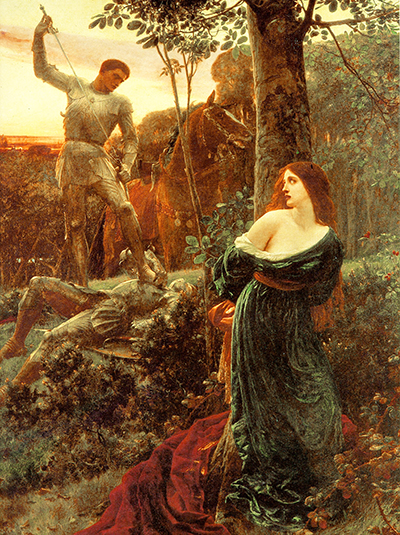
1884Chivalry
1885Startled
1892The Two Crowns
1900Contents
- A nymph in Renaissance dress
- A golden apple that looked like an orange
- The 1887 Royal Academy exhibition
- Frederic Leighton and the same garden
- The etching and the watercolour
A nymph in Renaissance dress
The first surprise is the weight of the dress. The sleeves swell at the shoulders and open into long folds of coppery lining. A broad belt gathers the patterned fabric at the waist, and below it the skirt falls in folds that interrupt the gold floral design. Dicksee uses the same reds and golds to describe very different surfaces. Look for the small, broken lights on the brocade, then for the wide, smooth highlights on the lining. At the hem, a turn of the fabric lets the two effects meet. The white edge of the square neckline and the slender chain above it bring the eye back to the face. [1]
The pose works across the width of the canvas. On the left as we look, Hesperia raises the fan beside her head. The dark feathers spread into the canopy and their eyes emerge slowly against the leaves. On the right her other arm extends towards the frame, the open hand supporting the bright fruit. Her head turns in the same general direction, but her eyes look above the fruit. The gesture has the ease of a woman showing something to a person just outside the frame. The stillness of the face leaves that encounter open. [1]
The terrace offers a second way into the picture. Its pale stone anchors the figure and provides a clear edge for the deep red of the skirt. Behind her, fruit recurs in the much darker branches. A fountain beyond the outstretched hand repeats the pale stone of the terrace. Higher up, a statue rises above the foliage and the hillside opens to the sky. It is a formal place with room for a person to walk and pause, a setting more familiar from images of Renaissance villas than from most accounts of the edge of the mythical world. [1]
A golden apple that looked like an orange
Hesiod places the Hesperides beyond Ocean, where they tend trees bearing golden apples. In the account attributed to Apollodorus, the apples were a gift from Earth on the marriage of Zeus and Hera. A dragon guards them alongside four named Hesperides, including Hesperia. The apples are the object of one of Heracles' labours. In Euripides, Heracles kills the dragon and plucks the fruit. In the main account attributed to Apollodorus, Atlas fetches the apples while Heracles holds up the sky in his place. Dicksee gives the fruit to a guardian and lets her keep the stage. The myth supplies a reason for her gesture without settling whom she might be offering the apple to. [1] [5] [6]
Two exhibition reviewers, in The Athenaeum and The Builder, described the fruit as an orange. The rounded shape, the vivid colour and the dense foliage make that reading easy to understand. The name Hesperia asks a viewer to see the same thing as an apple from the legend. The gap between the two readings is part of the pleasure of the painting. Dicksee has made one of the most extraordinary objects in Greek myth look familiar enough to pick up. The fan works in the other direction. It is a recognisable accessory, yet the dark feather eyes behind Hesperia's hair lend her silhouette an unfamiliar outline. [1] [7] [8]
The 1887 Royal Academy exhibition
At the Academy, Hesperia hung in Gallery V. Henry Blackburn's illustrated guide places it at the centre between two Scottish coastal pictures by John Brett, with a calm summer view towards the mountains of Skye on one side and a clouded shore on the other. Anyone standing back to take in the wall would have seen Dicksee's tall figure between two far-reaching views of sea and sky. Blackburn singled out the dress and the objects in her hands, and gave the picture a page of its own in the illustrated section. [9]
The exhibition press paid close attention to what the paint could do. The Builder found the picture's brilliance nearly startling and judged it a success on its own terms. F. G. Stephens in The Athenaeum praised the scale of the design and described it in terms of sixteenth-century Italian decoration. He considered it Dicksee's strongest work to date and took the resemblance to Frederic Leighton's paintings as evidence of what Dicksee was aiming for. The Art Journal admired the dress but found the picture disappointing beside the promise of earlier works such as Harmony and Evangeline. For all their differences, these reviewers treated the costume as central. Their disagreement was over how much expressive work its colour and surface could carry. [1] [7] [8]
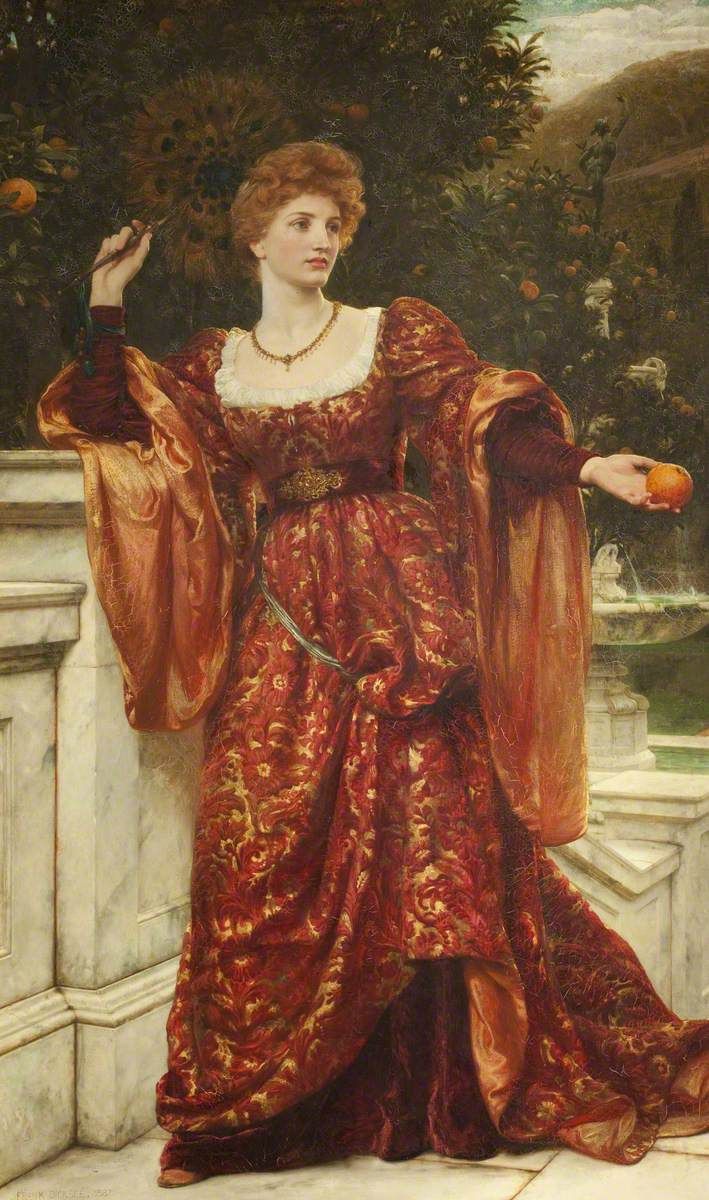
Hesperia, the 1887 oil in the Harris collection, PRSMG:P819. Image source. Public domain.
Frederic Leighton and the same garden
At the Academy in 1892, Leighton showed The Garden of the Hesperides, now in the Lady Lever Art Gallery. The Royal Academy's 1897 retrospective catalogue describes a circular canvas with three guardians resting below the tree and a dragon beside them. The shape influences how the scene unfolds. The spread of the branches follows the upper arc and the bodies draw the eye round the lower portion. The view of the sea beyond the garden gives the viewer a sense of its remoteness. Dicksee built his upright picture around the reach of one arm and the presence of a single figure. The apple comes close to us in Hesperia. In Leighton's garden the fruit is still on the tree, and the dragon's coils make the act of guarding it visible. [1] [10] [11] [12]
Stephens's comparison in 1887 concerned paintings of Leighton's that viewers already knew. An earlier point of comparison is Pavonia, shown at the Academy in 1859. Leighton spread a fan behind his model Anna Risi so the eyes of its peacock feathers frame her turned face. Dicksee makes the fan part of Hesperia's gesture and lets it merge into the garden behind her. In both paintings the array of feathers makes a face partly turned away from us the focus of attention. [7] [13]
The shared myth had already produced a different Victorian garden. In Edward Burne-Jones's The Garden of the Hesperides, made around 1869–1873 and held by the Hamburger Kunsthalle, three standing women gather so close to the fruit tree that the figures seem almost woven through its branches. Here the tree separates and connects the women. In Dicksee the light on the marble gives the woman room to stand clear of the trees, and her outstretched hand brings the fruit into her own space. [1] [14]
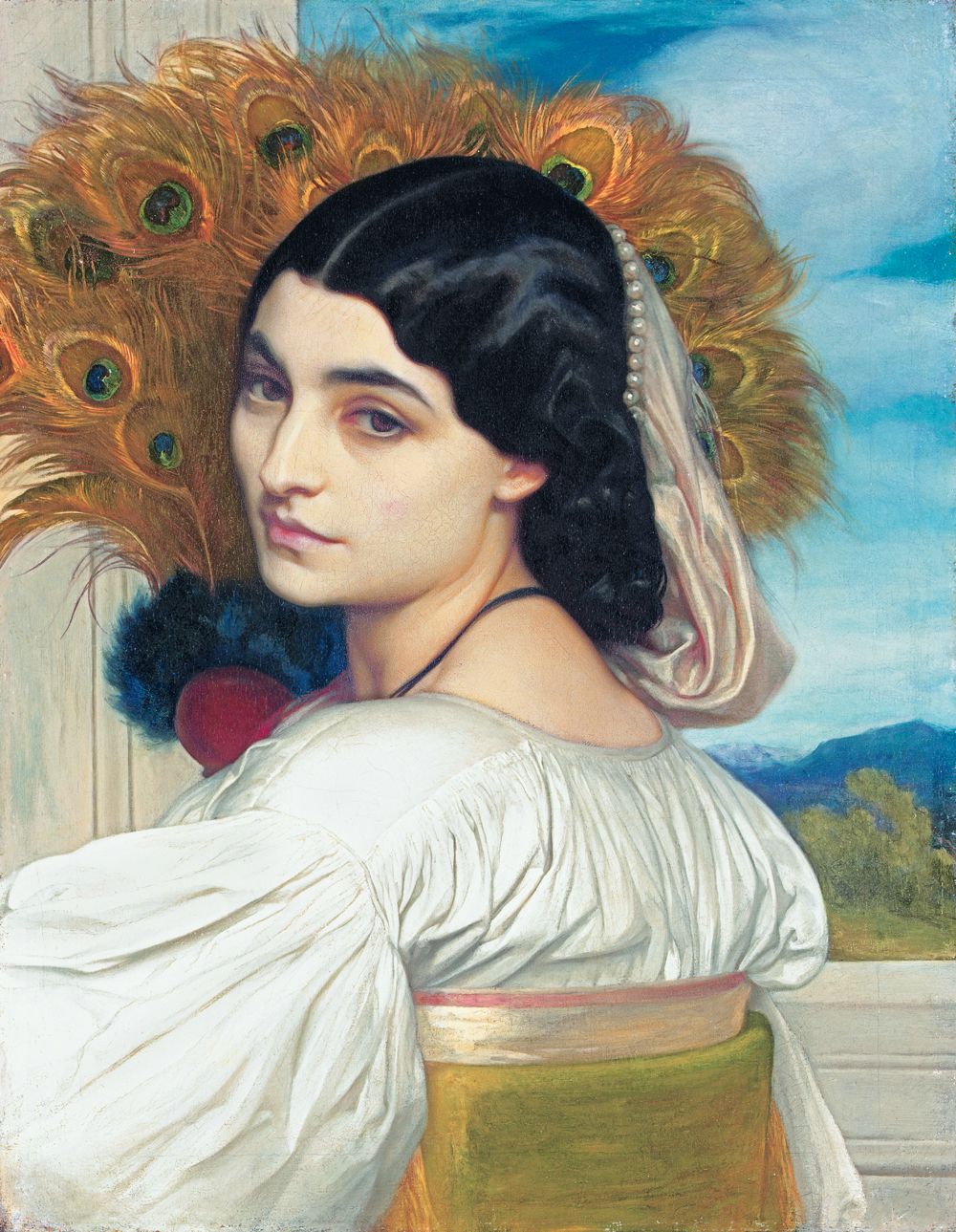
Frederic Leighton, Pavonia. The fan frames the sitter’s face. Frederic Leighton, Pavonia. Public-domain reproduction. Image source. Public domain.
The etching and the watercolour
The figure soon reappeared in another form. Herbert Thomas Dicksee's etching Hesperia, after Frank's painting, was no. 1688 at the Royal Academy in 1889. The Fine Art Society published it that year. One surviving printer's proof catalogued by Sworders was printed in brown on vellum and bears the pencil monogram of the printer Frederick Goulding. It also has a remarque, a small supplementary image in the margin, showing apples. Frank's painting singles out the golden fruit by placing it against the dark foliage. The print gives the fruit a second appearance outside the picture itself. With the red and gold translated into a single ink colour, the outlines of the figure and the marks that describe folds and foliage take on more of the work. A different proof is catalogued with both artists' signatures. On a single sheet, they acknowledge the roles of the painter who made the design and the printmaker who translated it. [1] [2] [4] [15]
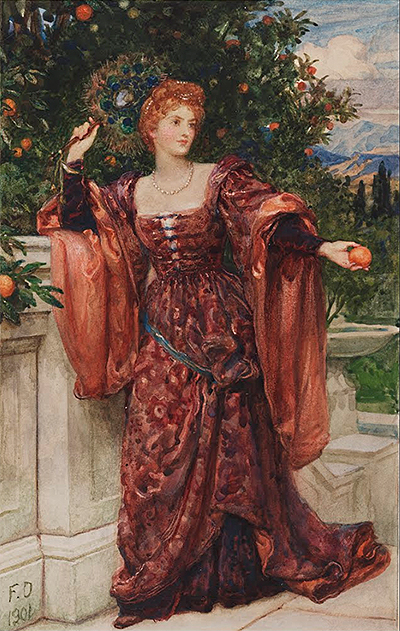
In 1901 Frank Dicksee returned to the composition himself. The Art Gallery of New South Wales records its Hesperia as a small reworking in watercolour and bodycolour, with scraping out over traces of pencil. The image measures 20 × 12.5 cm, close to the proportions of the oil at roughly one twelfth of its height. The gallery records Dicksee's initials and the date at lower left, and the work came to the collection through Albert and Katey Nathan's 1941 bequest. At that scale the figure can be taken in at a glance, while the marks in the paint ask for a much closer view. The date 1901 belongs to this later version. The oil, the 1889 etching and the watercolour carry the same design from a major exhibition canvas to two quite different works made to be seen up close. [1] [2] [3] [4]
Frank Dicksee artworks directory
Browse documented paintings, studies, illustration designs and prints. Where an article is available, the title opens it. Simon Toll’s catalogue
| Name | Date | Medium |
|---|---|---|
| A Love Story | 1882 | Painting |
| A Reverie | 1895 | Painting |
| An Offering | 1898 | Painting |
| Chivalry | 1885 | Painting |
| Dawn | 1897 | Painting |
| Elijah Confronting Ahab and Jezebel in Naboth’s Vineyard | By 1875 | Painting |
| Harmony | 1877 | Painting |
| Harmony, etching by Charles-Albert Waltner after Dicksee | 1880 | |
| Harmony, the smaller Towneley version | Late 1870s | Painting |
| Hesperia | 1887 | Painting |
| Hesperia, watercolour version | Late 1880s | Painting |
| Italian Coast from La Mortola | 1925 | Painting |
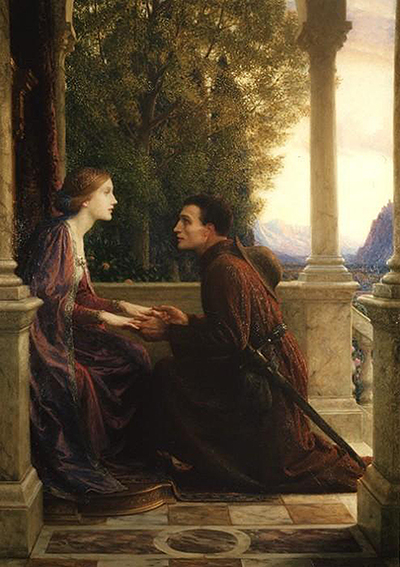
| La Belle Dame sans Merci | c. 1901 | Painting |
| Memories | 1886 | Painting |
| Paolo and Francesca | 1894 | Painting |
| Portrait of Camille Sutton Palmer | 1914 | Painting |
| Portrait of Elsa | 1927 | Painting |
| Portrait of the Duchess of Buckingham and Chandos | 1901 | Painting |
| Romeo and Juliet | 1884 | Painting |
| Romeo and Juliet, monochrome design on joined wood | c. 1880s | Painting |
| Sir Edmund William Gosse, collotype after Dicksee | 1912 | |
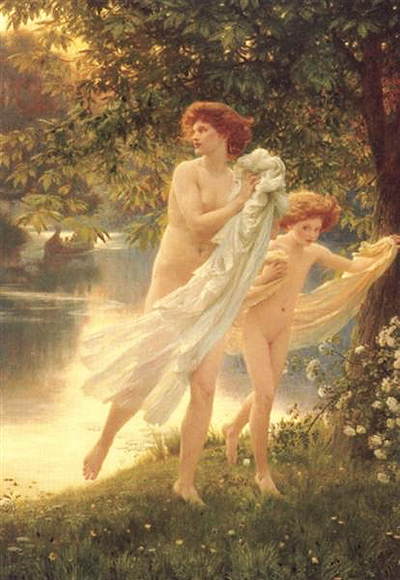
| Startled | 1892 | Painting |
| Study for Startled | Early 1890s | Drawing |
| The Confession | 1896 | Painting |
| The Crisis | 1891 | Painting |
| The Daughters of Eve | 1925 | Painting |
| The Embarkation | 1879 | Painting |
| The End of the Quest | 1921 | Painting |
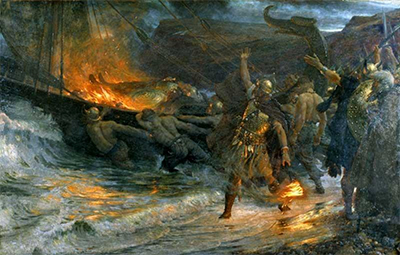
| The Funeral of a Viking | 1893 | Painting |
| The House Builders | 1880 | Painting |
| The Magic Crystal | 1894 | Painting |
| The Passing of Arthur | 1889 | Painting |
| The Redemption of Tannhäuser | 1890 | Painting |
| The Symbol | 1881 | Painting |
| The Two Crowns | 1900 | Painting |
| Yseult | 1901 | Painting |
Discussion
Look again at the images and ideas explored in Hesperia by Frank Dicksee. These editorial prompts invite your observations.
Reader Insights
Where does your eye go after the apple, and how does the fan bring it back towards Hesperia's face?
Which part of the picture first suggests the world of myth to you, and which part makes it feel like a place you could visit?
Join the Conversation
Tell us which detail you would most like to see at the scale of the original canvas, or what stands out when you compare it with one of the smaller versions.
References
- Dennis T. Lanigan, Hesperia by Sir Frank Dicksee, Harris oil caption and object photograph, discussion of the setting, and contemporary reviews. View source.
- Algernon Graves, The Royal Academy of Arts, vol. II, pp. 324–325, Frank Dicksee in 1887, no. 420, and Herbert Thomas Dicksee in 1889, no. 1688. View source.
- Art Gallery of New South Wales, Hesperia, 1901, collection record 7149, published on Google Arts & Culture. View source.
- Sworders, Hesperia by Herbert Thomas Dicksee after Frank Dicksee, 10 March 2020, lot 432. View source.
- Hesiod and Euripides, Theogony 215–216 and Heracles 394–407, collected in the University of Georgia sourcebook for Timothy Gantz's Early Greek Myth. View source.
- Pseudo-Apollodorus, Library 2.5.11, translated by J. G. Frazer. View source.
- F. G. Stephens, ‘Fine Arts. The Royal Academy’, The Athenaeum, no. 3109, 28 May 1887, p. 708. View source.
- The Builder, ‘The Royal Academy’, vol. LII, 7 May 1887, p. 663. View source.
- Henry Blackburn, Academy Notes, 1887, Gallery V discussion on p. 13 and illustration on p. 73. View source.
- Royal Academy of Arts, Exhibition of Works by the Old Masters, 1897, p. 14, no. 39, Leighton's The Garden of the Hesperides. View source.
- National Museums Liverpool, Myths and Legends teachers' notes, p. 5, Leighton's The Garden of Hesperides in the Lady Lever Art Gallery. View source.
- Ernest Rhys, Frederic Lord Leighton, ‘Year by Year—1878 to 1896’, pp. 49–50, on the 1892 Academy exhibition. View source.
- Christie's, Frederic Leighton, Pavonia, lot 6011508, exhibition history and catalogue essay on the use of peacock feathers. View source.
- Bibliothèque nationale de France, The Garden of the Hesperides by Edward Burne-Jones, Hamburg Kunsthalle, c.1869–1873. View source.
- Sworders, Hesperia by Herbert Thomas Dicksee after Frank Dicksee, lot 341, proof signed by both artists. View source.