 by Tom Gurney
Tom Gurney BSc (Hons) is an art history expert with over 20 years experience
Published on June 19, 2020 / Updated on November 25, 2026
Email: tomgurney1@gmail.com / Phone: +44 7429 011000
Startled: Introduction
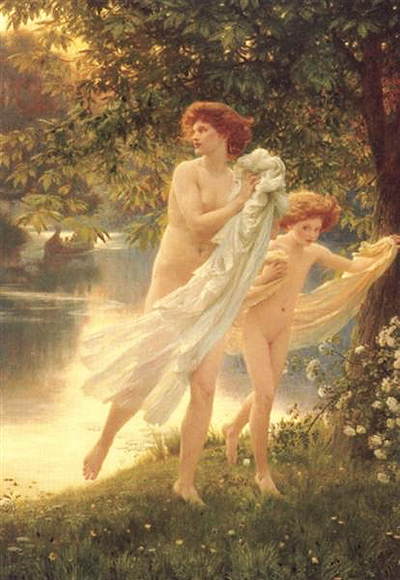
The boat is easy to miss in Frank Dicksee’s Startled. A dark shape appears through the branches on the left, beyond a brilliant stretch of river. Two bathers already have one foot off the ground. The older figure looks back towards the water while the younger turns towards the bank. Dicksee makes their alarm clear before the eye has time to find its cause. The painting, exhibited in 1892, was his diploma work for the Royal Academy of Arts. [1] [2]
At a Glance
- ArtistFrank Dicksee
- Date1892
- MediumOil on canvas
- Dimensions97.8 × 67.3 cm
- CollectionRoyal Academy of Arts, London, 03/1039
- ExhibitionRoyal Academy, 1892, no. 150 [1] [2]
This work across Frank Dicksee’s career
Contents
- What startled the bathers?
- The figures and the riverbank
- A diploma painting in the 1892 exhibition
- Two studies, two problems to solve
- The Royal Academy’s 2024 interpretation
- Annotated details
What startled the bathers?
At the left of the painting, under the lower branches, a high, dark prow breaks the lighter line of the far bank. Dicksee leaves only a sliver of open water around it. Its size in the picture suggests how far it still has to travel, yet the bathers’ response makes that distance feel suddenly small. We see the white folds and pale faces first, then follow the older bather’s glance towards the dimmer part of the river. The foliage that seemed to shelter the pair also conceals the approaching boat. [1]
The writer Mary Angela Dickens recorded an explanation of the scene in an 1897 profile for The Windsor Magazine. Dicksee reportedly told a young niece that the bathers hear a boat coming, grab their clothes and run. His niece asked, “Where are the clothes?” Dicksee had painted ample fabric, but her question goes to the heart of a picture in which the practical business of getting dressed takes the form of billowing drapery. His account also gives the scene an implied sound. Look at the painting with that explanation in mind and the older figure’s turn can feel as much like an act of listening as of looking. [1] [3]
An 1892 account reproduced by the Art Renewal Center describes the interruption just before the bath, whereas Dicksee, according to Dickens, said the girls had already been in the water. The 1892 writer also calls the figures sisters. Dicksee’s reported explanation leaves their relationship open. Both accounts locate the incident at a river bend, where the next person to come into view might have been out of sight a moment earlier. [1] [3] [4]
The figures and the riverbank
The two bodies move in the same direction, but the heads tell different stories. The older bather’s gaze goes back over her shoulder and one leg is still extended towards the water. Her hands draw a mass of pale cloth up beside her face. The younger figure is a little ahead, with one arm stretched towards the tree at the right. Her cloth is held wide and catches the warmer light. Following their feet makes the direction of travel particularly clear. Both figures have one foot on the turf and one in the air. [1]
Dicksee makes their movement visible in the fabric too. The older bather bunches it tightly high up, and long folds fall diagonally away from her hands towards the river. The younger bather’s fabric makes a looser arc towards the tree. The cloth continues the motion of the bodies across the picture, even where the figures overlap. It also picks up differences in light across the bank. Cooler folds show in the deep bunch of fabric against the older figure, and gold and peach come through in the thinner passages closer to the water and at the right. [1]
The overhanging tree fills much of the tall canvas. Branches and leaves gather over the figures, with the brightest water low on the left and the dark tree trunk anchoring the right edge. The open strip of river draws the eye into the distance while the curves of the cloth pull it across the near bank. Details emerge at very different distances. Individual blooms are easy to make out beside the tree, while the boat is built from a few dark shapes. The 1892 writer identified the spreading branches as a Spanish chestnut and singled out the flowering rose, as well as the effect of light on the older figure’s red hair against the leaves. Those were details a viewer in 1892 looked at closely, even in a painting whose title prompts the eye to search for an incident. [1] [4]
Annotated Details from Startled in the 1892 Academy reproduction
The numbered points identify visible features discussed in this article. Return from each detail to the numbered overview. Two startled bathers reproduced in monochrome in Royal Academy Pictures in 1892. Frank Dicksee, Startled, monochrome reproduction in Royal Academy Pictures, 1892, p. 21. Image source. Public domain. The annotation marks details on the monochrome publication plate.
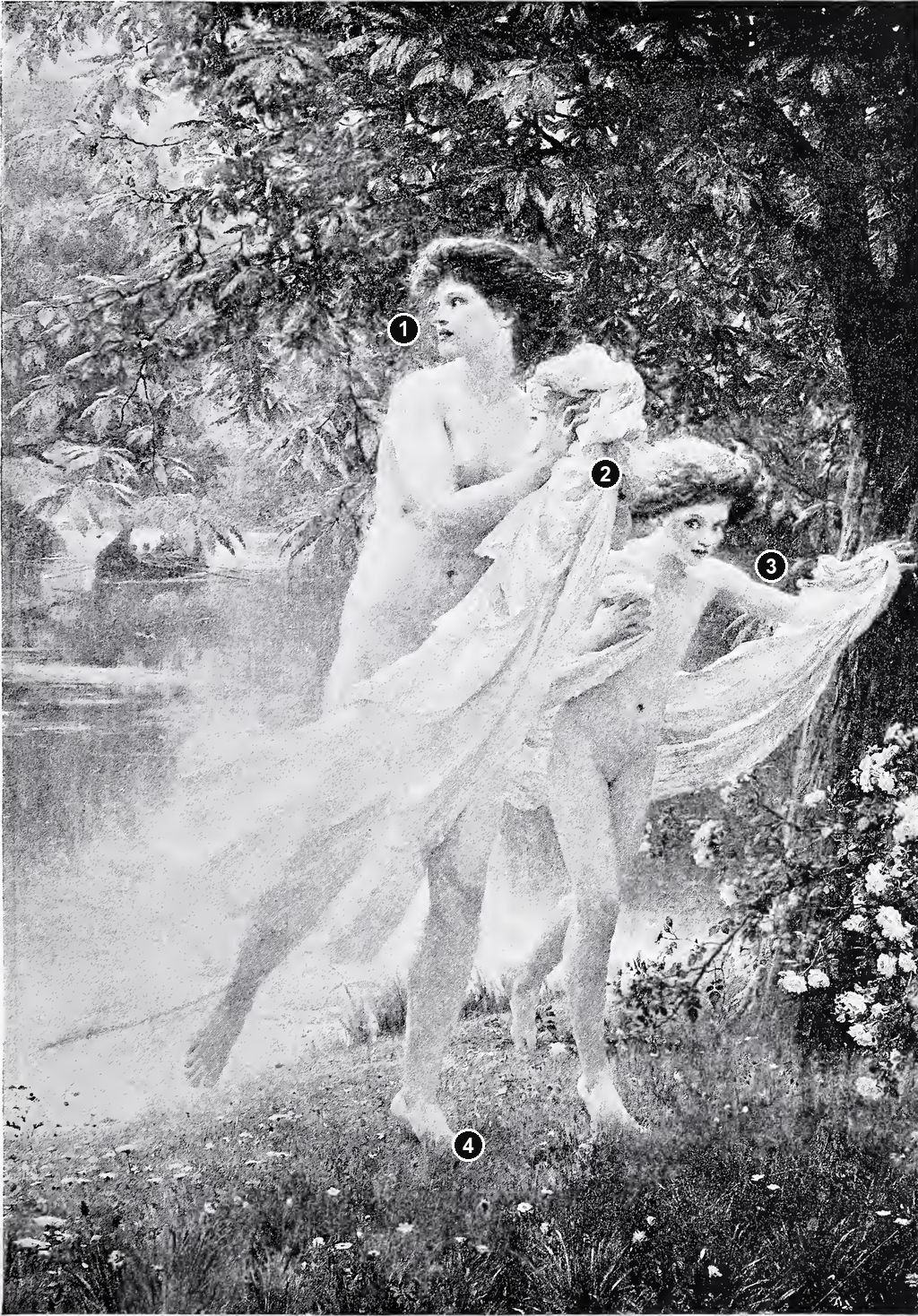
Details from STARTLED IN THE 1892 ACADEMY REPRODUCTION
Compare the cropped details with the source images above. Notice how their colours, shapes and positions contribute to the larger compositions.
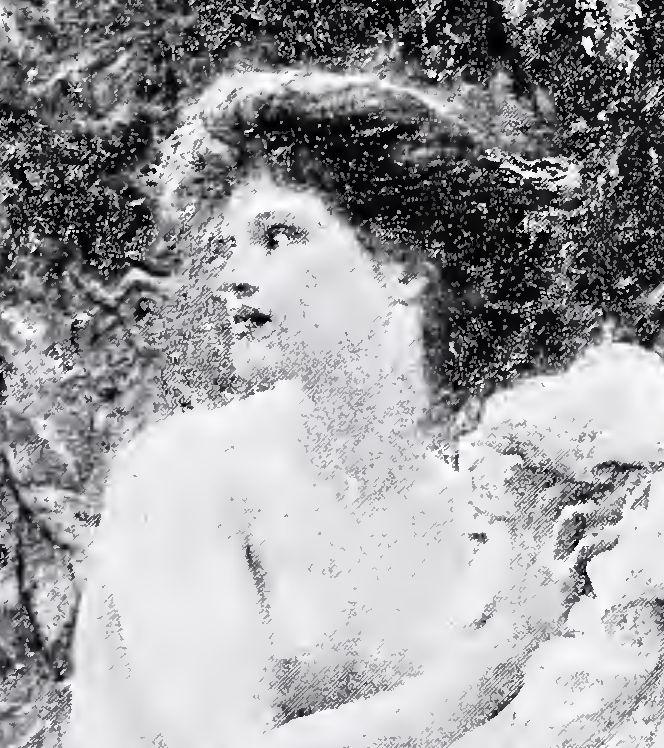
A look back over the river
The taller bather turns her face back towards the water. Dark leaves outline her head and help make the turn readable in this monochrome reproduction.
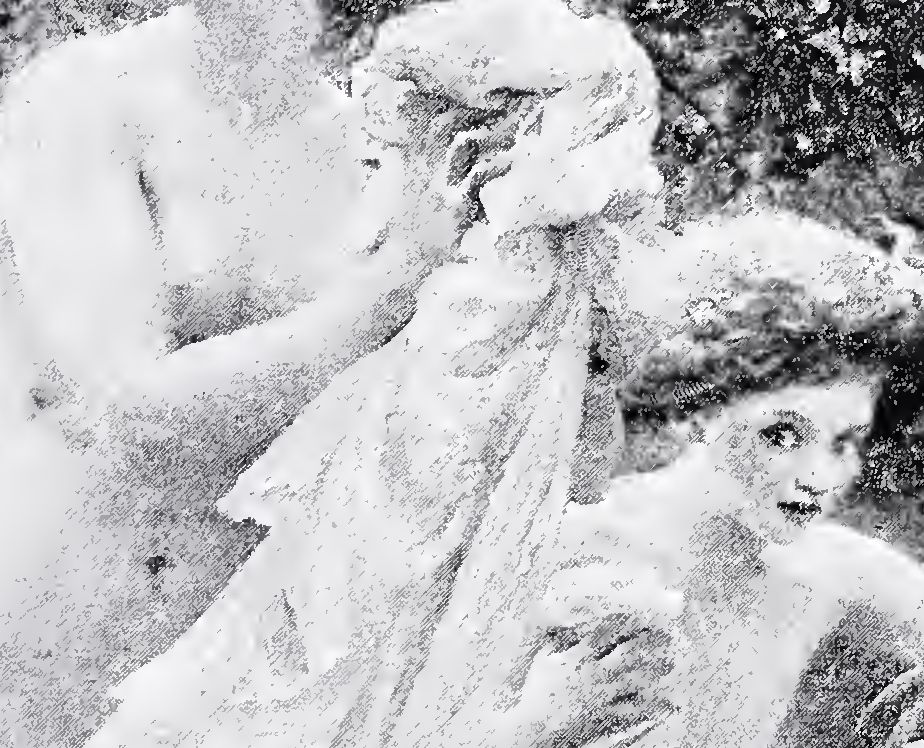
Hands gathering the cloth
One hand holds the gathered fabric close to the body. A loose sweep of pale cloth runs from this point down across the foreground.
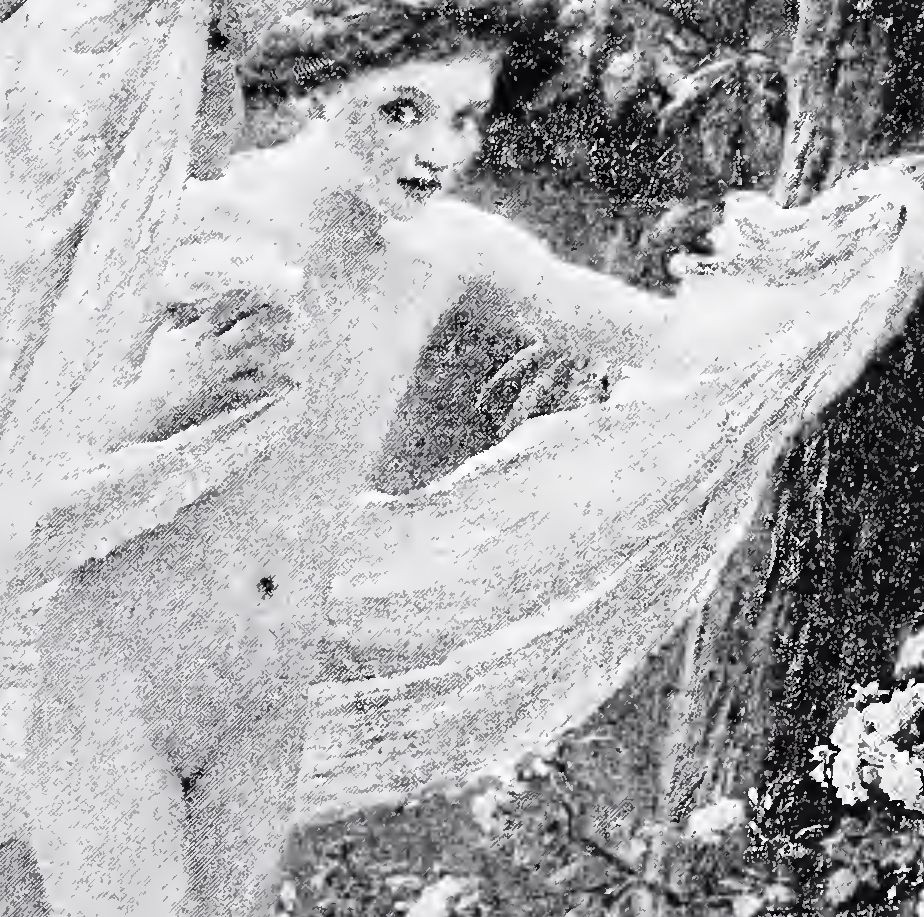
The younger bather
The younger figure holds out a second piece of cloth while looking towards the bank. The other bather turns the opposite way.
A foothold on the bank
Bare feet and the fine marks of grasses bring the movement to a point on the bank. Above them the cloth cuts across the softer shapes of river and trees.
A diploma painting in the 1892 exhibition
Dicksee was elected a full Royal Academician in 1891. Startled was the work he gave to mark that election, and it appeared at the following year’s exhibition at Burlington House. Algernon Graves’s record of Academy exhibitors gives Startled as no. 150 and Leila, Dicksee’s other painting at the show, as no. 97. On page 21 of the illustrated supplement Royal Academy Pictures, the full-page reproduction carries Dicksee’s name and identifies the painting as his diploma work. The same supplement illustrates Leila on page 131. [2] [5]
The diploma system required newly elected Academicians to deposit a work as an example of their skill. Dicksee offered a painting that shows how much he could do in a modest space, with two overlapping figures, two different kinds of drapery and a landscape that makes their alarm intelligible. [1] [2] [5] [6]
The 1892 commentary praised the care taken over what it regarded as a relatively small picture and judged it a particularly generous submission. The same writer turned from the sunlit riverbank to describe Leila as a substantially larger painting, with rich dress and furnishings. Put side by side in the account, the works show Dicksee working with two very different settings and scales of colour. The light in Startled has to travel through leaves and across water before it reaches the figures, while the writer’s account of Leila dwells on strong colour in silk, embroidery and interior fabrics. [4]
The election gift remained in the Academy’s collection while the image reached readers elsewhere. A full-page reproduction appeared in the first half-year volume of the Munich art periodical Die Kunst unserer Zeit for 1902, in the pages of Alfred Lys Baldry’s survey of English painting. The German volume kept the English title Startled and credited Franz Hanfstaengl on the plate. In monochrome, the tall tree, light cloth and pale opening in the river remain easy to pick out. The distinct reds, greens and yellows described by the 1892 writer become differences of tone. [1] [4] [7]
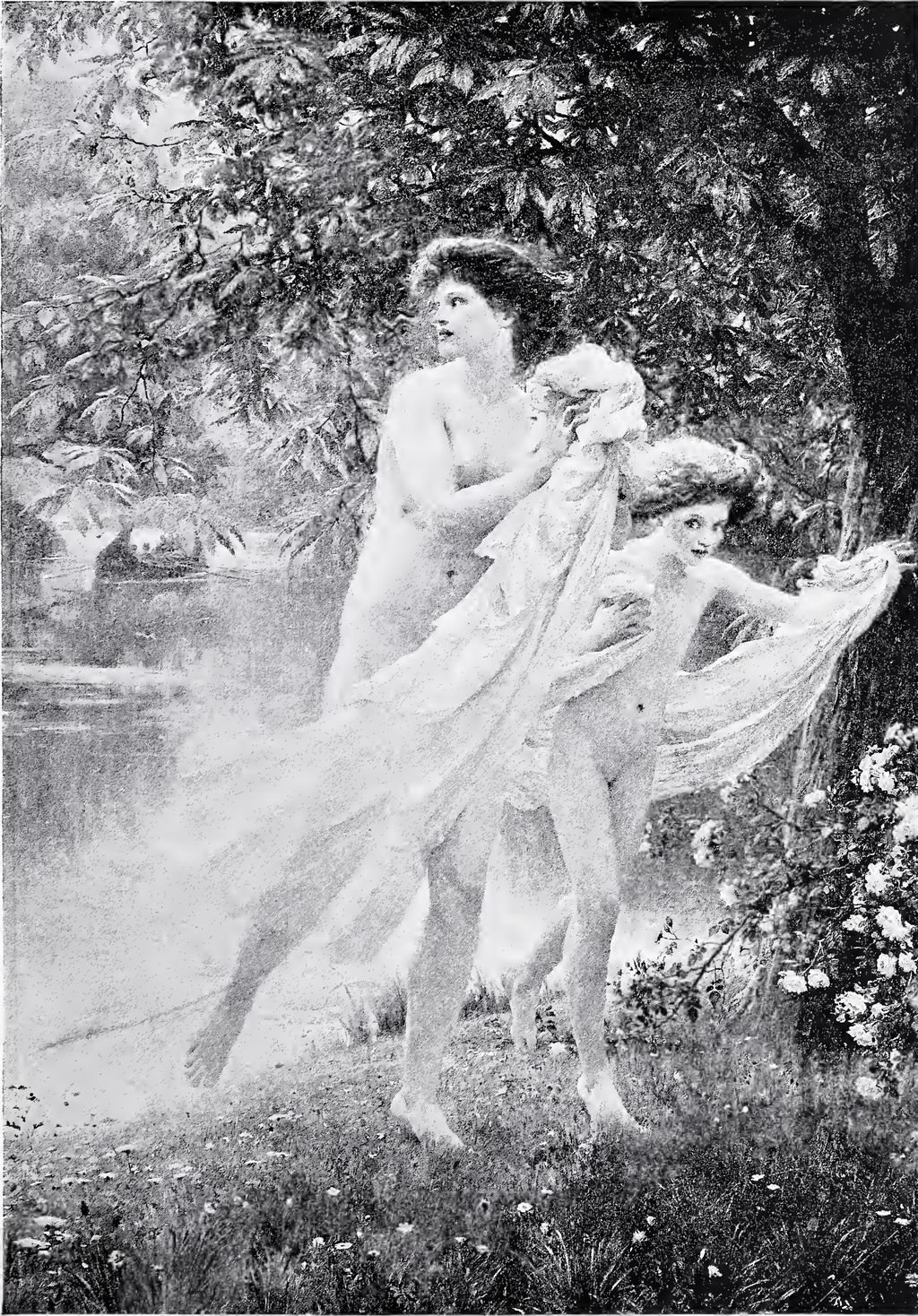
The Academy plate for Startled, published in Royal Academy Pictures in 1892, p. 21. Frank Dicksee, Startled, monochrome reproduction in Royal Academy Pictures, 1892, p. 21. Image source. Public domain.
Two studies, two problems to solve
The Royal Academy holds a drawing, Study for ‘Startled’, dated about 1892, in pencil and white chalk on green wove paper. It isolates the younger figure. Against a middle-toned sheet, a pencil mark can deepen the shade and white chalk can lift a highlight without the need to fill the whole surface. In the oil, those changes of tone have to work alongside the light off the river and the brighter folds of fabric. On its own, the figure shows how much of the motion comes from a shift of weight, before landscape or costume supplies a direction. [1] [8]
A separate signed chalk drawing, catalogued by Bonhams as a study of the principal figure’s head, concentrates on the older bather. The auction catalogue identifies it with the drawing printed opposite page 38 of Thomas Catling’s The Press Album in 1909. The album itself gives it the title Portrait of a Lady. The profile and swept-up hair are recognisable without the river or the second figure. Under that later title a reader could encounter it as an independent portrait, even though Bonhams connects it to the painted scene. [9] [10]
Dickens’s studio account describes Dicksee beginning with an imagined arrangement, testing poses with models and then making studies of such things as tone and drapery. She was describing how he worked in general. Together, the two surviving studies give a sense of why separate sheets could be useful. In the finished painting, the younger figure’s pose helps convey the rush towards the bank, while the older bather’s profile directs attention back towards the water. [3] [8] [9]
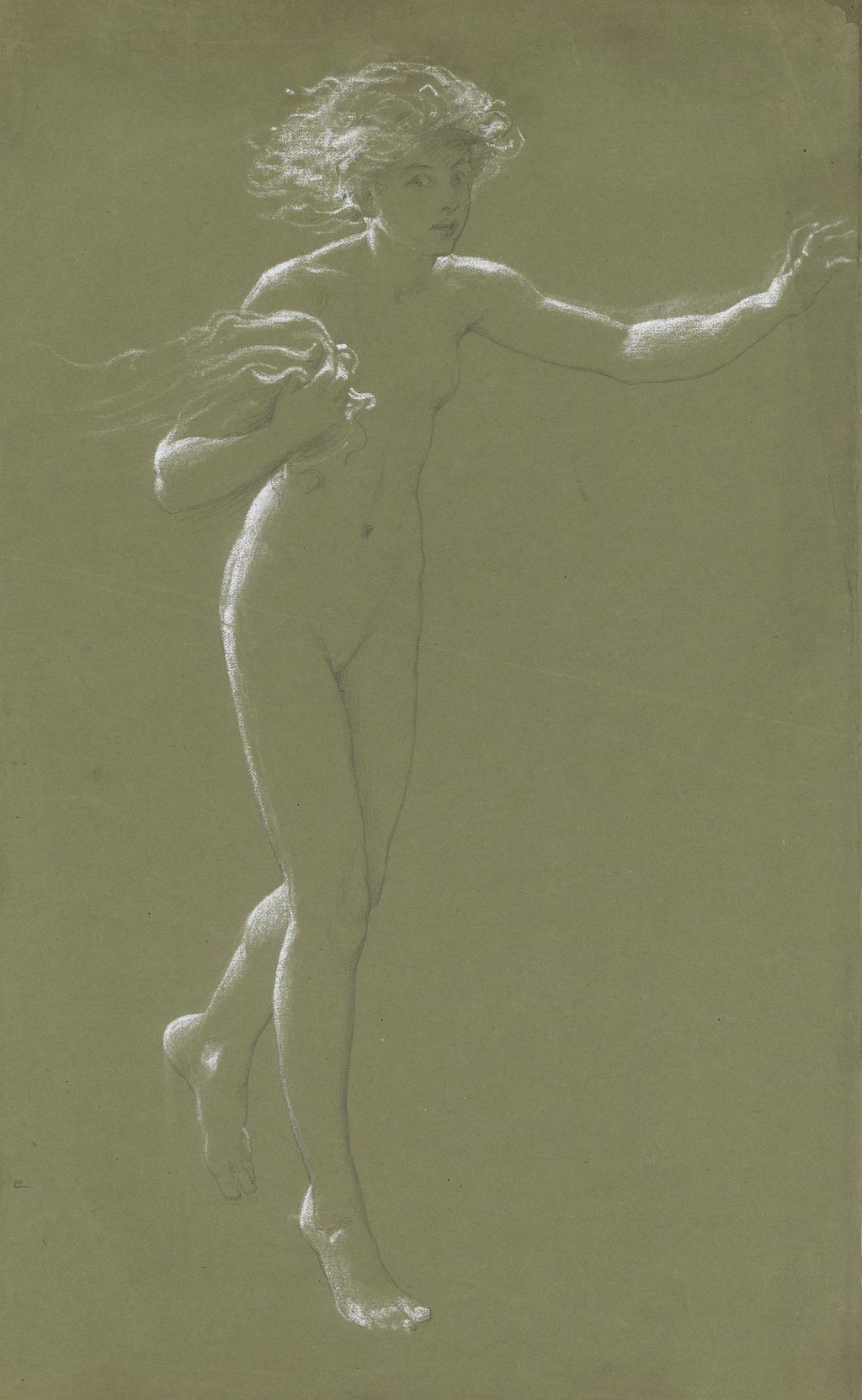
Royal Academy study for Startled, 09/2072. The light marks trace the arm, legs and movement of the drapery. Frank Dicksee, Study for Startled, Royal Academy of Arts, 09/2072. Image source. Public domain.
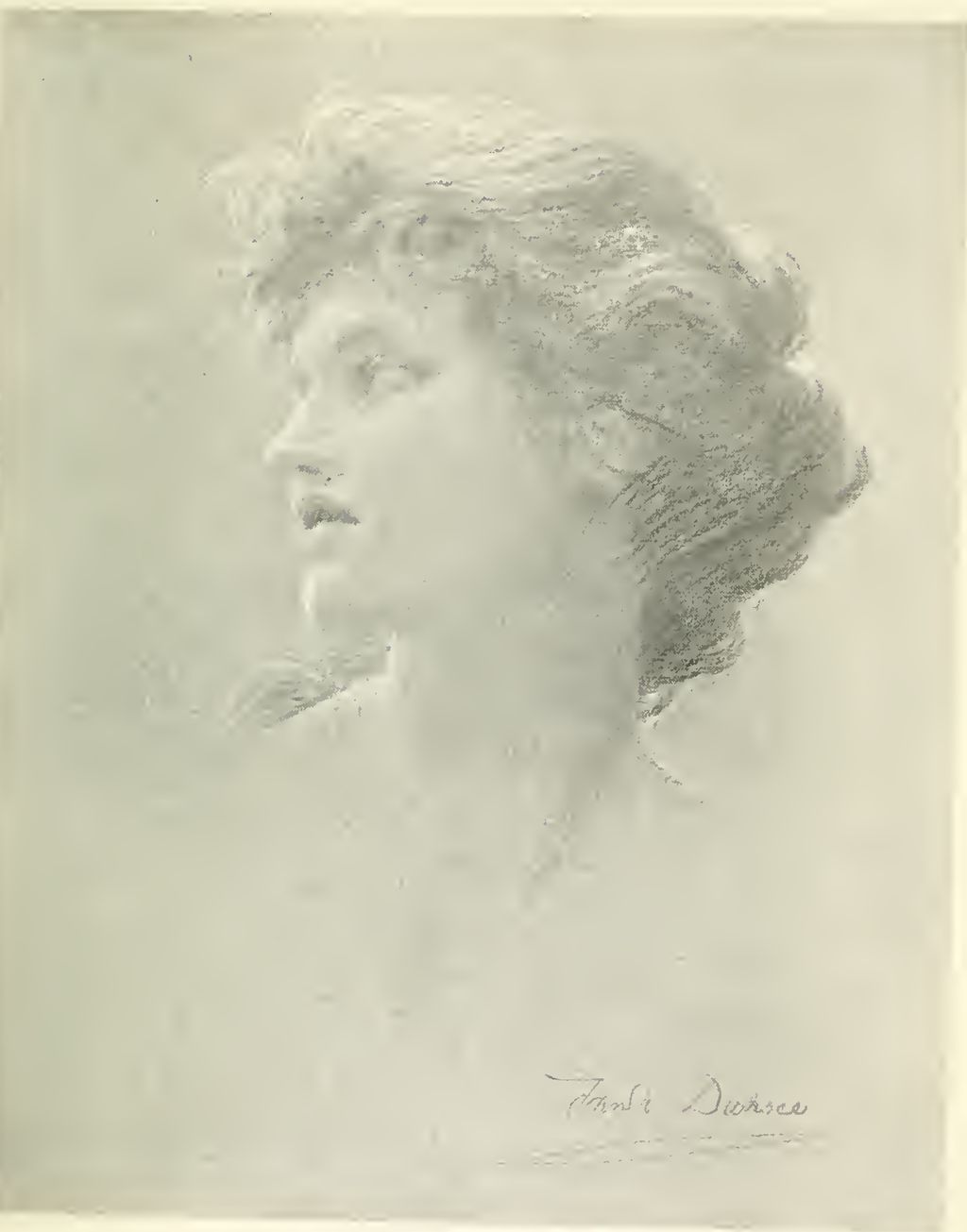
The head study reproduced in The Press Album, 1909, facing p. 38. A separate study from the Academy sheet. Frank Dicksee, study of a head for Startled, printed in The Press Album, 1909, facing p. 38. Image source. Public domain.
The Royal Academy’s 2024 interpretation
The Royal Academy exhibited Startled again in Entangled Pasts, 1768–now: Art, Colonialism and Change in 2024. Its curators placed the canvas in Gallery 4 under the heading “Constructing Whiteness”. The label connected the figures’ luminous skin and idealised forms to a racial ideal of beauty promoted in academic art. It identified the vessel as a Viking longship and treated it as an emblem of a supposed Nordic racial identity. The curators also cited Dicksee’s later insistence, from his years as Royal Academy president, that his ideal of beauty was white. [11]
The exhibition setting made that reading concrete. The room also contained Betye Saar’s I’ll Bend But I Will Not Break, a 1998 assemblage that uses a diagram of the slave ship Brookes on the surface of an ironing board. A ship that occupies a dim patch in Dicksee’s river and a ship diagram that is central to Saar’s work have quite different functions. The Academy brought them into the same room to ask how works of art had represented racial ideals and the afterlives of enslavement. In that setting, the Academy’s own decision to accept and preserve Dicksee’s painting became part of its history on display. [11]
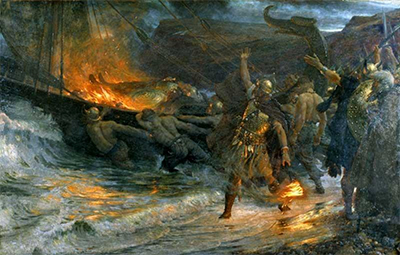
Dicksee’s explanation as reported in 1897 accounts for the movement and alarm. The modern label addresses the choice of bodies and vessel through which he made that incident visible. There is another comparison within Dicksee’s own work. In The Funeral of a Viking, exhibited at the Academy the following year, the boat and its crew occupy the foreground. Art historian Nancy Rose Marshall contrasts the funerary painting’s emphasis on masculine figures with Dicksee’s preceding figure paintings, including Startled. In one work the boat carries the central action, and in the other a small sign of it is enough to set the story in motion. [3] [11] [12]
Frank Dicksee artworks directory
Browse documented paintings, studies, illustration designs and prints. Where an article is available, the title opens it. Simon Toll’s catalogue
| Name | Date | Medium |
|---|---|---|
| A Love Story | 1882 | Painting |
| A Reverie | 1895 | Painting |
| An Offering | 1898 | Painting |
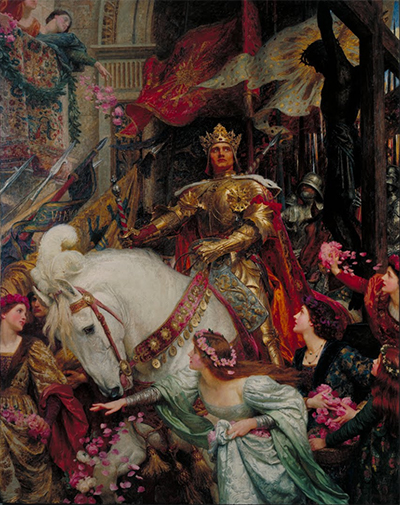
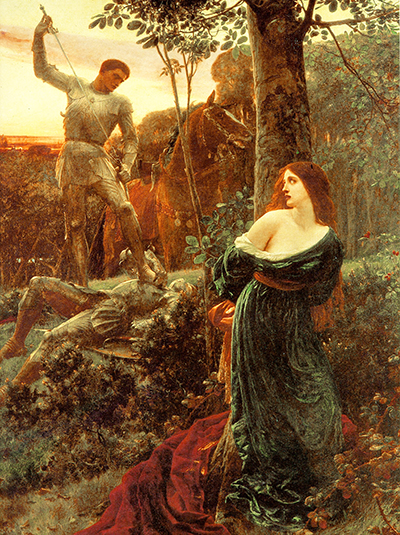
| Chivalry | 1885 | Painting |
| Dawn | 1897 | Painting |
| Elijah Confronting Ahab and Jezebel in Naboth’s Vineyard | By 1875 | Painting |
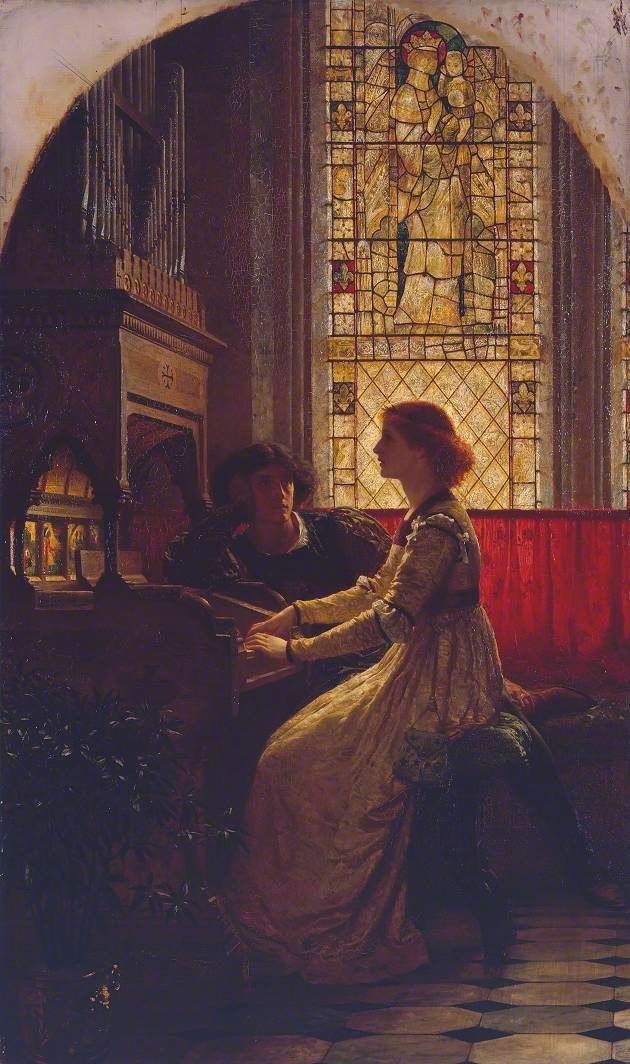
| Harmony | 1877 | Painting |
| Harmony, etching by Charles-Albert Waltner after Dicksee | 1880 | |
| Harmony, the smaller Towneley version | Late 1870s | Painting |
| Hesperia | 1887 | Painting |
| Hesperia, watercolour version | Late 1880s | Painting |
| Italian Coast from La Mortola | 1925 | Painting |
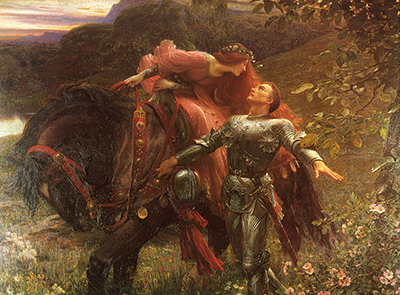
| La Belle Dame sans Merci | c. 1901 | Painting |
| Memories | 1886 | Painting |
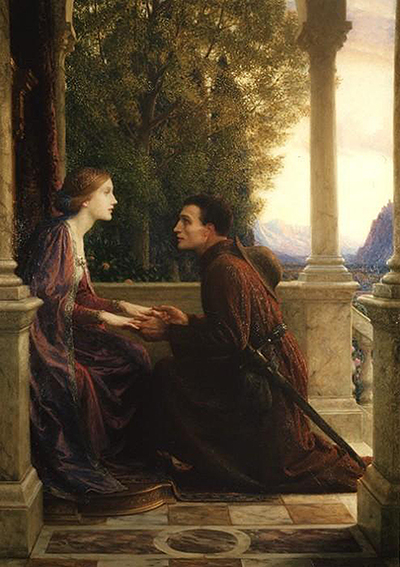
| Paolo and Francesca | 1894 | Painting |
| Portrait of Camille Sutton Palmer | 1914 | Painting |
| Portrait of Elsa | 1927 | Painting |
| Portrait of the Duchess of Buckingham and Chandos | 1901 | Painting |
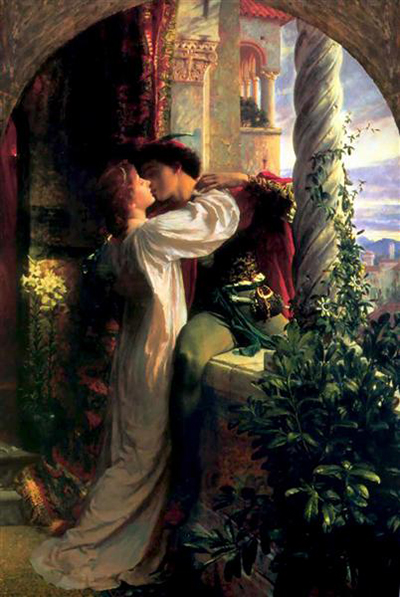
| Romeo and Juliet | 1884 | Painting |
| Romeo and Juliet, monochrome design on joined wood | c. 1880s | Painting |
| Sir Edmund William Gosse, collotype after Dicksee | 1912 | |
| Startled | 1892 | Painting |
| Study for Startled | Early 1890s | Drawing |
| The Confession | 1896 | Painting |
| The Crisis | 1891 | Painting |
| The Daughters of Eve | 1925 | Painting |
| The Embarkation | 1879 | Painting |
| The End of the Quest | 1921 | Painting |
| The Funeral of a Viking | 1893 | Painting |
| The House Builders | 1880 | Painting |
| The Magic Crystal | 1894 | Painting |
| The Passing of Arthur | 1889 | Painting |
| The Redemption of Tannhäuser | 1890 | Painting |
| The Symbol | 1881 | Painting |
| The Two Crowns | 1900 | Painting |
| Yseult | 1901 | Painting |
Frequently Asked Questions
Discussion
Look again at the images and ideas explored in Startled. These editorial prompts invite your observations.
Reader Insights
When did you notice the boat, and which detail drew your eye towards it?
What do the older bather’s backward glance and the younger bather’s outstretched arm tell you about how each is responding?
What changes when you look at the picture with the 1892 description in mind and then read the 2024 Royal Academy label?
Join the Conversation
Share the detail that changed your reading of Startled. Was it something in the figures’ gestures or a glimpse of the river through the branches?
References
- Royal Academy of Arts, Startled, 1892, diploma work, 03/1039, collection photograph and object data reproduced on Wikimedia Commons. View source.
- Algernon Graves, The Royal Academy of Arts: A Complete Dictionary of Contributors and Their Work, vol. 2, p. 324, 1891 election and 1892 exhibition entries. View source.
- Mary Angela Dickens, “A Popular Painter: Mr. Frank Dicksee, R.A.”, The Windsor Magazine, 1897, p. 391, studio process and reported conversation. View source.
- Art Renewal Center, Paul Ripley’s The Obituary of Frank Dicksee, section “Contemporary Comments, Royal Academy Pictures, 1892”, transcription of the 1892 account. View source.
- Cassell and Company, Royal Academy Pictures, 1892, The Magazine of Art supplement, Startled, p. 21, Leila, p. 131, and index to illustrations. View source.
- J. E. Hodgson and Fred A. Eaton, The Royal Academy and Its Members, 1768–1830, appendix V, pp. 370 and 375, diploma rule and Dicksee entry. View source.
- Die Kunst unserer Zeit, 1902, first half-year volume, index to full-page plates and Startled plate listed at p. 17. View source.
- Royal Academy of Arts, Study for ‘Startled’, c. 1892, 09/2072, collection photograph and object data reproduced on Wikimedia Commons. View source.
- Bonhams, British and European Art, 2015, p. 20, lot 35, A study for ‘Startled’. View source.
- Thomas Catling, ed., The Press Album, John Murray, London, 1909, Portrait of a Lady facing p. 38. View source.
- Royal Academy of Arts, Entangled Pasts, 1768–now: Art, Colonialism and Change, 2024 online guide, Gallery 4, “Constructing Whiteness”, PDF pp. 93, 95 and 100, archived 2 February 2024. View source.
- Nancy Rose Marshall, “Victorian Imag(in)ing of the Pagan Pyre: Frank Dicksee’s Funeral of a Viking”, 19: Interdisciplinary Studies in the Long Nineteenth Century, 25 (2017), pp. 6–8 and fig. 5. View source.
- Sworders, Fine Interiors, 10 March 2020, lot 443, Herbert Thomas Dicksee, Startled (tiger). View source.