 by Tom Gurney
Tom Gurney BSc (Hons) is an art history expert with over 20 years experience
Published on June 19, 2020 / Updated on November 25, 2026
Email: tomgurney1@gmail.com / Phone: +44 7429 011000
Paolo and Francesca: Introduction
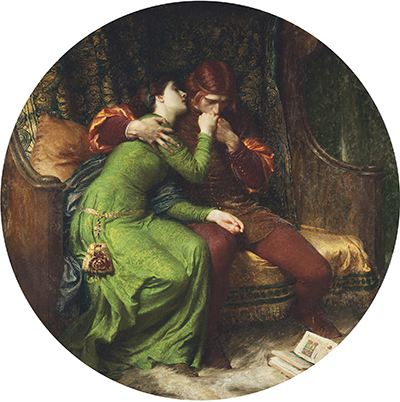
The book has fallen open at their feet. Paolo draws Francesca towards him and lifts her hand to his lips. Her face tilts back into the light, and the green folds of her dress spread across the lower half of Frank Dicksee’s painting. The scene comes from the fifth canto of Dante’s Inferno, where Francesca tells the poet how a story about Lancelot led to a kiss of their own. Dicksee signed his canvas in 1894 and exhibited it at the Royal Academy the following year. He pictures the moment when the two readers become lovers, leaving the consequences beyond the frame. [1] [2] [3]
At a Glance
- ArtistFrank Dicksee
- DateSigned 1894
- MediumOil on canvas
- FormatCircular painted field, approximately 129 cm across
- First exhibitionRoyal Academy, London, 1895, no. 171
- Literary sourceDante Alighieri, Inferno, Canto V
This work across Frank Dicksee’s career
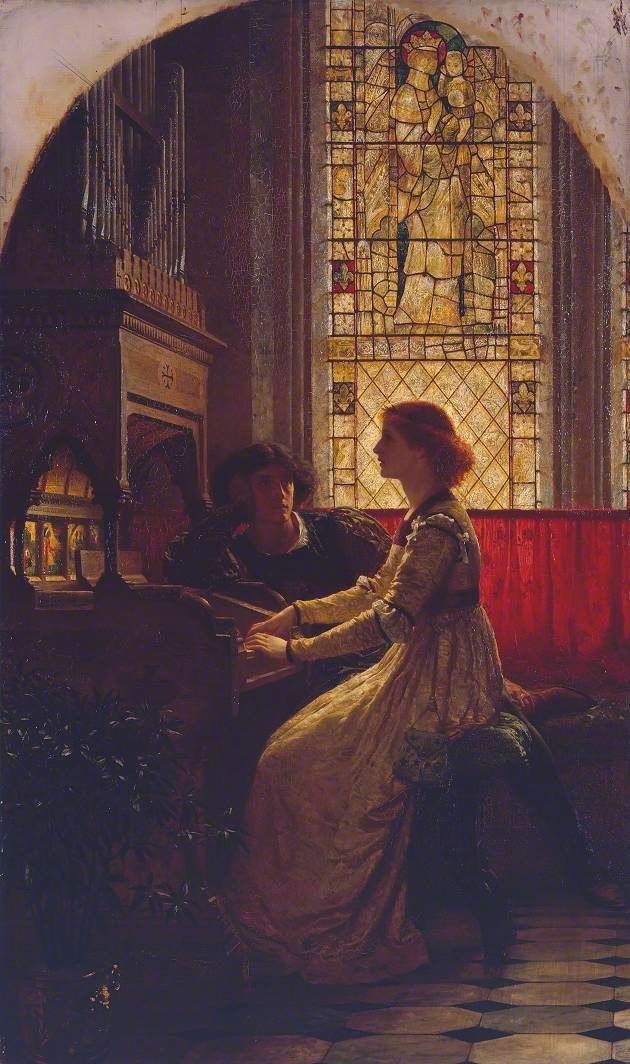
Harmony
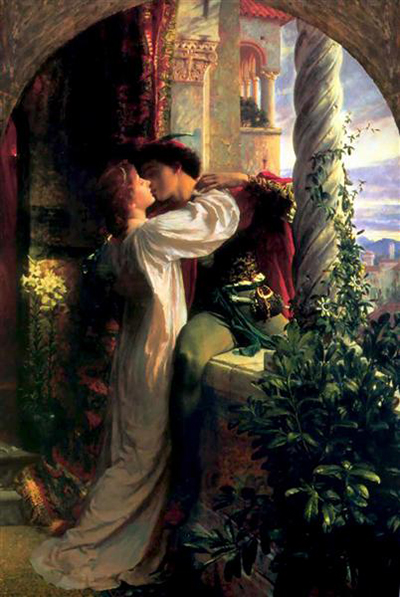
1877Romeo and Juliet
1884Chivalry
1885Startled
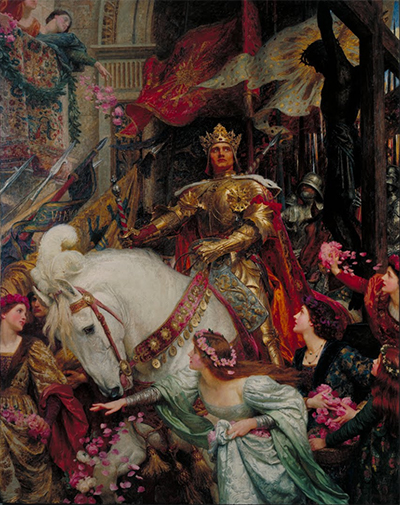
1892The Two Crowns
1900Contents
- The story Francesca tells
- The book and the lovers’ hands
- Three ways to picture Dante’s lovers
- The Royal Academy and Stanmore Hall
- A Love Story and the earlier lovers
The story Francesca tells
Dante and Virgil meet the lovers in the second circle of Hell, where a relentless wind sweeps along the souls of the lustful. Francesca speaks for the pair. She explains that she and Paolo were reading about Lancelot for pleasure and that the story repeatedly made them look at one another and brought the colour from their faces. When they reached the kiss in the romance, Paolo trembled and kissed Francesca on the mouth. She tells Dante that they read no further that day. Paolo weeps as she speaks, and the poet falls to the ground in a faint. [3] [4]
Francesca calls the book and its author Galeotto, the Italian form of Galehaut, the figure who helps Lancelot meet Guinevere in the French prose romance. As the linguist Antonio Montinaro explains, the book plays the go-between for Francesca and Paolo. Reading gives them both an example to follow and the chance to recognise what is already passing between them. Francesca’s choice of words also leaves a question hanging over her account. How much responsibility is she giving the story for a decision that she and Paolo made? [3] [4]
In the traditional account, Francesca da Polenta was married to Giovanni Malatesta, Paolo’s brother, who killed them both. Dante has Francesca say that Caïna, the place reserved for traitors to kin, awaits their killer. The poem gives its closest attention to her recollection of the reading and to its effect on Dante. The murder scene familiar from later paintings belongs to the wider telling of the story. Dicksee preserves the lovers’ seclusion, a circumstance Francesca emphasises when she says that they had been reading alone. [2] [3] [4] [5]
The book and the lovers’ hands
Francesca and Paolo sit against a high-backed settle. Its dark patterned surface gives the stronger colours of their clothing something to play against. Her light sleeve lies across his darker costume, and the deep folds of green fabric pull the eye down to the foreground. Paolo’s hand comes around her far shoulder. His other hand holds hers near his mouth, so there is a second point of contact just below their faces. The closeness of the figures makes those small movements legible even in a crowded composition. [1]
Dante gives Francesca the last word and tells us directly where Paolo kissed her. Dicksee puts the emphasis on the approach. Her chin is lifted, her eyes appear lowered, and a sliver of space remains between their faces. The gesture can be read as a kiss on the hand, or as the instant before their mouths meet. Francesca’s account belongs to someone who already knows the cost of the encounter. The painting gives the couple a moment in which that knowledge is still in the future. [1] [3]
The fallen book offers another way into the scene. Its pages are still open, and small patches of colour on them suggest illustration. The book sits away from their hands, near the lower right, where it marks how abruptly the activity that brought them together came to an end. For a viewer who knew Dante, a glance down from the embrace to those open pages would have been enough to recall Francesca’s last line about the day they stopped reading. The 1897 Guildhall exhibition catalogue made that connection explicit by placing the line directly under the picture’s entry. [1] [3] [6]
The visible picture is circular even though the canvas is roughly square. The shape draws the folds of Francesca’s dress and the couple’s bent bodies into the same sweep. There is a second round form behind the lovers, which art historian Claire Elizabeth Yearwood identifies as a mirror. Yearwood reads the mirror alongside the Dante subject and the deep green of the dress as part of a dialogue with Pre-Raphaelite painting. Its position near the edge of their embrace allows it to register as part of the furnished room. The broad curve around the figures makes their outlines feel unusually close to the outer limits of the image. [1] [7]
The apparently spontaneous lean took preparation. The Martin Beisly dossier reproduces a study of the two figures posed together without their costumes and a separate drawing of Francesca’s raised head in pencil and white chalk. The head study appeared in The Magazine of Art in 1895. A watercolour dated 1894 also survives. Christie’s records its composition as reversed relative to the oil, and the Beisly reproduction shows a different inclination of Francesca’s head. The studies give a sense of the work Dicksee put into making the figures’ weight and balance convincing before the patterning and colour came into play. [1] [2]
Three ways to picture Dante’s lovers
Jean-Auguste-Dominique Ingres brings a third figure into the room. In his 1814 panel at the Musée Condé, painted for Caroline Murat, Paolo leans in, Francesca lets the book fall, and her husband appears from behind the curtain with a sword. The effect depends on the viewer seeing the danger while the lovers are still caught up in the kiss. Ingres returned to the episode several times and changed details between versions. Dicksee’s dropped book invites comparison with the Chantilly panel, where it is still in the act of falling. [1] [8]
Dante Gabriel Rossetti’s 1855 watercolour at Tate makes room for several points in the canto. On the left the lovers kiss with the book still in front of them. In the centre Dante and Virgil look towards the scene on the right, where the lovers drift together in Hell. The divisions let the viewer move from an intimate scene to its retelling and aftermath. Dicksee takes the earthly scene and gives it the full area of the painting, bringing the lovers close enough for a change in the tilt of a head or the touch of a hand to matter. [1] [9] [10]
Gustave Doré worked on both sides of that divide. His designs for the 1861 French Inferno included a plate about the moment the lovers stopped reading. His large oil exhibited at the Paris Salon in 1863 shows the lovers in the afterlife. The contrast is especially sharp next to Dicksee’s deep, furnished interior. Doré’s bodies appear suspended together in darkness, while the cushions and seat in Dicksee’s painting help account for the way Francesca’s weight falls towards Paolo. The same canto could prompt a picture about bodies settling together or a picture about bodies forever denied rest. [1] [11] [12]
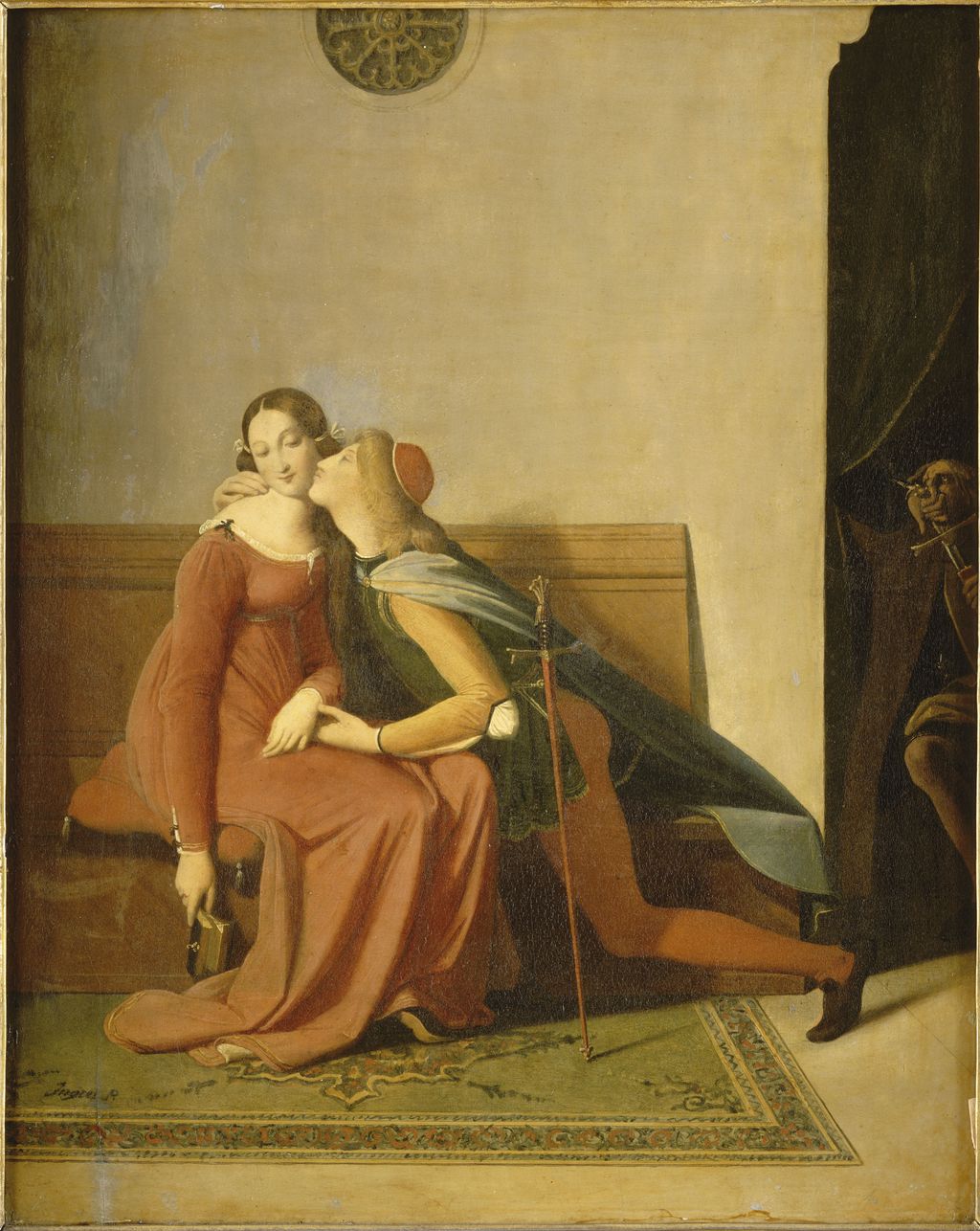
Ingres, Françoise de Rimini, 1814. The Musée Condé version brings the husband into view at the right. Jean-Auguste-Dominique Ingres, Françoise de Rimini. Musée Condé, Chantilly. Image source. Public domain.
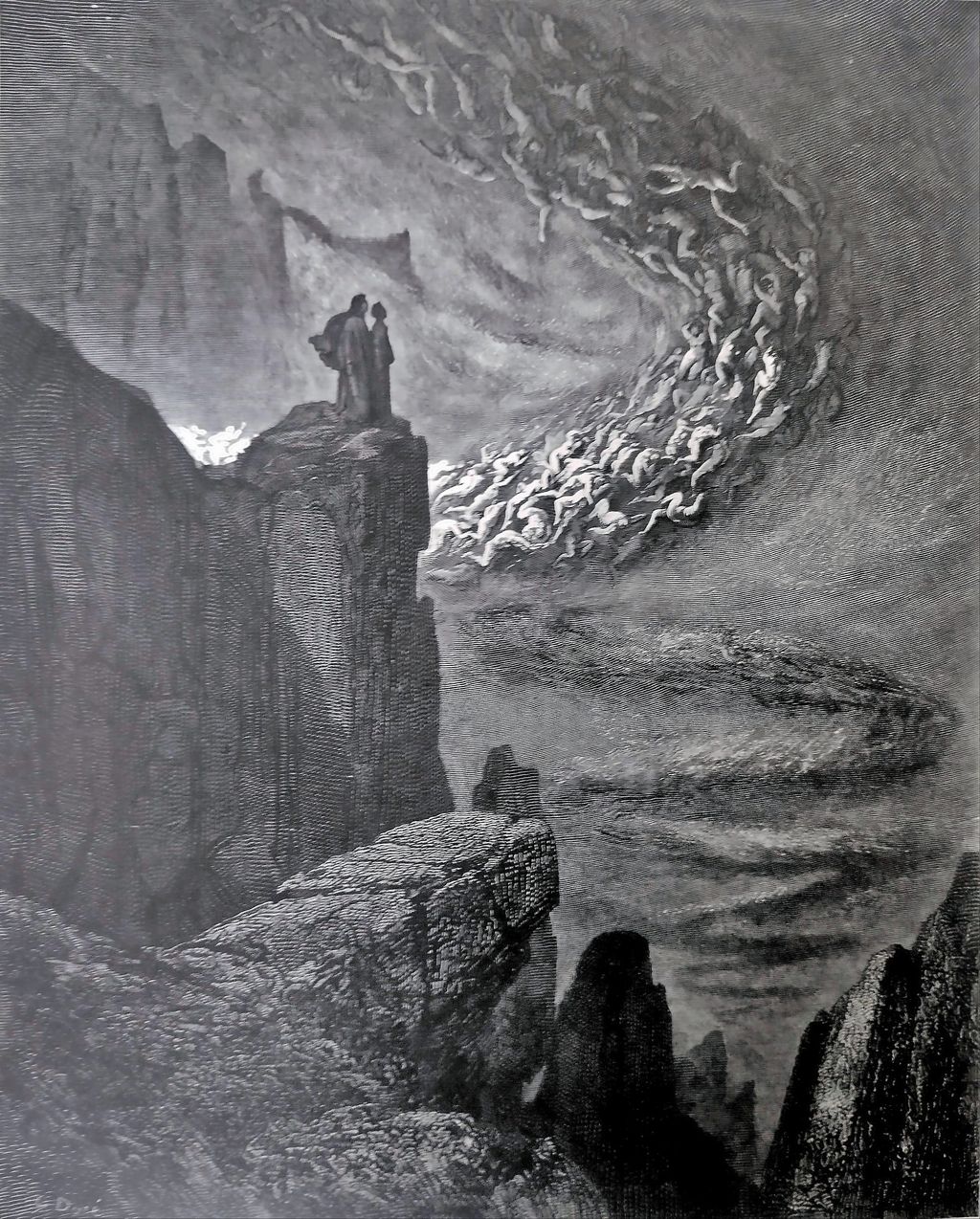
The whirlwind of Dante’s Inferno, Canto V, in a print after Gustave Doré. This is a separate work from Doré’s 1863 Salon oil. Engraving after Gustave Doré, illustration to Dante’s Inferno, canto V. Public-domain reproduction. Image source. Public domain.
The Royal Academy and Stanmore Hall
Christie’s records Dicksee’s signature and the date at the lower left, together with the artist’s name, title and Campden Hill address on the back. Following its Royal Academy exhibition in 1895, the oil was lent by William Knox D’Arcy to the Guildhall Art Gallery in 1897, where it appeared as Paolo and Francesca da Rimini. The catalogue also records a photogravure published by the Fine Art Society. The reproduction gave the composition a life outside the exhibition and the private collection. [1] [2] [6]
Dicksee showed four works at the Academy in 1895, including two Devon landscapes and A Reverie, a modern interior in which a ghostly figure appears beside a piano. As quoted in the Beisly dossier, Robert Jope Slade recalled seeing the two large pictures side by side in Dicksee’s studio. Writing in The Art Journal, he remarked on how different they were and described the Dante painting in terms that recalled the Pre-Raphaelites. Other critics admired parts of it. The Christie’s catalogue quotes Frederic George Stephens as praising the colour and asking for greater pathos. Claude Phillips likewise admired the grouping of colours and the balance of the composition while questioning whether the result conveyed the passion of the scene. Phillips thought Paolo looked too respectful for the story’s violent outcome. That response depends partly on which action one sees. Anne-Florence Gillard-Estrada reads it as a kiss directed at Francesca’s hand and sees the discretion of the gesture as part of a late Victorian treatment of the subject. She compares it with Charles Edward Hallé’s painting shown at the New Gallery in 1888, where Paolo kneels as he draws Francesca’s hand towards him and the book already lies on the ground. Hallé sets his couple in a park. Dicksee closes the view around the embrace. [1] [2] [10]
D’Arcy, who also patronised William Morris and Edward Burne-Jones, owned the painting by the time of its Guildhall appearance. The Beisly dossier identifies him as its commissioner and reproduces a photograph of D’Arcy and his second wife, Nina, at Stanmore Hall. Part of the canvas can be seen above the piano. The photograph suggests how the public exhibition piece worked in a private setting, amid furniture and textiles that a visitor would see alongside Dicksee’s painted ones. The dealer traces the oil through D’Arcy’s family to a 1957 Christie’s sale and records its reappearance at auction in 2008. [1] [2] [6]
A Love Story and the earlier lovers
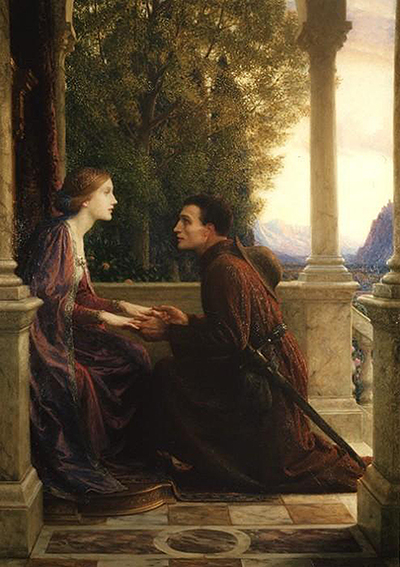
Dicksee had painted another couple in medieval dress in A Love Story, the horizontal oil with an arched top that Stephen George Holland bought from him in 1882. It appeared at that year’s Royal Academy, then at later exhibitions under the title Love’s Whisper, including a Guildhall loan show in 1895. The two oils passed through the Guildhall two years apart with different lenders. The 1882 painting belonged to Holland, and the 1894 work was lent by D’Arcy. Sotheby’s and the Beisly dossier cite separate entries in Simon Toll’s catalogue of Dicksee’s work, FD.1882.1 and FD.1894.2. [1] [6] [13] [14]
In A Love Story, the woman sits with her hands clasped and the man leans towards her on a marble bench. Moonlight catches her pale gown against the dark garden. A passage from Tennyson about lovers’ whispers accompanied the painting in the Academy catalogue, and it appears again in the 1908 sale catalogue for Holland’s collection. The silent exchange might suggest any number of literary romances. Sotheby’s connected its atmosphere with Dicksee’s illustrations for Romeo and Juliet and placed it among treatments of clandestine love, where the Paolo and Francesca story offers one point of comparison. [13] [14] [15]
Reviewing A Love Story in 1882, Stephens singled out the theatrical moonlight and the way that it partly reveals the figures in the shade of the laurels. His 1895 response to Paolo and Francesca again picked up on Dicksee’s colour, this time with reservations about its dramatic force. The two works also reached audiences as prints. Adolphe Lalauze etched A Love Story, and the Fine Art Society issued its photogravure of Paolo and Francesca. A newspaper account in 1925 called the lovers with the book The Love Story. Its brief description does not match the 1882 oil’s garden scene or the position of the book in the 1894 oil. It shows how easily an account of the subject could blur the distinctions that the exhibition and sale records preserve. [2] [6] [14] [15] [16]
The paintings set different kinds of intimacy before the viewer. In the garden the man has leaned towards a woman who keeps her hands to herself. In the later work Paolo’s hand draws Francesca into their embrace, and the open volume on the floor tells us which story brought them there. [1] [13] [15]
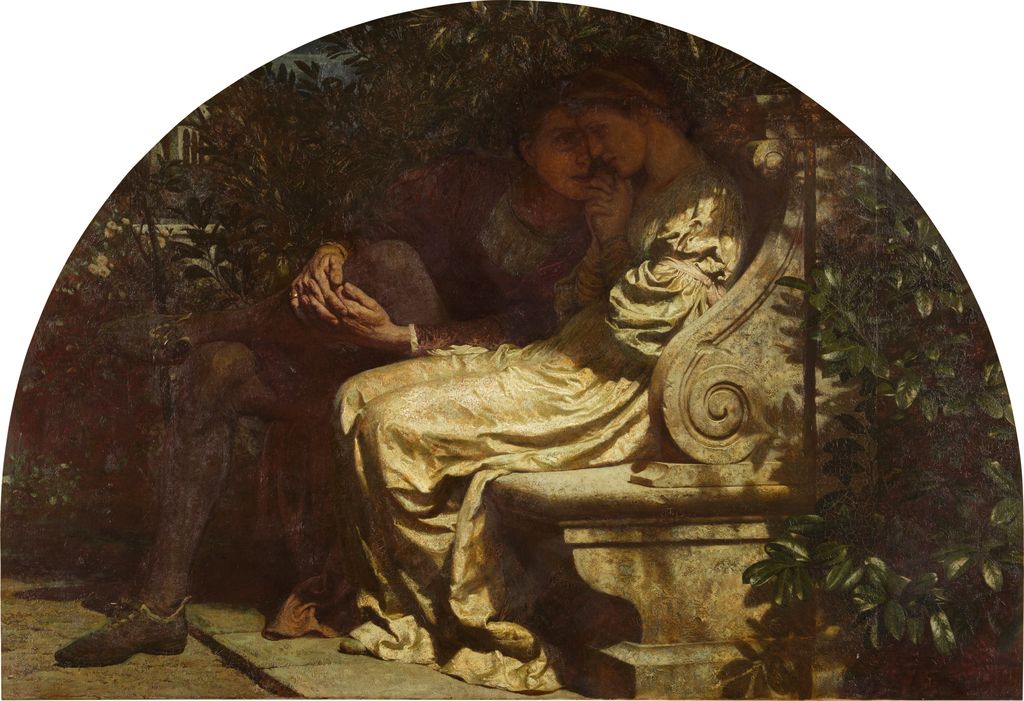
A Love Story, 1882. A separate canvas and a different setting from Paolo and Francesca. Frank Dicksee, A Love Story, 1882. Image source. Public domain.
Frank Dicksee artworks directory
Browse documented paintings, studies, illustration designs and prints. Where an article is available, the title opens it. Simon Toll’s catalogue
| Name | Date | Medium |
|---|---|---|
| A Love Story | 1882 | Painting |
| A Reverie | 1895 | Painting |
| An Offering | 1898 | Painting |
| Chivalry | 1885 | Painting |
| Dawn | 1897 | Painting |
| Elijah Confronting Ahab and Jezebel in Naboth’s Vineyard | By 1875 | Painting |
| Harmony | 1877 | Painting |
| Harmony, etching by Charles-Albert Waltner after Dicksee | 1880 | |
| Harmony, the smaller Towneley version | Late 1870s | Painting |
| Hesperia | 1887 | Painting |
| Hesperia, watercolour version | Late 1880s | Painting |
| Italian Coast from La Mortola | 1925 | Painting |
| La Belle Dame sans Merci | c. 1901 | Painting |
| Memories | 1886 | Painting |
| Paolo and Francesca | 1894 | Painting |
| Portrait of Camille Sutton Palmer | 1914 | Painting |
| Portrait of Elsa | 1927 | Painting |
| Portrait of the Duchess of Buckingham and Chandos | 1901 | Painting |
| Romeo and Juliet | 1884 | Painting |
| Romeo and Juliet, monochrome design on joined wood | c. 1880s | Painting |
| Sir Edmund William Gosse, collotype after Dicksee | 1912 | |
| Startled | 1892 | Painting |
| Study for Startled | Early 1890s | Drawing |
| The Confession | 1896 | Painting |
| The Crisis | 1891 | Painting |
| The Daughters of Eve | 1925 | Painting |
| The Embarkation | 1879 | Painting |
| The End of the Quest | 1921 | Painting |
| The Funeral of a Viking | 1893 | Painting |
| The House Builders | 1880 | Painting |
| The Magic Crystal | 1894 | Painting |
| The Passing of Arthur | 1889 | Painting |
| The Redemption of Tannhäuser | 1890 | Painting |
| The Symbol | 1881 | Painting |
| The Two Crowns | 1900 | Painting |
| Yseult | 1901 | Painting |
Discussion
Look again at the images and ideas explored in Paolo and Francesca. These editorial prompts invite your observations.
Reader Insights
Where does your eye go first, and how does the scene change once you notice the open pages?
How does the tilt of her head affect your reading of the two figures?
What changes when an artist shows the discovery or the punishment as well as the kiss?
Join the Conversation
Tell us which moment of Dante’s story you see in Dicksee’s painting and which detail led you there.
References
- Martin Beisly Fine Art, Paolo and Francesca, object dossier, including provenance, exhibition history, studies and the reproduction of the 1894 watercolour. View source.
- Christie’s, Paolo and Francesca, sale of 11 December 2008, lot 38. View source.
- Dante Alighieri, Inferno, Canto V, vv. 130–142, Princeton Dante Project. View source.
- Antonio Montinaro, Galeotto fu il libro, Treccani, including the Italian text of Inferno V.127–138. View source.
- Dante Alighieri, Inferno, Canto V, vv. 103–108, Princeton Dante Project. View source.
- Guildhall Art Gallery, Descriptive Catalogue of the Loan Collection of Pictures, 1897, p. 83, no. 150. View source.
- Claire Elizabeth Yearwood, The Looking-Glass World: Mirrors in Pre-Raphaelite Painting, 1850–1915, University of York, 2014, vol. I, illustration 245 and p. 249. View source.
- Musée Condé, Jean-Auguste-Dominique Ingres, Paolo et Francesca, PE 434. View source.
- National Gallery of Australia, Love & Desire: Pre-Raphaelite Masterpieces from the Tate, Dante Gabriel Rossetti, Paolo and Francesca da Rimini, Tate N03056. View source.
- Anne-Florence Gillard-Estrada, ‘He, “for ever, kissed my mouth, all quivering”: Paolo and Francesca in Pre-Raphaelite and Aesthetic painting’, Dante e l’arte 11 (2024), especially pp. 69–75. View source.
- Musée d’Art Moderne et Contemporain de Strasbourg, Gustave Doré, Paolo et Francesca, 1861 preparatory drawing, Joconde record 00160004191. View source.
- Christie’s, Gustave Doré, Paolo and Francesca da Rimini, sale of 17 July 2014, lot 1061. View source.
- Sotheby’s, Frank Dicksee, A Love Story, sale of 2 February 2024, lot 833. View source.
- Christie, Manson & Woods, sale catalogue for the Stephen G. Holland collection, 25 June 1908, lot 23. View source.
- Dennis T. Lanigan, A Love Story, with a reproduction and extracts from the 1882 reception and Sotheby’s catalogue, Victorian Web. View source.
- Otago Daily Times, ‘The Royal Academy’, 27 January 1925, p. 4, Papers Past, National Library of New Zealand. View source.