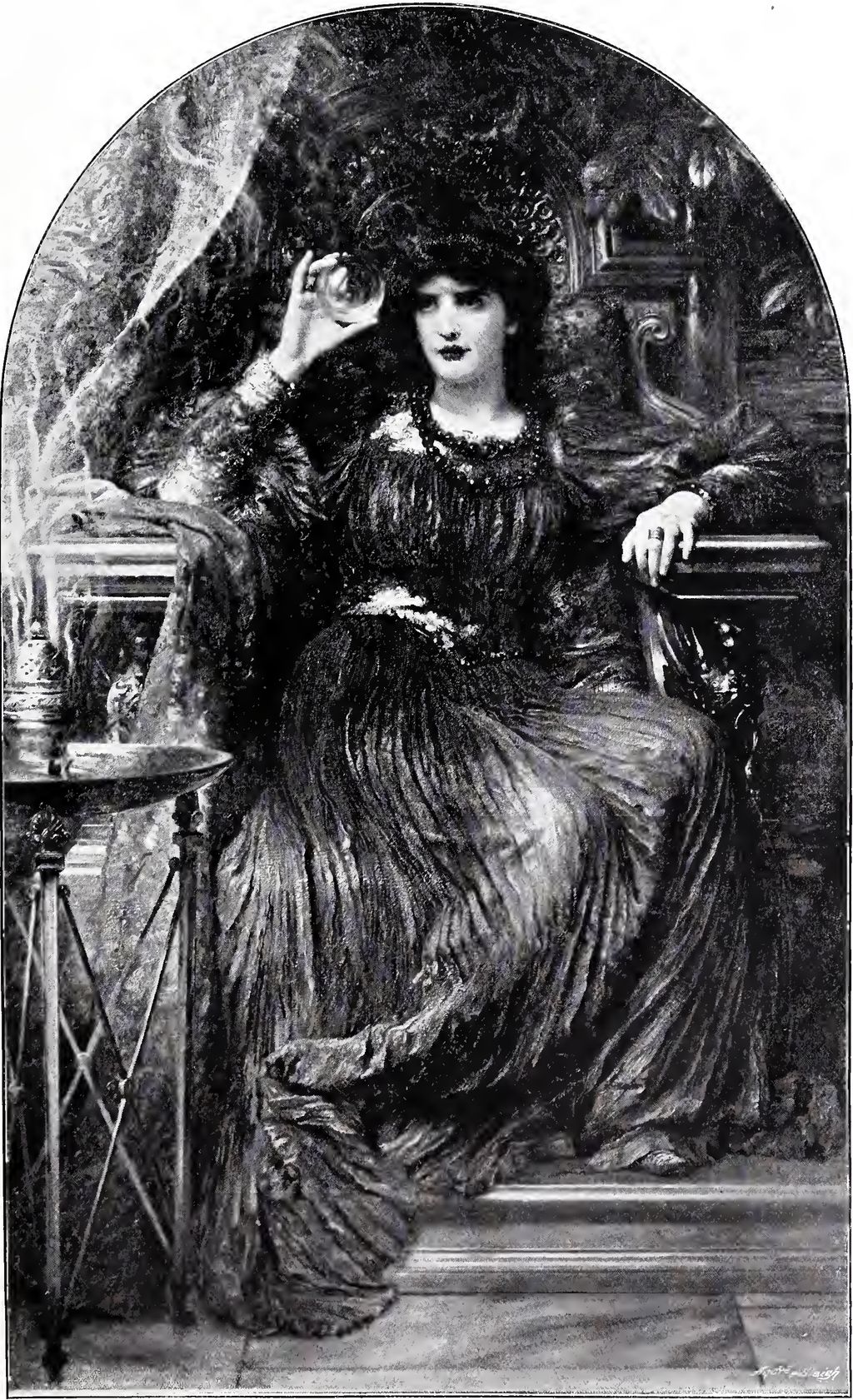
The Magic Crystal, as reproduced in Royal Academy Pictures, 1894, p. 135. This contemporary plate is monochrome. Frank Dicksee, The Magic Crystal, monochrome reproduction in Royal Academy Pictures, 1894, p. 135. Image source. Public domain.
 by Tom Gurney
Tom Gurney BSc (Hons) is an art history expert with over 20 years experience
Email: tomgurney1@gmail.com / Phone: +44 7429 011000
The Magic Crystal by Frank Dicksee: Introduction
A seated woman raises a crystal to the level of her eyes. Her fingers hold it lightly, and her other hand rests on the arm of a carved chair. She appears to study something quite intently. Frank Dicksee gives us the crystal's bright rim, the turn of her eyes and the dark space between the two. Whatever might be taking shape for her remains private. The longer we look, the harder it is to tell whether the bright sphere has shown her anything. [1]
At a Glance
- ArtistFrank Dicksee (1853–1928). [2]
- Date and medium1894, oil on canvas. [2]
- Dimensions168.5 × 102 cm, as listed by the Victorian Web. [2]
- CollectionLady Lever Art Gallery, Port Sunlight, accession LL3622. [2]
- First documented exhibitionRoyal Academy Summer Exhibition, London, 1894, no. 218. [3]
This work across Frank Dicksee’s career
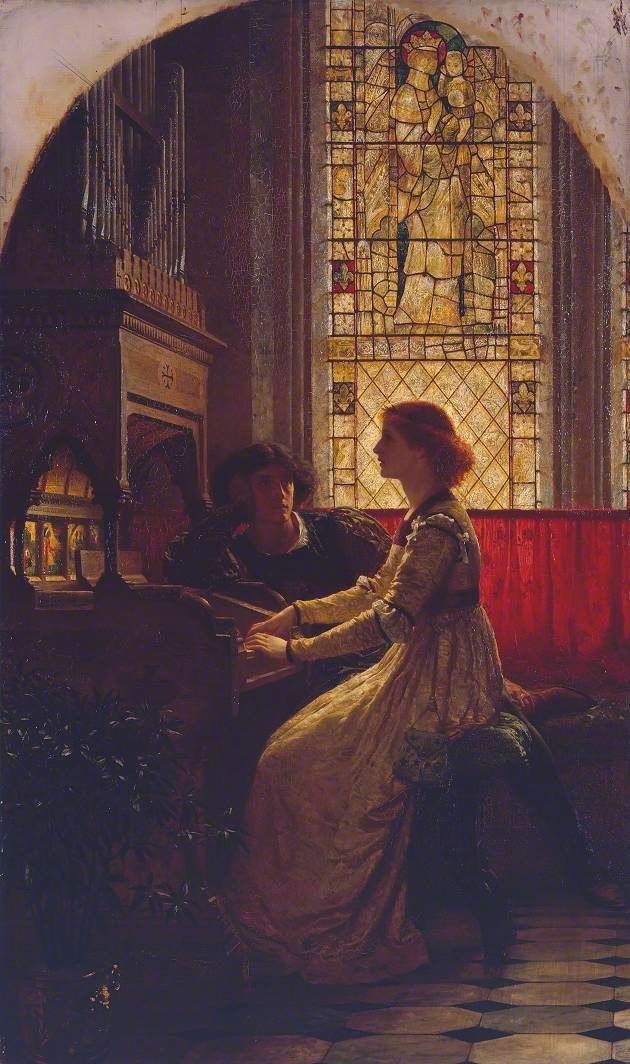
Harmony
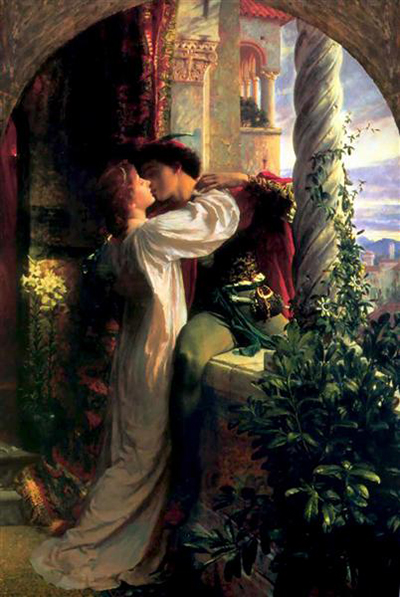
1877Romeo and Juliet
1884Chivalry
1885Startled
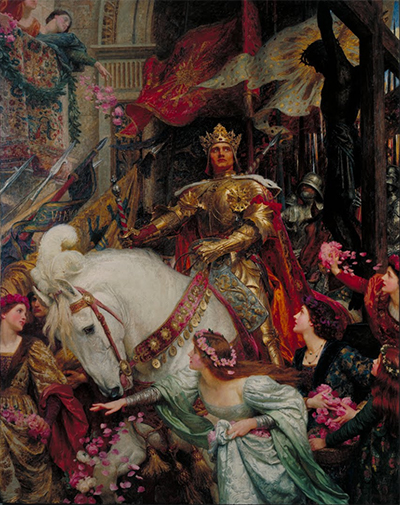
1892The Two Crowns
1900Contents
- The woman and the crystal
- A model and a borrowed dress
- At the Royal Academy in 1894
- A frontispiece for crystal-gazers
- From the studio to Port Sunlight
- Annotated details
The woman and the crystal
The woman sits squarely in the picture while the action takes place off centre. Horizontal chair arms steady the composition. Beneath them, folds fall from her lap, spread over a shallow step and pool on the tiled floor. Above, the rounded top encloses a dense arrangement of foliage, patterned drapery and ornament. The broad curtain on the left sweeps towards the figure even as it interrupts the symmetry of the seat. Her raised forearm answers that diagonal and brings the eye in towards the crystal. Its circle is tiny beside the curve overhead, but the two shapes give the top of the picture a relation to the object at its centre of attention. [1]
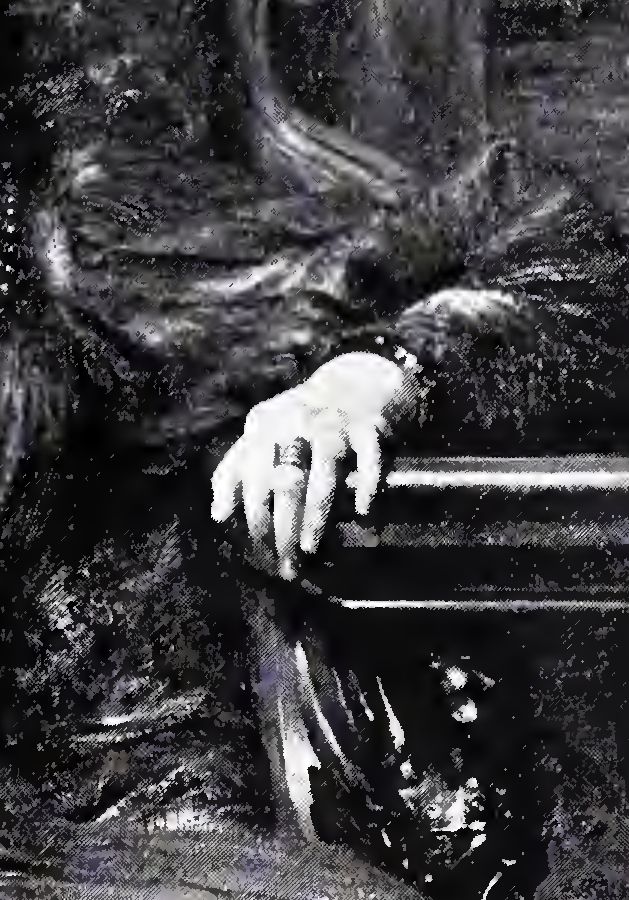
Look at the difference between the two hands. The lowered one hangs over a rail, its fingers heavy and loose. In the raised hand, slivers of light between the fingers help pick out the delicate grip. The ease of the first gesture makes the precision of the second all the more apparent. At the lower left, a shallow table supports a pierced vessel that art historian Jana Wijnsouw reads as an incense burner. Its placement opposite the falling skirt gives that corner a distinct purpose, even for a viewer who misses the association with ritual. Among objects large enough to catch the eye on their own, Dicksee makes attention settle on a sphere small enough to hold between finger and thumb. [1] [4]
In the colour reproduction, greenish dress fabric picks up highlights that break into narrow bands across the fold of her knee. Warmer reds gather in the covering of the chair and in the beads beneath her throat. Both the face and the raised hand have a comparatively plain surface. Against the shifting patterns and gleams, the head can seem remarkably still. An early reviewer writing from London, whose account appeared in New Zealand's Otago Daily Times, chiefly noticed the dress's peacock blues and greens, its violet undertone and the way touches of gold drew the eye around the canvas. That reviewer also imagined the woman searching for something she desired. The review records how readily viewers supplied a motive for an expression Dicksee left open. [2] [5]
A model and a borrowed dress
The clothes that make the scene feel remote came, according to Angela Bolger's research into the model Mary Lloyd, from a contemporary hostess. Dicksee admired a gown worn by Lady Jean Palmer, whose husband was associated with the Huntley and Palmer biscuit business. Bolger describes a sheer peacock-coloured layer over a pink underdress, with pink trim and sequinned sleeves. Palmer sent the garment to Dicksee, and Bolger identifies Lloyd as the woman who posed in it. In the painting the sleeves sparkle at the bends of the arms, where the fabric catches the light. A fashionable garment became part of an imagined scene, with its original texture still doing much of the work. [1] [6]
Lloyd's name restores some of the practical history behind the finished figure. As a professional model she could supply the steady pose and the exact angle of the head that bind this symmetrical composition to an action. Elsewhere in the same year, Bolger traces her sittings to Frederic Leighton's mural for the Royal Exchange, a commission with an entirely different subject and setting. Bolger also reports that in 1895 Dicksee repeated Lloyd's head on a leaf of an ivory fan for Palmer. In the painting the turn of the head answers the crystal. Taken into a small object meant to be held, the likeness could work as a decorative image in its own right. The reported reuse is a reminder of how readily an Academy picture could enter private life in another form. [6]
Annotated Details from The Magic Crystal in the 1894 Academy reproduction
The numbered points identify visible features discussed in this article. Return from each detail to the numbered overview. Monochrome 1894 reproduction of Dicksee’s seated figure holding the crystal beside her face. Image source. Public domain.
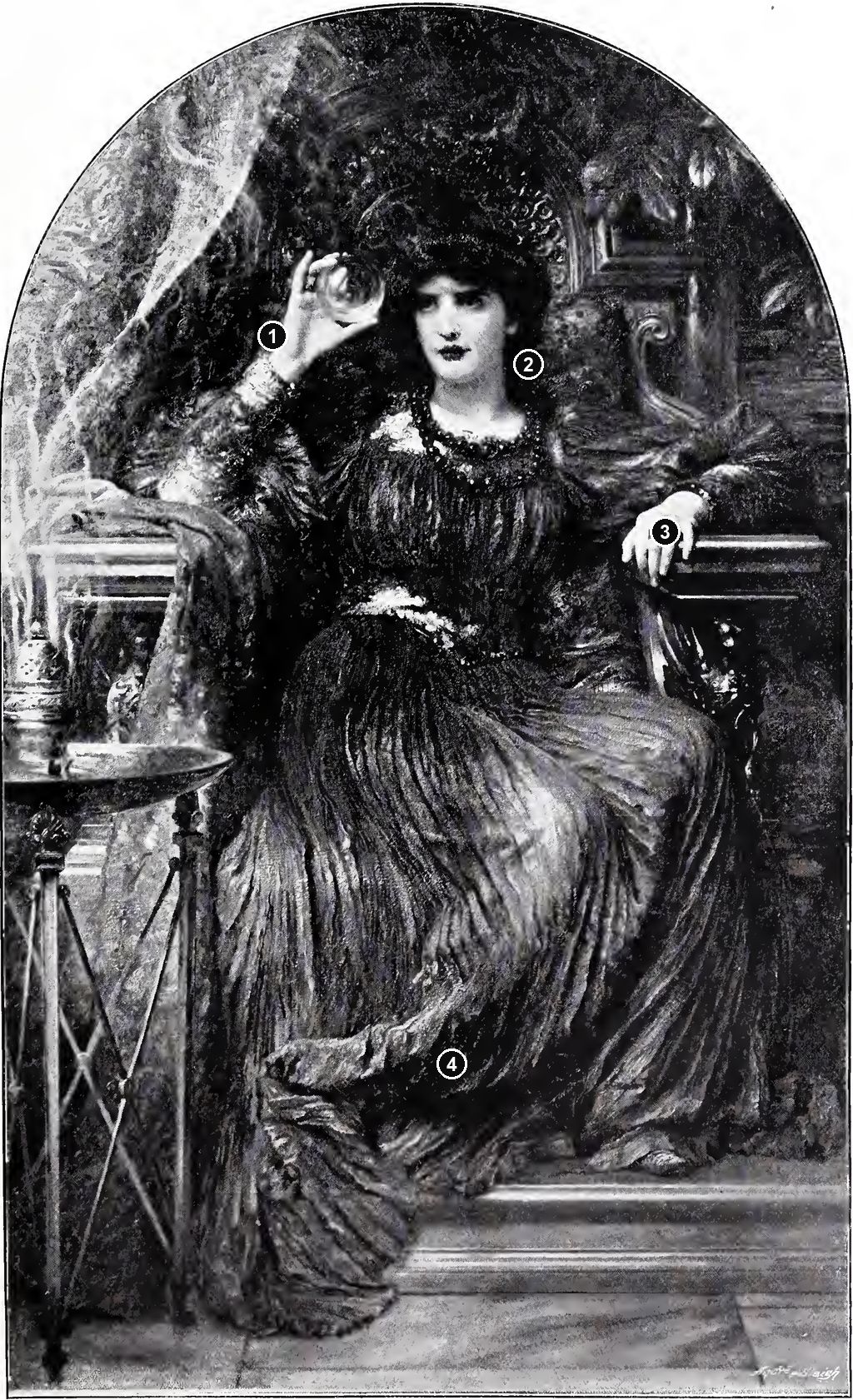
Details from THE MAGIC CRYSTAL IN THE 1894 ACADEMY REPRODUCTION
Compare the cropped details with the source images above. Notice how their colours, shapes and positions contribute to the larger compositions.
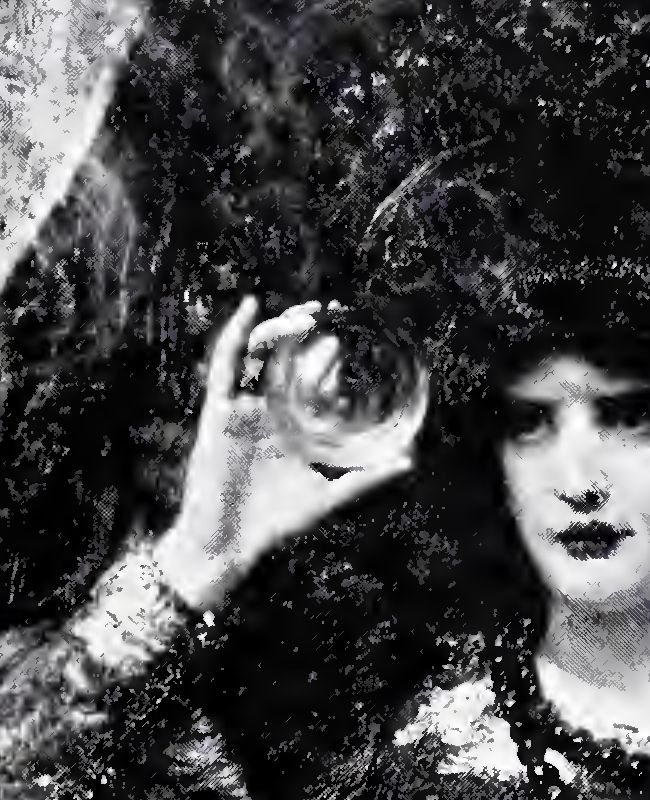
The raised crystal
The period reproduction preserves the outline of the round crystal within the curve of the raised hand. The close grouping of object, fingers and eye makes looking itself central.
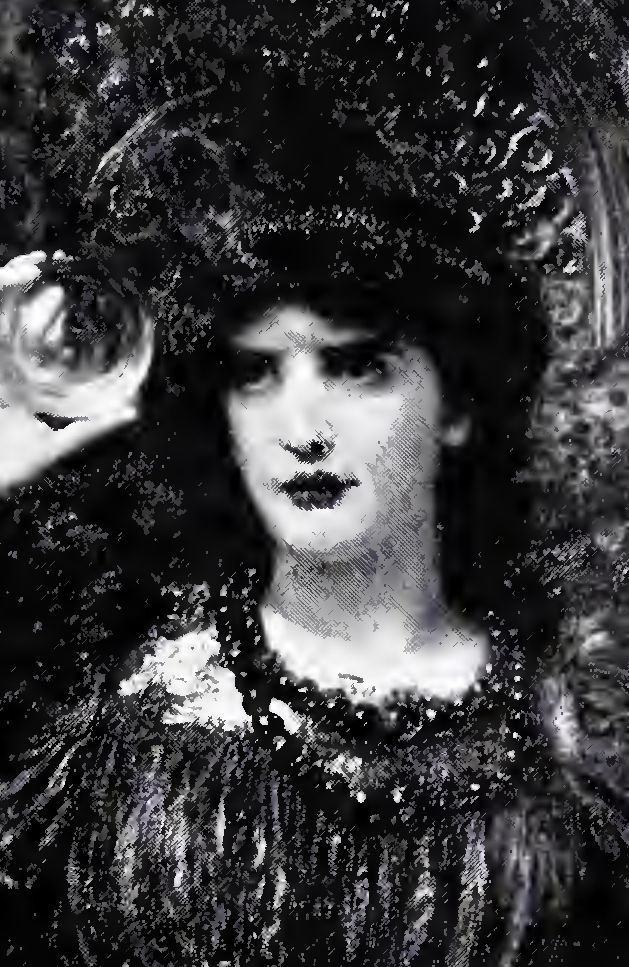
The face
The dark hair and surround make the face stand out. The printed greys give a clear view of where the figure turns even though the sheet cannot reproduce the painting’s colour.
The resting hand
The right hand rests over an arm of the seat, its weight suggested by the loose curve of the fingers. It is a quieter gesture than the raised hand.
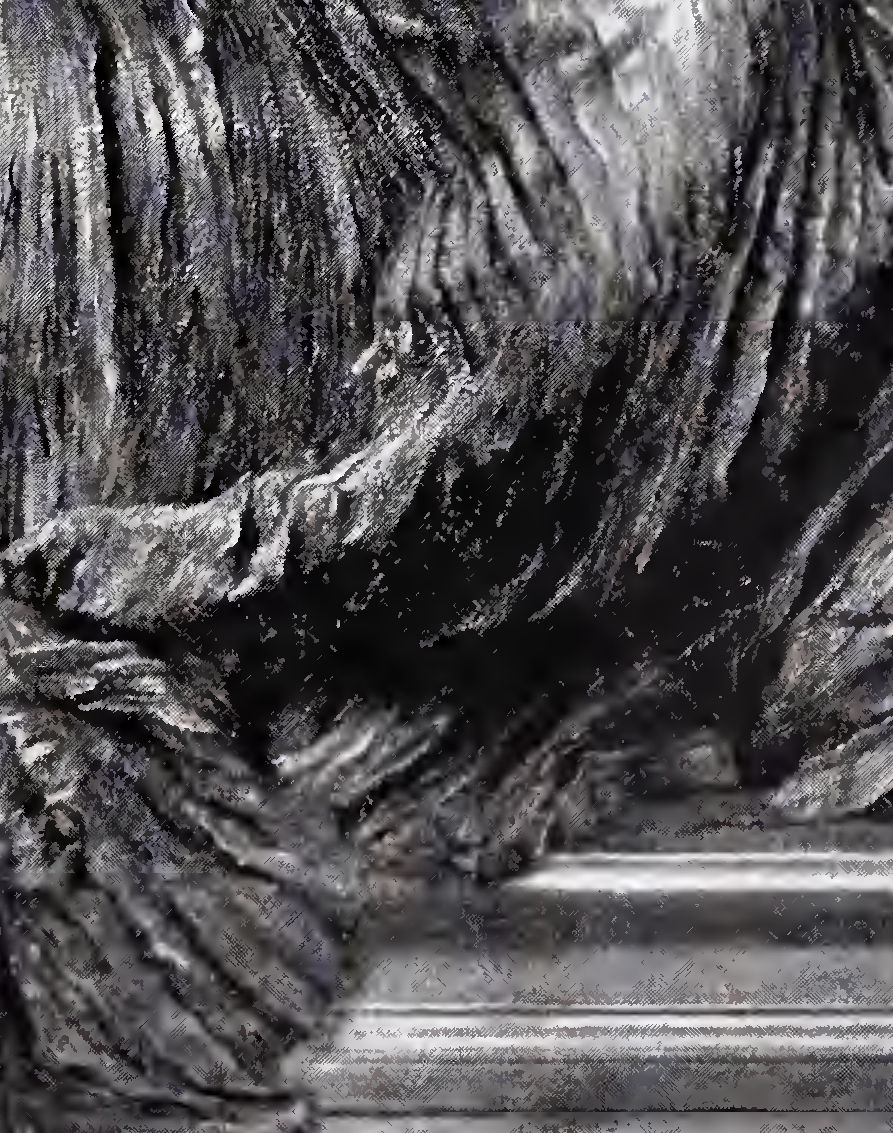
From cloth to step
Dense folds spread from the seat towards the lower edge. The set of horizontal steps at the base holds that movement within the upright format.
At the Royal Academy in 1894
Algernon Graves's record of Royal Academy exhibitors lists The Magic Crystal as no. 218 and Dicksee's A Summer Sea as no. 631. The illustrated Royal Academy Pictures reproduced the figure on a page of her own and gave the size as 65 by 39 inches. By the collection dimensions now published, the canvas stands nearly 1.7 metres high. At that scale a seated figure can have something of the presence of a person across the room. The courtly pose and the slight lift of the hand can be read at a distance. The small shifts of tone around the sphere and the workmanship of the costume reward a closer approach. [1] [2] [3]
Claude Phillips, reviewing the exhibition in The Academy on 12 May 1894, took the colour arrangement seriously. He singled out the translucent outer layer and dark necklace and recognised the care with which the whole picture was balanced. In his view, the flesh lacked the vitality needed to hold its own against all that splendour. He turned next to John William Waterhouse's 1894 Lady of Shalott, finding greater expressive force in the face of the woman who rises from her loom in alarm. Phillips still thought Waterhouse's picture less evenly composed. The pairing puts two uses of a reflective object side by side. Waterhouse brings Tennyson's story to a point of crisis as the Lady turns from the mirror towards Lancelot. Dicksee gives the woman time to look. Her stillness, which Phillips found unsatisfying, leaves us to guess whether anything has happened yet. [7]
A frontispiece for crystal-gazers
In July 1894 the quarterly Borderland borrowed the image for its frontispiece. Its editorial discussed purported supernatural phenomena as subjects for investigation and put Dicksee alongside reports of recent meetings of the Society for Psychical Research. Under the heading Borderland in Art, the editor objected to the way the woman held the sphere. In the editor's view it would catch distracting lights and shadows, spoiling the visualisation on which crystal-gazers relied. Publishing the image so prominently made it an invitation to examine the picture and an example of where the editor thought painters could learn from practitioners. The objection concerns what the magazine expected of such a picture. Dicksee's own beliefs about crystal-gazing remain unknown. [8]
The detail that bothered the editor is also what makes the sphere legible. Held high against a dark area, it remains distinct from the curtain and the raised sleeve. Nor does Dicksee supply a scene inside it that would resolve the question. In her study of British and Belgian art, Wijnsouw places the painting alongside works that use mirrors and crystal balls as objects of divination, including Edward Burne-Jones's The Wizard. The wizard's reflective surface presents an identifiable shipwreck. Dicksee's scene can be understood at a glance as an act of crystal-gazing, while the woman keeps whatever she sees to herself. [1] [4] [8]
From the studio to Port Sunlight
When Mary Angela Dickens profiled Dicksee for The Windsor Magazine in 1897, the magazine ran the picture again as a full-page monochrome illustration, after a photograph credited to Dixon. Her account describes Dicksee's London studio as both a workshop and a setting in which he could develop his imagined scenes. In that context the carved furniture and gathered fabrics read as materials of a working painter, arranged to make an invented interior convincing. Dicksee put that approach to a different use in An Offering, shown at the Academy in 1898. There a little figure of Cupid is offered to a reclining woman, and the prop gives two people something around which to act. In The Magic Crystal the sphere is already in the woman's possession. The picture can stay with her absorbed attention. [3] [9] [10]
Bolger records that the Palmers bought the canvas for their Berkshire home. It subsequently belonged to the soap manufacturer and collector William Hesketh Lever, later Lord Leverhulme, who owned several of Dicksee's works. The collection history records its transfer from Lever's private collection in 1922, the year the Lady Lever Art Gallery opened to the public. Lever had the building made to house his collection and named it in memory of his wife. The painting had thus already taken on several public meanings before entering the gallery, from a large Academy exhibit to the frontispiece of an occult journal. The journal had invited its readers to judge the gesture up close. A visitor to the gallery can first take it in at life size. [2] [6] [8] [9] [11] [12]
Frank Dicksee artworks directory
Browse documented paintings, studies, illustration designs and prints. Where an article is available, the title opens it. Simon Toll’s catalogue
| Name | Date | Medium |
|---|---|---|
| A Love Story | 1882 | Painting |
| A Reverie | 1895 | Painting |
| An Offering | 1898 | Painting |
| Chivalry | 1885 | Painting |
| Dawn | 1897 | Painting |
| Elijah Confronting Ahab and Jezebel in Naboth’s Vineyard | By 1875 | Painting |
| Harmony | 1877 | Painting |
| Harmony, etching by Charles-Albert Waltner after Dicksee | 1880 | |
| Harmony, the smaller Towneley version | Late 1870s | Painting |
| Hesperia | 1887 | Painting |
| Hesperia, watercolour version | Late 1880s | Painting |
| Italian Coast from La Mortola | 1925 | Painting |
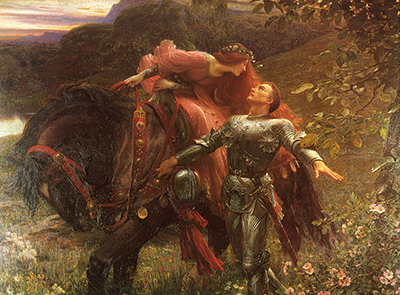
| La Belle Dame sans Merci | c. 1901 | Painting |
| Memories | 1886 | Painting |
| Paolo and Francesca | 1894 | Painting |
| Portrait of Camille Sutton Palmer | 1914 | Painting |
| Portrait of Elsa | 1927 | Painting |
| Portrait of the Duchess of Buckingham and Chandos | 1901 | Painting |
| Romeo and Juliet | 1884 | Painting |
| Romeo and Juliet, monochrome design on joined wood | c. 1880s | Painting |
| Sir Edmund William Gosse, collotype after Dicksee | 1912 | |
| Startled | 1892 | Painting |
| Study for Startled | Early 1890s | Drawing |
| The Confession | 1896 | Painting |
| The Crisis | 1891 | Painting |
| The Daughters of Eve | 1925 | Painting |
| The Embarkation | 1879 | Painting |
| The End of the Quest | 1921 | Painting |
| The Funeral of a Viking | 1893 | Painting |
| The House Builders | 1880 | Painting |
| The Magic Crystal | 1894 | Painting |
| The Passing of Arthur | 1889 | Painting |
| The Redemption of Tannhäuser | 1890 | Painting |
| The Symbol | 1881 | Painting |
| The Two Crowns | 1900 | Painting |
| Yseult | 1901 | Painting |
Discussion
Look again at the images and ideas explored in The Magic Crystal by Frank Dicksee. These editorial prompts invite your observations.
Reader Insights
Where do you look first in the painting, and which part of the composition takes you from her face to the crystal?
Which details support the Borderland editor's interest in crystal-gazing, and which make the scene feel like a performance staged by the painter?
Join the Conversation
Share the detail that most changes your reading of the woman and what she might see.
References
- Royal Academy Pictures, 1894, p. 135, exhibition plate of The Magic Crystal. View source.
- Jacqueline Banerjee, The Victorian Web, The Magic Crystal, Lady Lever Art Gallery object details and colour reproduction. View source.
- Algernon Graves, The Royal Academy of Arts: A Complete Dictionary of Contributors and Their Work, vol. 2, p. 324, Dicksee's exhibition entries for 1894 and 1898. View source.
- Jana Wijnsouw, Ghent University, Reflections on Reflections: De spiegel in Belgische en Britse kunst, 1848–1918, p. 117 and catalogue no. 325. View source.
- Otago Daily Times, The Royal Academy, 23 June 1894, London dispatch dated 4 May. View source.
- Angela Bolger, The Victorian Web, Mary Lloyd – The Face of an Angel, Part II, section on the Royal Academy in 1894. View source.
- Claude Phillips, Fine Art: The Royal Academy. I, The Academy, vol. 45, 12 May 1894, pp. 399–400. View source.
- Borderland, vol. 1, no. 5, July 1894, frontispiece and The Chronique of the Quarter, section Borderland in Art, p. 400. View source.
- Mary Angela Dickens, A Popular Painter: Mr. Frank Dicksee, R.A., The Windsor Magazine, 1897, pp. 385–387. View source.
- Dennis T. Lanigan, The Victorian Web, An Offering by Sir Frank Dicksee, the composition, gift and Academy showing. View source.
- Christie's, Paolo and Francesca, lot 5161181, discussion of Lord Leverhulme's ownership of The Magic Crystal. View source.
- National Museums Liverpool, Lady Lever Art Gallery Guide, introduction to the collection and gallery. View source.