 by Tom Gurney
Tom Gurney BSc (Hons) is an art history expert with over 20 years experience
Published on June 19, 2020 / Updated on November 25, 2026
Email: tomgurney1@gmail.com / Phone: +44 7429 011000
The Two Crowns: Introduction
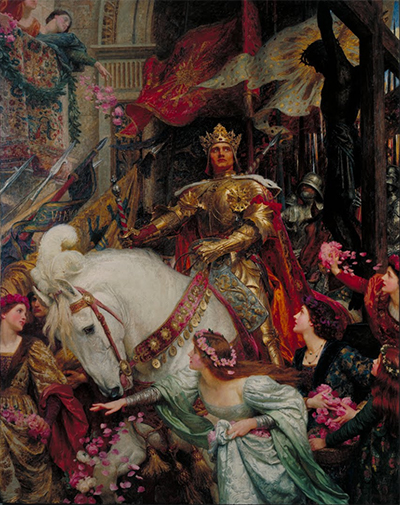
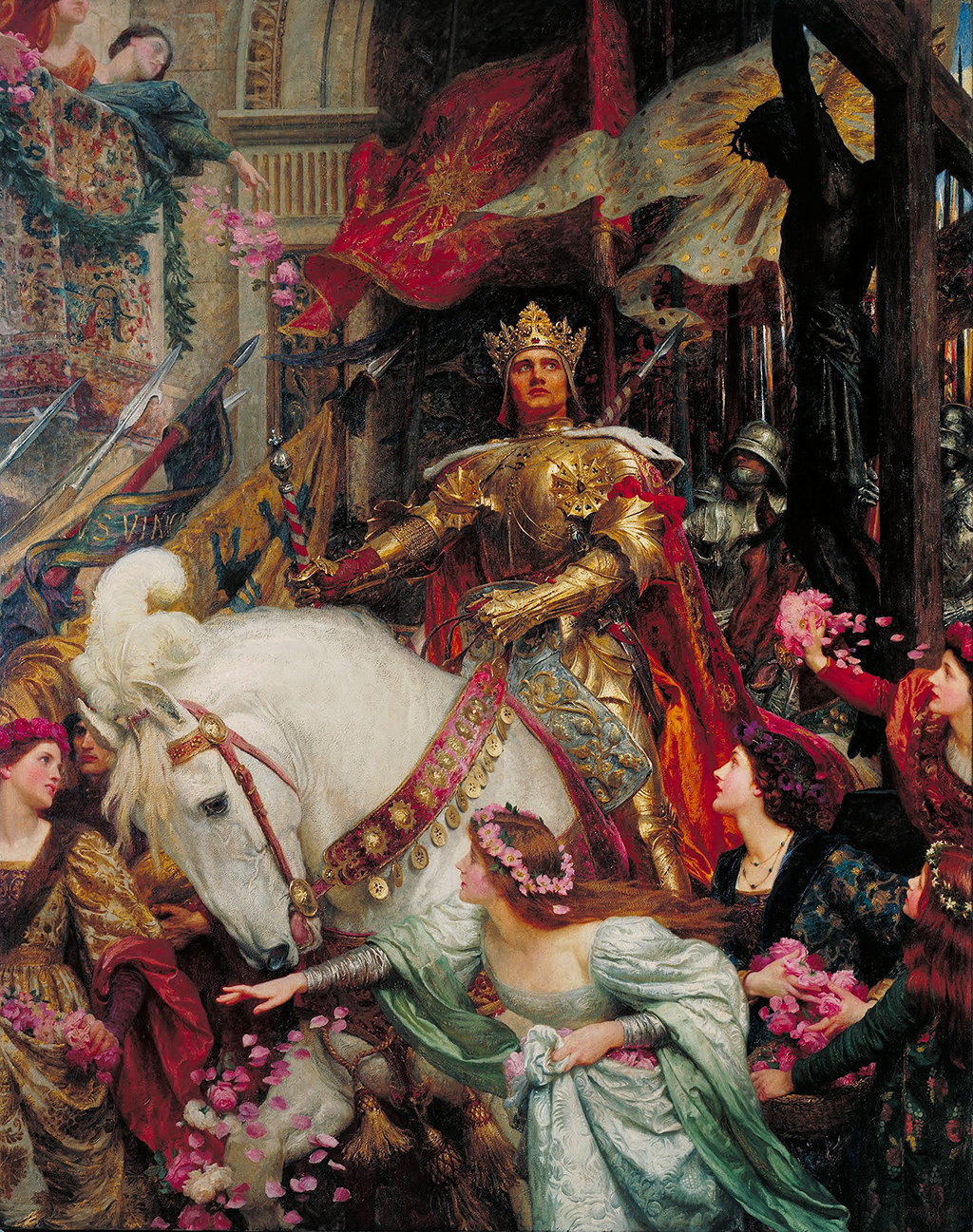
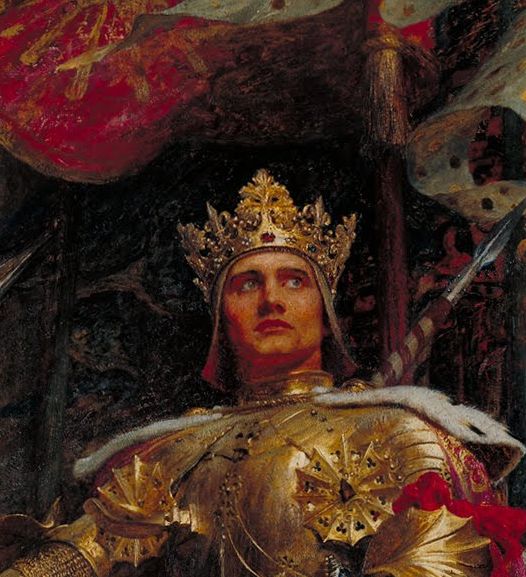
A young ruler rides through a crowd scattering roses. His horse lowers its head towards the people at the front, but the rider looks up and to the right. There, nearly lost in shadow, is the figure of Christ on the cross. Frank Dicksee's The Two Crowns takes its title from the ruler's jewelled crown and the thorns around Christ's head. At the height of a public celebration, the person everyone has come to see is looking elsewhere. [1]
At a Glance
- ArtistFrank Dicksee
- Date1900
- MediumOil on canvas
- Dimensions231.1 × 182.3 cm, height by width
- CollectionTate, London, N01839
- ExhibitionRoyal Academy, 1900, catalogue no. 167
- AcquisitionChantrey Bequest, 1900, for £2,000. [1] [2] [3]
This work across Frank Dicksee’s career
Contents
- Follow the procession
- Gold and thorns
- What the critics saw at the Royal Academy
- The Chantrey purchase and the picture in print
- Annotated details
Follow the procession
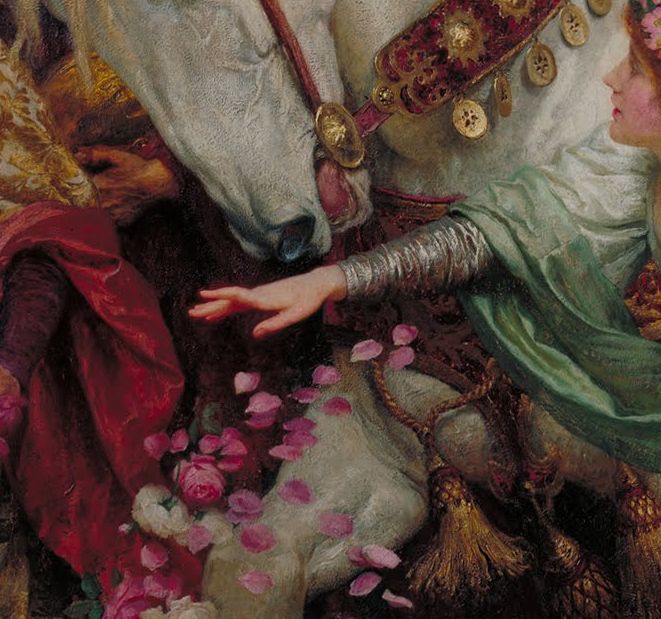
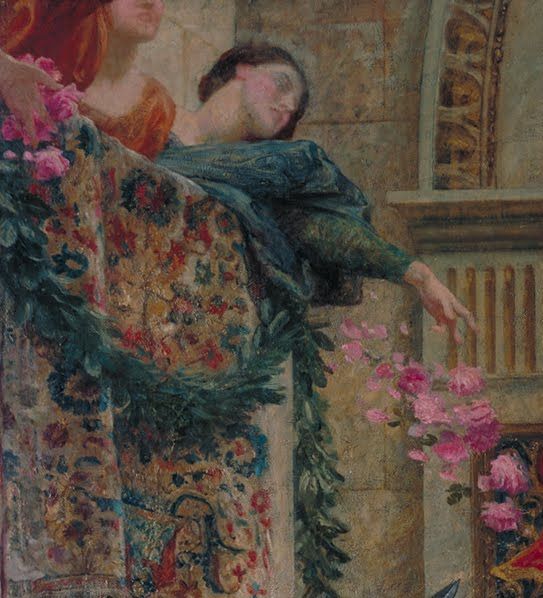
The horse's white neck is the broadest light area in the picture. It curves down towards an outstretched hand and the roses at the horse's feet. The woman reaching towards it gathers her skirt in one hand as she leans into the foreground. Pink petals run across the lower part of the canvas and reappear high on the left, where another figure reaches over a balcony draped in patterned cloth. Dicksee puts the same colour into falling petals, flowers still held in people's hands and garlands already woven into their hair. The celebration is visible at several stages at once. [1]
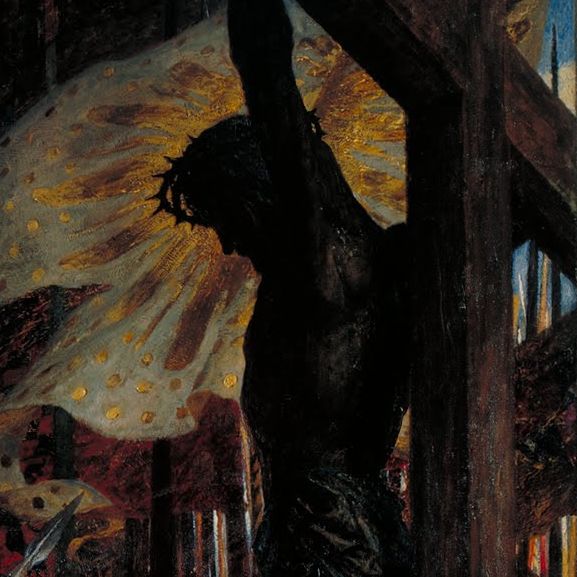
The horse and rider give the picture two directions. The horse bows its head towards the left foreground. The rider keeps his body upright and raises his eyes towards the upper right. Behind him, lance points and folds of fabric carry the eye upwards. A light banner billows behind Christ's head, giving the dark profile an edge the viewer can pick out. The upright of the cross runs close to the right edge of the canvas, where it might first pass for a shadowed post. The rider's face makes a prominent signpost to something the painting has made difficult to see. [1]
At more than two metres high, the canvas gives Dicksee room to sustain the procession through changes in scale and surface. The nearest woman has a face, a gesture and a swathe of pale fabric. A guard behind the rider is reduced to the glint of his helmet and armour, and the lances farther back suggest people the frame gives us little room to see. The horse wears a bright harness fringed with discs. Together with the decorated bridle and pale plumes, it extends the ruler's display well below his crown. A woman at the right lifts a handful of flowers into the dark space beneath the cross. Her gesture belongs to the welcome and carries its colour almost to Christ's feet. [1]
Gold and thorns
The two crowns are painted with unequal clarity. The gold crown catches the light and continues the shine of the ruler's armour. Christ's crown shows as an irregular fringe against the banner. The comparison depends as much on who can see each crown as on what it is made of. The crowd can recognise its ruler at a glance. His upward gaze asks the viewer to look past the brightest display for the darker figure. Tate's account reads the encounter as a reminder that worldly achievement and power pass. [1]
The gold and the thorns also belong to different kinds of ceremony. A crown worn in a triumph advertises rank. An actual piece of medieval regalia, the Imperial Crown of the Holy Roman Empire in Vienna, shows how precious stones, gold and Christian imagery could all endorse the authority of a ruler. In Dicksee's imagined procession, those associations come apart. The rider's jewels proclaim the authority the crowd recognises, while the image of Christ calls him away from its acclaim. [1] [4]
In the Passion story, the thorns are an instrument of mockery, the soldiers' cruel imitation of the honour given to a king. In Hieronymus Bosch's Christ Mocked (The Crowning with Thorns), painted around 1510, one of the tormentors is about to force the crown onto Christ's head. Bosch makes the act itself visible. Dicksee gives us a later moment in the Passion through the figure on the cross and lets the ruler's expression convey its effect on him. The comparison helps explain why one headpiece can recall the other even though their textures, visibility and purpose differ. [1] [5]
A crucifix or a vision?
In June 1900, The Art Journal took the dark figure for a life-size bronze effigy mounted on a cross. Its reviewer read the scene as a returning king's entry into his capital following war, with the sculpture interrupting his thoughts for a moment. The upright support and the outline of Christ's body give that reading something to work with. The material is part of the reviewer's description. In the painting, the figure's deep shadow makes its surface hard to judge. [1] [6]
Tate also allows for a vision of Christ. Since the people around the horse remain occupied with the welcome, the encounter can feel as though it belongs to the rider alone. On a reading of the cross as a public object, the same scene asks how a familiar sight might suddenly command someone's attention. Dicksee leaves the rider in the midst of the procession, his hands still occupied, his face turned aside. His reaction could be alarm, reverence or a first moment of doubt. What he does with the experience lies beyond the instant Dicksee chose to paint. [1] [6]
The face of an invented ruler
The catalogue at the Royal Academy lists the title and Dicksee's name without identifying a king or describing an episode. Tate presents the triumph as an invented medieval scene. Dennis T. Lanigan reports that Dicksee's biographer Simon Toll identifies Giovannino Mancini as the model for the mounted figure. The sitter's name belongs to the making of the painting. Within the story the crown, attendants and ceremony establish the character's position, leaving his dynastic identity open. [1] [2] [7]
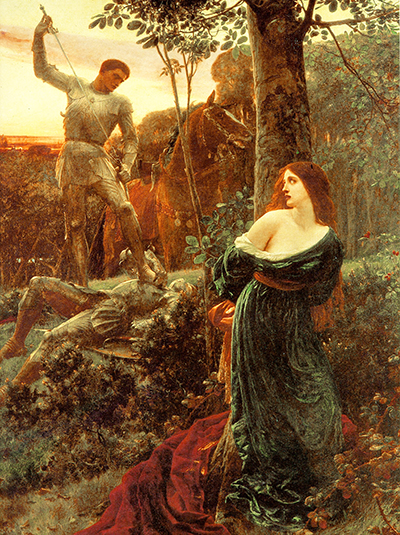
Dicksee had used a mounted figure to tell a different kind of story in Chivalry, his 1885 Academy painting. There, the struggle between the armoured knight and his opponent gives the scene a clear physical action. In The Two Crowns all the trappings of a victorious knight are already on display, and the change takes place in his attention. Edmund Blair Leighton's The Accolade, exhibited in 1901, offers another contemporary comparison. A sword held over a kneeling knight confers an honour before witnesses. In Dicksee's procession, the man at the centre has already received his honours, and the sight he encounters puts their value in question. Both artists use medieval ceremony to tell a story their own exhibition audiences could read from gestures. [1] [8] [9]
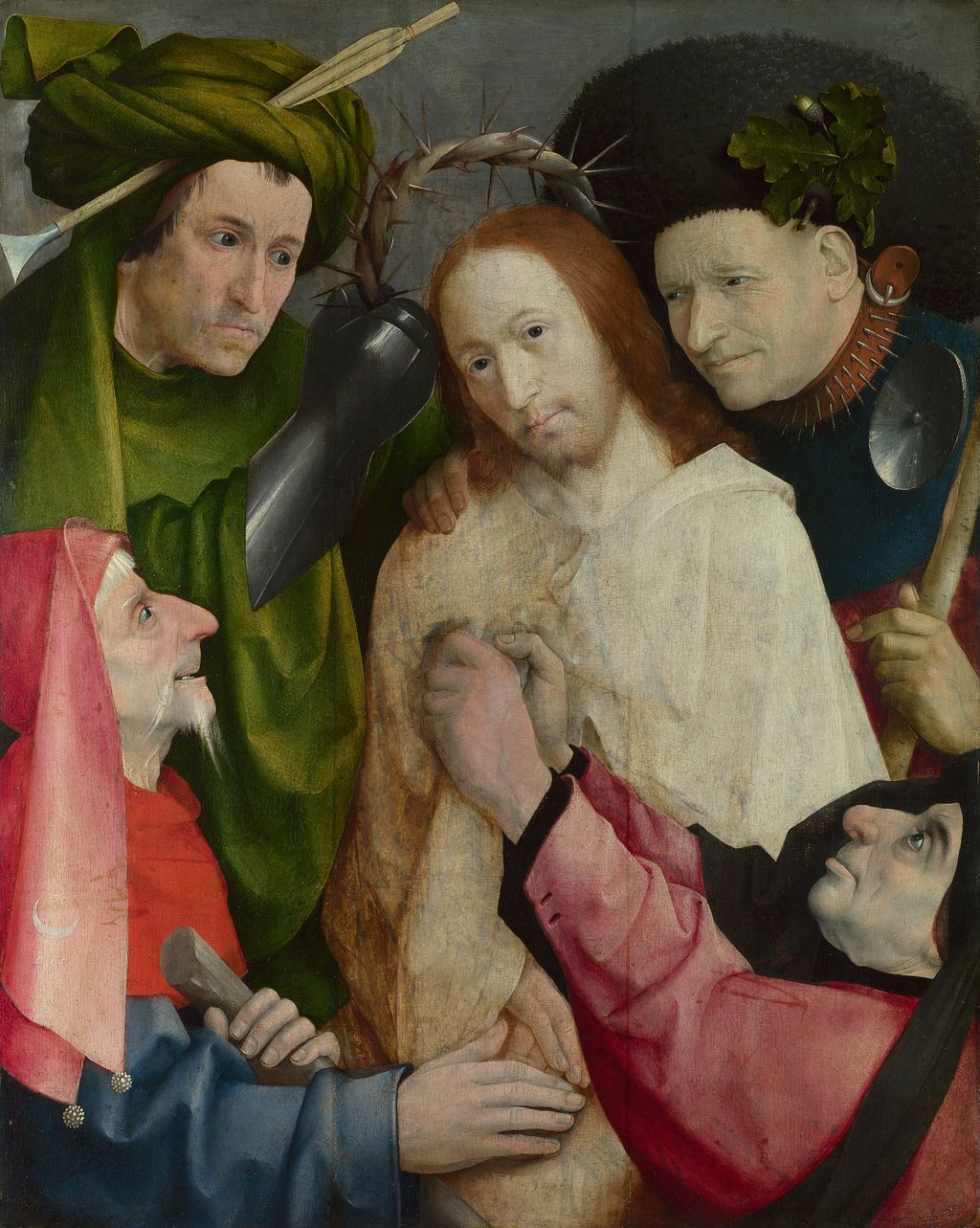
Hieronymus Bosch, Christ Mocked (The Crowning with Thorns). Image source. Public domain.
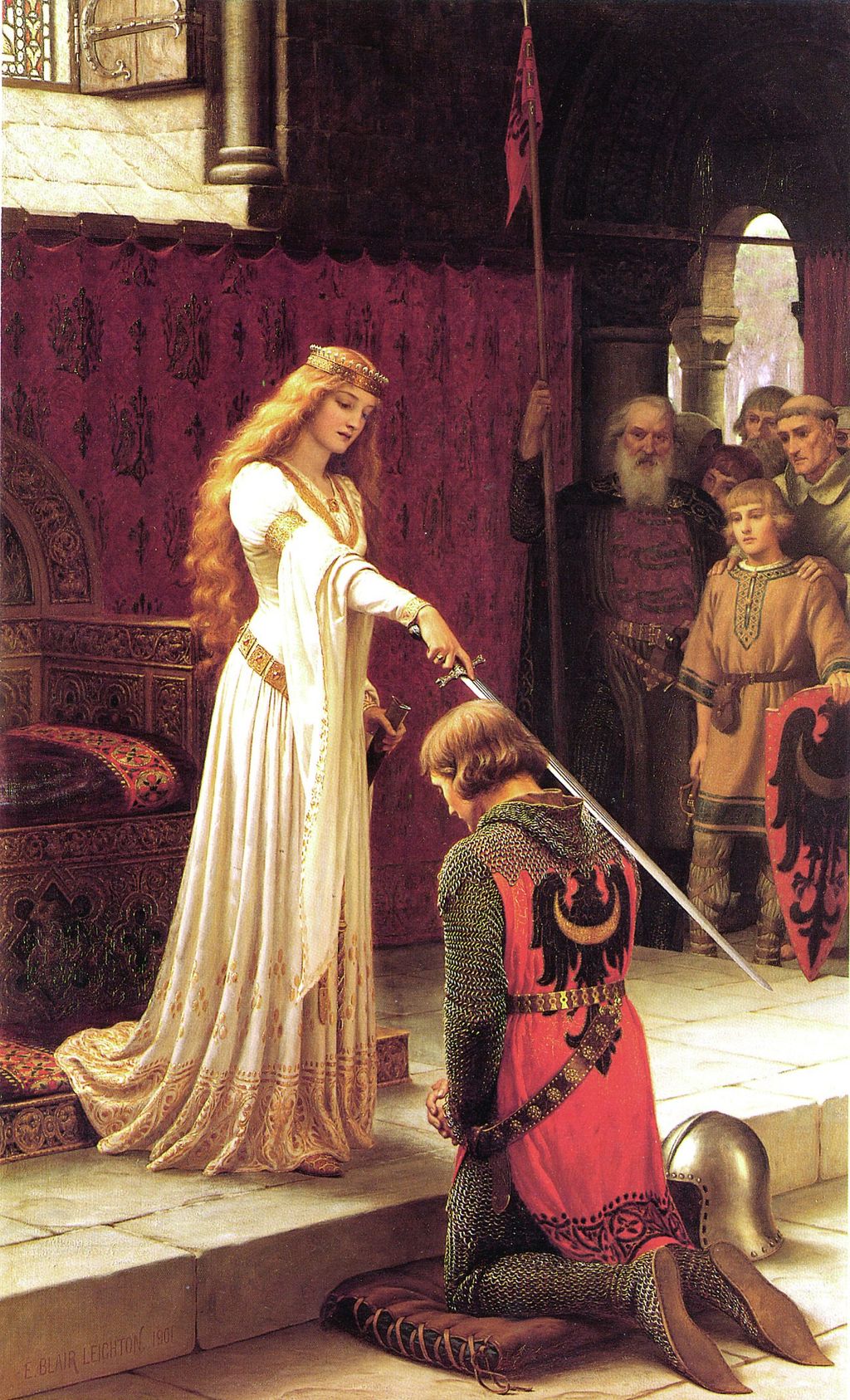
Edmund Blair Leighton, The Accolade. Here the sword confers a distinction in a public ceremony. Image source. Public domain.
Annotated Details from The Two Crowns
The numbered points identify visible features discussed in this article. Return from each detail to the numbered overview. The ruler looks up from his white horse towards Christ on the cross. Image source. Public domain.
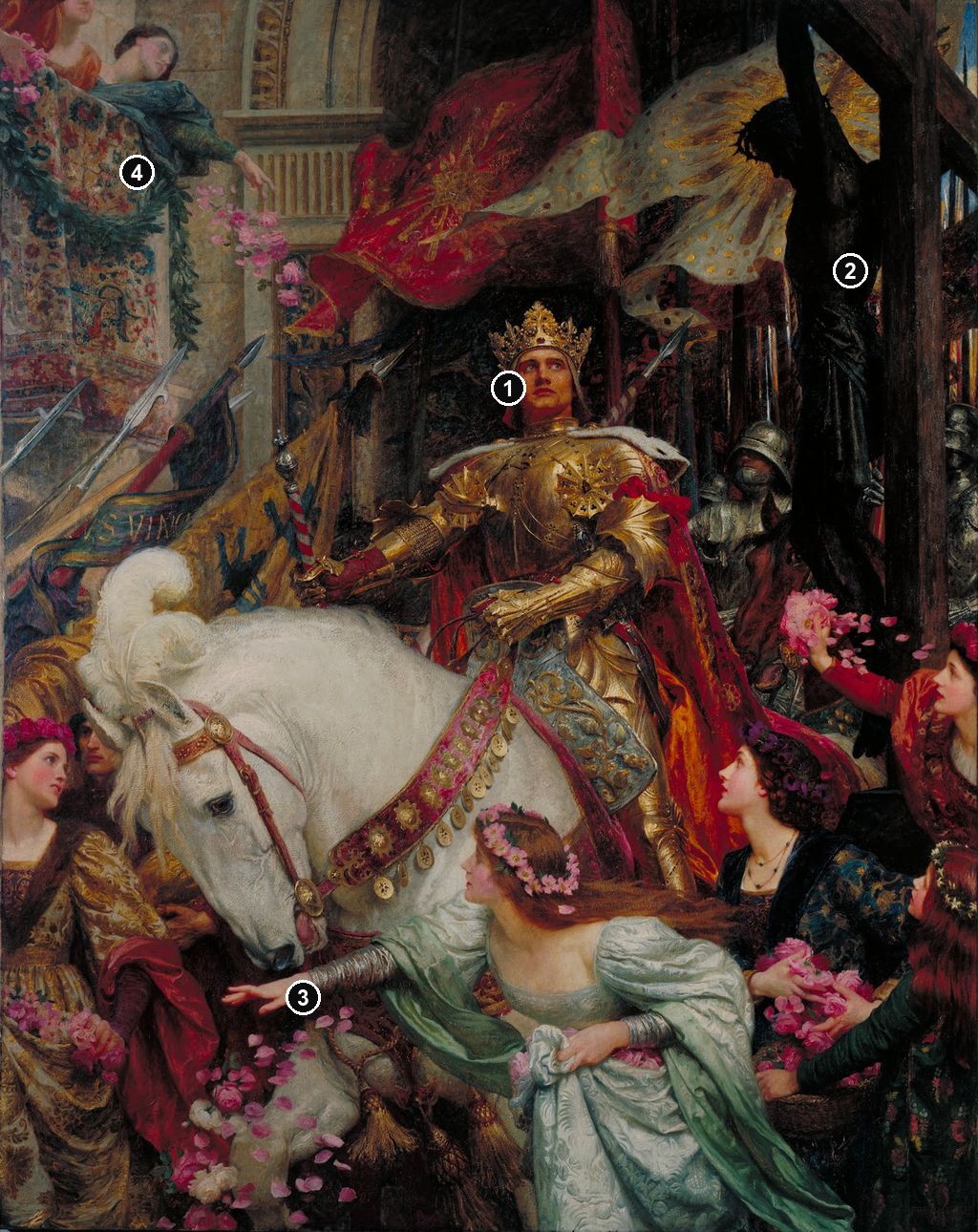
Details from THE TWO CROWNS
Compare the cropped details with the source images above. Notice how their colours, shapes and positions contribute to the larger compositions.
The ruler’s gaze
The face is framed by gold, but the eyes travel towards the dark figure above the street. The turn directs attention away from the people on either side.
Christ in shadow
A pale banner helps make Christ’s profile legible. The body is much darker than the rider’s armour, so the crown of thorns sits within an area the eye has to search.
Roses in the horse’s path
The bending horse and outstretched hand bring the viewer down to the level of the crowd. The pink roses repeat the colour of the garlands above.
Spectators above the street
The people leaning over the draped balcony nearly disappear into armour, flowers and cloth. The horizontal edge of the balcony holds this part of the spectacle above the horse.
What the critics saw at the Royal Academy
The 1900 Academy catalogue places The Two Crowns in Gallery III, between Simon H. Vedder's Flight into Egypt and G. D. Leslie's In Time of War. The catalogue gives Edwin Austin Abbey's The Trial of Queen Katherine number 96. That painting depicts the queen's appeal in Shakespeare's Henry VIII. For the reviewer in The Spectator on 5 May, the two large pictures offered a test of how historical costume served a scene. The critic admired the illusion that the details of Dicksee's armour projected from the canvas, yet found the figures unconvincing as people. The effect suggested an actor under electric light. The critic admired Abbey's ability to give a room full of richly costumed people different roles in a single event. The court's halberds, reflecting cool light against the colours of stained glass, were an example of decorative detail that also helped establish a place. [2] [10] [11]
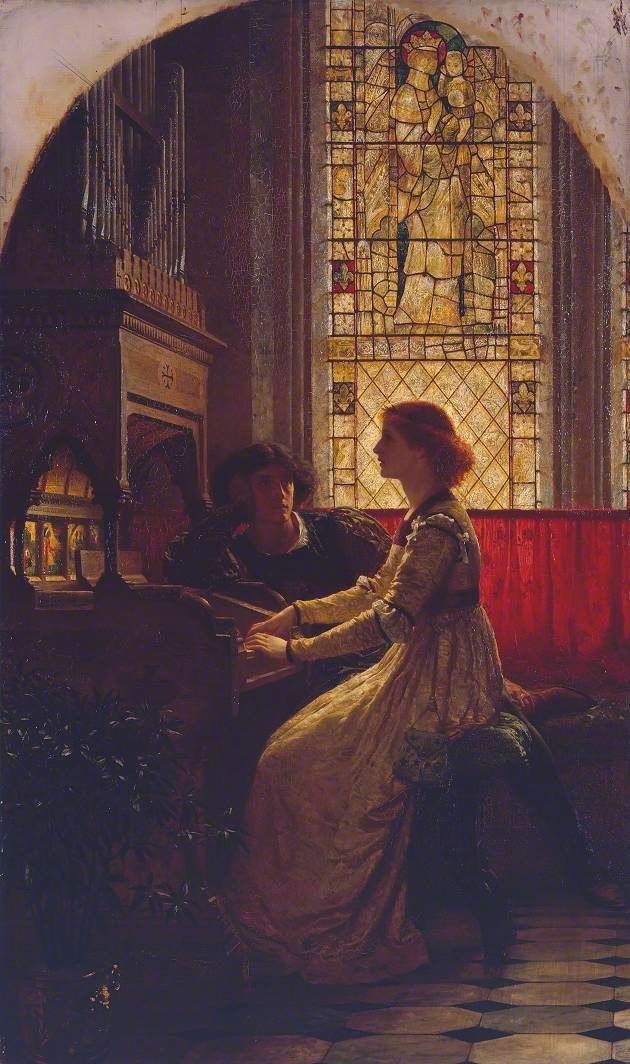
The Magazine of Art also ranked Abbey's picture ahead of Dicksee's among the exhibition's figure paintings. Its reviewer found The Two Crowns crowded and elaborate but thought it told the story effectively. Colour was the reservation. The bright combinations struck the reviewer as strident, with the hope that age would bring a quieter effect. The Art Journal admired the idea of placing Christ before a triumphant ruler and found the interruption legible through the surrounding activity. Its reviewer also remarked on the distance Dicksee had travelled since Harmony, with its quiet colours and two figures. The new picture tested whether he could keep a single moment intelligible across a large crowd. The Daily News judged the profusion of detail more favourably, arguing, in an assessment preserved by E. Rimbault Dibdin, that the design still made a strong impression as a whole. [6] [12] [13]
The richness of the painting gives those responses a common object. Dicksee catches the light on the little projections of the armour with enough precision to interest even a critic suspicious of his theatrical effect. The story also needs some of that brilliance. The armour and flowers let the viewer experience the attraction of the display before following the rider's gaze into shadow. A viewer who stays with the cloth, metal and colour for an extra moment comes to the cross later, much as the rider only encounters it in the midst of his triumph. [1] [10]
The Chantrey purchase and the picture in print
The £2,000 purchase brought Dicksee's oil into the national collection in the year it was exhibited. The money came from the bequest of the sculptor Sir Francis Chantrey, whose will provided income for the acquisition of painting and sculpture made in Britain. The Royal Academy's president and council chose the works. Tate records the formal presentation by the trustees in 1900. Dicksee's Harmony had already entered the national collection through the same bequest following its Academy display in 1877. [1] [3] [14] [15]
That earlier purchase was central to H. P. Horne's objection in the Morning Leader of 23 May 1900. In his second notice on the exhibition, he suspected that the Academy was seeking popularity and argued that the collection already held a characteristic Dicksee in Harmony. He compared the new painting's accomplishment to the appeal of a popular ballad and the theatrical successes of Wilson Barrett. He expected the new picture to fall out of favour as Harmony had, and saw its lavish detail as theatrical. In a separate review for The Londoner, he also dismissed the painting's drawing, handling and conception. The Morning Leader article gives those objections a longer horizon. Horne asked what the Academy should choose for a collection that future museum visitors would inherit. [16]
By 1904 the administration of the bequest was under discussion in the House of Lords. One dispute was whether the Academy's practice of buying from its own exhibition gave the national collection too narrow a view of British art. The debate also exposed competing ideas about the fund's purpose. It could be used to build a collection of leading British painters or to encourage artists earlier in their careers. The case of a recognised Academician receiving a second purchase makes it easy to see why a single selection could prompt arguments about the character of a national collection. [14] [15] [16]
Public appetite also had a commercial consequence. In June, the Highland News reported that reproduction rights had been bought with a view to publishing an engraving. The newspaper was cautious about the reported price of the oil. Arthur Fish's illustrated record of the bequest later gives £2,000 and credits Frost & Reed as publishers of the plate. Fish's book shows how the painting reads in monochrome. The white horse and the silhouetted cross still establish the two ends of the story. The roses, banners and gold armour that had drawn so much comment in 1900 now depend on their tonal differences to separate them on the page. [3] [17]
Frank Dicksee artworks directory
Browse documented paintings, studies, illustration designs and prints. Where an article is available, the title opens it. Simon Toll’s catalogue
| Name | Date | Medium |
|---|---|---|
| A Love Story | 1882 | Painting |
| A Reverie | 1895 | Painting |
| An Offering | 1898 | Painting |
| Chivalry | 1885 | Painting |
| Dawn | 1897 | Painting |
| Elijah Confronting Ahab and Jezebel in Naboth’s Vineyard | By 1875 | Painting |
| Harmony | 1877 | Painting |
| Harmony, etching by Charles-Albert Waltner after Dicksee | 1880 | |
| Harmony, the smaller Towneley version | Late 1870s | Painting |
| Hesperia | 1887 | Painting |
| Hesperia, watercolour version | Late 1880s | Painting |
| Italian Coast from La Mortola | 1925 | Painting |
| La Belle Dame sans Merci | c. 1901 | Painting |
| Memories | 1886 | Painting |
| Paolo and Francesca | 1894 | Painting |
| Portrait of Camille Sutton Palmer | 1914 | Painting |
| Portrait of Elsa | 1927 | Painting |
| Portrait of the Duchess of Buckingham and Chandos | 1901 | Painting |
| Romeo and Juliet | 1884 | Painting |
| Romeo and Juliet, monochrome design on joined wood | c. 1880s | Painting |
| Sir Edmund William Gosse, collotype after Dicksee | 1912 | |
| Startled | 1892 | Painting |
| Study for Startled | Early 1890s | Drawing |
| The Confession | 1896 | Painting |
| The Crisis | 1891 | Painting |
| The Daughters of Eve | 1925 | Painting |
| The Embarkation | 1879 | Painting |
| The End of the Quest | 1921 | Painting |
| The Funeral of a Viking | 1893 | Painting |
| The House Builders | 1880 | Painting |
| The Magic Crystal | 1894 | Painting |
| The Passing of Arthur | 1889 | Painting |
| The Redemption of Tannhäuser | 1890 | Painting |
| The Symbol | 1881 | Painting |
| The Two Crowns | 1900 | Painting |
| Yseult | 1901 | Painting |
Discussion
Look again at the images and ideas explored in The Two Crowns. These editorial prompts invite your observations.
Reader Insights
Where did your eye land first, and which detail finally led it to the cross?
What in the crowd's behaviour supports your reading of what the rider sees?
Which quality of the painting would have mattered most to you if you had been choosing a work for the national collection in 1900?
Join the Conversation
Share the detail that changed your reading of the procession. The horse's lowered head, the rider's expression and the banner behind Christ each offer a different place to begin.
References
- Tate, The Two Crowns, 1900, N01839, Tate's partner collection entry on Google Arts & Culture. View source.
- Royal Academy of Arts, The Exhibition of the Royal Academy of Arts MDCCCC, 1900, catalogue no. 96, Gallery II, p. 13, and no. 167, Gallery III, p. 18. View source.
- Arthur Fish, Chantrey and His Bequest: A Complete Illustrated Record of the Purchases of the Trustees, 1904, The Two Crowns plate, p. 116. View source.
- Kunsthistorisches Museum Wien, Geistliche und weltliche Schatzkammer, Imperial Crown of the Holy Roman Empire, p. 9, inv. XIII 1. View source.
- The National Gallery, Hieronymus Bosch, Christ Mocked (The Crowning with Thorns), about 1510, NG4744. View source.
- The Art Journal, “The Royal Academy of 1900”, vol. 62, June 1900, p. 180. View source.
- Dennis T. Lanigan, “The Two Crowns by Sir Frank Dicksee”, citing Simon Toll, Frank Dicksee 1853–1928: His Art and Life, p. 116. View source.
- Christie's, Frank Dicksee, Chivalry, signed 1885 oil, 2012 sale catalogue, lot 11. View source.
- Christie's, After Edmund Blair Leighton, catalogue note on the 1901 Academy exhibition of the original The Accolade, no. 434. View source.
- The Spectator, “Art. The Academy.—I”, vol. 84, 5 May 1900, pp. 631–32. View source.
- Corcoran Gallery of Art, A Catalogue of the Collection of American Paintings in the Corcoran Gallery of Art, The Trial of Queen Katharine, 26.2, p. 7. View source.
- The Magazine of Art, “The Royal Academy – II”, vol. 23, 1900, p. 386, excerpt transcribed by Dennis T. Lanigan. View source.
- E. Rimbault Dibdin, Frank Dicksee: His Life and Work, 1905, p. 18, Daily News extract reproduced by Dennis T. Lanigan. View source.
- UK Parliament, House of Lords debate, “Chantrey Trust”, 21 June 1904. View source.
- Tate, Harmony, 1877, N01587. View source.
- H. P. Horne, “The Royal Academy, Second notice”, Morning Leader, 23 May 1900, p. 15, and “The Pictures at the Royal Academy I”, The Londoner, 1900, pp. 151–52, both transcribed by Elizabeth A. Molina, Appendix II, nos. 67 and 70, pp. 290–93 and 299–300. View source.
- The Highland News, report on reproduction rights, 9 June 1900, p. 7, National Library of Scotland. View source.