 by Tom Gurney
Tom Gurney BSc (Hons) is an art history expert with over 20 years experience
Published on June 19, 2020 / Updated on November 25, 2026
Email: tomgurney1@gmail.com / Phone: +44 7429 011000
Harmony by Frank Dicksee: Introduction
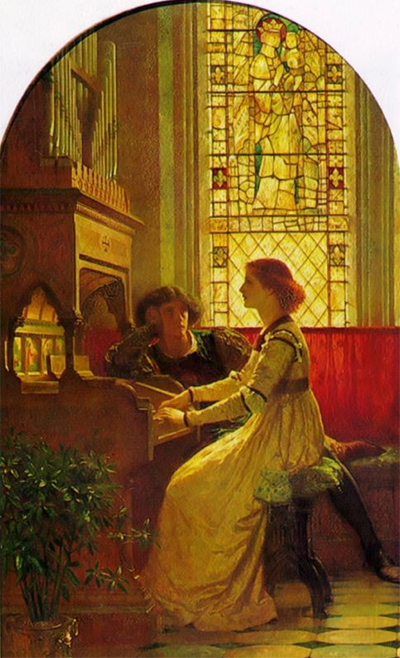
A young woman plays an organ while a man leans close enough to watch her face. Behind them, light from a tall stained-glass window catches her hair and the folds of her gown. Frank Dicksee painted Harmony in 1877, and it made his name at that year's Royal Academy exhibition. The original entered the national collection through the Chantrey Bequest. Within a few years an etching had carried the scene as far as a New York picture shop. [1] [2] [3]
At a Glance
- ArtistFrank Dicksee
- Date1877
- MediumOil on canvas
- Dimensions157.5 × 94 cm (height × width)
- CollectionTate, London, N01587
- First exhibitionRoyal Academy, London, 1877, catalogue no. 14
- SubjectA woman at a pipe organ and her companion in a medievalising interior. [1] [2]
This work across Frank Dicksee’s career
Contents
- The organist and her listener
- How Dicksee made the medieval room
- Who posed for the organist?
- The Royal Academy and the Chantrey purchase
- The smaller painting and Waltner's etching
The organist and her listener
The two figures occupy a small part of the tall canvas. At the left, the organ pipes draw the eye up into shadow. Opposite them, the narrow window rises above the musicians' level, its leadwork dividing the glass into figures and patterns. The woman's pale gown descends almost to the chequered floor. Between those verticals and the sweep of the fabric, a few small gestures carry the scene. Her forearms extend towards the keyboard while the man, partly hidden by the organ, leans forward and turns his face towards hers. [4]
Her head is raised and her eyes appear directed past the keyboard. She may be listening to the sound she is making. His attention is plainly visible, whereas the line of her profile leaves room to imagine what she is thinking. Perhaps she knows he is looking. The pose allows for absorption in music as easily as it does for awareness of a companion. Dicksee leaves their relationship in the space between a look we can see and a response we have to infer. [4]
The organ's case screens part of the man and sets the woman's hands against dark wood. A small painted scene near the keyboard sits below the larger figures in the glass, so the room contains images at several scales. The red hanging behind the pair brings a sustained note of colour across the canvas at shoulder height. Amber light above it and cooler shadows at the floor let the costume and furnishings register without drawing attention away from the two faces. [4]
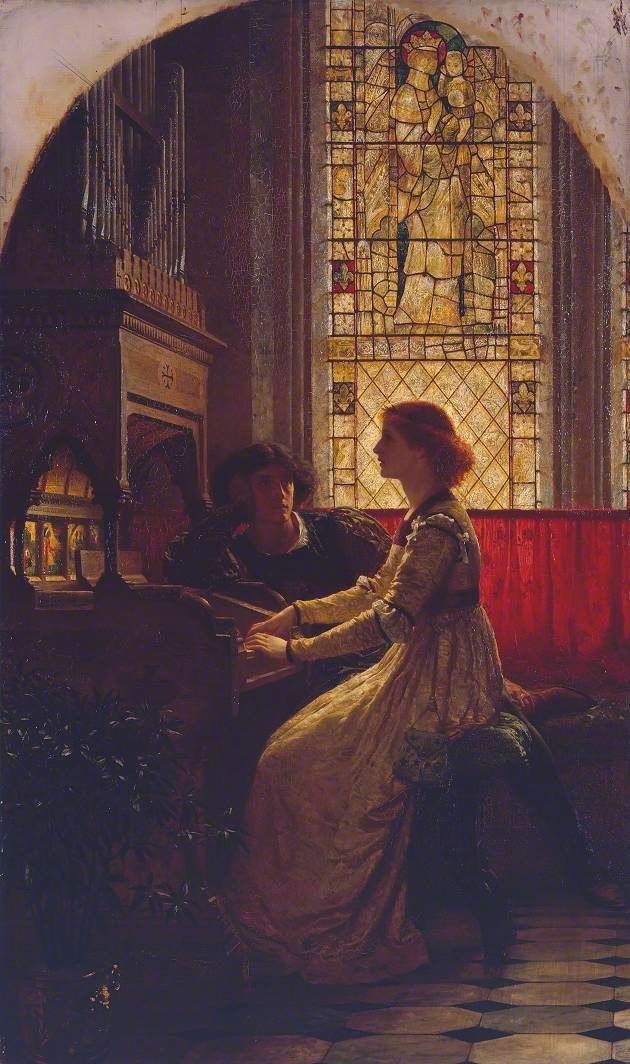
Harmony, the original 1877 Royal Academy oil, Tate N01587. Image source. Public domain.
How Dicksee made the medieval room
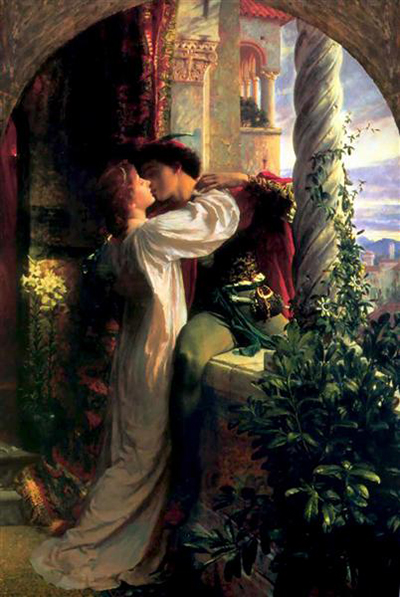
Art historian Dennis T. Lanigan traces the idea to the Langham Sketching Club, where members drew on an agreed theme. Dicksee was still training at the Royal Academy Schools when the club chose music as its subject. The theme left him free to invent the circumstances of the performance. Later in his career, the catalogue for Romeo and Juliet printed Romeo's farewell beside the title. At the Academy, the title Harmony invited viewers to connect the performance with the relationship. [2] [4]
Dicksee was also doing decorative work with the stained-glass designer Henry Holiday. Mary Angela Dickens, who interviewed the painter for The Windsor Magazine, says that during his Academy training he worked with Holiday on alternate days, including on cartoons, the designs used to plan windows. In the painting, the dark divisions of the glass give the bright area a clear pattern, and the warm edge of the woman's head carries its light into the figures. Dicksee gives us the coloured material and lets us follow its light into the room. [4] [5]
The Metropolitan Museum of Art traces the painted glass to an early example at St Mary the Virgin in Westwell, Kent. The church's heritage record describes a partly surviving thirteenth-century Jesse window at the east end and medieval fragments in the north aisle. The Met's account links the glass to the church and leaves the specific panel open. Even in 1877 the reviewer for The Spectator could see either a hall or a chapel in the tiled space. The combination lets the artist give a private encounter some of the concentration of worship. [4] [6] [7]
The painted organ case has a Victorian context too. Lanigan reproduces a Tate account comparing its imagery to the medievalising furniture associated with William Burges and William Morris. Burges's Great Bookcase, made for the books in his London office, is a surviving example of furniture designed to carry pictures as well as serve a practical use. Its painted panels bring Christian and pagan subjects into a single piece, and Holiday was among the artists who worked on it. The bookcase offers a parallel for the care lavished on Dicksee's instrument and for the overlap between painting, furnishing and glass design in the circle in which he trained. [4] [8]
Who posed for the organist?
In her studio profile, Dickens tells a story about Dicksee's search for a model. While visiting Chatsworth on a walking tour of Derbyshire, he was shown around by a young guide who pointed out a local woman passing through another corridor. Dicksee said he caught only a glimpse “of a cheek and a bit of nose beyond”. Years later, when he had struggled to find the right person for Harmony, a widow was recommended to him. In the account he gave Dickens, he recognised her as the woman he had glimpsed that day. Dickens distinguishes the passing woman from the guide who drew Dicksee's attention to her. [5]
An earlier Tate description reproduced by Lanigan names Hilda Spencer, a student at Queen's College in London, where Dicksee taught drawing. Lanigan also reports that Simon Toll describes studies of several pupils as possible sources for the musician and identifies Gaetano Meo as the male model. Dickens's story leaves the woman unnamed, and it is unclear how the sittings and studies relate to the two finished figures. Her account of Dicksee's broader practice helps explain how several names could enter the history of one image. He began with an imagined pose, tried it with models, and revised what he had drawn when the pose proved difficult to sustain. [4] [5]
The Royal Academy and the Chantrey purchase
Dicksee had exhibited a biblical subject in 1876, the prize painting in which Elijah confronts Ahab and Jezebel. Harmony was his sole entry the following year, catalogue no. 14. Dickens recalled that it hung on the line in the middle of the exhibition's first room, a prominent position for a painter of twenty-three. The picture's size made it possible to read the room from across the gallery, while the small scenes painted on the organ rewarded a closer look. [2] [4] [5] [6]
What struck reviewers was how much feeling Dicksee drew from a simple encounter. As transcribed by Lanigan, The Art Journal singled out the painting's tonal unity and welcomed the Academy's decision to buy it. The Illustrated London News saw the composition and expressive faces as reminiscent of Daniel Maclise's work of the 1830s and praised the softness of Dicksee's colour. The Architect singled out the tints of the window. F. G. Stephens, writing in The Athenaeum, also admired the light and colour, but found the subject sentimental and wondered whether such brilliant lighting appealed too readily to the spectator. [4]
The trustees paid £367 10s under the terms of the Chantrey Bequest. The sculptor Francis Chantrey's will had provided for purchases towards a public national collection of painting and sculpture executed in Britain, and the trustees began buying in 1877. The Chantrey works went first to the South Kensington Museum and moved to the new gallery at Millbank when it opened in 1897. In 1888, the Royal Academy lent Harmony to an Easter exhibition in East London. The exhibition catalogue treated the music as an image of agreement between the couple and likened the light around the player's hair to a halo. It included a couplet from William Blake to guide visitors towards that reading. E. T. Cook's 1898 handbook used much the same interpretation. The catalogue and guidebook gave readers a way to connect the religious imagery to the scene below it. [2] [9] [10] [11] [12]
The man watches and the woman plays, a division a Victorian viewer might take as an image of complementary roles. As Lanigan reports, Jan Marsh reads the music and the mother-and-child image in the glass in relation to Victorian ideals of wifehood. The woman's performance is the source of that apparent accord. Her upright composure gives her a presence quite distinct from the man who leans towards her. [4] [10]
The smaller painting and Waltner's etching
Towneley Hall Art Gallery and Museum in Burnley holds a smaller oil on canvas, accession BURGM:paoil150, measuring 117 × 69.2 cm. The woman, the organ and the tall window remain in the same relationship, while the detail around the figures reads differently. In the Towneley image the seated man is easier to pick out beneath the window, and the legs of the woman's seat and the foliage beside the organ are more readily legible. The same arrangement can consequently feel more open and less enveloped by shadow. Reproductions vary in colour and exposure, so the differences in apparent brightness call for care. [4] [13]
A third object is the etching made by Charles-Albert Waltner and published in London by Thomas Agnew & Sons. The Metropolitan Museum of Art dates its proof to 1880, and Wake Forest University's impression is catalogued to the same year. In his French catalogue of modern prints, Henri Béraldi also lists Harmony under 1880 among the works Waltner made after contemporary British painters following his time in England. The Met identifies the Burnley oil as the model for the etching. Its account gives that canvas a date of 1887, which comes seven years after its own date for the proof. Lanigan gives the smaller painting as 1878 and the collection-linked image record lists 1879. Both earlier dates would fit the print sequence. The exact year for the Burnley oil remains unsettled. [4] [6] [13] [14] [15]
An 1881 survey of the print trade places Waltner's plate among the works declared to the Printsellers' Association from October 1879 to October 1880. The survey also lists artists' proofs on vellum and on Japanese paper. Collectors could buy impressions on different supports. That variety helps explain why a museum record describes the particular sheet it holds, as well as the image printed on it. [16]
The Met proof's printed image is 40.5 × 23.5 cm, on a considerably larger sheet. Waltner uses fine lines and stronger passages of shadow to carry the design at this scale. The window becomes a conspicuous pattern of light and dark, and the woman's profile can still be read across the space between the two heads. The National Gallery of British Art illustrated the painting as no. 1587 in its 1908 catalogue, crediting Agnew as the copyright owner at the time. The public collection held the canvas while a commercial publisher helped the image reach readers and buyers. [6] [14] [17]
Cassell's late nineteenth-century profile credited Waltner's etching with bringing Dicksee to notice overseas. One documented example of that circulation appeared on 12 January 1882, when The New-York Evangelist printed a story prompted by an etching of Harmony seen in a New York shop. In the story, a New England organist hangs an engraving of the picture above his own keyboard and searches for a tune that might sound like the woman's playing. The writer gives us no way to identify the particular impression in the shop. The story shows how closely a viewer could attend to a printed image away from the gallery. Years after Dicksee began his sketch on the theme of music, someone in another country was still imagining what his organist might play. [3] [18]
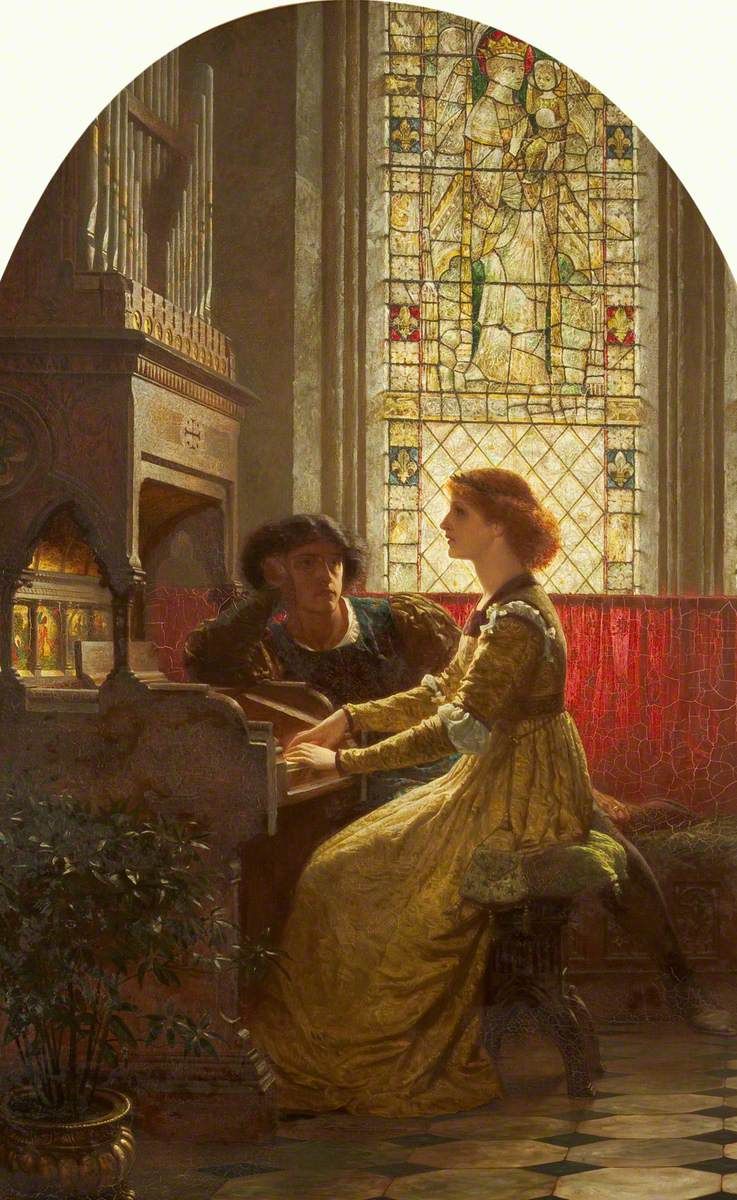
The smaller oil in Towneley Hall Art Gallery & Museum, BURGM:paoil150. Published dates for this version differ. Image source. Public domain.
Frank Dicksee artworks directory
Browse documented paintings, studies, illustration designs and prints. Where an article is available, the title opens it. Simon Toll’s catalogue
| Name | Date | Medium |
|---|---|---|
| A Love Story | 1882 | Painting |
| A Reverie | 1895 | Painting |
| An Offering | 1898 | Painting |
| Chivalry | 1885 | Painting |
| Dawn | 1897 | Painting |
| Elijah Confronting Ahab and Jezebel in Naboth’s Vineyard | By 1875 | Painting |
| Harmony | 1877 | Painting |
| Harmony, etching by Charles-Albert Waltner after Dicksee | 1880 | |
| Harmony, the smaller Towneley version | Late 1870s | Painting |
| Hesperia | 1887 | Painting |
| Hesperia, watercolour version | Late 1880s | Painting |
| Italian Coast from La Mortola | 1925 | Painting |
| La Belle Dame sans Merci | c. 1901 | Painting |
| Memories | 1886 | Painting |
| Paolo and Francesca | 1894 | Painting |
| Portrait of Camille Sutton Palmer | 1914 | Painting |
| Portrait of Elsa | 1927 | Painting |
| Portrait of the Duchess of Buckingham and Chandos | 1901 | Painting |
| Romeo and Juliet | 1884 | Painting |
| Romeo and Juliet, monochrome design on joined wood | c. 1880s | Painting |
| Sir Edmund William Gosse, collotype after Dicksee | 1912 | |
| Startled | 1892 | Painting |
| Study for Startled | Early 1890s | Drawing |
| The Confession | 1896 | Painting |
| The Crisis | 1891 | Painting |
| The Daughters of Eve | 1925 | Painting |
| The Embarkation | 1879 | Painting |
| The End of the Quest | 1921 | Painting |
| The Funeral of a Viking | 1893 | Painting |
| The House Builders | 1880 | Painting |
| The Magic Crystal | 1894 | Painting |
| The Passing of Arthur | 1889 | Painting |
| The Redemption of Tannhäuser | 1890 | Painting |
| The Symbol | 1881 | Painting |
| The Two Crowns | 1900 | Painting |
| Yseult | 1901 | Painting |
Discussion
Look again at the images and ideas explored in Harmony by Frank Dicksee. These editorial prompts invite your observations.
Reader Insights
Where does the line of her profile take your eye, and what does it suggest about what she hears or sees?
How does the painting's emotional tone change when you move from the illuminated glass to the dark face of the organ?
Which detail carries the strongest sense of intimacy in Waltner's etching?
Join the Conversation
Share the detail that most affects how you hear the silence of Dicksee's painted room.
References
- Tate, Harmony, 1877, N01587, collection object metadata. View source.
- Algernon Graves, The Royal Academy of Arts: A Complete Dictionary of Contributors and Their Work, vol. 2, p. 323, Frank Dicksee entries for 1876 and 1877. View source.
- The New-York Evangelist, “Harmony: A Legend of To-Day,” 12 January 1882, vol. 53, no. 2. View source.
- Dennis T. Lanigan, “Harmony by Sir Frank Dicksee (1853–1928),” The Victorian Web, comparative reproductions, sitter accounts and transcribed reviews. View source.
- Mary Angela Dickens, “A Popular Painter: Mr. Frank Dicksee, R.A.,” The Windsor Magazine, vol. 5 (December 1896–May 1897), pp. 385–391, especially pp. 386 and 388. View source.
- The Metropolitan Museum of Art, Harmony, 1880, Charles-Albert Waltner after Frank Dicksee, 46.140.7. View source.
- Church of England, Church Heritage Record, Westwell: St Mary, building description and east window. View source.
- Ashmolean Museum, “Great Bookcase,” account of William Burges's design and its decorative scheme. View source.
- UK Parliament, Hansard, “The Royal Academy — Sir Francis Chantrey's Bequest.—Question,” House of Commons, 20 February 1877. View source.
- Whitechapel Gallery archive, 1888 Easter exhibition catalogue, Ground Floor, Room I, no. 19, Harmony. View source.
- E. T. Cook, A Popular Handbook to the Tate Gallery, National Gallery of British Art, 1898, pp. 208–209. View source.
- Architectural Review, Chantrey and His Bequest, purchase list and illustrated entry for Harmony, p. 44. View source.
- Wikimedia Commons, Harmony, Towneley Hall Art Gallery and Museum, BURGM:paoil150, digital image and collection-linked metadata. View source.
- Wake Forest University, Department of Art, Harmony, 1880, PC1989.10. View source.
- Henri Béraldi, Les Graveurs du XIXe siècle, vol. 12, 1892, pp. 263–264, Waltner catalogue no. 88. View source.
- Marcus B. Huish, The Year's Art, 1881, pp. 155–156 and 162, Printsellers' Association and entry for Harmony. View source.
- National Gallery of British Art, Illustrated Catalogue, 1908, entries and plate for no. 1587. View source.
- Cassell and Company, Cassell's Universal Portrait Gallery, “Mr. Frank Dicksee, R.A.,” p. 346. View source.