 by Tom Gurney
Tom Gurney BSc (Hons) is an art history expert with over 20 years experience
Published on June 19, 2020 / Updated on November 25, 2026
Email: tomgurney1@gmail.com / Phone: +44 7429 011000
The End of the Quest: Introduction
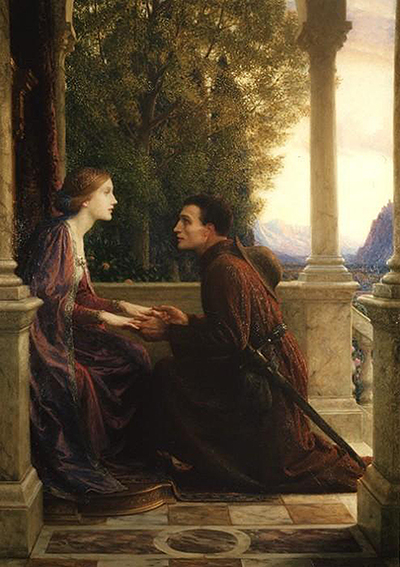
A man kneels before a seated woman and takes both her hands. A sword hangs from his waist, but he has come close enough to speak without raising his voice. Frank Dicksee called the painting The End of the Quest. He gives us the moment of arrival and leaves the journey itself somewhere beyond the terrace. Leighton House holds the oil painting, which Dicksee exhibited at the Royal Academy in 1921. [1] [2]
At a Glance
- ArtistFrank Bernard Dicksee
- DateCirca 1921. Exhibited in 1921. [1] [2]
- Medium and dimensionsOil on canvas, approximately 145 × 107 cm. [1]
- CollectionLeighton House, London, accession LH0060. [1]
- ExhibitionRoyal Academy Summer Exhibition, Gallery III, no. 158. [2]
This work across Frank Dicksee’s career
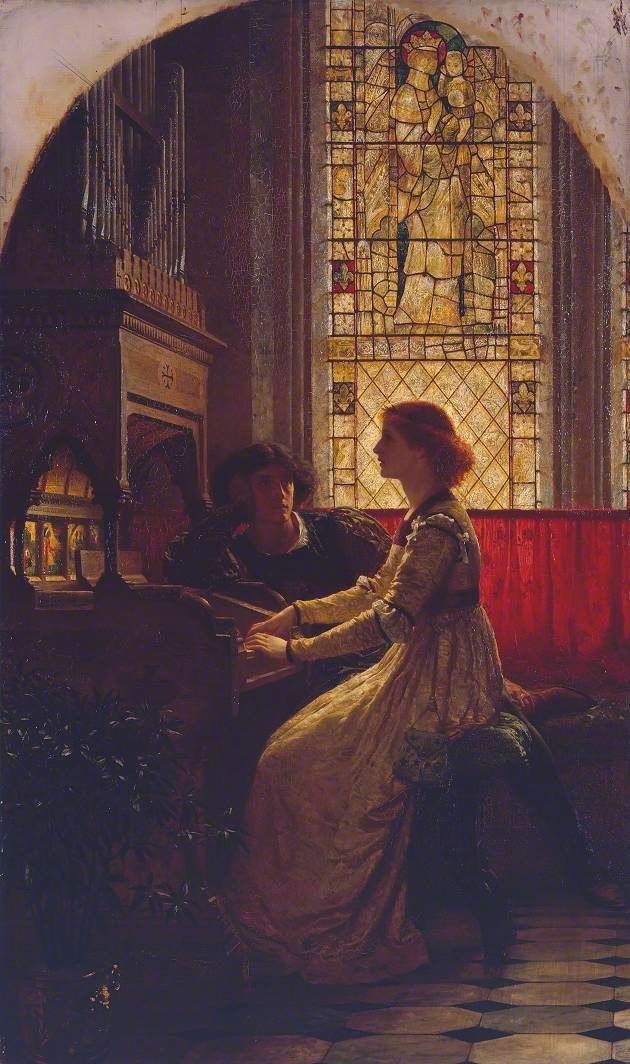
Harmony
1877Romeo and Juliet
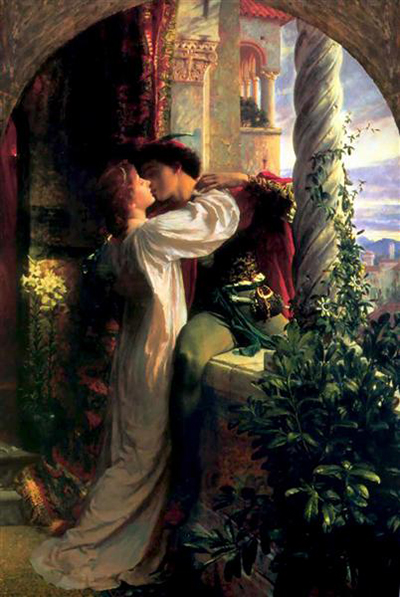
1884Chivalry
1885Startled
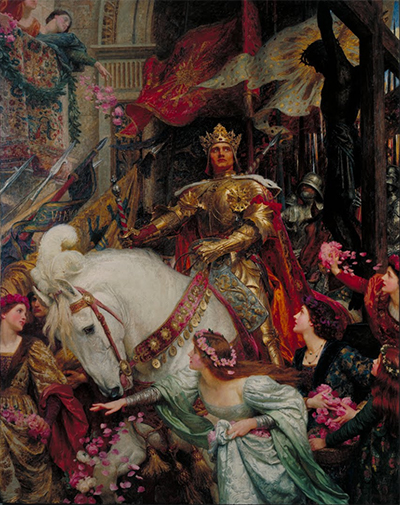
1892The Two Crowns
1900Contents
- The meeting on the terrace
- From the stone floor to the mountains
- What kind of quest?
- A small oil sketch and a public exhibition
The meeting on the terrace
Dicksee brings the figures together a little below the centre of the painting. The woman's forearms extend from the left and the man's hands rise to meet them. Both of hers are visible, one slightly farther forward than the other. The light catches the fingers and the turn of her wrists against the dark folds of their clothes. Her arms reach across the space between them, even as her back stays upright. His head and shoulders follow the movement of his hands. By letting the kneeling figure look up and placing the seated figure just above him, Dicksee gives the encounter both intimacy and formality. [1]
Look from the hands to the faces and the scene grows harder to read. His brow lifts and he looks towards her face. In profile, her gaze appears steadier and more distant. The gentleness of the touch leaves room for a welcome, a plea or a promise. The slight turn of her face holds the exchange open. The man has reached her, but whatever he has come to say still hangs between them. [1]
The man's sword is slung low at his side. Its dark diagonal runs away from the hands towards the corner of the terrace, where it almost meets the hem of his cloak. The fittings catch some light, but the russet cloth takes up far more space than the weapon. His fingers, face and head are bare. The sword suggests the world of armed adventures that the title invites us to imagine, while the way he wears it allows him to put both hands into the gesture. The woman's purple fabric has a different weight. It falls over her shoulder in long folds and gathers around the base of the seat, with a narrow line of gold-coloured trim leading the eye down the front. The richly dressed figures make a ceremony out of an exchange which might last only a few seconds. [1]
From the stone floor to the mountains
The distance in the painting is easiest to see by starting at the bottom. A roundel in the patterned stone floor sits low in the foreground and makes the terrace feel like a space we could step into. Behind it the figures occupy a shallow area between columns. Some of the woman's drapery overlaps the column at left, drawing her towards the foreground. The tree immediately behind the pair offers a dark backing for both faces. On the right, a slim column divides the view of the valley and the much more distant mountain slopes. The low wall gives the meeting a sheltered character while the pale light and glimpses of landscape keep the terrace open to the world beyond it. [1]
Dicksee uses colour to connect these zones. The foliage contains small points of yellow-green, while the sky and the stone take the light in broader areas. The deep purple, red and brown of the clothes set off the much paler flesh. The distant blue and violet of the landscape answer the purples that gather on the woman's lap. We can follow the figure of the man back into that distance in our imagination, although the ground outside drops out of sight below the wall. The view gives the journey room to have happened without tracing its course. [1]
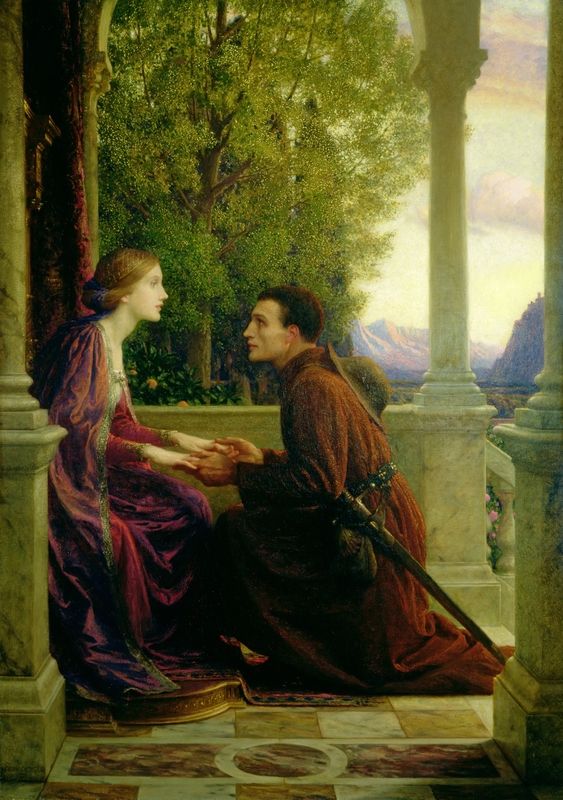
The End of the Quest, Leighton House, LH0060. Image source. Public domain.
What kind of quest?
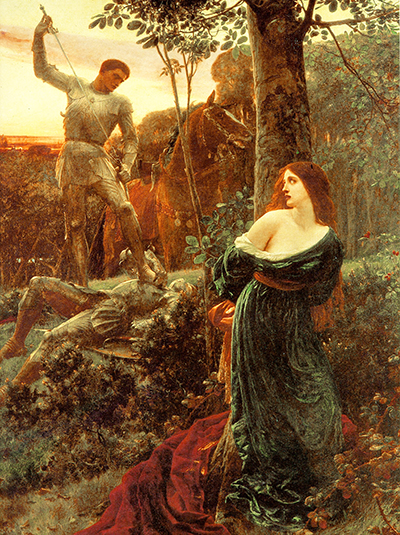
Christie's has placed the work in a line of paintings by Dicksee associated with courtly love, from Harmony through Chivalry. In Chivalry, a knight intervenes to free a bound woman, and the action is clear from the rope, the defeated figure and the knight's raised sword arm. In The End of the Quest, the sword is sheathed and the encounter depends on what passes between two people at close quarters. The resemblance shows how Dicksee could use the same broad medieval vocabulary for a rescue or for the more private and uncertain act of addressing someone whose answer matters. [3]
The Royal Academy catalogue gives Dicksee's painting its title and the painter's name. Its reticence is apparent beside another exhibit that year, E. Reginald Frampton's Elaine, which came with lines from Tennyson. Dicksee could also furnish a literary identity when a subject called for it. His 1901 Yseult names the figure at the heart of its story and makes a view of the sea part of the action, as Yseult watches from the terrace. In The End of the Quest, the name belongs to the action just completed. The people, the purpose of the journey and the terms of the meeting remain open to interpretation. [2] [4] [5]
Two works by other artists show how much a title or a gesture can tell us about a journey. In Edmund Blair Leighton's God Speed of 1900, a woman ties a favour to a departing knight's arm outside a fortified gateway. The horse and the gateway give the encounter a direction, and the title takes the form of a farewell. Morris & Co.'s The Attainment, designed by Edward Burne-Jones, William Morris and John Henry Dearle, gives the Grail quest an explicit climax. Three named knights approach the sacred vision, and the revelation orders the whole scene. Dicksee's meeting has the physical closeness of the first work and the sense of reaching a destination of the second. The gesture at its centre stops short of either a farewell or a revelation. [1] [6] [7]
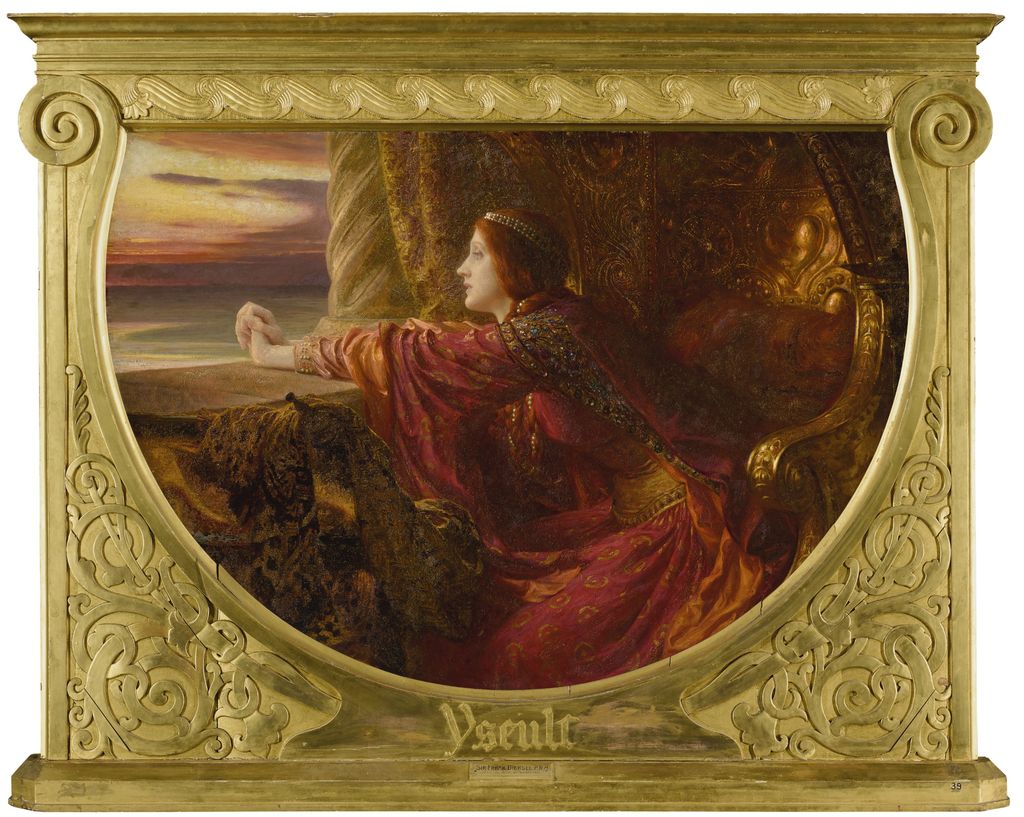
Yseult, 1901. In this earlier canvas Dicksee named the figure from the story. Image source. Public domain.
A small oil sketch and a public exhibition
A small oil on board, Victory, a Knight Being Crowned with a Laurel-Wreath, offers a comparison within Dicksee's own work. Sotheby's proposed a possible connection when the sketch came to auction in 2005. There, a woman's action gives the encounter a clear purpose. She reaches across to set the wreath on his head. His bright metal armour, seen largely from behind, catches the light in front of a cluster of witnesses. The much larger Leighton House canvas brings both faces into view and gives the hands a gesture they can share. These are two distinct objects, and the relationship Sotheby's suggested remains tentative. [1] [8] [9]
The End of the Quest appeared in Gallery III at Burlington House, where the catalogue places it between Gilbert B. Solomon's Miss Macqueen and Solomon J. Solomon's Mrs. Samuel J. Cohen. Dicksee also showed a portrait of Lieutenant W. R. Slayter and landscapes of the country around Beccles. Seen alongside those entries, the terrace and mountain scenery belong to one strand of an active painter's work in 1921. His Academy audience could encounter a naval officer, a Suffolk landscape and a scene of courtly romance by the same artist on one visit. Three years later his fellow Academicians elected him President. [2] [4] [10] [11]
The picture's later home brings it into the orbit of another painter and Royal Academy president, Frederic Leighton. An image catalogue records a gift from Miss Mary Dicksee, Frank's sister, in 1929, the year after his death. Leighton himself died in 1896 and his belongings were dispersed. When his studio-house opened as a museum in 1900, a collection was being built anew around his work. Dicksee's canvas belongs to that later museum collection, where it carries the tradition of Victorian narrative painting into the twentieth century. [1] [12] [13] [14]
Frank Dicksee artworks directory
Browse documented paintings, studies, illustration designs and prints. Where an article is available, the title opens it. Simon Toll’s catalogue
| Name | Date | Medium |
|---|---|---|
| A Love Story | 1882 | Painting |
| A Reverie | 1895 | Painting |
| An Offering | 1898 | Painting |
| Chivalry | 1885 | Painting |
| Dawn | 1897 | Painting |
| Elijah Confronting Ahab and Jezebel in Naboth’s Vineyard | By 1875 | Painting |
| Harmony | 1877 | Painting |
| Harmony, etching by Charles-Albert Waltner after Dicksee | 1880 | |
| Harmony, the smaller Towneley version | Late 1870s | Painting |
| Hesperia | 1887 | Painting |
| Hesperia, watercolour version | Late 1880s | Painting |
| Italian Coast from La Mortola | 1925 | Painting |
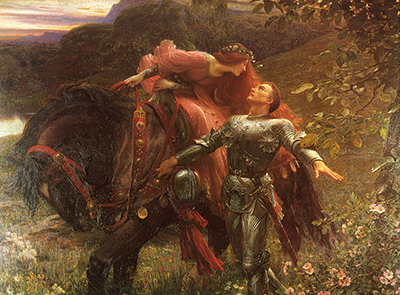
| La Belle Dame sans Merci | c. 1901 | Painting |
| Memories | 1886 | Painting |
| Paolo and Francesca | 1894 | Painting |
| Portrait of Camille Sutton Palmer | 1914 | Painting |
| Portrait of Elsa | 1927 | Painting |
| Portrait of the Duchess of Buckingham and Chandos | 1901 | Painting |
| Romeo and Juliet | 1884 | Painting |
| Romeo and Juliet, monochrome design on joined wood | c. 1880s | Painting |
| Sir Edmund William Gosse, collotype after Dicksee | 1912 | |
| Startled | 1892 | Painting |
| Study for Startled | Early 1890s | Drawing |
| The Confession | 1896 | Painting |
| The Crisis | 1891 | Painting |
| The Daughters of Eve | 1925 | Painting |
| The Embarkation | 1879 | Painting |
| The End of the Quest | 1921 | Painting |
| The Funeral of a Viking | 1893 | Painting |
| The House Builders | 1880 | Painting |
| The Magic Crystal | 1894 | Painting |
| The Passing of Arthur | 1889 | Painting |
| The Redemption of Tannhäuser | 1890 | Painting |
| The Symbol | 1881 | Painting |
| The Two Crowns | 1900 | Painting |
| Yseult | 1901 | Painting |
Discussion
Look again at the images and ideas explored in The End of the Quest. These editorial prompts invite your observations.
Reader Insights
Which gives you the stronger impression of the woman's response, the direction of her gaze or the way she extends her hands?
How would you read the encounter if Dicksee had closed off the view of the mountains?
Join the Conversation
Share the detail that first suggested a story to you and what changed when you looked again.
References
- Leighton House via Art UK, The End of the Quest, collection image and object metadata for LH0060 archived at Wikimedia Commons. View source.
- Royal Academy of Arts, 1921 Summer Exhibition catalogue, p. 21, Gallery III, nos. 155–160, including The End of the Quest at no. 158. View source.
- Christie's, Chivalry, lot 5631457, object and essay comparing the painting with Harmony and The End of the Quest. View source.
- Royal Academy of Arts, 1921 Summer Exhibition catalogue, including Gallery II no. 71, Gallery IX nos. 364, 421 and 444, and index of exhibitors. View source.
- Sotheby's, Yseult, New York, 1 February 2019, lot 426. View source.
- Sotheby's, Edmund Blair Leighton, God Speed, London, 10 May 2012, lot 26. View source.
- Birmingham Museums Trust, The Attainment; The Vision of the Holy Grail to Sir Galahad, Sir Bors and Sir Percival, accession 1907M131, reproduced in Artefacts, Spring 2023. View source.
- Sotheby's via Invaluable, Victory, a Knight Being Crowned with a Laurel-Wreath, catalogue text from the sale of 10 March 2005. View source.
- Art Renewal Center via Wikimedia Commons, Victory, a Knight Being Crowned with a Laurel-Wreath, object metadata and reproduction. View source.
- Royal Academy of Arts, Rebecca Salter Elected New President of the Royal Academy of Arts, including the list of past presidents. View source.
- Royal Scottish Academy, Sir Frank Bernard Dicksee, artist overview and presidency date. View source.
- Wikimedia Commons, The End of the Quest, separate image record giving the date and donor of the museum gift. View source.
- Paul Ripley, The Obituary of Frank Dicksee, Art Renewal Center, account of the 1928 funeral identifying Miss Mary Dicksee as his sister. View source.
- Royal Borough of Kensington and Chelsea Museums, History of Leighton House, including the transition from home to public museum. View source.