 by Tom Gurney
Tom Gurney BSc (Hons) is an art history expert with over 20 years experience
Published on June 19, 2020 / Updated on November 25, 2026
Email: tomgurney1@gmail.com / Phone: +44 7429 011000
Romeo and Juliet: Introduction
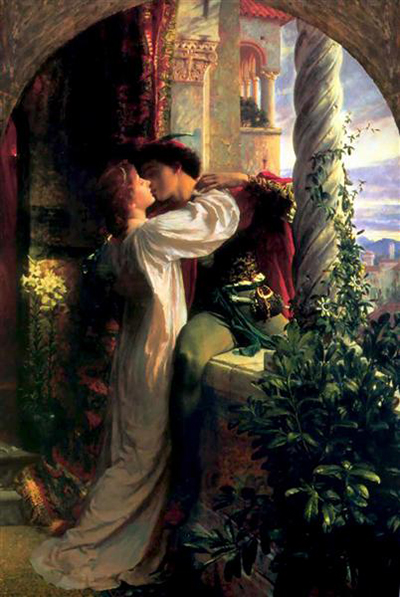
Romeo has one leg over the stone parapet, but his face is still turned towards Juliet. Her white sleeve catches the light as she draws him close. Beyond them, the sky is growing pale above Verona. In Frank Dicksee’s Romeo and Juliet of 1884, the day that separates the lovers is already breaking. In Act III, scene 5 of Shakespeare’s play, Romeo tells Juliet, “Farewell, farewell. One kiss and I’ll descend.” The painting is now at Southampton City Art Gallery. [1] [2]
Romeo and Juliet at dawn
Watch the scene that provides the setting for Dicksee’s painting.
RSC Learning. This performance follows the lovers as the coming daylight forces them apart. Watch on YouTube.
At a Glance
- ArtistFrank Dicksee
- Date1884
- MediumOil on canvas
- Dimensions171 × 118 cm
- CollectionSouthampton City Art Gallery, SOTAG 1006
- SubjectThe lovers’ dawn farewell in Act III, scene 5
- ExhibitionRoyal Academy Summer Exhibition, 1884, no. 430. [3]
This work across Frank Dicksee’s career
Contents
- The morning Romeo must leave
- A window between two worlds
- A drawing, a book and a painting
- What the Academy critics saw
- Later versions and the painting’s travels
- Annotated details
The morning Romeo must leave
The scene opens with a disagreement about a bird. Juliet hears, or wants to hear, the nightingale and insists Romeo can stay. Romeo says it was the lark, and points to the streaks of light in the sky. He has been banished for killing Tybalt and must leave Verona or risk death. When he offers to stay and let himself be taken, Juliet can hear the lark clearly enough. She urges him to go. The Nurse then warns her that Lady Capulet is coming. The kiss Dicksee chose takes place in the few moments between the warning and Romeo’s descent. [2]
The earlier scene commonly called the balcony scene, Act II, scene 2, has a different shape. Romeo enters the Capulets’ orchard after the feast and looks up as Juliet appears at her window. The height separates two people who are learning what they mean to one another and who can still talk about a future together. At dawn, they have already married in secret. The same difference in height is about to open up again, this time as Romeo leaves. After he climbs down, Juliet imagines that she sees him at the bottom of a tomb. Shakespeare puts a glimpse of the ending into the first moments of their separation. [2] [4]
Dicksee holds the lovers at the point just before they separate. Juliet’s raised chin almost bridges the space between their faces. With his weight already on the stone, Romeo can turn away in a single movement. The opening to the right lets us see the mounting light at the same time as the lovers appear least willing to look at it. That timing gives a quiet, almost motionless picture much of its tension. [1] [2]
A window between two worlds
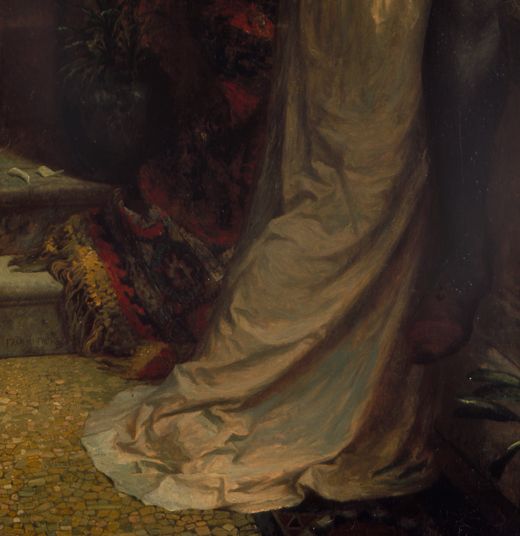
The painting is 171 centimetres high. At that scale the parapet, curtain and twisted pillar have a physical presence that is easy to miss in a small reproduction. On the left, a heavy patterned hanging leaves much of the window in shadow. Juliet’s gown falls towards the tiled floor in long folds, gathering at her feet. Romeo’s bent leg and the edge of the sill make a shorter horizontal beneath her lifted arm. Follow that ledge towards the right and foliage closes off the foreground. The space opens again above the leaves, where the rooftops and hills recede in bands of cool colour. [1]
The first light catches Juliet’s face and broad sleeve, reaches the side of Romeo’s neck and picks out small flashes of metal at his belt. Much of his clothing and the room behind Juliet stay dark. The folds of her gown turn from bright ivory at the shoulder to muted greys and browns near the floor. Dicksee can suggest a new day across an entire city and still register what it does to one loose sleeve. Henry Blackburn, writing about the Academy exhibition, singled out the early light touching the laurel leaves as one of the picture’s strengths. [1] [5]
There are flowers in two places. Pale lilies stand beside the curtain on the left, and passionflowers are visible on the climber winding round the stone at the right. The lilies echo the pale gown, drawing the eye back from Juliet’s sleeve to the shaded lower edge of the window. The climber borrows the upward twist of the column. Art historian Dennis T. Lanigan reads the lilies in connection with Juliet’s purity and, following Simon Toll, notes the romantic associations of the passionflowers. The flowers also do straightforward work in the painting. Their placement leads the eye in and out of the shadow and helps the opening read as a place where air and light reach the chamber. [1] [6]
Lanigan traces the Verona view and carved column to sketches from Dicksee’s Italian visit of 1882. The Royal Academy holds a travel sketchbook with Italian drawings from these years, including pages worked in pencil and gouache. The painting gives an invented encounter the weight of things that could be studied closely on a journey, from the carving at the window to the way rooflines stack up across the city. By bringing the foreground stone up to the picture’s edge and narrowing the view beyond it, Dicksee makes the architecture feel like somewhere the viewer could stand. [6] [7] [8]
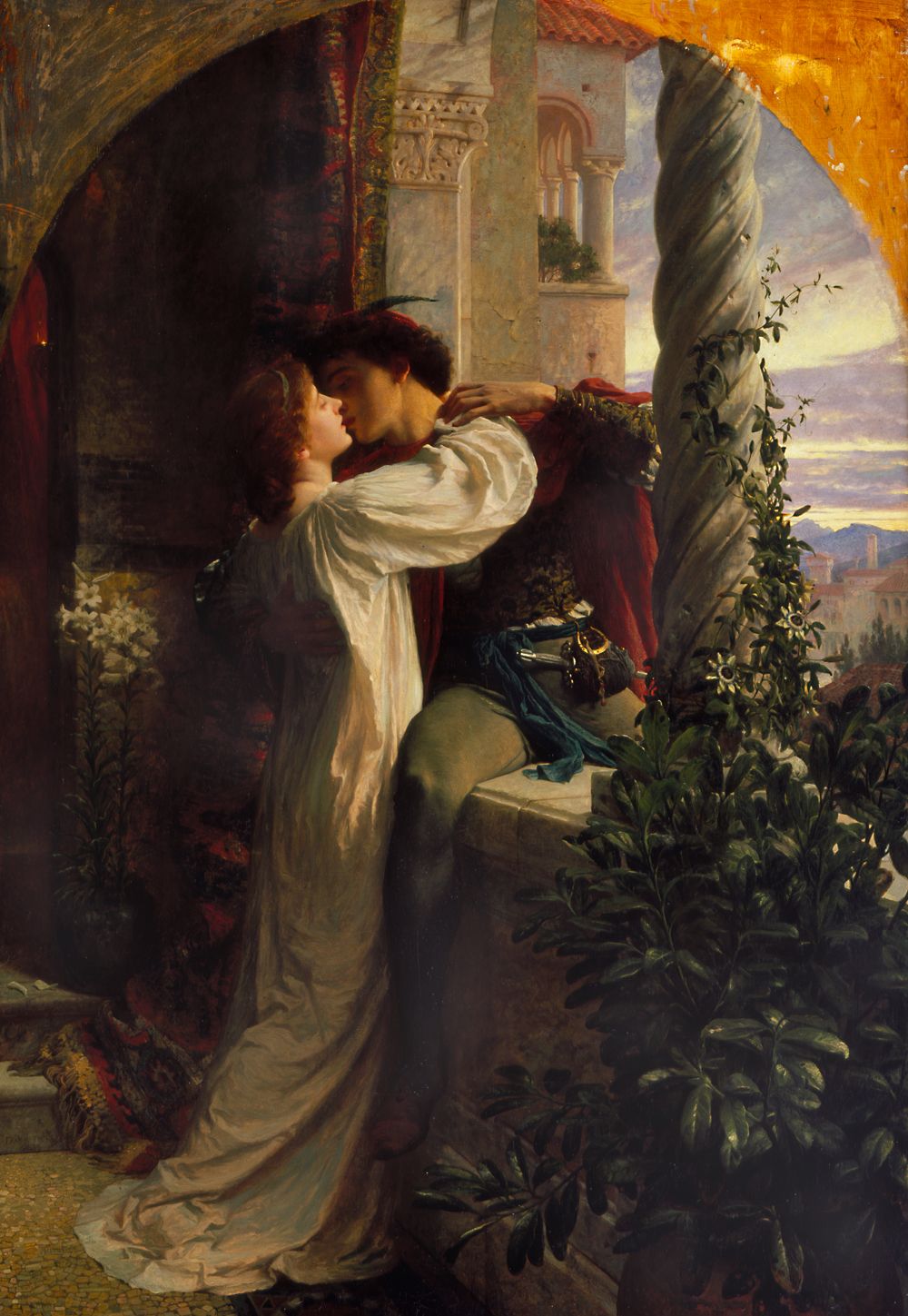
The Southampton oil, shown at the Royal Academy in 1884. Image source. Public domain.
Annotated Details from The Southampton canvas of Romeo and Juliet
The numbered points identify visible features discussed in this article. Return from each detail to the numbered overview. The Southampton canvas of Romeo and Juliet. Image source. Public domain.
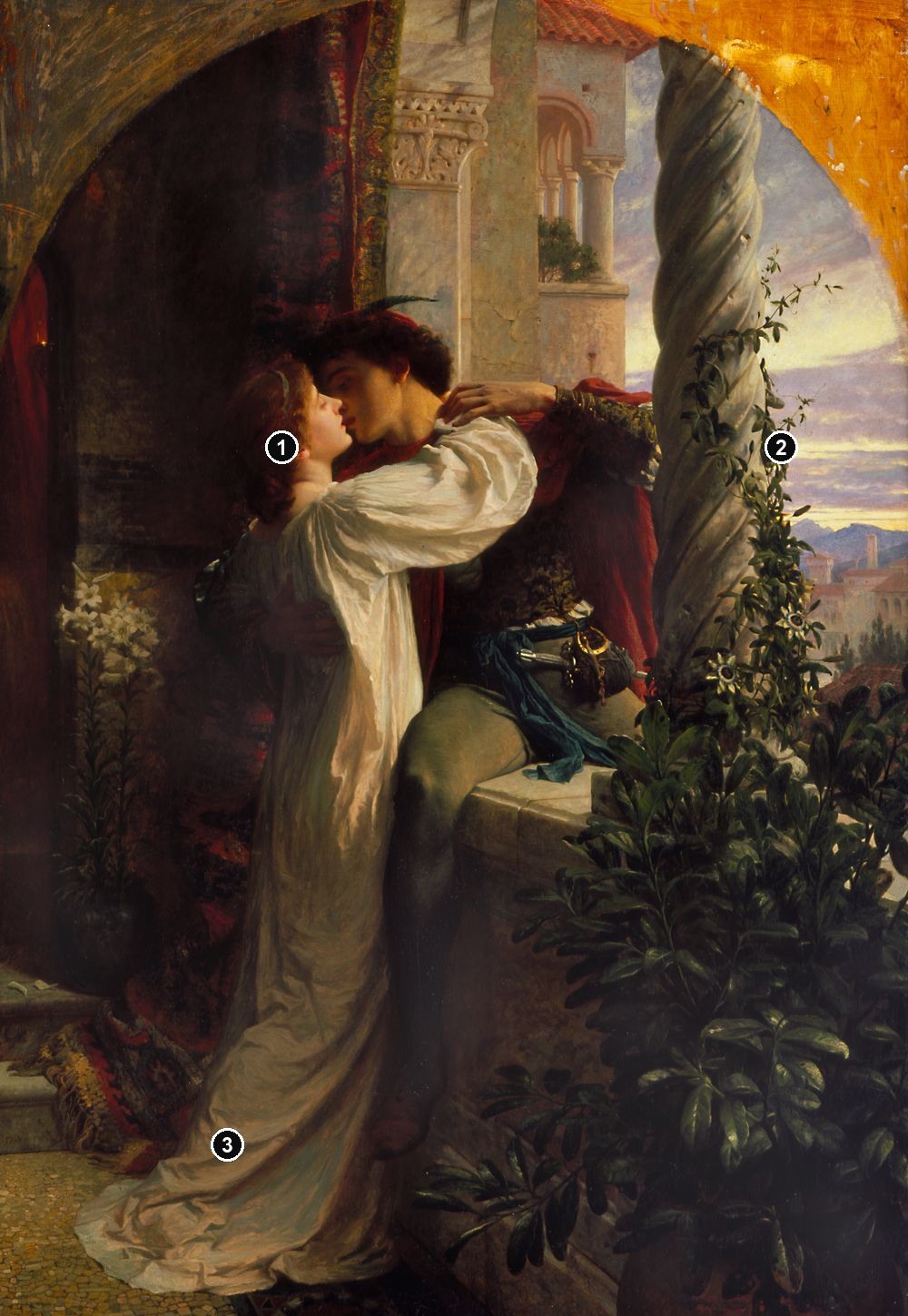
Details from THE SOUTHAMPTON CANVAS OF ROMEO AND JULIET
Compare the cropped details with the source images above. Notice how their colours, shapes and positions contribute to the larger compositions.
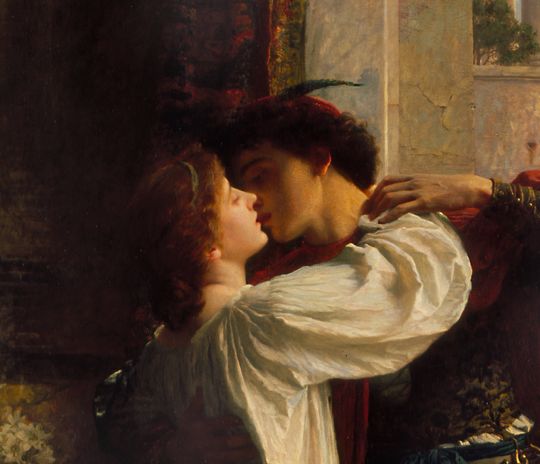
The embrace at the window
The lovers’ faces come very close. A pale sleeve folds across the dark opening and makes the urgency of the embrace visible.
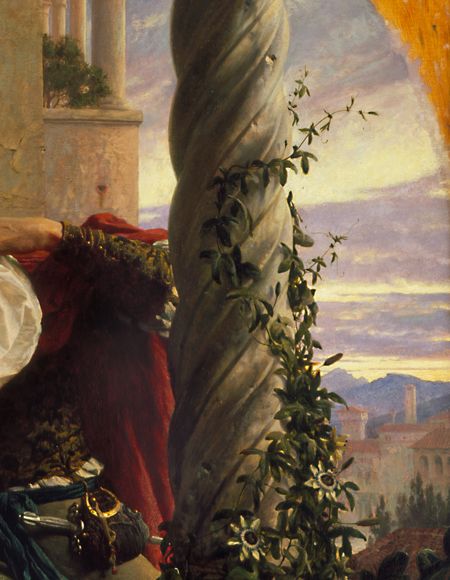
Daylight beyond the column
The lighter sky remains visible through a narrow part of the opening. Turning leaves and neighbouring walls keep the outside world close to the pair.
The hem on the floor
The train of the pale dress covers much of the foreground. Its folds descend from the upright figure and make the lift towards Romeo more apparent.
A drawing, a book and a painting
The museum records help trace how Dicksee developed the farewell. The Victoria and Albert Museum dates its sketch design to 1880–84 and identifies it as a study for the exhibited painting. It is a sheet about twelve inches high, worked in Indian ink and Chinese white. The drawing establishes the pale gown against the dark window. The use of ink and opaque white gives Dicksee a way to test the pattern of light before working it out in colour. On the canvas he could develop those relationships in colour, giving the long gown, the canopy and the distant sky their different kinds of brightness. [1] [6] [9]
In the year the painting went to the Academy, Cassell & Company published a separate edition of the play with twelve illustrations by Dicksee and an introduction by the Shakespeare scholar Edward Dowden. The title page credits Goupil & Co. with reproducing the illustrations in photogravure. Goupil had introduced its photogravure process in 1872. A photographic image was transferred to a printing plate, allowing gradations between shadow and light to carry over into the printed picture. The publisher advertised the volume on handmade Whatman paper, with the text printed in red and black. Among the twelve plates, the dawn farewell has pride of place opposite the title page. Southampton traces the oil painting to the illustrated design. The two share the tilt of Romeo’s head, Juliet’s lifted arm and the strong vertical dividing the shadowed opening from the sky. They also share a caption. The frontispiece takes its line from the same passage used in the Academy catalogue. [1] [3] [6] [10] [11] [12]
Readers of the Cassell volume encountered the kiss before reading the lovers’ first meeting. The illustration at page 13 takes its cue from the dialogue at the Capulets’ feast, where Romeo and Juliet compare hands and lips to pilgrims and saints. Dowden’s introduction asks readers to look at Dicksee’s illustration to see the lovers’ feeling within the formal courtesies of their first exchange. At page 27, Mercutio’s curse introduces a wholly different use of gesture, as his companions attend to a man mortally wounded by Tybalt. Romeo kills Tybalt in revenge and is banished. Returning to the frontispiece after those illustrations, a reader can see the parting as the consequence of acts that took place in front of witnesses, even though the kiss itself appears to go unseen. [2] [10]
A small monochrome painting in the Dahesh Museum carries the same title and belongs to Dicksee’s illustrations of the earlier night-time exchange. The museum dates it to about the 1880s and records its support as six joined pieces of wood. Here the space between the figures is essential, with Romeo below and Juliet overhead. Dicksee painted the design in reverse, right down to his initials, in preparation for reproduction. The Dahesh identifies the associated illustration as a steel engraving in Cassell’s Royal Shakespeare, captioned with Juliet’s goodnight from Act II, scene 2. The canvas at Southampton and the 1884 photogravure frontispiece put the two bodies within reach of one another at the later farewell. [4] [10] [13]
What the Academy critics saw
The canvas was no. 430 at the Royal Academy in 1884. Blackburn remembered it hanging in the corner of a gallery and suspected that some visitors passed it without seeing its finer effects. His survey, English Art in 1884, included a photographic reproduction to give readers a sense of the composition. He also reported that an engraving was in progress, with the expectation that viewers would gain a closer look at the costumes and textures. The exhibition, book and separately circulating prints gave viewers different ways to spend time with a single design. [3] [5] [10]
Reviewers disagreed over whether Dicksee’s carefully arranged embrace felt convincing. In press excerpts collected by The Artist in June 1884, The Times praised the drawing of Romeo and the care given to the foreground laurel, while The Telegraph found Romeo’s exit ungainly and the romance commonplace despite the quality of the handling. F. G. Stephens in The Athenaeum found the setting stage-like and preferred the force of Ford Madox Brown’s treatment. Brown’s oil in the Delaware Art Museum shows Romeo reaching back towards Juliet with a rope ladder hanging below the railing. In Dicksee’s arrangement, the descent is still to come. A viewer’s sense of urgency depends on how long that pause seems possible. [6] [14]
Alfred George Temple, director of the Guildhall Art Gallery, defended the pose in his 1897 survey of Victorian painting. He admired the plausibility of Dicksee’s pose and considered the absence of a conspicuously dangling rope ladder a strength. He also recorded the canvas in the collection of Charles Churchill. The original illustrations had a public life of their own. When they were shown at Vokins’s after the 1884 Academy exhibition, a reviewer for The Art Journal questioned their emotional fire but praised Dicksee’s handling of line and singled out the dawn parting as perhaps the best of the set. The drawing’s outline and tonal balance gave the reviewer something to admire even while the reservations about Dicksee’s restraint persisted. [6] [15] [16]
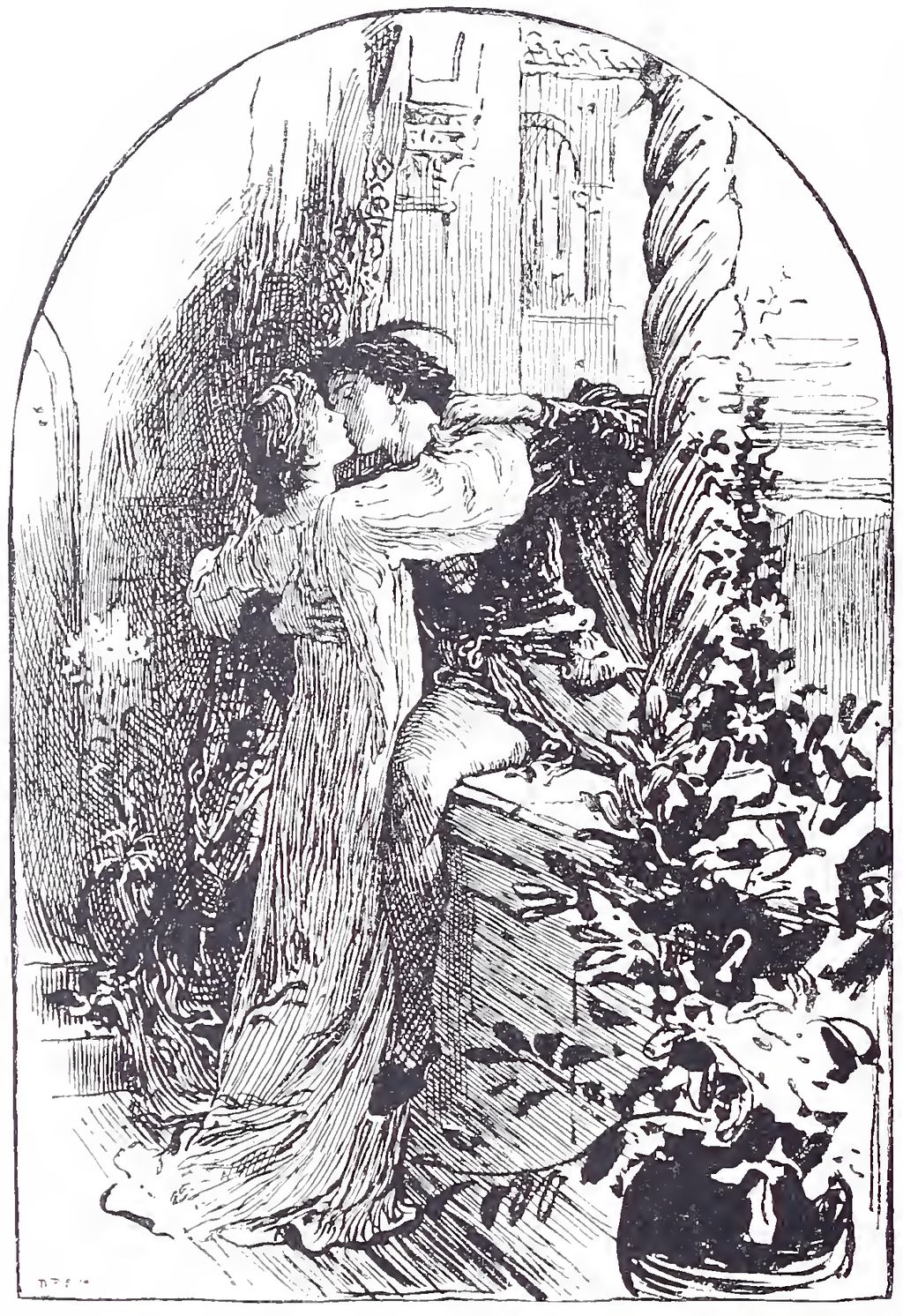
Dicksee’s Romeo and Juliet as illustrated in Henry Blackburn’s English Art in 1884, p. 28. Frank Dicksee, Romeo and Juliet, printed in Henry Blackburn, English Art in 1884, p. 28. Image source. Public domain.
Later versions and the painting’s travels
Charles-Albert Waltner made a separate etching after the painting, published by Thomas Agnew & Sons according to Lanigan. An 1894 Christie’s catalogue of the collection of Dr A. G. Medwin records a vellum proof of Waltner’s Romeo and Juliet in a lot with another print. The sale entry shows how the composition could be collected independently of the book, and how paper, technique and proof status could become part of what buyers valued in an image they might already recognise. Southampton records the painting itself as a bequest from J. J. Crossfield in 1941. [1] [6] [17]
The farewell remained a subject Dicksee could revisit. In 1925 he exhibited a circular watercolour, The Last Parting, as no. 681 at the Royal Academy. A separate small watercolour and pencil design, worked up with opaque bodycolour, is linked to the colour illustration for the 1927 Kingsway Shakespeare. In that composition Juliet holds Romeo’s head as she draws him towards her. The change concentrates the action on her gesture, giving her a more active role in the final embrace than she has in the 1884 canvas. [18] [19] [20]
The canvas and the Dahesh panel came together in 2024 in Preraffaelliti. Rinascimento moderno at the Museo Civico San Domenico in Forlì, alongside Dicksee’s Royal Academy travel sketchbook. The show examined the influence of Italian art on the Pre-Raphaelite movement and on later British artists. Its three Dicksee loans allowed viewers to look closely at his work on very different scales, in direct studies on paper, in a compact painted design for print and in the tall exhibition canvas. The city glimpsed beyond Romeo and Juliet belongs to the fiction, but the care with which Dicksee makes its stonework, rooftops and first light visible helps explain why this brief encounter endured as an image on its own. [1] [7] [8]
Frank Dicksee artworks directory
Browse documented paintings, studies, illustration designs and prints. Where an article is available, the title opens it. Simon Toll’s catalogue
| Name | Date | Medium |
|---|---|---|
| A Love Story | 1882 | Painting |
| A Reverie | 1895 | Painting |
| An Offering | 1898 | Painting |
| Chivalry | 1885 | Painting |
| Dawn | 1897 | Painting |
| Elijah Confronting Ahab and Jezebel in Naboth’s Vineyard | By 1875 | Painting |
| Harmony | 1877 | Painting |
| Harmony, etching by Charles-Albert Waltner after Dicksee | 1880 | |
| Harmony, the smaller Towneley version | Late 1870s | Painting |
| Hesperia | 1887 | Painting |
| Hesperia, watercolour version | Late 1880s | Painting |
| Italian Coast from La Mortola | 1925 | Painting |
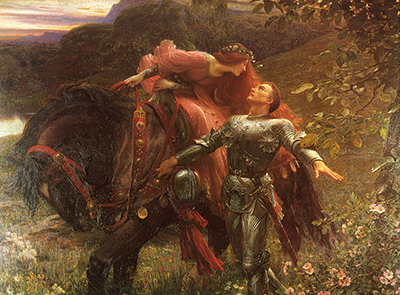
| La Belle Dame sans Merci | c. 1901 | Painting |
| Memories | 1886 | Painting |
| Paolo and Francesca | 1894 | Painting |
| Portrait of Camille Sutton Palmer | 1914 | Painting |
| Portrait of Elsa | 1927 | Painting |
| Portrait of the Duchess of Buckingham and Chandos | 1901 | Painting |
| Romeo and Juliet | 1884 | Painting |
| Romeo and Juliet, monochrome design on joined wood | c. 1880s | Painting |
| Sir Edmund William Gosse, collotype after Dicksee | 1912 | |
| Startled | 1892 | Painting |
| Study for Startled | Early 1890s | Drawing |
| The Confession | 1896 | Painting |
| The Crisis | 1891 | Painting |
| The Daughters of Eve | 1925 | Painting |
| The Embarkation | 1879 | Painting |
| The End of the Quest | 1921 | Painting |
| The Funeral of a Viking | 1893 | Painting |
| The House Builders | 1880 | Painting |
| The Magic Crystal | 1894 | Painting |
| The Passing of Arthur | 1889 | Painting |
| The Redemption of Tannhäuser | 1890 | Painting |
| The Symbol | 1881 | Painting |
| The Two Crowns | 1900 | Painting |
| Yseult | 1901 | Painting |
Discussion
Look again at the images and ideas explored in Romeo and Juliet. These editorial prompts invite your observations.
Reader Insights
Where does your eye go first, to the lovers’ faces or to the leg already across the parapet? How does that change the time you give the kiss?
Look at the narrow band of sky and then at Juliet’s sleeve. How much of the sense of dawn comes from the landscape, and how much comes from the way light falls on the figures?
Join the Conversation
Which detail makes the farewell feel most immediate to you? Share what you noticed in Dicksee’s painting and how it affected your reading of the scene.
References
- Southampton City Art Gallery, Romeo and Juliet, SOTAG 1006, object record and image. View source.
- William Shakespeare, Romeo and Juliet, Act 3, scene 5, Folger Shakespeare Library edition. View source.
- Royal Academy of Arts, 1884 Summer Exhibition catalogue, no. 430, scan 20 in the Paul Mellon Centre’s catalogue viewer. View source.
- William Shakespeare, Romeo and Juliet, Act 2, scene 2, Folger Shakespeare Library edition. View source.
- Henry Blackburn, English Art in 1884 (1885), Royal Academy, reproduction of no. 430 and pp. 29–30. View source.
- Dennis T. Lanigan, Romeo and Juliet, by Sir Frank Dicksee, including the sketch reproduction, Simon Toll on the painting, and transcriptions from The Athenaeum and The Artist. View source.
- Royal Academy of Arts, Annual Report 2023–24, exhibition loans, Dicksee travel sketchbook 06/3640. View source.
- Fondazione Cassa dei Risparmi di Forlì, Preraffaelliti. Rinascimento moderno, 2024 exhibition dossier, checklist with Dicksee’s canvas, wood panel and travel sketchbook. View source.
- Victoria and Albert Museum, Romeo and Juliet, sketch design for the 1884 painting, E.351-1933, online collections data. View source.
- William Shakespeare, Romeo and Juliet, illustrated by F. Dicksee, with an introduction by Edward Dowden (Cassell, 1884), frontispiece, title and illustration list, plates at pp. 13 and 27. View source.
- Pierre-Lin Renié, “De l’imprimerie photographique à la photographie imprimée”, Études photographiques, 20 (2007), on Goupil’s photogravure process. View source.
- Cassell & Company, “New Fine-Art Works”, advertisement in The Publishers’ Circular, 1 October 1884. View source.
- Dahesh Museum of Art, Romeo and Juliet, 1999.18, object record and Cassell illustration context. View source.
- Delaware Art Museum, Ford Madox Brown, Romeo and Juliet, 1869–70, 1935-1, collection image and interpretation. View source.
- Alfred George Temple, Frank Dicksee entry in The Art of Painting in the Queen's Reign (1897), pp. 205–206. View source.
- The Art Journal, review of the exhibition at Messrs. Vokins’s, 1885, p. 127. View source.
- Christie, Manson & Woods, Dr A. G. Medwin sale of modern etchings and engravings, 11 December 1894, lot 131. View source.
- Royal Academy of Arts, 1925 Summer Exhibition catalogue, no. 681, scan 50 in the Paul Mellon Centre’s catalogue viewer. View source.
- Dreweatts, Frank Dicksee, Romeo and Juliet, 10 February 2026, lot 265, auction listing through Gazette Drouot. View source.
- Dennis T. Lanigan, Romeo and Juliet, Sketch and Illustration, image of the pencil and watercolour study, reproduction of the Kingsway Shakespeare illustration and discussion of The Last Parting. View source.