 by Tom Gurney
Tom Gurney BSc (Hons) is an art history expert with over 20 years experience
Published on June 19, 2020 / Updated on November 25, 2026
Email: tomgurney1@gmail.com / Phone: +44 7429 011000
Frank Dicksee Prints and Book Illustration: Introduction
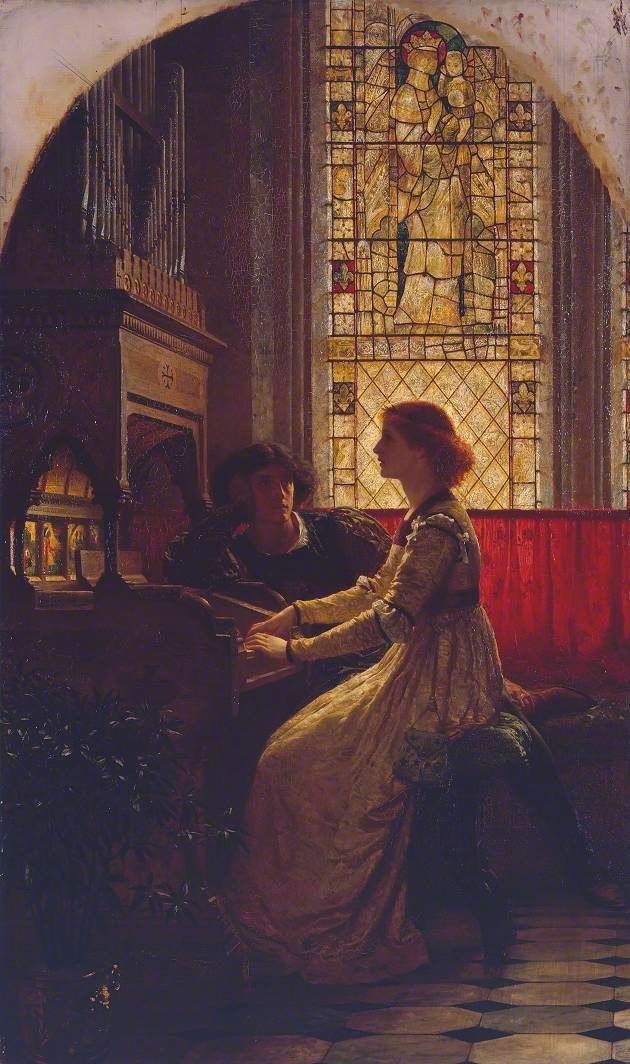
The woman at the organ in Frank Dicksee’s Harmony first met the public in an oil painting at the Royal Academy in 1877. Within three years she was on a sheet of paper, in an etching by Charles-Albert Waltner. The two works shared a composition, but the etched image had its own maker, publisher and buyers. Dicksee also painted and drew pictures expressly for books. Some of those designs became exhibition paintings in their own right. [1] [2]
At a Glance
- Reproductive etchingCharles-Albert Waltner’s Harmony after Frank Dicksee, published by Thomas Agnew & Sons. The Met’s proof is dated 1880. [2]
- Family collaborationHerbert Thomas Dicksee etched Hesperia after a painting by his cousin Frank. The Fine Art Society published the etching in 1889. [3] [4]
- Illustrated booksCassell published Dicksee’s Shakespeare illustrations and used both photogravure and wood engraving for his Evangeline designs. [5] [6] [7] [8]
- Portrait reproductionsThe National Portrait Gallery records heliogravures, collotypes and photogravures after Dicksee, with both individual and corporate makers credited. [9]
Contents
- Harmony from Academy canvas to Agnew etching
- Hesperia and the two Dicksees
- Shakespeare in different editions
- Evangeline in London, New York and Paris
- Portraits and photomechanical reproductions
- What to look for when buying a Frank Dicksee print
Harmony from Academy canvas to Agnew etching
A young man leans towards a woman at a richly decorated organ. Behind them the stained glass gives a medieval character to an imagined scene. An etcher had to bring the couple forward while keeping all that ornament legible, using ink and paper to do the work of oil paint. In an etching the ink is held in the recessed marks of a metal plate. Groups of close lines can suggest the shadow around an instrument, and a stretch of pale paper can distinguish a face or sleeve from its surroundings. What travels from canvas to sheet is a set of relationships between forms and tones. Even where the design is faithful, the etched marks are Waltner’s work. [1] [2]
The Met catalogues its impression as a proof from 1880 and names Thomas Agnew & Sons as publisher. The image measures 40.5 by 23.5 centimetres on a sheet 55 by 39.8 centimetres. The two sets of figures tell a buyer something useful. A trimmed impression could preserve the whole scene while losing substantial margins and any evidence they carried. The Met identifies Dicksee’s smaller second oil, now at Towneley Hall, as Waltner’s model. Its text supplies a date of 1887 for that oil, which would place it seven years after the proof. Dennis T. Lanigan dates the Towneley version to 1878. The secure sequence begins with the Academy canvas in 1877 and places the published etching in circulation by 1880. [1] [2] [10] [11]
The trade annual The Year’s Art lists Agnew’s Harmony among engravings and etchings published between October 1879 and October 1880. Its entry identifies artists’ proofs on vellum and Japanese paper. It also explains the Printsellers’ Association’s system of declarations and stamps for proofs. Buyers could choose what the image was printed on, and a stamp could identify the category of impression they were paying for. The later Cassell’s Universal Portrait Gallery credited Waltner’s etching with spreading Dicksee’s reputation abroad. The Academy purchase gave the painting a place in a national collection. Agnew gave the picture a way into private homes, and the Tate’s early illustrated catalogue credited Agnew as copyright owner when it reproduced the image. [1] [11] [12]
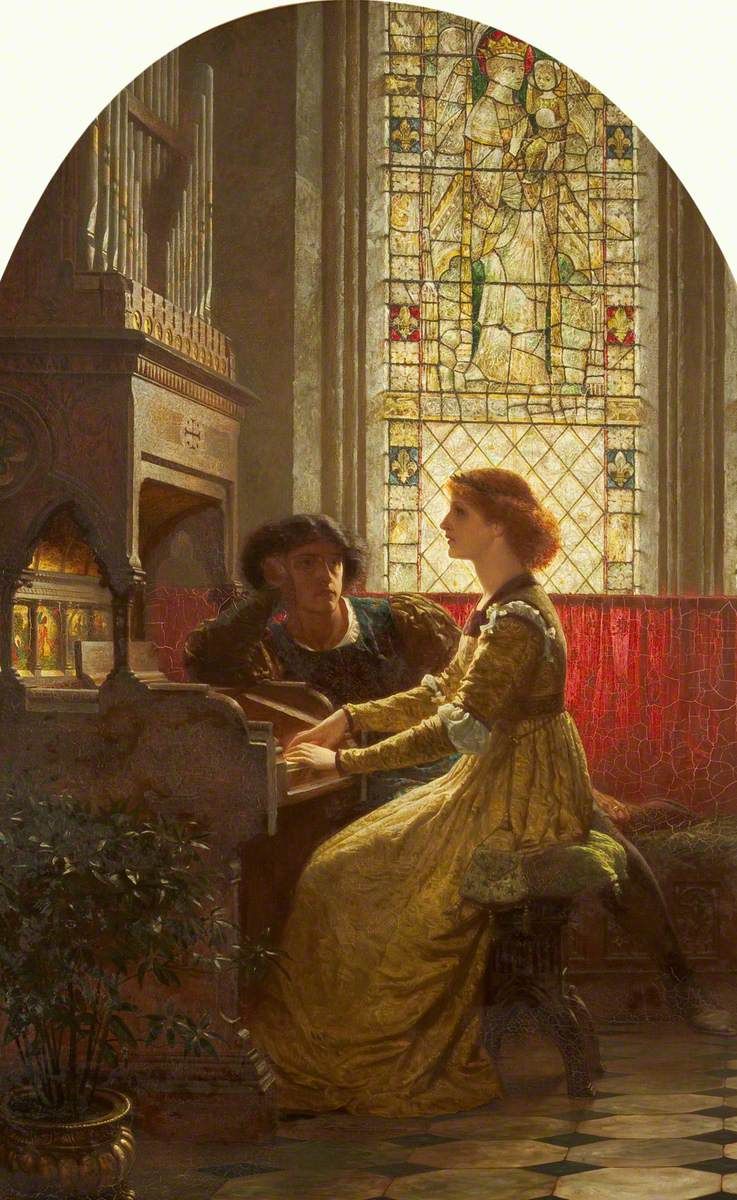
The smaller oil in Towneley Hall, the version the Met identifies as Waltner’s model. Image source. Public domain.
Hesperia and the two Dicksees
In Hesperia, a woman holds out a piece of fruit before a tree. A proof catalogued by Sworders repeats the figure and adds a tiny sketch of fruit in the margin. Such an addition is called a remarque. It sits apart from the composition and rewards a look beyond the picture’s edge. Sworders describes this impression as brown ink on vellum and identifies a pencil monogram of Frederick Goulding, the printer. The Fine Art Society published the print in London in 1889. Here the painter, etcher, printer and publisher can all be named for the same project. [3]
The 1889 Academy entry files Hesperia under Herbert Thomas Dicksee and explicitly credits Frank as the source. The index records the same arrangement three years later for Memories. A signature from a Dicksee on such a sheet may belong to the designer or to the etcher. The margin can establish a distinction that a label saying only “Dicksee print” leaves open. [4]
Shakespeare in different editions
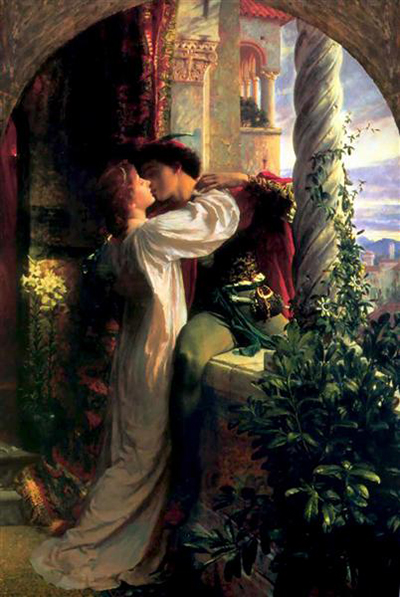
Dicksee could design for the press before there was a painting to reproduce. A small Romeo and Juliet in the Dahesh Museum of Art is painted in monochrome oil on six joined pieces of wood. Both the composition and Dicksee’s initials are reversed. The museum identifies it as preparation for the steel engraving of the Act II balcony scene in The Royal Shakespeare. Reversal mattered because an impression turns the image on its printing surface around. The surviving design lets us see a decision taken at the start of production, before the book’s readers encountered Juliet’s goodnight beneath the picture. [5]
Cassell & Company’s 1884 standalone Romeo and Juliet, with an introduction by Edward Dowden, used a different episode at the front of the book. Its frontispiece takes its caption from Romeo’s farewell in Act III, the parting at dawn also painted in the Southampton oil. Giving that moment first place changes the experience of opening the play. The reader sees a couple already about to part before reaching the brawl that opens the action. Across the volume, the twelve designs move between the public fight, the lovers’ meeting, Friar Laurence’s intervention, Mercutio’s death and the tomb. The street scene makes Verona’s feud visible before we see the intimacy of the lovers’ meeting. [6] [13]
The Hornby library catalogue credits Goupil with reproducing the twelve illustrations in photogravure for its 1884 edition de luxe. That process could translate gradations of tone from an original design into a printing plate. The same catalogue lists a set of twelve Othello illustrations in photogravure, in signed proofs on India paper, with a tentative date of 1890. An individual sheet can therefore belong to a set assembled and sold apart from the ordinary experience of reading the play. The title page, list of illustrations and caption are worth checking alongside any signature. [7]
Other Cassell Shakespeare plates preserve the name of a specialist engraver. On the Antony and Cleopatra sheet held by the Folger Shakespeare Library, Dicksee is credited as the painter and Georg Goldberg as the engraver. The scene follows Antony’s defeat at sea. A servant kneels at his armour while Cleopatra stands at his side. The armour gives the tenderness of the accompanying line a military context. In a separate Cassell special edition of the plays edited by Charles and Mary Cowden Clarke, a Romeo and Juliet wood engraving credits Dicksee as illustrator and Bellenger as engraver. Each credit belongs to a specific plate. It takes the edition and the scene to establish which picture a bookseller or collection is describing. [14] [15]
The Southampton composition had a life in print beyond Cassell’s book. In English Art in 1884, Henry Blackburn praised the dawn light in the Academy painting and mentioned an engraving in progress. The book itself offered a photographic reproduction so readers could see the composition. In June 1894, the sale of Dr A. G. Medwin’s collection paired vellum proofs of Harmony and Romeo and Juliet under Waltner’s name. An exhibition notice, the photograph it printed and the loose proof a collector owned each brought the picture to a different audience. [16] [17]
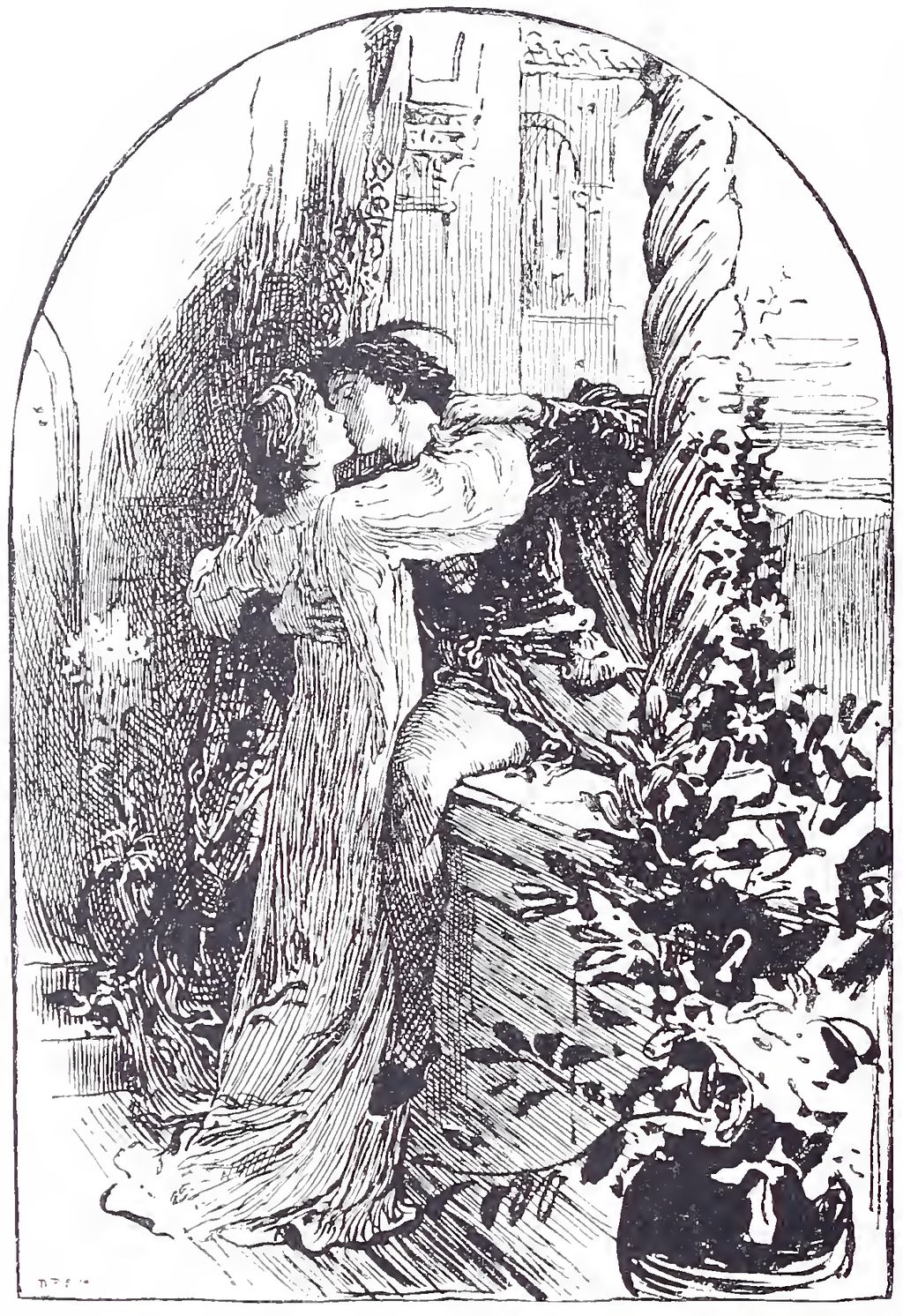
Dicksee’s Romeo and Juliet as illustrated in Henry Blackburn’s English Art in 1884, p. 28. Frank Dicksee, Romeo and Juliet, printed in Henry Blackburn, English Art in 1884, p. 28. Image source. Public domain.
Evangeline in London, New York and Paris
Cassell, Petter, Galpin & Co.’s October 1881 advertisement for a deluxe Evangeline lays out the division of labour. Dicksee supplied 23 designs. Goupil of Paris reproduced 15 in photogravure, and Klinkicht and Lacour engraved the remainder on wood. A. Barraud and H. Scott designed the ornamental initials. A wood engraving takes its ink from the raised parts of the block, with the areas cut away left light. The publisher planned to print the book on handmade Whatman paper and the wood engravings on China paper. Readers of Longfellow’s narrative poem would encounter images with different surfaces and tonal qualities in a single volume. [8]
An American announcement in The Chautauquan in December 1882 described a separately titled project by Noah Porter, Evangeline—The Place, The Story and the Poem. It promised 19 illustrations, with 15 Goupil photogravures and four proofs from the woodblocks. In Paris, Boussod, Valadon & Cie, successors to Goupil, advertised a French Évangéline translated and introduced by Louis Dépret. Their catalogue specified 24 facsimiles after Dicksee’s designs in 300 numbered copies. The figures describe three publication programmes. A loose Evangeline plate cannot be assigned to one of them simply by knowing whose design it reproduces. A photogravure could also circulate outside the book trade. The 1884 Royal Cambrian Academy catalogue records an Evangeline illustration in its exhibition’s black-and-white section, contributed by T. H. Thomas. [18] [19] [20]
Portraits and photomechanical reproductions
The National Portrait Gallery’s prints extend this story beyond literary pictures. Frederick John Jenkins made a heliogravure after Dicksee’s portrait of Alice Anne, Duchess of Buckingham and Chandos, dated to 1901. The Autotype Company is credited for a collotype of Sir Edmund Gosse dated to 1912, and Henry Dixon & Son for a photogravure of Lewis Harcourt dated to 1917. The Gallery holds several impressions of the Gosse portrait, with separate accession numbers. The names underneath these images record the commercial specialists who brought painted likenesses into circulation. [9]
Collotype and photogravure both relied on photographic transfer but used different printing surfaces. A collotype uses a light-sensitive layer of gelatine to receive ink in varying amounts. A photogravure prints from recessed areas of an etched plate, with tonal variation created by the way those areas hold ink. Both could render the subtle modelling of a painted face or the shift from dark fabric to a lighter background. The choice of process tells us about the making of the object in hand. The sitter’s name and Dicksee’s credit take us back to the image it reproduces. [9] [21]
Publishers also sold photogravures after Dicksee as individual pictures. The Berlin Photographic Company listed his tall, narrow Dawn in a catalogue headed London, Berlin, Paris and New York. A proof from its edition of 100 was priced at four guineas, while the India print was priced at one. On the same page, the company gave a separate entry to Margaret I. Dicksee, Frank’s sister, whose The Child Handel was also offered as a photogravure. The artist’s initial on a loose sheet matters for these prints as much as it does on Herbert’s etchings. [22]
What to look for when buying a Frank Dicksee print
If you are choosing an early impression, ask for photographs of the complete sheet, its margins and its back. Look for a publisher’s line, a plate mark, an emblem or stamp, and the position of any pencil signature. Compare the listing’s measurements with those of a documented impression and check whether the seller measured the image, the sheet or the frame. A date engraved in a plate can refer to a publication or the work on the plate. A year in a seller’s title may simply be the date of the painting. For a detached book illustration, an edition statement or a photograph of the original volume can be more informative than an attractive mount. [2] [11] [3] [6]
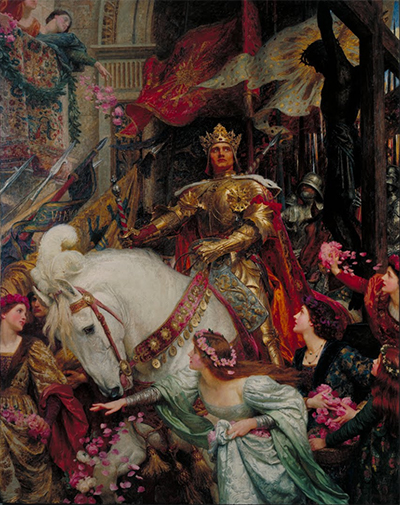
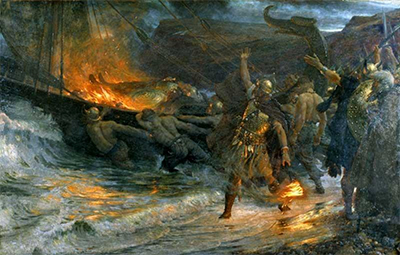
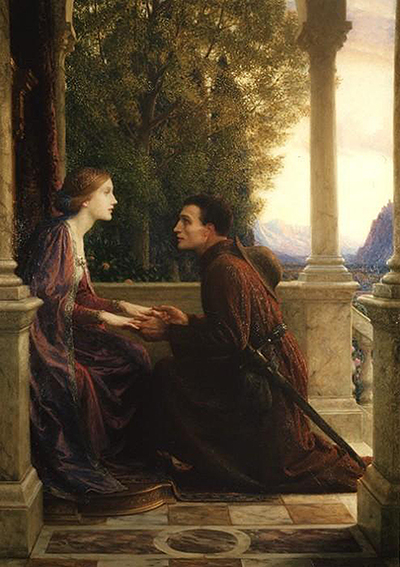
If you are choosing a modern reproduction to hang, start with the shape and colour of the source. The tall Two Crowns and the broad Funeral of a Viking call for different proportions. In The End of the Quest, the elongated format gives the figures room to face one another without crowding out the setting. Compare the available print with the full composition, especially if the retailer’s preview crops it to fill a standard format. A paper print with a window mount gives the image space inside the frame. A canvas wrap can carry parts of the picture around the sides, so check where the edges will fall. Measure the finished frame before ordering and consider the effect of glare where you plan to hang it. Framing and glazing also affect the total price and shipping weight.
Frank Dicksee artworks directory
Browse documented paintings, studies, illustration designs and prints. Where an article is available, the title opens it. Simon Toll’s catalogue
| Name | Date | Medium |
|---|---|---|
| A Love Story | 1882 | Painting |
| A Reverie | 1895 | Painting |
| An Offering | 1898 | Painting |
| Chivalry | 1885 | Painting |
| Dawn | 1897 | Painting |
| Elijah Confronting Ahab and Jezebel in Naboth’s Vineyard | By 1875 | Painting |
| Harmony | 1877 | Painting |
| Harmony, etching by Charles-Albert Waltner after Dicksee | 1880 | |
| Harmony, the smaller Towneley version | Late 1870s | Painting |
| Hesperia | 1887 | Painting |
| Hesperia, watercolour version | Late 1880s | Painting |
| Italian Coast from La Mortola | 1925 | Painting |
| La Belle Dame sans Merci | c. 1901 | Painting |
| Memories | 1886 | Painting |
| Paolo and Francesca | 1894 | Painting |
| Portrait of Camille Sutton Palmer | 1914 | Painting |
| Portrait of Elsa | 1927 | Painting |
| Portrait of the Duchess of Buckingham and Chandos | 1901 | Painting |
| Romeo and Juliet | 1884 | Painting |
| Romeo and Juliet, monochrome design on joined wood | c. 1880s | Painting |
| Sir Edmund William Gosse, collotype after Dicksee | 1912 | |
| Startled | 1892 | Painting |
| Study for Startled | Early 1890s | Drawing |
| The Confession | 1896 | Painting |
| The Crisis | 1891 | Painting |
| The Daughters of Eve | 1925 | Painting |
| The Embarkation | 1879 | Painting |
| The End of the Quest | 1921 | Painting |
| The Funeral of a Viking | 1893 | Painting |
| The House Builders | 1880 | Painting |
| The Magic Crystal | 1894 | Painting |
| The Passing of Arthur | 1889 | Painting |
| The Redemption of Tannhäuser | 1890 | Painting |
| The Symbol | 1881 | Painting |
| The Two Crowns | 1900 | Painting |
| Yseult | 1901 | Painting |
Discussion
Look again at the images and ideas explored in Frank Dicksee Prints and Book Illustration. These editorial prompts invite your observations.
Reader Insights
When you compare versions of Harmony, which parts of the image gain the most from the switch to monochrome?
How does meeting Romeo and Juliet at their farewell change the way you read the 1884 Cassell edition’s opening scenes?
Join the Conversation
If you have compared two impressions or editions, share the title, the names in the margin and the detail that helped you tell them apart.
References
- The National Gallery of British Art (Tate Gallery), illustrated catalogue, entry and plate no. 1587, Harmony. View source.
- The Metropolitan Museum of Art, Charles-Albert Waltner after Frank Dicksee, Harmony, 1880, 46.140.7. View source.
- Sworders, Herbert Thomas Dicksee after Frank Dicksee, Hesperia, printer’s proof, Bryan Steele Collection, lot 432. View source.
- Algernon Graves, The Royal Academy of Arts, vol. II, p. 325, Herbert Thomas Dicksee, 1889 no. 1688 and 1892 no. 1505. View source.
- Dahesh Museum of Art, Frank Dicksee, Romeo and Juliet, c. 1880s, 1999.18. View source.
- Cassell & Company, William Shakespeare, Romeo and Juliet, introduction by Edward Dowden, 1884, title leaf, frontispiece and list of illustrations, University of North Carolina Tannenbaum Shakespeare Collection. View source.
- Free Public Library of the City of Liverpool, Ex Bibliotheca Hugh Frederick Hornby, “Dicksee, Frank”, entries for Othello and Romeo and Juliet. View source.
- Cassell, Petter, Galpin & Co., Evangeline edition de luxe advertisement, The Publishers’ Circular, 1 October 1881, p. 839, no. 498. View source.
- National Portrait Gallery, Frank Dicksee as artist, including portrait reproductions D32302, D20806, D9768, D18072, D20800 and D9787. View source.
- Dennis T. Lanigan, Harmony by Sir Frank Dicksee, object comparison of the Tate and Towneley Hall paintings. View source.
- The Year’s Art, “Engravings and Etchings Published During the Year”, October 1879 to October 1880, pp. 155–56 and 162. View source.
- Cassell’s Universal Portrait Gallery, “Mr. Frank Dicksee, R.A.”, contemporary account of the success of Harmony and Waltner’s etching. View source.
- Southampton City Art Gallery, Frank Dicksee, Romeo and Juliet, 1884, SOTAG 1006. View source.
- Folger Shakespeare Library, Georg Goldberg after Frank Dicksee, Antony & Cleopatra, Act III, Scene XI, ART File S528a3 no. 9 copy 2, facsimile at Cambridge University Press. View source.
- Victorian Illustrated Shakespeare Archive, Romeo and Juliet, Dicksee and Bellenger, facsimile and credits for plate 23 of the special wood-engraved illustrations. View source.
- Henry Blackburn, English Art in 1884, Royal Academy review, pp. 29–30. View source.
- Christie, Manson and Woods, sale catalogue of the collection of Dr A. G. Medwin, 20 June 1894, p. 12, lot 145. View source.
- The Chautauquan, December 1882, announcement for Noah Porter’s Evangeline—The Place, The Story and the Poem. View source.
- Boussod, Valadon & Cie, Catalogue des ouvrages de luxe, p. 4, Évangéline. View source.
- Royal Cambrian Academy, 1884 exhibition catalogue, “Black and White”, no. 906, Illustration to Evangeline. View source.
- Victoria and Albert Museum, “An A to Z of photographic processes”, entries for collotype and photogravure. View source.
- Berlin Photographic Company, catalogue of select publications, p. 49, Dawn, no. 2731, and The Child Handel, no. 2314. View source.