 by Tom Gurney
Tom Gurney BSc (Hons) is an art history expert with over 20 years experience
Published on June 19, 2020 / Updated on November 25, 2026
Email: tomgurney1@gmail.com / Phone: +44 7429 011000
Portrait of Elsa: Introduction
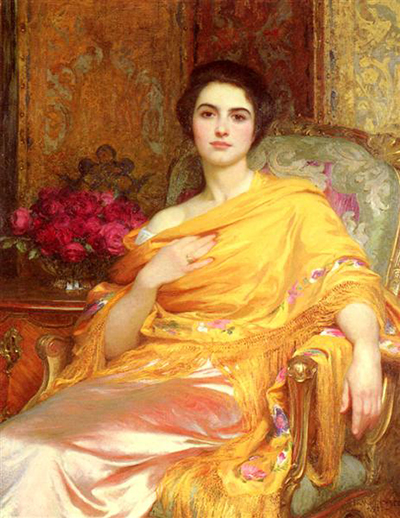
Elsa sits low in a carved armchair, with one hand gathering a yellow shawl at her chest and the other falling over the armrest. The shawl takes up much of Frank Dicksee’s canvas. Its flowers and long fringe draw the eye down to her lap, while her face, framed by dark hair and facing out of the picture, keeps bringing the eye back. Dicksee signed and dated the portrait in 1927, when he was president of the Royal Academy. The portrait appeared in Gallery III of that year’s Summer Exhibition. [1] [2]
At a Glance
- ArtistSir Frank Dicksee (1853–1928)
- Date1927, signed and dated [1]
- MediumOil on canvas [1]
- DimensionsApproximately 107 × 81 cm, based on the recorded 42 × 32 in. [1]
- SitterElsa, daughter of William Hall, as named in the contemporary exhibition catalogue [2]
- ExhibitedRoyal Academy Summer Exhibition, London, 1927, Gallery III, no. 149 [2]
This work across Frank Dicksee’s career
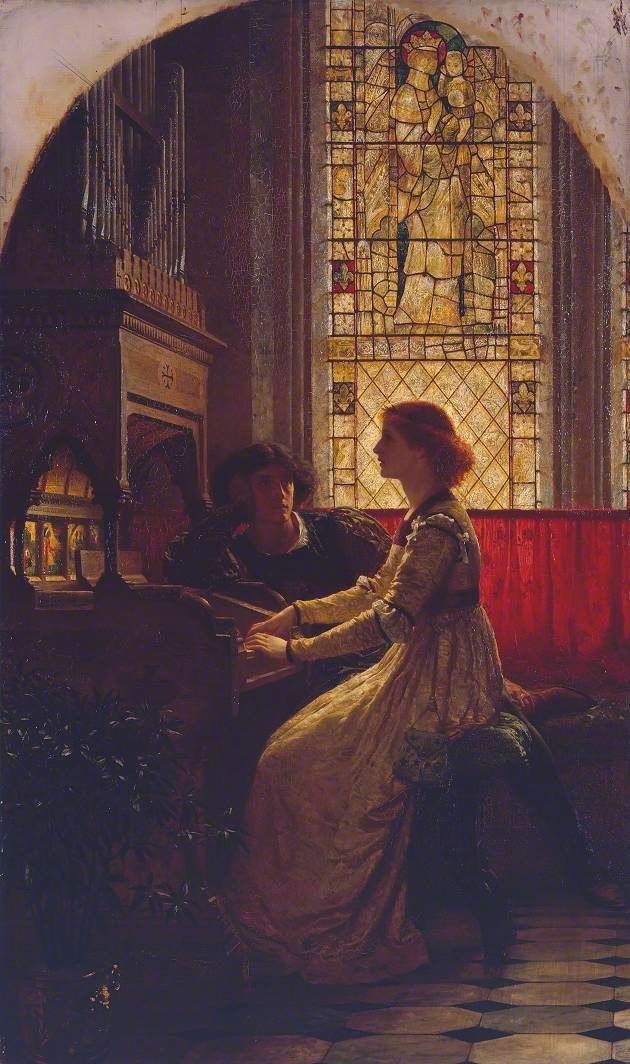
Harmony
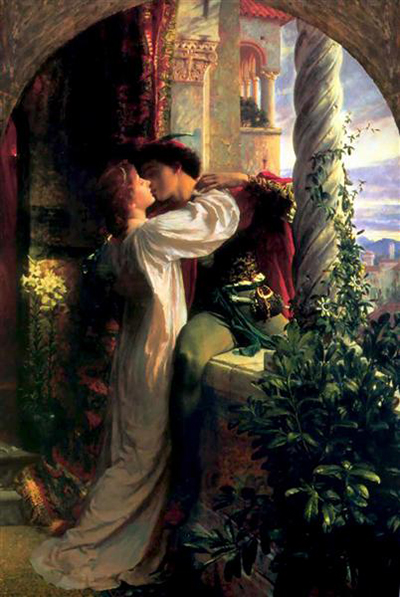
1877Romeo and Juliet
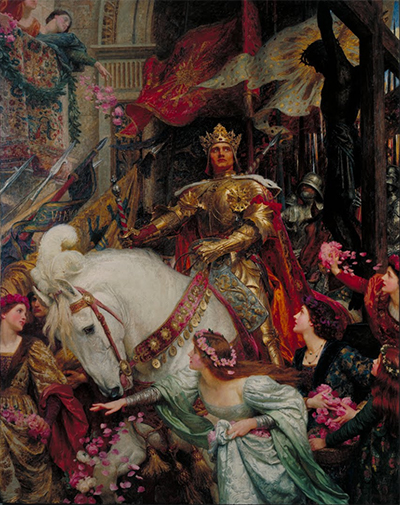
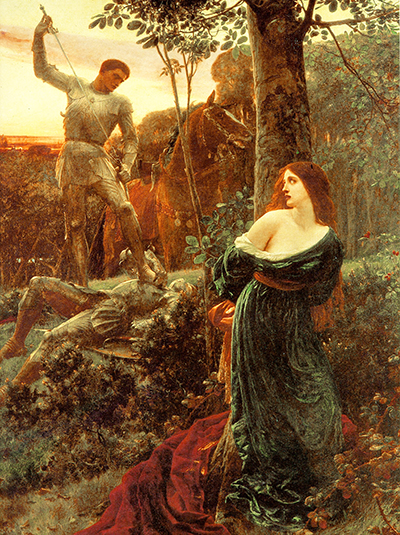
1884Chivalry
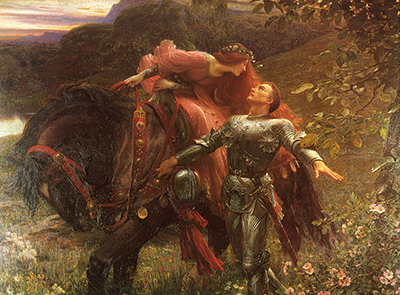
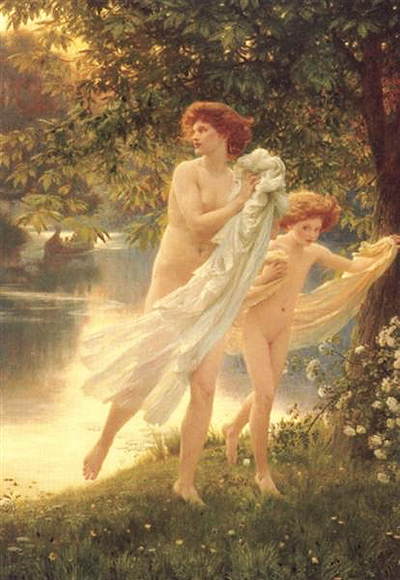
1885Startled
1892The Two Crowns
1900Contents
- Elsa and the armchair
- The painted fabric and the fashion of the 1920s
- A late portrait
- The Royal Academy in 1927
- What the title tells us about Elsa
Elsa and the armchair
The chair does much of the work of establishing the pose. Its back rises just above Elsa’s shoulder and fills the space beside her head. The gilded carving at the right catches the light near her wrist. Her weight settles into the chair at an angle, and the pink skirt extends towards the lower left corner, carrying that angle almost out of the frame. Her face turns towards us independently of the body. At the scale of the original, just over a metre tall, the tilt of the torso and the much smaller turn of the head would have been felt across a substantial surface. [1]
The two hands give the pose different kinds of movement. The fingers at her chest lie across a fold, with a small ring picked out in the light. On the other side, the forearm rests against the chair and the fingers hang down. Trace a path from one hand to the other and you follow the spread of the shawl across the body. Trace a path from the lowered hand up the chair back and you arrive again at her shoulders and face. The pose gives an impression of ease while supplying Dicksee with a way to direct the viewer around the canvas. [1]
Behind her are broad areas of reddish brown, with muted ornamental shapes. The dark hair provides a clean edge around the upper face before the background and upholstery grow busier near her shoulders. On the left, a low bowl of closely grouped roses makes a concentrated patch of red. The individual petals are easier to pick out where they catch the light. The bouquet gives the picture weight on the side where the chair occupies least space, and the pinks in the shawl’s border and dress pick up some of its colour. The flowers and furniture give the setting substance even though the view is too close to tell us much about the room. [1]
The painted fabric and the fashion of the 1920s
Across Elsa’s lap the pink dress shifts quickly between bright, almost white highlights and broad salmon-coloured shadows. Those changes give it the appearance of a smooth, lustrous fabric bending at the knee. The yellow wrap calls for a different treatment. Broad folds carry the light across the shoulder and chest, while broken touches of pink, purple, green and white describe flowers in the border. Along the edge, finer marks gather into the fringe. It sweeps diagonally across the lap and drops in longer, near-vertical strands where it passes over the chair arm. The change in direction shows where the fabric is supported and where it falls under its own weight. [1]
The fringed shawl has a place in the dress history of the decade, even in a portrait whose carved furniture and ornamental backdrop evoke an older kind of interior. The Metropolitan Museum of Art’s evening shawl by Madeleine Vionnet, dated about 1925, uses red silk jersey and staggered knots to make its fringe part of the moving surface. In London, a shawl hand-painted by Gwen Pike in 1927–28 was paired with a yellow dress by Elspeth Little. The London Museum records a fringe 32 centimetres long on the shawl, a reminder of how much of an outfit’s silhouette could come from the hanging threads. These surviving garments give a context for the way a wrap could carry much of an evening outfit’s colour and decoration. The painting leaves the maker and fibre of Elsa’s shawl open. What Dicksee makes clear is the difference between the plain expanse that catches the light and the decorated edge that follows the body. [1] [3] [4]
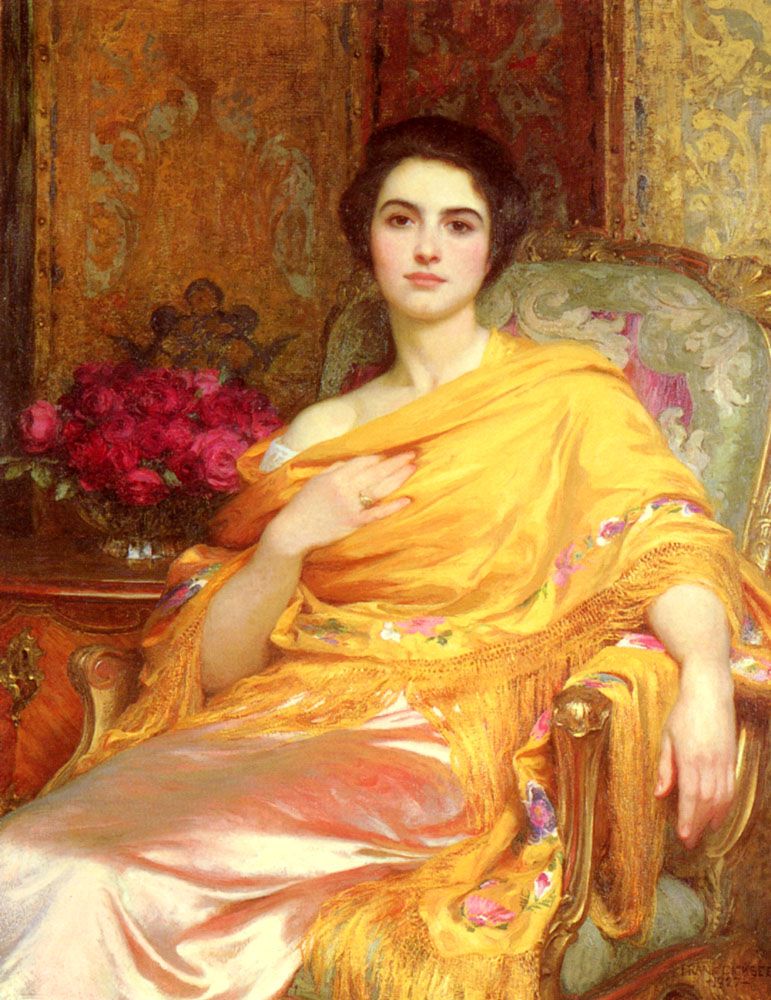
Portrait of Elsa, signed and dated 1927. The gold shawl lies diagonally across the pink skirt. Frank Dicksee, Portrait of Elsa, 1927. Image source. Public domain.
A late portrait
Dicksee’s signed 1921 Portrait of Mrs Norman Holbrook, exhibited at the Royal Academy in 1924, offers a comparison in how he posed and dressed his sitters. Mrs Holbrook stands in a turquoise dress, with a white feather fan held low at one side and a length of fabric looped over her other arm. Each hand helps show off a different part of the outfit. In the smaller, seated portrait of Elsa, Dicksee uses a single sweep of yellow fabric to join her two gestures. In both canvases the dress and accessories help define the figure’s outline. The earlier picture also retains a label naming the sitter and giving Dicksee’s studio address, a kind of evidence that anchors a portrait to the working life of the painter. [1] [5]
The Royal Academy in 1927
The Summer Exhibition catalogue listed the portrait as Elsa, daughter of William Hall, Esq. and gave it number 149. Other entries in Gallery III included William Orpen’s portrait of Miss Penelope Lawrence and Alfred Munnings’s The Old Oak. The catalogue places Elsa’s likeness in a room where visitors encountered named sitters alongside landscape and historical subjects. Dicksee also showed Francis, son of M. Walter A. de Bourg elsewhere in the exhibition, using the same convention of identifying a sitter through a parent. Dicksee’s two Harlech exhibits show how readily he worked across subjects, even while the named portraits reveal something of the social world of the Academy. [2]
Dod Procter’s Morning drew crowds at the same Summer Exhibition. Procter posed her model, Cissie Barnes, on a bed, with daylight falling across her figure. The shape of the turned head, shoulders and bent arms does much of the work in a setting with few objects. Dicksee puts just as much care into the weight of a resting body, but uses a chair, flowers, furniture and rich textiles to give Elsa a social setting. The two paintings offer different ways that artists of the same decade could make a figure feel present. They could be seen in the same exhibition, at a moment when the Academy was making room for distinct approaches to painting the figure. [1] [2] [6]
What the title tells us about Elsa
The title that Academy visitors read in 1927 gives Elsa’s first name and identifies her father. It tells us how the sitter was introduced in public. The later Christie’s photographic caption also describes the pose and the colours, details that help match the record to the canvas. Her full name and the circumstances of the sittings remain uncertain. William Hall’s name alone supplies too little information to trace the family or identify the person who arranged the portrait. [1] [2]
There is a further trace in the London auction records. Artsy indexes a 1927 portrait titled Elsa, daughter of William Hall Esq as lot 79 at Sotheby’s on 19 June 1990. The entry gives a width equivalent to 32 inches, with a height an inch greater than the Christie’s photograph records. The unusual title, artist, date and broadly corresponding dimensions make this a strong lead for the canvas. The difference in height needs the original sale catalogue to resolve, and the public index gives no result for the lot. The Christie’s photograph is the firmer evidence for identifying the image and its reported size, while the earlier ownership and present location remain to be established. [1] [7]
Frank Dicksee artworks directory
Browse documented paintings, studies, illustration designs and prints. Where an article is available, the title opens it. Simon Toll’s catalogue
| Name | Date | Medium |
|---|---|---|
| A Love Story | 1882 | Painting |
| A Reverie | 1895 | Painting |
| An Offering | 1898 | Painting |
| Chivalry | 1885 | Painting |
| Dawn | 1897 | Painting |
| Elijah Confronting Ahab and Jezebel in Naboth’s Vineyard | By 1875 | Painting |
| Harmony | 1877 | Painting |
| Harmony, etching by Charles-Albert Waltner after Dicksee | 1880 | |
| Harmony, the smaller Towneley version | Late 1870s | Painting |
| Hesperia | 1887 | Painting |
| Hesperia, watercolour version | Late 1880s | Painting |
| Italian Coast from La Mortola | 1925 | Painting |
| La Belle Dame sans Merci | c. 1901 | Painting |
| Memories | 1886 | Painting |
| Paolo and Francesca | 1894 | Painting |
| Portrait of Camille Sutton Palmer | 1914 | Painting |
| Portrait of Elsa | 1927 | Painting |
| Portrait of the Duchess of Buckingham and Chandos | 1901 | Painting |
| Romeo and Juliet | 1884 | Painting |
| Romeo and Juliet, monochrome design on joined wood | c. 1880s | Painting |
| Sir Edmund William Gosse, collotype after Dicksee | 1912 | |
| Startled | 1892 | Painting |
| Study for Startled | Early 1890s | Drawing |
| The Confession | 1896 | Painting |
| The Crisis | 1891 | Painting |
| The Daughters of Eve | 1925 | Painting |
| The Embarkation | 1879 | Painting |
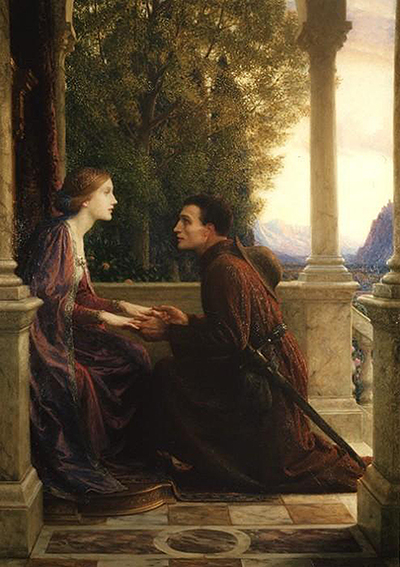
| The End of the Quest | 1921 | Painting |
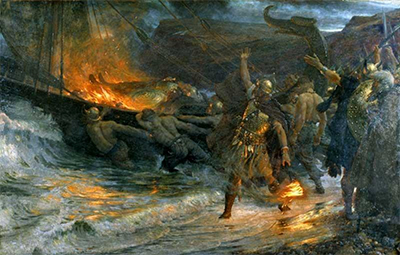
| The Funeral of a Viking | 1893 | Painting |
| The House Builders | 1880 | Painting |
| The Magic Crystal | 1894 | Painting |
| The Passing of Arthur | 1889 | Painting |
| The Redemption of Tannhäuser | 1890 | Painting |
| The Symbol | 1881 | Painting |
| The Two Crowns | 1900 | Painting |
| Yseult | 1901 | Painting |
Discussion
Look again at the images and ideas explored in Portrait of Elsa. These editorial prompts invite your observations.
Reader Insights
Follow the line between Elsa’s hands. Where does the yellow wrap draw your eye first?
Compare the skirt at the lower left with the fringe over the chair arm. Which marks give you the strongest impression of how each fabric falls?
What happens to the balance of the portrait if you cover the roses at the left?
Join the Conversation
Which detail of Elsa’s portrait feels closest to the 1920s to you? Share what you see in the painting.
References
- Christie’s Images via Bridgeman Images, Portrait of Elsa, Daughter of William Hall, photographic record CH656985. View source.
- Royal Academy of Arts, The Exhibition of the Royal Academy of Arts, The One Hundred and Fifty-Ninth (1927), Gallery III, no. 149, and exhibitors’ index, p. 107. View source.
- The Metropolitan Museum of Art, House of Vionnet, Evening shawl (c.1925), 2009.300.3888. View source.
- London Museum, Gwen Pike, Shawl (1927–28), 70.105. View source.
- Christie’s, Portrait of Mrs Norman Holbrook, lot record 5457077. View source.
- Tim Barringer, Royal Academy Summer Exhibition Chronicle, 1927: Dod Procter’s Morning. View source.
- Artsy auction index, Sotheby’s London, Elsa, daughter of William Hall Esq, 19 June 1990, lot 79. View source.