 by Tom Gurney
Tom Gurney BSc (Hons) is an art history expert with over 20 years experience
Published on June 19, 2020 / Updated on November 25, 2026
Email: tomgurney1@gmail.com / Phone: +44 7429 011000
The Funeral of a Viking by Frank Dicksee: Introduction
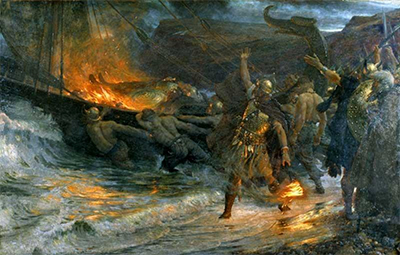
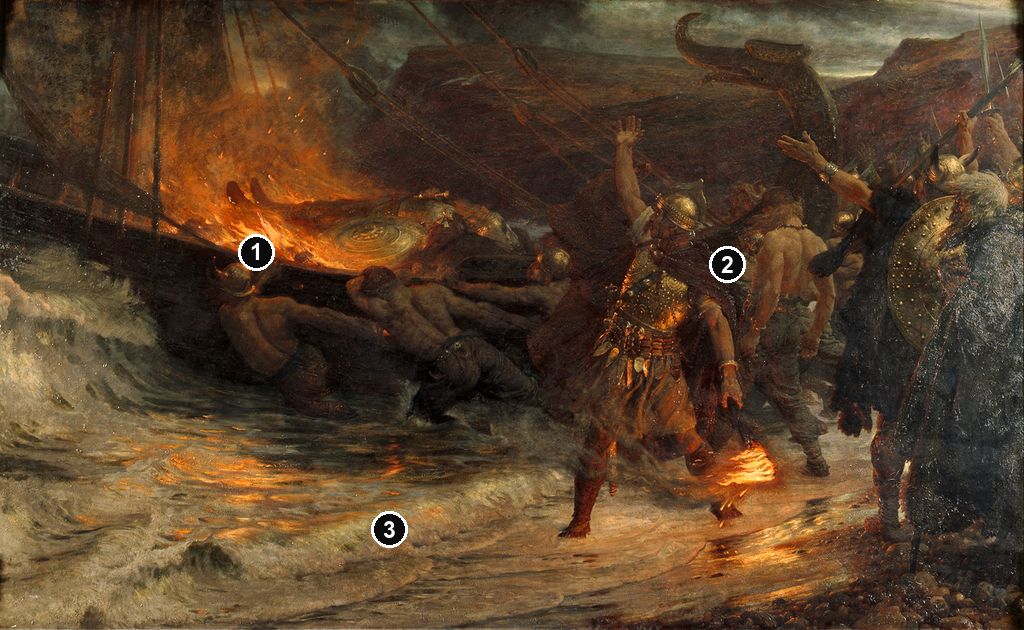
A warrior lies in a burning ship while his companions strain to push it through the surf. On the beach, a man lowers a torch with one hand and lifts the other in farewell. Frank Dicksee painted The Funeral of a Viking in 1893 and showed it that year at the Royal Academy. The canvas, now in Manchester Art Gallery, is just over three metres wide. At that scale the waves, the men and the fire can hold the eye before the face of the dead man comes into view. [1] [2]
The Oseberg ship burial
Compare Dicksee’s burning ship with the evidence of an excavated ship burial.
Vikingtidsmuseet. The museum introduces a ship buried at Oseberg in Norway in 834. Watch on YouTube.
At a Glance
- ArtistFrank Dicksee
- Date1893
- MediumOil on canvas
- Canvas dimensions186.4 × 305.5 cm (height × width). [1]
- CollectionManchester Art Gallery, 1928.13. [1]
- First exhibitionRoyal Academy, London, 1893, catalogue no. 131. [2]
- SubjectAn imagined Norse warrior's funeral at the water's edge. [1] [3]
This work across Frank Dicksee’s career
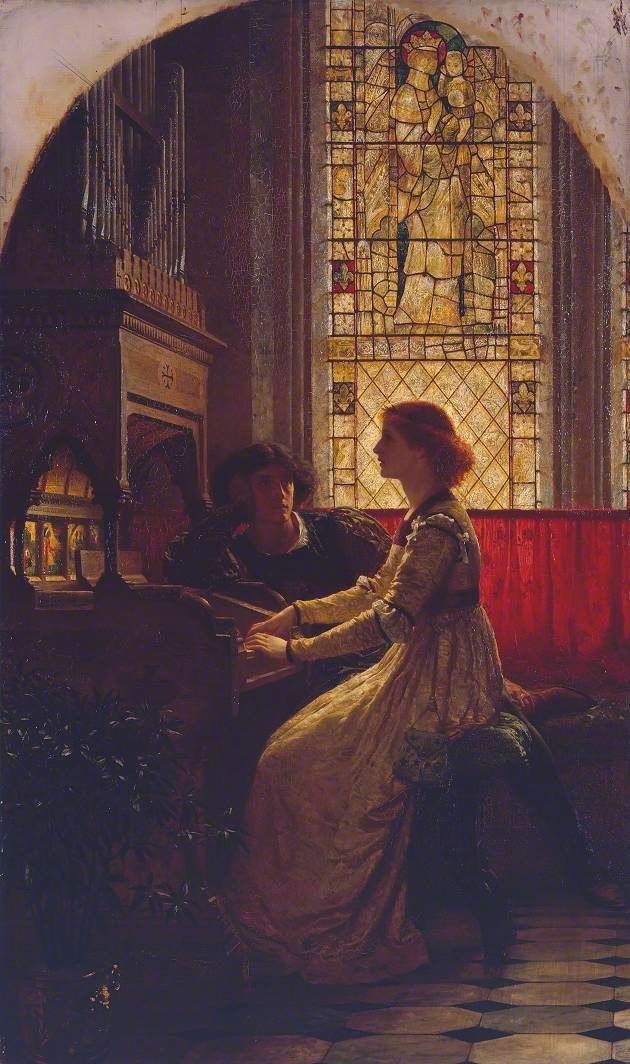
Harmony
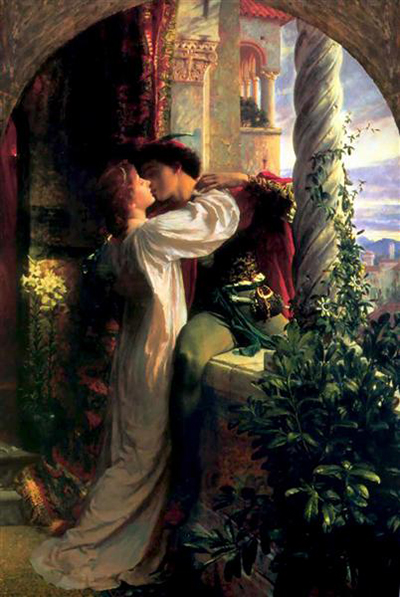
1877Romeo and Juliet
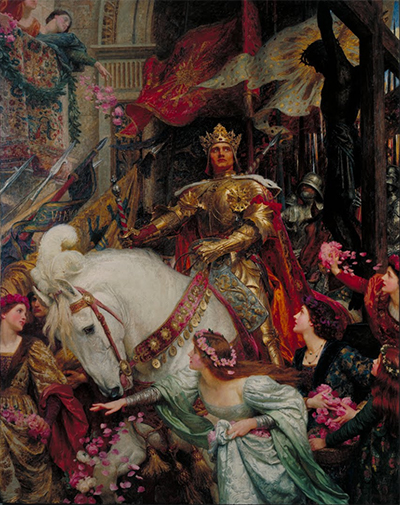
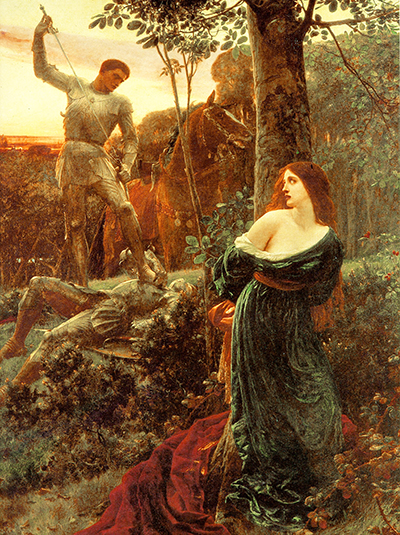
1884Chivalry
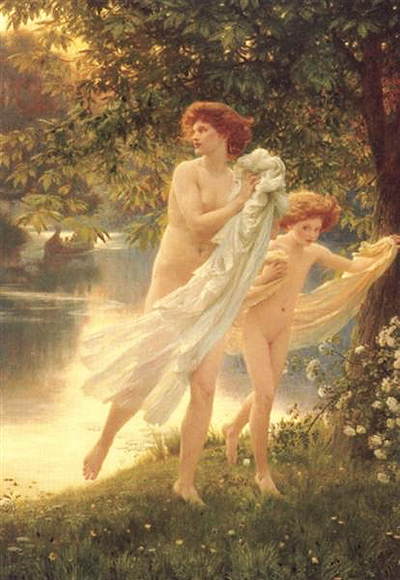
1885Startled
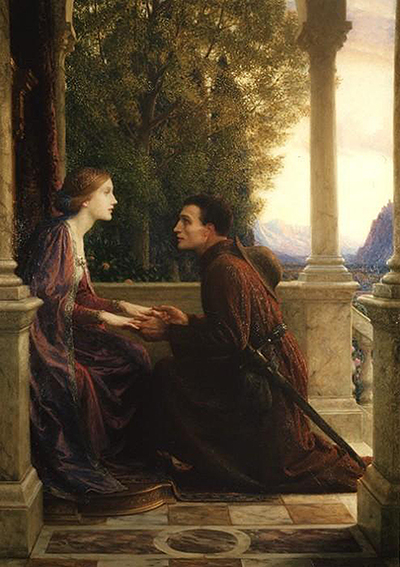
1892The Two Crowns
1900Contents
- Standing at the water's edge
- A rough sea studied at Seaton
- The Academy's place of honour
- Ship burials and the Victorian Norse revival
- What a Victorian audience could see in the flames
- The picture after the exhibition
- Annotated details
Standing at the water's edge
The nearest man in armour is almost at the centre, where the foam reaches his feet. He has turned his face towards the dead warrior. His open right hand stands out against the dark cliff, while the torch in his left burns low enough to light the water below it. The breastplate picks up the same orange in little points and streaks. The low torch and the open hand make the two gestures of the ceremony legible from across a room. Behind him more hands go up among helmets and weapons, some sharply outlined against the sky and others lost in the crowd. [1]
Follow the raised hand across the water and the shape of the ship emerges. At the left the hull almost disappears into shadow. Just below its rim, men with bare backs lean into the wood. A slope of broken water crosses their legs, and a broad wave at the left rises almost high enough to interrupt the view of the hull. Dicksee fixes the scene during those last moments in which the men can still touch the vessel. On the right a high carved ship-end curves over the crowd. Ropes run across the dusky sky and bring the eye back towards the fire. A round shield catches a wide pool of orange on the deck, close to the long, still body. [1]
On the beach at far right, an older man in a dark cloak stands among brighter shields and more conspicuous gestures. His stillness gives the eye somewhere to rest after the effort in the shallows. Across the canvas the waves scatter the fire into broken flecks of colour. In Manchester Art Gallery's reading, the mourners are sending the warrior on his way to Valhalla, the hall of the slain. The image shows the companions only as far as they can see him go. A last strip of pale sky beyond the cliff makes the darkness into which the boat will pass feel nearer. [1] [3]
A rough sea studied at Seaton
Dicksee wanted the view of a person surrounded by foam. Mary Angela Dickens, writing about her visit to his studio in The Windsor Magazine, recorded his attempts to study it at Seaton on the Devon coast. The artist first tried a bathing machine, then set a plank out over the water. The water receded and returned far enough to leave him high and dry at one moment and make him and his easel liable to be washed away at the next. He eventually worked from a boat held as firmly as two men and a rope could manage. The boat still rolled and swayed. “One could only make little studies,” Dicksee told Dickens. [4]
Those studies help explain a particular quality in the picture. The reflected light breaks into narrow streaks on water that is changing shape from one part of the foreground to the next. It catches the thin sheet receding over the shore, then disappears under a curl of foam. The canvas also gives us a stable view of the bodies pushing the hull and of the torches that illuminate them. Dicksee had to put these separate kinds of looking together on a scale very different from that of his sketches. The shore scene could look plausible even where its objects and customs came from the painter's reconstruction. [1] [4]
A studio report in The Artist before the exhibition described studies of the draped figures made from nude models and a special shield made for the painting. Dennis T. Lanigan identifies the model for the torch-bearer as Angelo Colarossi senior. Nancy Rose Marshall traces the identification through Simon Toll and notes that Dicksee's teacher Frederic Leighton used Colarossi for Athlete Wrestling with a Python. The torch-bearer stays upright on uneven ground, one foot well ahead of the other. His stance holds the composition steady across the diagonal made by the men pushing the hull. [1] [5]
Dickens placed the Seaton story alongside other coastal pictures. She contrasted the effect in this scene with Dicksee's Evangeline and printed an illustration of The Passing of Arthur on the same page. Arthur's barge, with its attendants gathered close to the dying king, has a different pace from the Viking ship in the breakers. The artist's earlier Academy diploma picture, Startled, offers an even sharper change of mood. There a longship comes towards bathers and interrupts their privacy. In The Funeral, people gather to send the ship away. [4] [5]
Annotated Details from The Funeral of a Viking in the Manchester collection
The numbered points identify visible features discussed in this article. Return from each detail to the numbered overview. The Funeral of a Viking in the Manchester collection. Image source. Public domain.
Details from THE FUNERAL OF A VIKING IN THE MANCHESTER COLLECTION
Compare the cropped details with the source images above. Notice how their colours, shapes and positions contribute to the larger compositions.
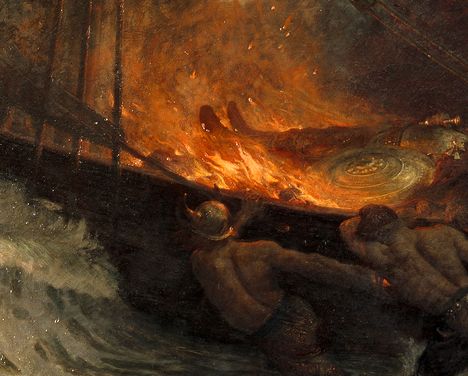
Fire on the boat
Fire rises behind the figures at the side of the vessel. The glow fixes the eye on the boat even where ropes, bodies and shadows overlap.
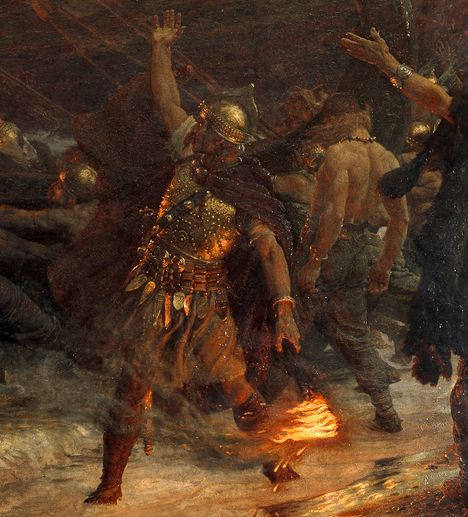
A figure on the wet shore
The central figure braces on the shore and throws up an arm. Reflected light punctuates the dark costume and the churning ground.
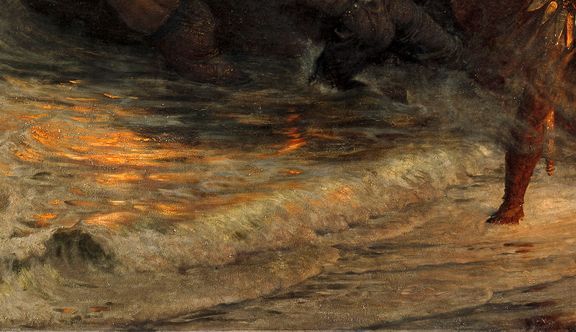
Light reflected through the wash
Long strokes of water and broken orange streaks run through the foreground. The low view puts the viewer close to the breaking wash.
The Academy's place of honour
Marshall identifies George McCulloch, whose fortune came partly from mining in Australia, as the patron who commissioned the work. It was Dicksee's sole Academy exhibit in 1893. M. H. Spielmann reported that it received the place of honour and praised the arrangement and drawing as achievements of Academy training. He also thought its academic finish came close to stagecraft and felt the lighting in the gallery did the dark painting few favours. Dicksee's success in directing the eye was part of what made the picture divisive. [1] [2] [5] [6]
Writing in The Athenaeum, F. G. Stephens admired the handling of torchlight on water and armour while treating the picture as a showpiece. D. S. MacColl in The Spectator thought the painstaking disposition of the scene resembled theatrical staging. A review printed in the German-language Allgemeine Kunst-Chronik took the prominent hang as telling evidence of the Academy's priorities. Its writer admired Dicksee's colour in general and thought the effort of filling this great canvas had cost him his usual judgement. The pre-exhibition report in The Artist had praised the same dark shore and conspicuous flames for making the subject solemn. [1] [7]
In 1897 A. L. Baldry discussed and reproduced the picture in The Art Journal as part of McCulloch's collection. He imagined the farewell as a chant and dwelt on the fitness of the ship for a seafarer's last journey. Sound, which the picture leaves to the imagination, had become part of one viewer's account of it. The work returned to the Royal Academy in the 1909 winter exhibition of McCulloch's collection, lent by Mrs McCulloch. The catalogue put it in Gallery III as The Burial of the Viking, no. 63, and transcribed the artist's signature and the date '93. The description of fire, raised weapons and the torch-bearer identifies the canvas under its variant title. [6] [8]
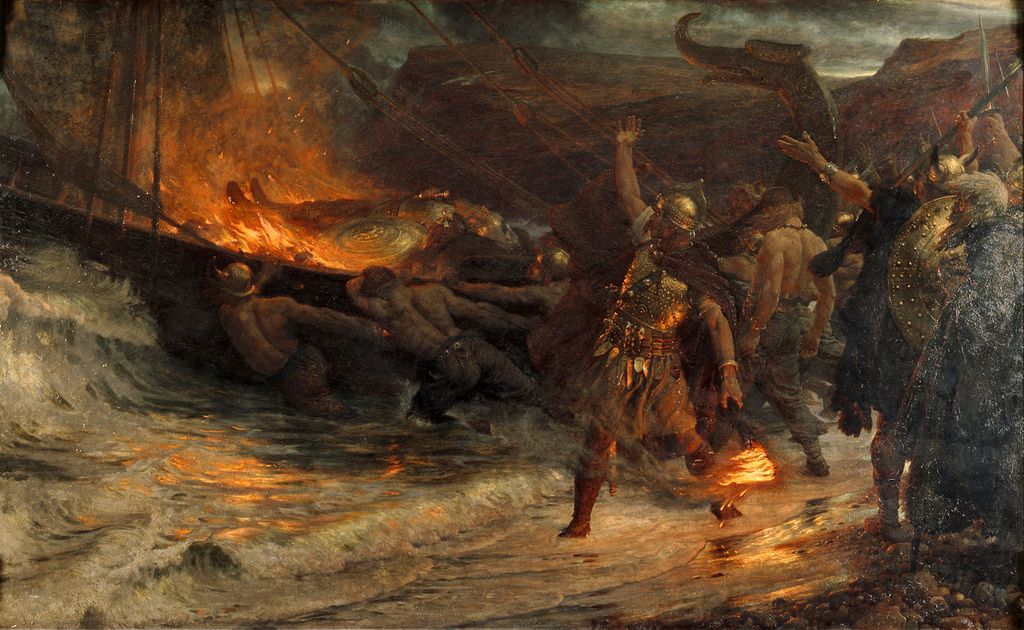
The Funeral of a Viking, Manchester Art Gallery. Image source. Public domain.
Ship burials and the Victorian Norse revival
The Gokstad ship offers a comparison with the real burial of a high-ranking man. It was excavated in Norway in 1880, thirteen years before Dicksee exhibited his canvas. The vessel was hauled ashore for the burial around the year 900. It came out of a mound with grave goods that included shields, carved wooden objects, gaming pieces and three smaller boats. In 1893 a full-size replica of the ship sailed across the Atlantic to the World's Columbian Exposition in Chicago, part of the same nineteenth-century revival of interest in Norse seafaring that made Dicksee's subject timely. The replica presented a working model of an excavated vessel. Dicksee gave a ship the role of carrying a warrior beyond the sight of his mourners. [5] [9] [10]
Some details look more at home in that revival than in the grave. The helmet with horns in Dicksee's crowd belongs to a picturesque vocabulary given currency by nineteenth-century costume design. Marshall points to Carl Emil Döppler's designs for Wagner's 1876 Ring at Bayreuth. The surviving Viking Age helmet from Gjermundbu has a rounded bowl and an eye guard. Oslo's Museum of the Viking Age distinguishes such equipment from ancient images in which horns appear on dancers or divine figures. Dicksee's painting makes armour, fur, skin and metal highly legible in torchlight, and that visual conviction can make details from different traditions seem to belong together. [5] [11]
Literature offers several ways to imagine the rite. Manchester Art Gallery's suggested comparison with Beowulf brings two passages into view. Near the beginning, Scyld Scefing's people send his body out to sea aboard a ship laden with treasures. At the end, Beowulf's people burn his body on a pyre on land. The two rites belong to separate funerals. The myth of Baldr in Snorri Sturluson's Gylfaginning brings fire and ship together more closely in the story of a god's death. The tenth-century traveller Ibn Faḍlān also witnessed the cremation of a Rus chieftain in a ship, but the vessel stayed ashore. Alongside the buried ship at Gokstad, the account shows how differently ships can figure in a funeral. Dicksee leaves the dead man unnamed, and his precise literary source remains uncertain. [1] [9] [12] [13]
What a Victorian audience could see in the flames
One contemporary writer in The Speaker expected the painting to reopen arguments about Britain's Viking origins. Marshall places those arguments beside the period's interest in a model of northern manhood associated with physical strength and self-command. In Brathair, Johnni Langer reads the painting within a Romantic fascination with the supposed freedoms of a warlike past and the nationalist ideals later attached to it. The picture gives those ideas a physical presence through hard armour, strained muscles and a largely unspoken code of honour. The Royal Academy's 2024 interpretation of Startled drew attention to racial ideas that could attach to a longship and idealised figures in Dicksee's period. The symbol carried meanings for nineteenth-century viewers well beyond the design of the vessel. [5] [14] [15]
Marshall also puts the canvas in the history of British cremation debates. The first official cremation at Woking took place in 1885, eight years before the Academy exhibition. In a Lords debate that spring, Earl De La Warr pointed out that burial was regulated and that legislation had yet to provide comparable rules for cremation. The Cremation Act of 1902 later set out a national framework. For Marshall, the canvas opens a line of enquiry into how Victorians thought about fire, the body and the possibility of an afterlife. That context helps explain how a scene set in the distant past can touch a question Victorians faced themselves. The correspondence between painting and debate is Marshall's interpretation. [4] [5] [16] [17]
Marshall draws a formal parallel with the atmospheric dissolution in Turner's Stormy Sea with Blazing Wreck. Her essay also puts Dicksee in conversation with Théodore Géricault's The Raft of the Medusa, where a heaving sea and a group of gesturing men make the fate of the vessel matter intensely. Géricault's men strain for rescue, whereas Dicksee's push a vessel away. The comparison brings out how clearly Dicksee has drawn bodies whose reflections have already begun to break apart. [5] [18]
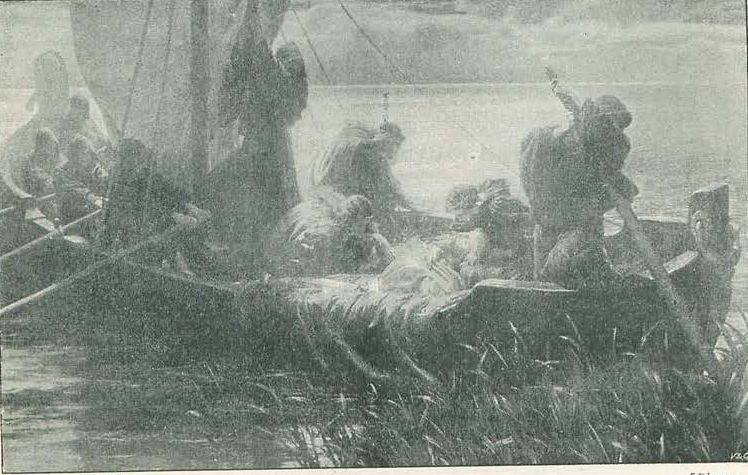
The Passing of Arthur, a separate picture, reproduced from a photograph credited to Dixon. A photograph credited to Dixon after Frank Dicksee, The Passing of Arthur. The Windsor Magazine, vol. 5, p. 390. Image source. Public domain.
The picture after the exhibition
Nearly a century later, the Swedish band Bathory used the painting on the cover of Hammerheart (1990). Mark Deeks reproduces the cover beside the canvas in his study of national imagery in heavy metal. The cover intensifies the orange and red and gives the painting a new frame in the lettering of the band name and title. The glow that divided Academy critics became part of the album's visual identity. [19]
The Viking Society for Northern Research used the painting on the cover of Old Norse Made New in 2007, a volume about the later reception of Old Norse literature and culture. It also appears in the NorseMap research archive as a nineteenth-century representation of a Viking funeral. The covers and the archive make the same image serve three different purposes, from setting the tone of a record to illustrating what later centuries made of the Norse past. [20] [21]
Frank Dicksee artworks directory
Browse documented paintings, studies, illustration designs and prints. Where an article is available, the title opens it. Simon Toll’s catalogue
| Name | Date | Medium |
|---|---|---|
| A Love Story | 1882 | Painting |
| A Reverie | 1895 | Painting |
| An Offering | 1898 | Painting |
| Chivalry | 1885 | Painting |
| Dawn | 1897 | Painting |
| Elijah Confronting Ahab and Jezebel in Naboth’s Vineyard | By 1875 | Painting |
| Harmony | 1877 | Painting |
| Harmony, etching by Charles-Albert Waltner after Dicksee | 1880 | |
| Harmony, the smaller Towneley version | Late 1870s | Painting |
| Hesperia | 1887 | Painting |
| Hesperia, watercolour version | Late 1880s | Painting |
| Italian Coast from La Mortola | 1925 | Painting |
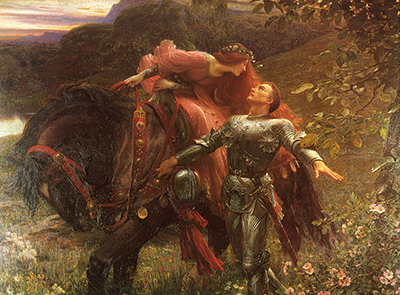
| La Belle Dame sans Merci | c. 1901 | Painting |
| Memories | 1886 | Painting |
| Paolo and Francesca | 1894 | Painting |
| Portrait of Camille Sutton Palmer | 1914 | Painting |
| Portrait of Elsa | 1927 | Painting |
| Portrait of the Duchess of Buckingham and Chandos | 1901 | Painting |
| Romeo and Juliet | 1884 | Painting |
| Romeo and Juliet, monochrome design on joined wood | c. 1880s | Painting |
| Sir Edmund William Gosse, collotype after Dicksee | 1912 | |
| Startled | 1892 | Painting |
| Study for Startled | Early 1890s | Drawing |
| The Confession | 1896 | Painting |
| The Crisis | 1891 | Painting |
| The Daughters of Eve | 1925 | Painting |
| The Embarkation | 1879 | Painting |
| The End of the Quest | 1921 | Painting |
| The Funeral of a Viking | 1893 | Painting |
| The House Builders | 1880 | Painting |
| The Magic Crystal | 1894 | Painting |
| The Passing of Arthur | 1889 | Painting |
| The Redemption of Tannhäuser | 1890 | Painting |
| The Symbol | 1881 | Painting |
| The Two Crowns | 1900 | Painting |
| Yseult | 1901 | Painting |
Discussion
Look again at the images and ideas explored in The Funeral of a Viking by Frank Dicksee. These editorial prompts invite your observations.
Reader Insights
Does the torch-bearer's raised hand or the older man's stillness convey the stronger feeling of leave-taking?
What changes if you follow the reflection of the fire across the water before looking at the ship itself?
Which detail comes closest to the theatrical effect Dicksee's critics described, and what does it contribute to the scene?
Join the Conversation
Tell us which figure or detail you would linger over if you were standing in front of Dicksee's canvas.
References
- Dennis T. Lanigan, “The Funeral of a Viking by Sir Frank Dicksee”, The Victorian Web, Manchester accession caption, object discussion and transcribed contemporary reviews. View source.
- Algernon Graves, The Royal Academy of Arts: A Complete Dictionary of Contributors and Their Work, vol. 2, Dicksee's 1893 entry, exhibition no. 131. View source.
- Manchester Art Gallery, Stepping Inside, education pack, interpretation of The Funeral of a Viking. View source.
- Mary Angela Dickens, “A Popular Painter: Mr. Frank Dicksee, R.A.”, The Windsor Magazine, vol. 5 (1896–97), pp. 385–391, especially p. 390. View source.
- Nancy Rose Marshall, “Victorian Imag(in)ing of the Pagan Pyre: Frank Dicksee's Funeral of a Viking”, 19: Interdisciplinary Studies in the Long Nineteenth Century, no. 25 (2017), DOI 10.16995/ntn.795. View source.
- Royal Academy of Arts, Exhibition of Modern Works in Painting and Sculpture Forming the Collection of the Late George McCulloch, 1909, p. 17, no. 63, and p. 25, McCulloch's career and collection. View source.
- Allgemeine Kunst-Chronik, vol. 17, no. 15 (1893), p. 350, German-language Royal Academy exhibition criticism. View source.
- A. L. Baldry, “The Collection of George McCulloch, Esq.”, The Art Journal, November 1897, pp. 325–329, especially p. 326. View source.
- Museum of the Viking Age, University of Oslo, “The Gokstad Ship: Fast, Sturdy and Built for the Open Sea”, discovery and burial sections. View source.
- Oslofjord Museum, “Vikings from the North”, account of the Gokstad replica and the 1893 World's Columbian Exposition. View source.
- Museum of the Viking Age, University of Oslo, “The Gjermundbu Helmet”, find context and discussion of horned figures. View source.
- University of Toronto Libraries, Beowulf, prologue, lines 26–52, and funeral, lines 3137–3142, Old English text and Francis B. Gummere's translation. View source.
- Olivia Elliott Smith, Museological Approaches to Pre-Christian Funerals and the Representation of the Past in Old Norse Literature, University of Oxford thesis (2023), pp. 84–85 and 99–100, discussions of Baldr and Ibn Faḍlān. View source.
- Johnni Langer, “Erfi: As Práticas Funerárias na Escandinávia Viking e Suas Representações”, Brathair 5, no. 1 (2005), pp. 114–127, especially pp. 118–121. View source.
- Royal Academy of Arts, Entangled Pasts, 1768–now: Art, Colonialism and Change, 2024 exhibition guide, entry for Startled. View source.
- UK Parliament, Lords Chamber, Hansard, 5 May 1885, Earl De La Warr on cremation and the Woking case. View source.
- UK Parliament, Cremation Act 1902, 2 Edw. 7 c. 8, as enacted. View source.
- Musée du Louvre, Le radeau de la Méduse, Théodore Géricault, INV 4884. View source.
- Mark Deeks, National Identity in Northern and Eastern European Heavy Metal, University of Leeds doctoral thesis (2016), pp. 80–81, fig. 3.19. View source.
- David Clark and Carl Phelpstead, eds, Old Norse Made New: Essays on the Post-Medieval Reception of Old Norse Literature and Culture, Viking Society for Northern Research (2007), front matter and cover credit. View source.
- NorseMap, Frank Dicksee, The Funeral of a Viking, Manchester Art Gallery, item 3909, NM-01207. View source.