


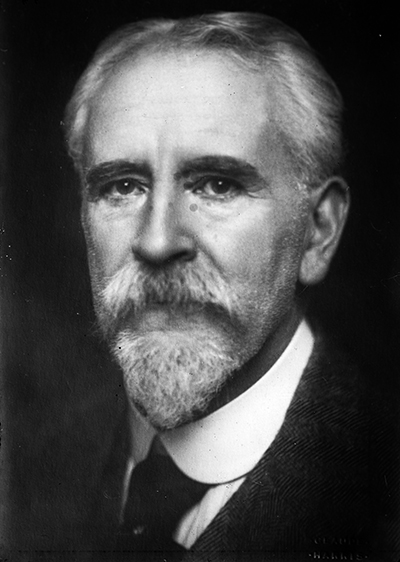
 by Tom Gurney
Tom Gurney BSc (Hons) is an art history expert with over 20 years experience
Published on June 19, 2020 / Updated on November 25, 2026
Email: tomgurney1@gmail.com / Phone: +44 7429 011000
Frank Dicksee: Introduction
A young woman plays an organ in Frank Dicksee’s Harmony. The man beside her leans towards her, his attention fixed on her face. Behind them, the tall stained-glass window gives the room the air of a medieval chapel. The painting made Dicksee’s reputation at the Royal Academy in 1877, when he was still in his twenties. It also shows a skill he would use across a much longer career. He could make an audience wonder what passed between two people simply by showing where each was looking. [1] [2] [3]
Sir Francis Bernard Dicksee (1853–1928) used that skill to paint lovers at a window, a man waiting at a sickbed and patrons contemplating the design of their new house. He also made illustrations for books and magazines. Some readers met his work on the printed page, while others knew the exhibition oils or the prints made after them. By the time he became president of the Royal Academy in 1924, the correspondent who reported his election to New Zealand readers introduced him as an eminent portrait painter. [1] [4] [5] [6] [7] [8]
Frank Dicksee’s paintings on film
See how Dicksee moves between medieval stories and intimate encounters.
TheHistoryOfArt. An illustrated overview of Dicksee’s work. Watch on YouTube.
At a Glance
- ArtistSir Francis Bernard (‘Frank’) Dicksee, British, 1853–1928. [1] [5]
- Best known forHarmony, Romeo and Juliet, The Funeral of a Viking and The Two Crowns. [1] [2] [9] [10] [11]
- Also worked inBook and magazine illustration, preparatory drawing and portraiture. [1] [4] [5]
- Royal AcademySchools gold medal in 1875, Associate in 1881, full Academician in 1891 and president from 1924 to 1928. [5]
Frank Dicksee’s artistic connections
See who taught Dicksee and how acquaintances brought his work to new audiences.
- Thomas Francis Dicksee: Dicksee’s earliest studio memories were of his father’s painting room. [15]
- Henry Holiday: Dicksee worked with Holiday on designs that included stained-glass cartoons. [15]
- Charles-Albert Waltner: Waltner carried the composition of Harmony into a print published by Thomas Agnew & Sons. [3]
- Hubert von Herkomer: Herkomer helped bring The Crisis to the National Gallery of Victoria. [16]
Frank Dicksee in context
Victorian Britain
1837–1901Pre-Raphaelite Brotherhood
1848–1853Edwardian Britain
1901–1910John Everett Millais
1829–1896Frederic Leighton
1830–1896Henry Holiday
1839–1927John William Waterhouse
1849–1917Harmony
1877Romeo and Juliet
1884Chivalry
1885Startled
1892The Two Crowns
1900Contents
- Harmony and the appeal of the imagined past
- From a Shakespeare illustration to an exhibition canvas
- A modern drama and portraits of real people
- How the pictures travelled
- The Academy and Dicksee’s reputation
Harmony and the appeal of the imagined past
The most telling detail in Harmony may be the organ keyboard. The musician’s hands have something precise to do, and the man can lean close without interrupting her work. Dicksee sets that fragile arrangement against a profusion of designed surfaces. The instrument bears painted decoration, and the upright of the organ enclosure leads the eye towards the tall window. The Metropolitan Museum of Art identifies a historical source for the glass at St Mary the Virgin in Westwell, Kent. Dicksee used a studied detail to give an invented encounter the weight of something that could have happened. [2] [3]
The original Brotherhood had formed in 1848, five years before Dicksee was born. His affinity lay with later Pre-Raphaelite painting, particularly its use of medieval subjects, rich colour and closely observed design. His training and success, meanwhile, ran through the Academy. At the 1877 exhibition, Harmony drew enough interest to establish his name while his career was still getting under way. It was bought through the Chantrey Bequest and joined the national collection. The old Tate illustrated catalogue lists it alongside a second Chantrey purchase from the artist, The Two Crowns. [1] [2] [3] [5] [12]
Twenty-three years separate the two pictures. The Two Crowns brings the apparatus of a medieval spectacle out into the street. A ruler rides through a crowded procession and turns towards a crucifix. The onlookers have assembled to look at the king, but the king has caught sight of something that seems to outweigh everything assembled in his honour. Tate identifies the crowns as the king’s gold regalia and Christ’s crown of thorns. The visual comparison makes an argument about power even for a viewer who has yet to read the title. The work was purchased from the 1900 Academy exhibition for £2,000. [2] [9]
Dicksee could use an armoured figure for a very different purpose. In Bristol’s La Belle Dame sans Merci, painted around 1901, a knight throws out his arms as the woman in the saddle bends down towards him. His armour catches the light while his open pose makes him look defenceless. Keats’s ballad gives the encounter a troubling aftermath. Dicksee concentrates on the earlier attraction, when danger and desire can register in the same gesture. The richly worked meadow and the scale of the horse would reward a close look, but the invitation and the uncertainty are evident across the room. [13]
Four stages of Frank Dicksee’s career
Training, exhibiting, portrait commissions and illustration overlapped during Dicksee’s career.
Learning in the studio and at the Academy
Dicksee began in his father’s studio, trained at the Royal Academy Schools and prepared designs for stained glass. [15]
From Harmony to the literary pictures
Harmony brought national attention. The expanding practice encompassed illustration, portraits and subject painting. [1]
From a Shakespeare illustration to an exhibition canvas
Dicksee had more than one answer to the question of how to picture Shakespeare’s lovers. The Dahesh Museum of Art holds an object that at first looks like a little monochrome painting. Dicksee painted it on joined pieces of wood, with his initials reversed, in preparation for a print. It depicts the lovers in Act II, in the nighttime scene where they declare their love. A steel engraving of the design appeared in Cassell’s Royal Shakespeare. Its intended place in a book explains features that would seem strange in an exhibition oil, especially the reversal and the restriction to tones that an engraver could carry into black and white. [4]
Southampton’s 1884 Romeo and Juliet belongs to another moment in the play. In Act III, day is breaking and Romeo has to leave Juliet’s room. The separate Cassell edition of the play places the design for that farewell at the front of the book. Readers thus saw the parting before they reached the lines that explain it. In the much larger painting, pale morning light and the ledge under Romeo give the embrace a physical deadline. He has somewhere to go, and the gap beneath him makes the next movement easy to imagine. [10] [14]
A published illustration can rely on the surrounding text to tell the reader who spoke and what happened next. An exhibition painting has to work at the pace of someone walking past it. These two versions show the choices Dicksee made in response to those conditions. The book’s caption tells us which farewell we are seeing. In the canvas, Juliet’s lean and Romeo’s precarious foothold can tell a visitor a good deal before the identity of either figure comes to mind. [4] [10] [14]
A modern drama and portraits of real people
The National Portrait Gallery groups Dicksee’s historical subjects with a second strand of his painting, contemporary melodrama. The Crisis, a large oil from 1891, takes place beside a curtained bed. An ill woman lies with her arms spread against the covers. Beside her, a man bends forward with a hand against his face. Everything that gives the scene urgency comes from the arrangement of familiar things. The curtains narrow the space around the sick woman, and the broad plane of the bedding makes the space between the two figures especially conspicuous. The watcher has a clear view of her face and no visible way of changing what happens next. [1] [6] [15]
At the Academy that year, The Crisis found a buyer on the other side of the world. Sir Hubert von Herkomer bought it directly from the exhibition for the National Gallery of Victoria in Melbourne. The same museum records Herkomer’s purchase in 1891 of John William Waterhouse’s Ulysses and the Sirens. The pairing gives a sense of the alternatives open to buyers at an Academy exhibition. A modern sickroom and a violent episode from Homer both offered drama on a scale suited to a public collection. [6] [16]
The boundaries between portraiture and subject painting were equally permeable. The House Builders (1880) portrays Sir William and Lady Welby-Gregory, with a model of Denton Manor and an architect’s drawing. The couple are named in Dicksee’s inscription on the reverse. The sheet visible in the painting bears the initials and date of Arthur Blomfield, who designed the house in a domestic Gothic style. The detail makes it possible to read the work both as a double portrait and as a record of the patrons’ architectural project. Where Harmony gathers two people around an organ, this commission brings its pair together over something they are preparing to build. [7]
The later portrait of Camille Sutton Palmer, shown at the Royal Academy in 1914, is a small oil on panel. It remained with the sitter and passed through her family. The panel’s scale brings the viewer into a different relationship with a Dicksee picture. The single figure holds the viewer’s attention. Commissions had been part of his work since the early years, and portraiture gained more emphasis in the later career. By December 1924 it supplied the shorthand by which an overseas correspondent could present a new Academy president. [7] [17] [8]
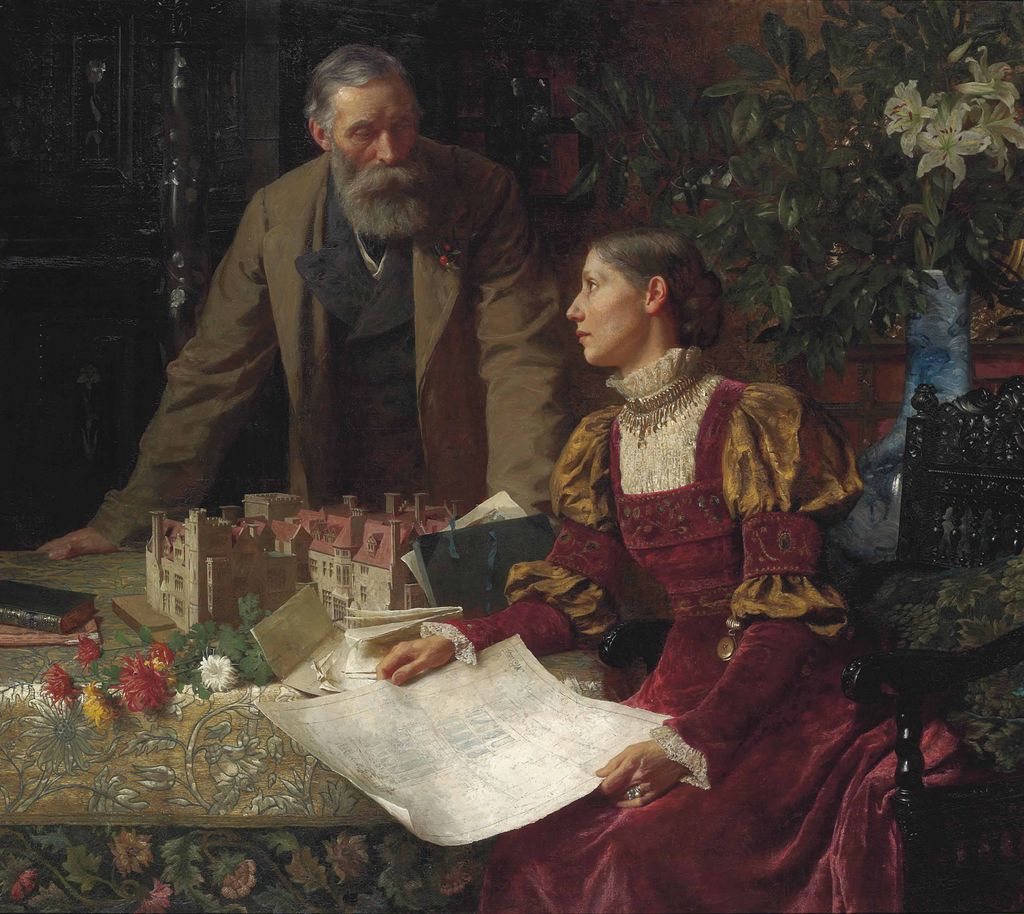
The House Builders, 1880. Dicksee brings an architectural commission into a double portrait. Image source. Public domain.
How the pictures travelled
Dicksee’s work also reached audiences who could never see a particular canvas. The Met’s proof of Harmony, dated 1880, names Charles-Albert Waltner as etcher and Thomas Agnew & Sons as publisher. ‘After Dicksee’ credits the design. Waltner translated the composition into lines and greys for a print that could circulate in multiple impressions. The painting’s atmosphere could survive that change of medium through the placement of light, the shape of the organ and the inclination of the man’s head. [3]
Portraits could reach viewers through reproduction too. The National Portrait Gallery holds three impressions of an image of the writer Edmund Gosse made by the Autotype Company after Dicksee. These are collotypes, printed by a photographic process, and one came to the gallery from Grillion’s Club in 1915. In this case the print helped carry the likeness of a known individual, into a collection. The object record preserves the roles of sitter, painter and printmaker. [18]
Magazines provided another route. Mary Angela Dickens’s illustrated studio profile for The Windsor Magazine reproduced The Crisis in monochrome. Its British readers could therefore see a version of a picture already in the Australian collection. In the same article she described Dicksee’s efforts to study waves at Seaton for The Funeral of a Viking. According to Dickens, he tried setting up in a boat held in position with a rope, but even there the swell kept the boat pitching. That detail helps explain the low, exposed position from which the painting’s viewer watches the burning vessel leave the shore. [6] [15] [11]
The painting also travelled between contexts. Nancy Rose Marshall has studied the way Victorian audiences could see the fire in The Funeral of a Viking through their own era’s debates about cremation. The picture gave a nineteenth-century public a dramatic image of a funeral outside Christian burial traditions. The burning ship and the figures on shore can be read as Dicksee’s construction of a ritual and as evidence of Victorian interest in the medieval past. Marshall also points out that a replica of the excavated Gokstad ship was crossing the Atlantic while the 1893 exhibition was on. The painted ship belonged to a moment when archaeological discovery as well as fiction was furnishing Victorians with images of a Viking past. [11]
The Academy and Dicksee’s reputation
The Academy gave Dicksee access to professional training, a public exhibition and elected office. His father, the painter Thomas Francis Dicksee, taught him before he went to the Royal Academy Schools. The Academy register records him as a student from January 1871, a gold medallist in 1875, an Associate in 1881 and a full member in 1891. [5] [10] [17] When he succeeded the architect Sir Aston Webb in 1924, the London correspondent writing for the Otago Daily Times treated the result as a surprise to those who had expected a younger member. The interview that followed presented the new president as sceptical of much recent painting and confident in the public’s appreciation of older standards. It appeared in January 1925, a month after the London dispatch and after the election itself. [5] [8]
The Academy has since revisited the values embodied in works it once accepted as evidence of professional distinction. In its 2024 exhibition Entangled Pasts, it showed Dicksee’s diploma painting Startled. The image presents two pale classical figures recoiling at the approach of a ship. The exhibition guide interpreted the conjunction of those bodies and the Viking vessel in the light of nineteenth-century racial ideals within academic art. The reading puts the conventions of the figure study back into their historical setting and asks what the institution once treated as an ideal body. [5] [19]
Looking across Dicksee’s work brings such conventions into view. We can recognise the knight’s surrender in La Belle Dame sans Merci and the watcher’s anxiety in The Crisis through their posture alone. The courtly gown, the decorated instrument, the sickbed curtains and the architect’s drawing all help define what a person can do in a particular space. Those choices repay attention whether the picture comes down to us as a gallery canvas, a book plate or an etcher’s proof. [2] [3] [6] [13] [14] [7]
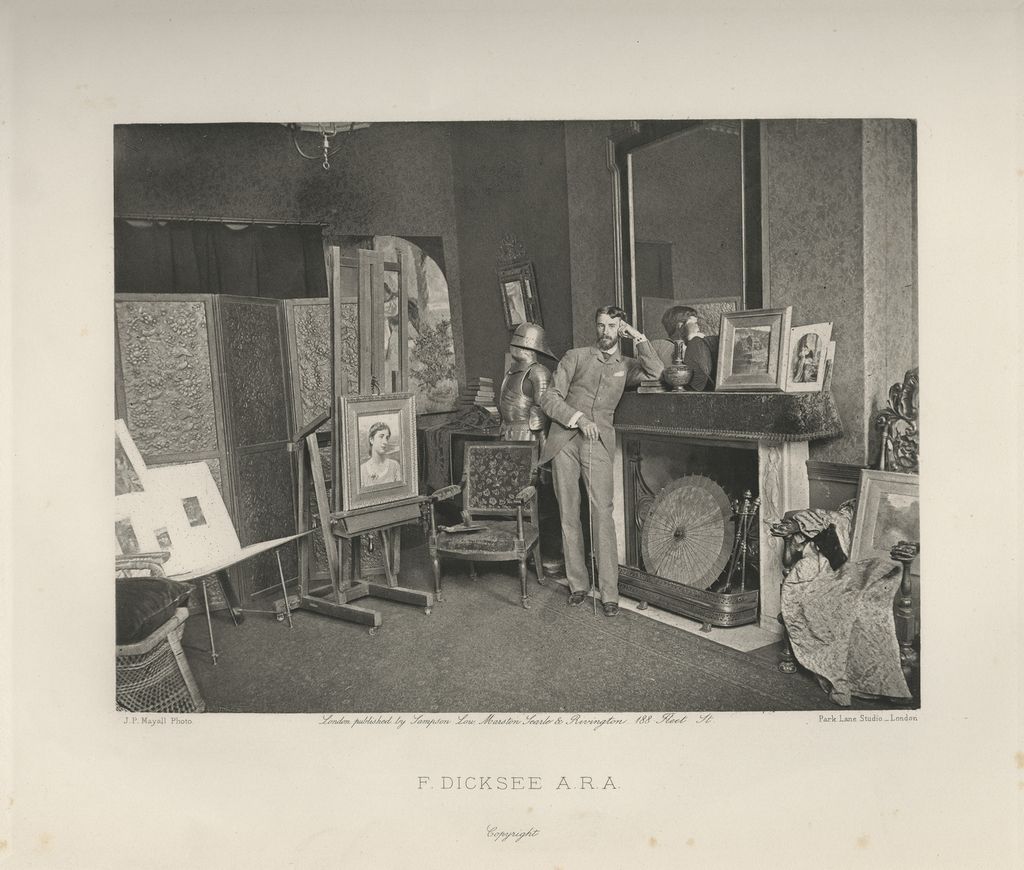
Frank Dicksee in his studio, photographed by Joseph Parkin Mayall. Image source. Public domain.
Essential Frank Dicksee works
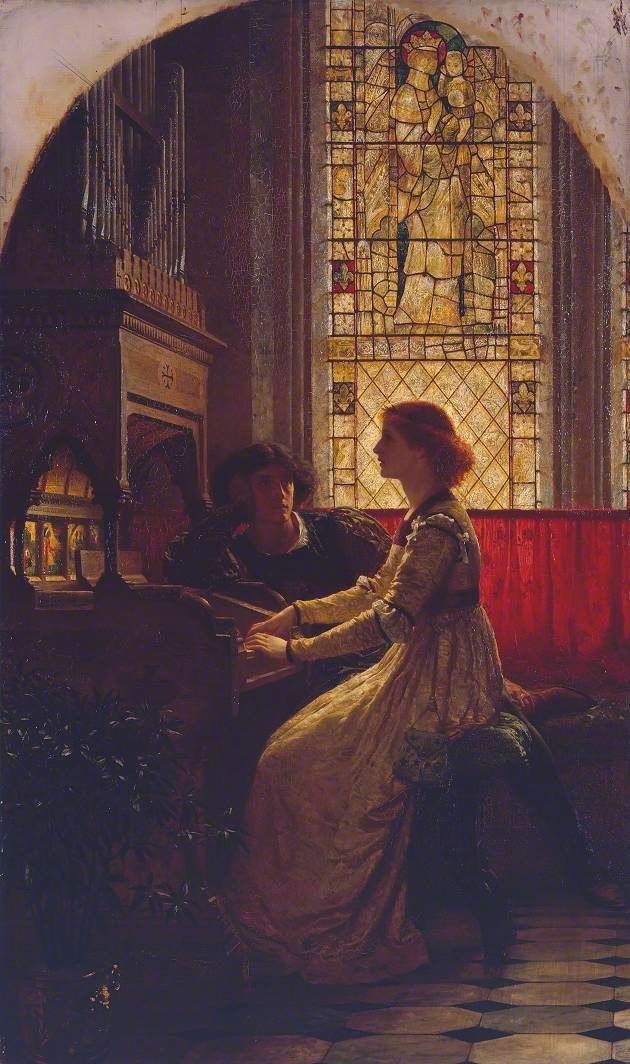
Harmony
1877 · Music, patterned glass and an intent listener brought Dicksee early public attention.
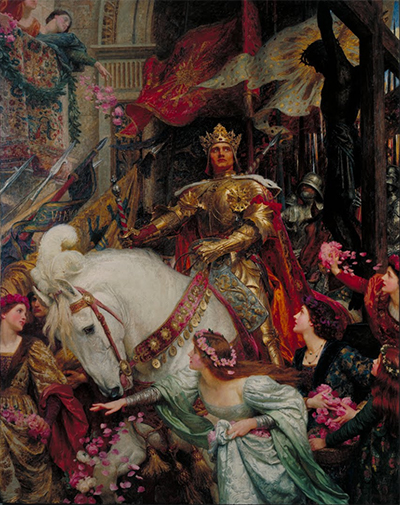
The Two Crowns
1900 · A mounted ruler looks away from his procession and towards the cross.
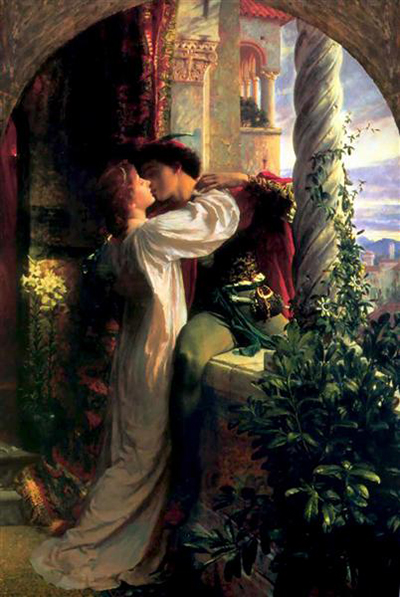
Romeo and Juliet
1884 · The brightening sky gives a farewell its deadline.
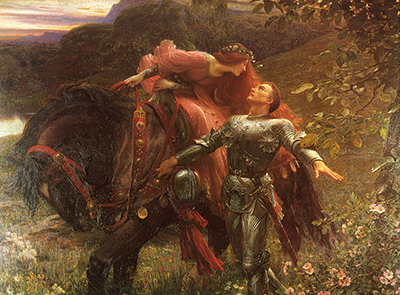
La Belle Dame sans Merci
c. 1901 · Dicksee concentrates Keats’s ballad into a meeting between a rider and a knight.
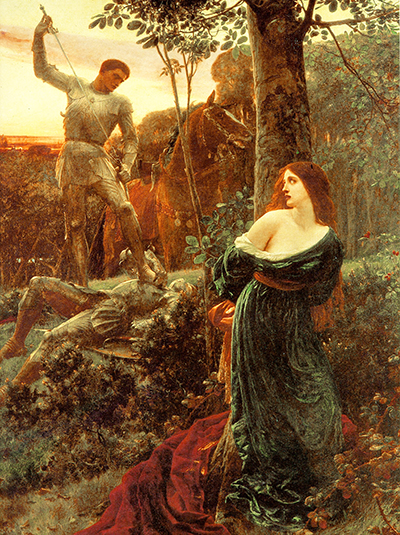
Chivalry
1885 · An armoured rescuer, a fallen opponent and a bound woman evoke a Victorian ideal of knighthood.
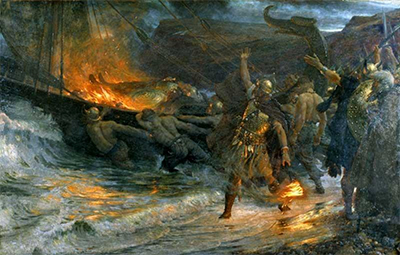
The Funeral of a Viking
1893 · Fire, water and figures on the shore create a Victorian vision of an imagined past.
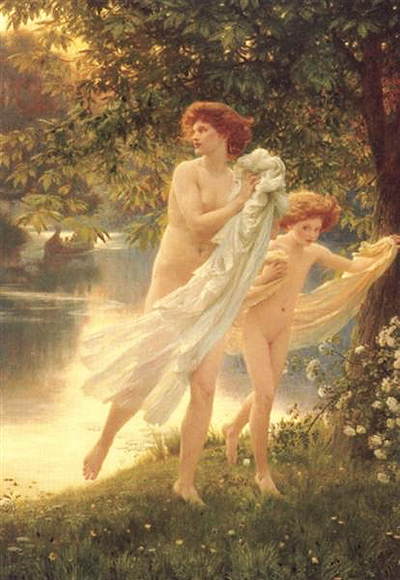
Startled
1892 · An unexpected arrival interrupts a moment by the water in Dicksee’s Academy diploma work.
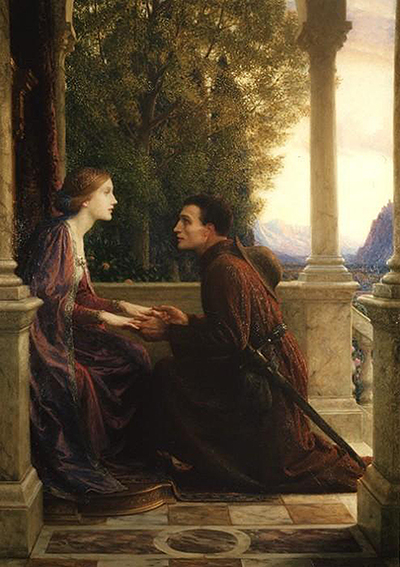
The End of the Quest
1921 · A late courtly scene slows the story to a meeting between two people.
Frank Dicksee artworks directory
Browse documented paintings, studies, illustration designs and prints. Where an article is available, the title opens it. Simon Toll’s catalogue
| Name | Date | Medium |
|---|---|---|
| A Love Story | 1882 | Painting |
| A Reverie | 1895 | Painting |
| An Offering | 1898 | Painting |
| Chivalry | 1885 | Painting |
| Dawn | 1897 | Painting |
| Elijah Confronting Ahab and Jezebel in Naboth’s Vineyard | By 1875 | Painting |
| Harmony | 1877 | Painting |
| Harmony, etching by Charles-Albert Waltner after Dicksee | 1880 | |
| Harmony, the smaller Towneley version | Late 1870s | Painting |
| Hesperia | 1887 | Painting |
| Hesperia, watercolour version | Late 1880s | Painting |
| Italian Coast from La Mortola | 1925 | Painting |
| La Belle Dame sans Merci | c. 1901 | Painting |
| Memories | 1886 | Painting |
| Paolo and Francesca | 1894 | Painting |
| Portrait of Camille Sutton Palmer | 1914 | Painting |
| Portrait of Elsa | 1927 | Painting |
| Portrait of the Duchess of Buckingham and Chandos | 1901 | Painting |
| Romeo and Juliet | 1884 | Painting |
| Romeo and Juliet, monochrome design on joined wood | c. 1880s | Painting |
| Sir Edmund William Gosse, collotype after Dicksee | 1912 | |
| Startled | 1892 | Painting |
| Study for Startled | Early 1890s | Drawing |
| The Confession | 1896 | Painting |
| The Crisis | 1891 | Painting |
| The Daughters of Eve | 1925 | Painting |
| The Embarkation | 1879 | Painting |
| The End of the Quest | 1921 | Painting |
| The Funeral of a Viking | 1893 | Painting |
| The House Builders | 1880 | Painting |
| The Magic Crystal | 1894 | Painting |
| The Passing of Arthur | 1889 | Painting |
| The Redemption of Tannhäuser | 1890 | Painting |
| The Symbol | 1881 | Painting |
| The Two Crowns | 1900 | Painting |
| Yseult | 1901 | Painting |
Discussion
Look again at the images and ideas explored in Frank Dicksee. These editorial prompts invite your observations.
Reader Insights
Where does Dicksee leave the outcome most open to your imagination, in The Crisis, Romeo and Juliet or La Belle Dame sans Merci?
Which details in Harmony do you think could carry its mood into an etching?
How does armour change the way you read the knight in La Belle Dame sans Merci and the ruler in The Two Crowns?
Join the Conversation
Choose a Dicksee painting or illustration and tell us which detail held your attention first. Did your reading change when you learned where the work was originally shown or published?
References
- National Portrait Gallery, Frank Dicksee, artist profile and portrait records. View source.
- National Gallery of British Art (Tate Gallery), illustrated catalogue, Harmony, no. 1587, illustrated on p. 23, and Dicksee entries on p. 27. View source.
- Metropolitan Museum of Art, Harmony, Charles-Albert Waltner after Frank Dicksee, etching proof, 1880, 46.140.7. View source.
- Dahesh Museum of Art, Romeo and Juliet, oil on joined wood, c. 1880s, 1999.18. View source.
- Royal Academy of Arts, Sir Frank Dicksee PRA, member and collection register. View source.
- National Gallery of Victoria, The crisis, 1891, p.396.2-1, object record and provenance. View source.
- Christie’s, The House Builders, signed and dated 1880, lot 5631467, inscription, provenance and lot essay. View source.
- Otago Daily Times, ‘The Royal Academy’, 27 January 1925, p. 4, London dispatch dated 16 December. View source.
- Tate Britain, The Two Crowns, 1900, collection record via Google Arts & Culture. View source.
- Southampton City Art Gallery, Romeo and Juliet, 1884, SOTAG 1006. View source.
- Nancy Rose Marshall, ‘Victorian Imag(in)ing of the Pagan Pyre: Frank Dicksee’s Funeral of a Viking’, 19: Interdisciplinary Studies in the Long Nineteenth Century, no. 25 (2017), including fig. 8. View source.
- Tate Publishing, Jason Rosenfeld, Pre-Raphaelites, book description and historical introduction. View source.
- Bristol Museums, La Belle Dame sans Merci, 1901, collection close reading via Google Arts & Culture. View source.
- William Shakespeare, Romeo and Juliet, with illustrations by Frank Dicksee, Cassell & Company, frontispiece, list of illustrations and Act III, Scene V. View source.
- Mary Angela Dickens, ‘A Popular Painter: Mr. Frank Dicksee, R.A.’, The Windsor Magazine, vol. V, pp. 385–391. View source.
- National Gallery of Victoria, collection timeline for Sir Hubert von Herkomer’s 1891 acquisitions. View source.
- Christie’s, Portrait of Camille Sutton Palmer, lot 1938856, provenance, Royal Academy exhibition record and lot essay. View source.
- National Portrait Gallery, Sir Edmund William Gosse, collotype by the Autotype Company after Dicksee, 1912, D20806 and related impressions. View source.
- Royal Academy of Arts, Entangled Pasts, 1768–now, 2024 exhibition guide, entry for Startled. View source.