 by Tom Gurney
Tom Gurney BSc (Hons) is an art history expert with over 20 years experience
Published on June 19, 2020 / Updated on November 25, 2026
Email: tomgurney1@gmail.com / Phone: +44 7429 011000
Frank Dicksee Drawings: Introduction
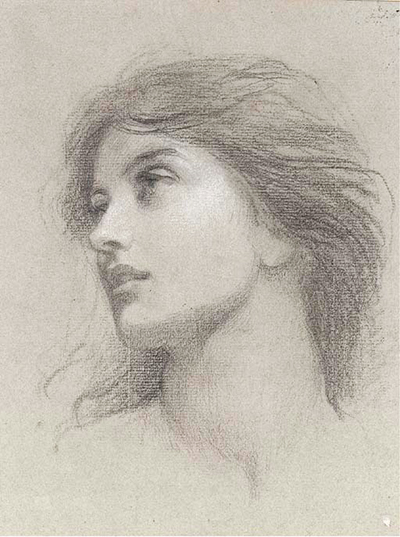
A woman's face in pencil and white chalk is the part of Chivalry that Frank Dicksee chose to work out on one small sheet. A separate study takes in the whole scene, using watercolour and opaque paint over pencil. The pair gives an unusually clear view of the decisions behind his elaborate exhibition paintings, from the turn of a face to the arrangement of a scene of rescue and combat. He also used drawing to record what he saw on his travels and to plan illustrations for books. [1] [2]
At a Glance
- TrainingDicksee learnt first from his father, Thomas Francis Dicksee, then studied at the Royal Academy Schools.
- Study for the head of the damsel in ChivalryPencil and white chalk on grey paper, 24.8 × 19.1 cm.
- Study for StartledPencil and white chalk on green wove paper, Royal Academy of Arts, 09/2072.
- Design for Romeo and JulietIndia ink and Chinese white, 1880–84, Victoria and Albert Museum, E.351-1933.
- SketchbookPencil and some gouache, Royal Academy of Arts, 06/3640, with travel drawings that include Italy.
Contents
- From an imagined scene to a pose
- Two ways of studying a figure
- Designing a scene and studying its details
- Drawing for a picture or for a printed page
- Returning to a subject on paper
From an imagined scene to a pose
Dicksee first studied with his father, the painter Thomas Francis Dicksee, before joining the Royal Academy Schools in 1871. Cassell's contemporary account records a silver medal in 1872 for a drawing from the antique. Working from an example of classical sculpture calls for close attention to proportion and to the way light distinguishes one plane of the body from another. Years later, Dicksee was still solving such problems on paper, even when the figures themselves sprang from a play or from his imagination. [3] [4]
Mary Angela Dickens described the sequence in an 1897 article for The Windsor Magazine. Dicksee began with an imaginative sketch of the picture as he saw it in his mind. Then he tried out the pose with models. If he could find nobody who fell naturally into the attitude he had envisaged, he took that as a reason to revise it. Studies of drapery, tone and individual details followed. For a painter of invented scenes, drawing from life could change the story the body told. A gesture that made sense in outline might need a turn of the head or a shift of weight before somebody could convincingly hold it. [5]
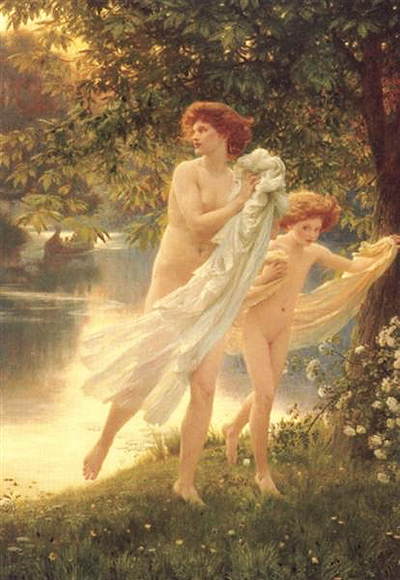
Dickens also recalled Dicksee explaining his diploma picture Startled to a young niece. The two bathers hear a boat, snatch up their clothes and hurry away, he told her. She looked at the thin drapery and asked where the clothes were. The exchange catches a tension that runs through the drawings and the paintings. Dicksee tested how the body would move, then chose which details to carry into the finished picture. His niece looked at the same arrangement and thought about what the bathers would actually need to get dressed. [5]
Two ways of studying a figure
The Royal Academy's Study for Startled, dated about 1892, isolates the younger bather. Pencil sets down the outline and shadow, and white chalk picks out the parts of the body that catch the light. The green paper supplies the middle tone. The figure can therefore read as a solid body before the painter has to place her against the riverbank or balance her movement with the other bather's. In the finished diploma painting, shown in 1892, the two figures have to make sense together. The single study lets us see one of the problems Dicksee addressed separately. [4] [6] [7]
A signed drawing in chalks, catalogued by Bonhams as a study for the head of the principal figure in Startled, has its own publication history. The profile faces left and the hair is swept back, with Dicksee's signature near the lower right. In 1909 Thomas Catling reproduced it as Portrait of a Lady in The Press Album, a volume published in aid of the Journalists' Orphan Fund. Readers turning to the plate facing page 38 met a self-contained portrait. The title gave them little reason to look for the alarmed bather of the Academy picture. An image made to work within a painting now held the page on its own. [8] [9]
A different profile in pencil, catalogued by Christie's as Portrait study of a young woman, in profile and with eyes downcast, shows how much attention Dicksee could give to an unnamed face. The downcast eyes make the angle of the head carry much of the expression. The sale catalogue traces the drawing through the artist's family and suggests two possible entries, both entitled Study of a head, in the Academy's 1933 winter exhibition. The catalogue identifies neither the woman nor the original purpose of the sheet. [10]
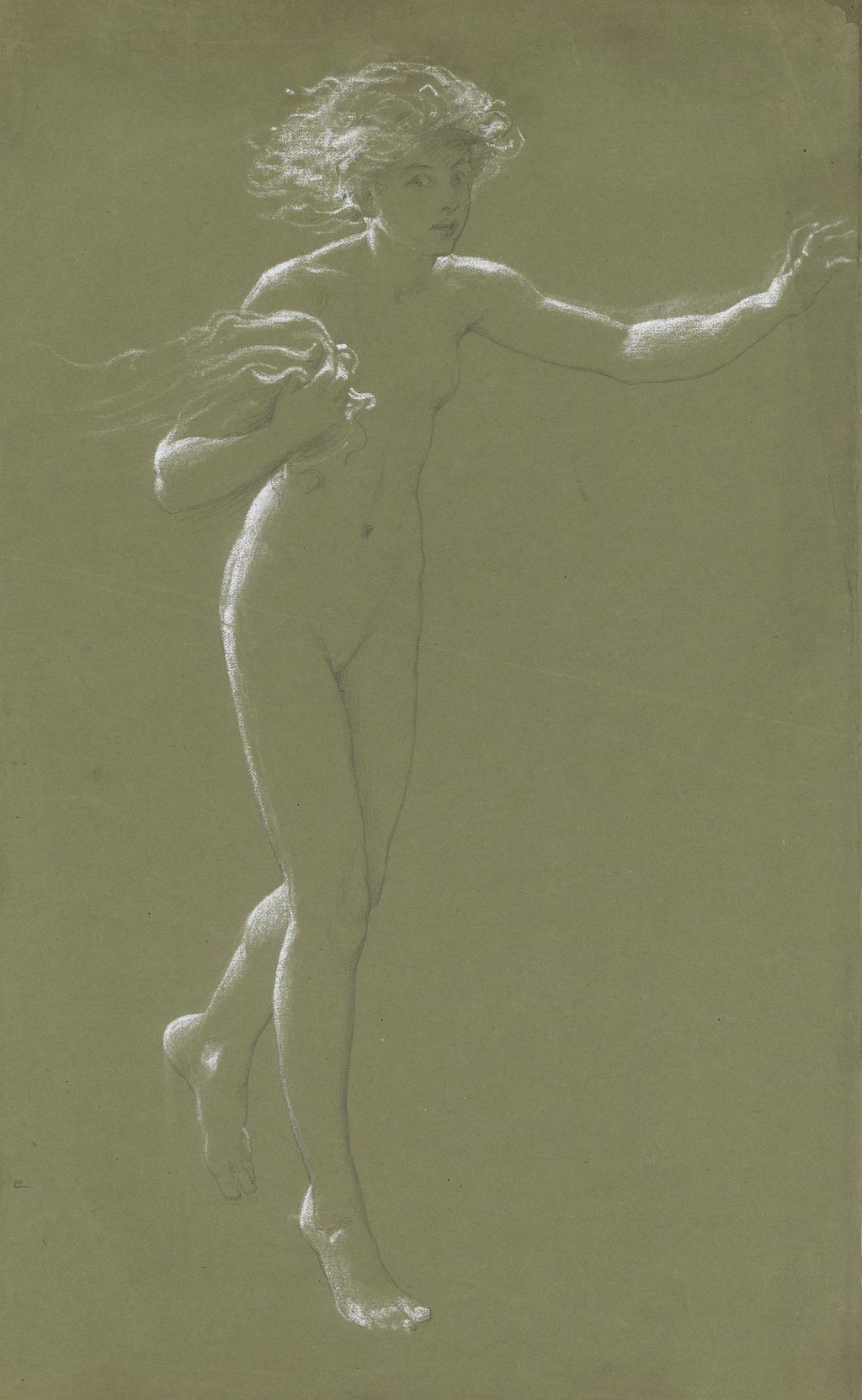
Royal Academy study for Startled, 09/2072. The light marks trace the arm, legs and movement of the drapery. Frank Dicksee, Study for Startled, Royal Academy of Arts, 09/2072. Image source. Public domain.
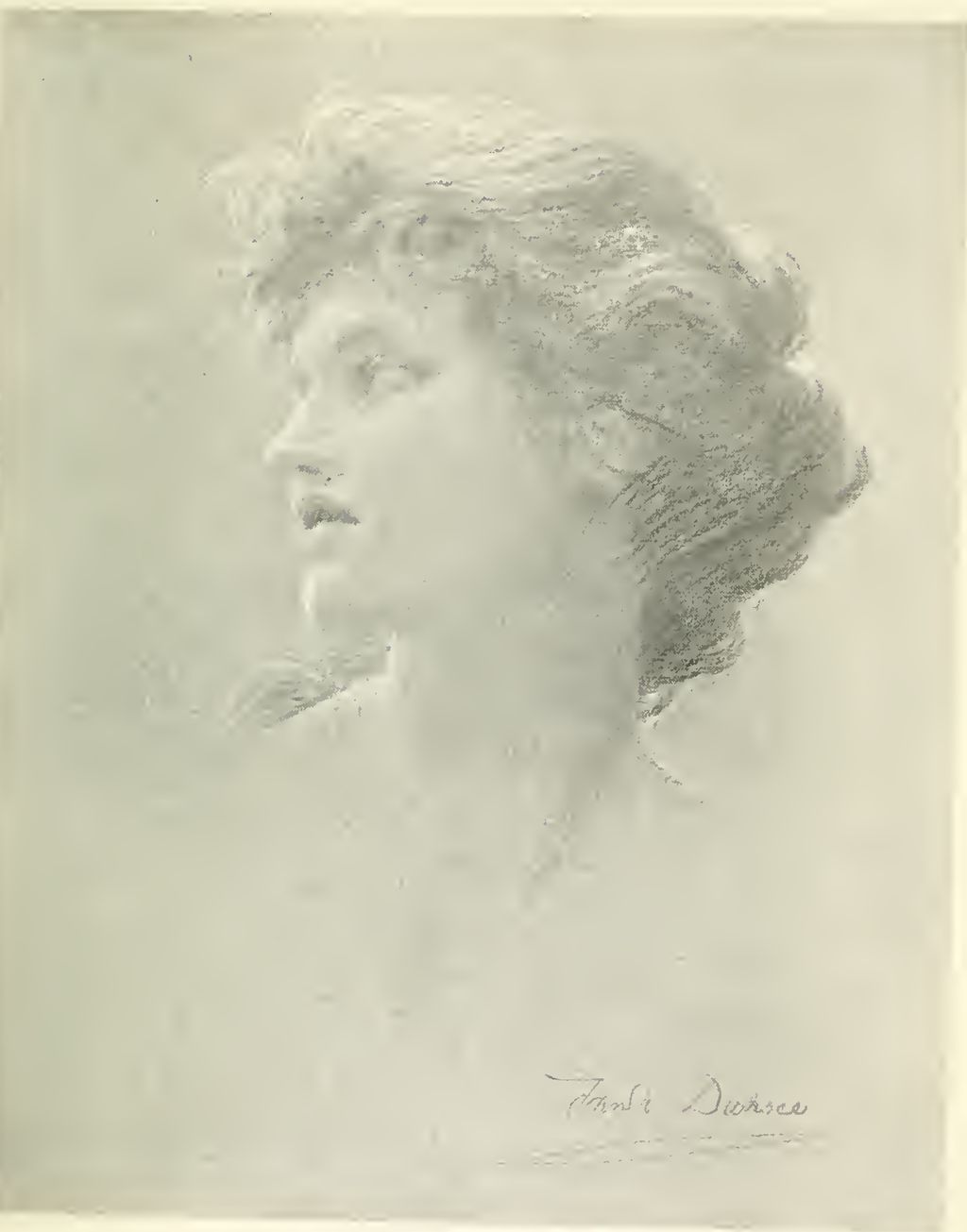
The head study reproduced in The Press Album, 1909, facing p. 38. A separate study from the Academy sheet. Frank Dicksee, study of a head for Startled, printed in The Press Album, 1909, facing p. 38. Image source. Public domain.
Designing a scene and studying its details
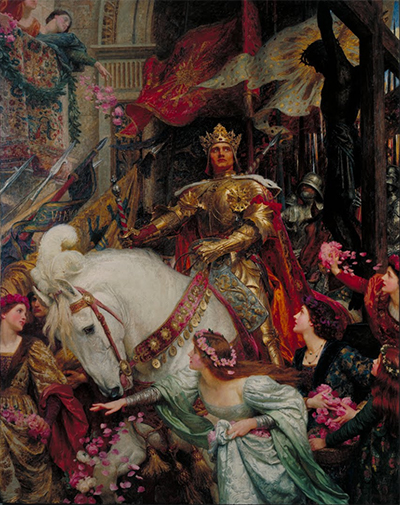
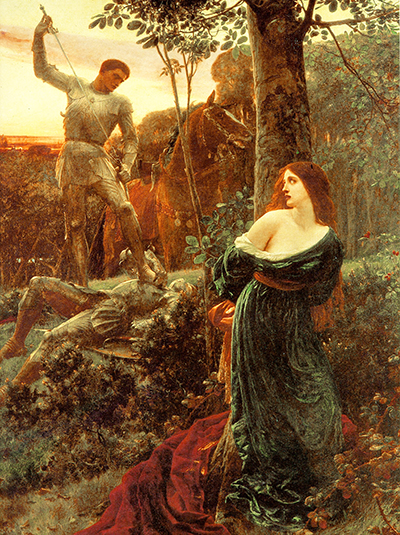
The pencil and white chalk drawing of the damsel in Chivalry is less than 25 centimetres high. The grey sheet gives Dicksee a tone between the marks of the two materials. White can stand for light where it strikes the face, while the pencil can suggest the softer passage into shadow. In the finished oil, she turns towards the armoured knight from the foot of the tree. The sweep of the knight's raised arm commands attention, but the woman's upward look draws the viewer back into the space between them. [1] [11]
The composition study asks bigger questions about the same encounter. Dicksee could use transparent watercolour to establish broad passages, then put in opaque bodycolour where he needed a light accent to cover what was underneath. Scratching out offered another way to recover a lighter mark. That range of handling on a sheet roughly 34 centimetres high suits a design with several kinds of surface and overlapping forms. With the whole composition on the sheet, the size of the figures and the gaps between them could be worked out before the scene was carried onto a canvas more than 1.8 metres high. [1] [2] [11]
Travel could give Dicksee material before he had fixed on a particular pose or story. A sketchbook in the Royal Academy collection records travels that took him to Italy. The 2024 Forlì exhibition checklist dates it to about 1881–84. The Academy describes pencil and some gouache on cream, blue, grey and pale green wove papers. Such grounds could change how a drawing read from the first mark. Pale paper already offers a light for the pencil to work against. Mid-toned paper gives white gouache room to register as a highlight alongside the dark marks. The sketchbook brings this flexible use of drawing into view beyond the individual sheets connected to finished paintings. [12] [13]
Drawing for a picture or for a printed page
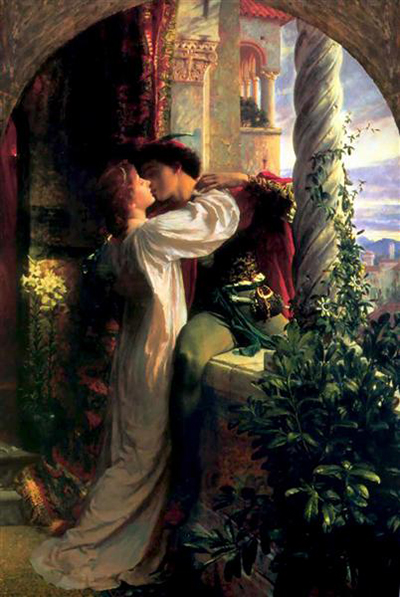
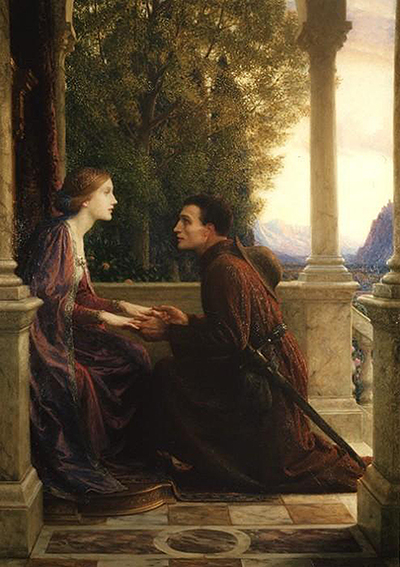
The Victoria and Albert Museum has a drawing in India ink and Chinese white that it identifies as a design for Dicksee's Romeo and Juliet, exhibited at the Royal Academy in 1884. At about 30.5 by 20.3 centimetres, the sheet concentrates on the balance of light and dark in a scene that would occupy a tall canvas. The museum records it as a gift from Herbert Dicksee. The main event in the Southampton oil is the dawn farewell in Act III, with the lovers close enough to embrace as Romeo prepares to descend. A frontispiece to Cassell's separate 1884 edition also shows that farewell. [14] [15] [16]
Dicksee faced another problem when he designed the Act II balcony scene for The Royal Shakespeare. In the Dahesh Museum's object (1999.18), Romeo looks up from the ground. The space between him and Juliet becomes part of their exchange. Dicksee painted this design in monochrome oil on six joined pieces of wood. The scene and his initials are reversed in preparation for reproduction, and the resulting book illustration was engraved on steel. The two episodes can be told apart by Romeo's position alone. In the earlier meeting he stands below Juliet. At the dawn farewell he is already at her level. [14] [17]
Book illustration could send designs into circulation in several forms. In 1881 Cassell advertised a deluxe Evangeline with 23 illustrations from Dicksee's designs. It named Goupil in Paris as the maker of 15 photogravures and credited Klinkicht and Lacour for the wood engravings. The French publisher Boussod, Valadon & Cie advertised 24 reproductions after Dicksee's drawings in a limited edition of Louis Dépret's French translation. The two announcements describe different editions. They also show why the artist's name alone can tell us only so much about a surviving book plate. The design was Dicksee's, and the printed image had its own makers, materials and format. [18] [19]
Returning to a subject on paper
The Art Gallery of New South Wales has a version of Hesperia with traces of pencil beneath watercolour and opaque bodycolour. The painted area is 20 by 12.5 centimetres. Dicksee signed and dated it in 1901, fourteen years after he exhibited the oil at the Royal Academy. Despite the alternative title Figure study, the gallery identifies it as a small-scale reworking of that earlier painting. The mixed technique bears comparison with the Chivalry composition, since both use pencil, transparent and opaque colour, and areas worked by scraping or scratching out. The chronology gives the similar materials different purposes. In Chivalry the paper helps settle an image for a much larger painting. In Hesperia it gives a subject already realised on canvas a new scale and surface. [2] [20]
Frank Dicksee artworks directory
Browse documented paintings, studies, illustration designs and prints. Where an article is available, the title opens it. Simon Toll’s catalogue
| Name | Date | Medium |
|---|---|---|
| A Love Story | 1882 | Painting |
| A Reverie | 1895 | Painting |
| An Offering | 1898 | Painting |
| Chivalry | 1885 | Painting |
| Dawn | 1897 | Painting |
| Elijah Confronting Ahab and Jezebel in Naboth’s Vineyard | By 1875 | Painting |
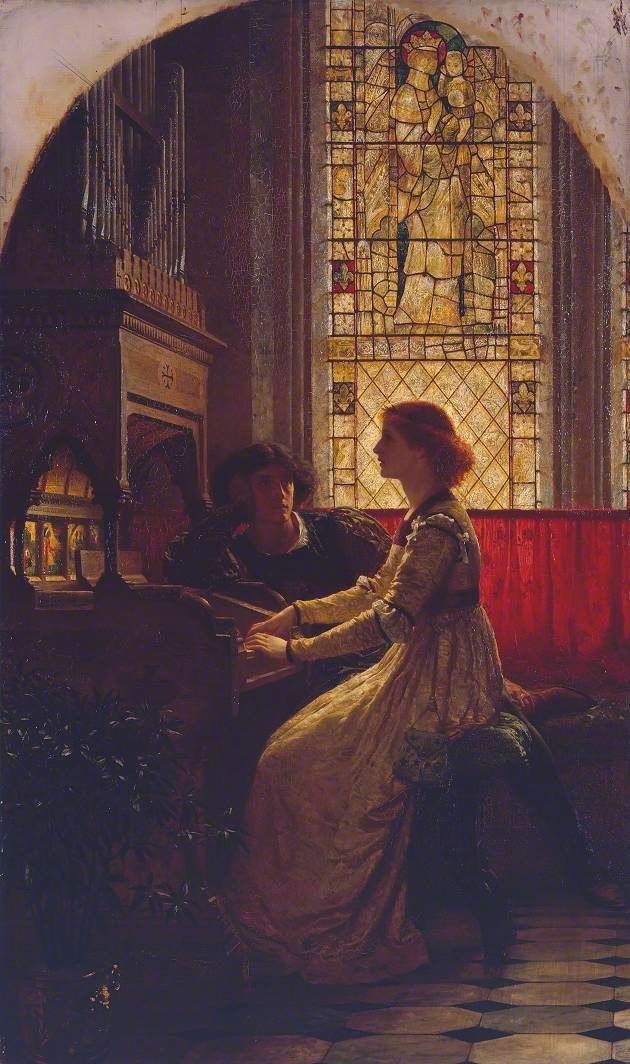
| Harmony | 1877 | Painting |
| Harmony, etching by Charles-Albert Waltner after Dicksee | 1880 | |
| Harmony, the smaller Towneley version | Late 1870s | Painting |
| Hesperia | 1887 | Painting |
| Hesperia, watercolour version | Late 1880s | Painting |
| Italian Coast from La Mortola | 1925 | Painting |
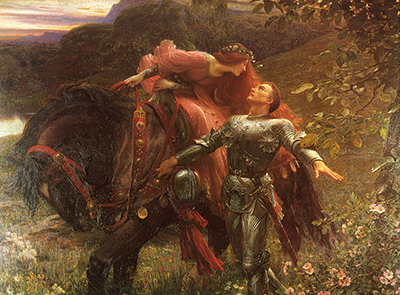
| La Belle Dame sans Merci | c. 1901 | Painting |
| Memories | 1886 | Painting |
| Paolo and Francesca | 1894 | Painting |
| Portrait of Camille Sutton Palmer | 1914 | Painting |
| Portrait of Elsa | 1927 | Painting |
| Portrait of the Duchess of Buckingham and Chandos | 1901 | Painting |
| Romeo and Juliet | 1884 | Painting |
| Romeo and Juliet, monochrome design on joined wood | c. 1880s | Painting |
| Sir Edmund William Gosse, collotype after Dicksee | 1912 | |
| Startled | 1892 | Painting |
| Study for Startled | Early 1890s | Drawing |
| The Confession | 1896 | Painting |
| The Crisis | 1891 | Painting |
| The Daughters of Eve | 1925 | Painting |
| The Embarkation | 1879 | Painting |
| The End of the Quest | 1921 | Painting |
| The Funeral of a Viking | 1893 | Painting |
| The House Builders | 1880 | Painting |
| The Magic Crystal | 1894 | Painting |
| The Passing of Arthur | 1889 | Painting |
| The Redemption of Tannhäuser | 1890 | Painting |
| The Symbol | 1881 | Painting |
| The Two Crowns | 1900 | Painting |
| Yseult | 1901 | Painting |
Discussion
Look again at the images and ideas explored in Frank Dicksee Drawings. These editorial prompts invite your observations.
Reader Insights
Compare the Royal Academy's Study for Startled with the painted scene. Which marks suggest movement before the other bather and the setting come into view?
How does a mid-toned ground change what Dicksee needs to draw or highlight in the Chivalry head?
What changes when the signed chalk drawing for Startled appears under the title Portrait of a Lady?
Join the Conversation
Choose a Dicksee study and describe one decision you can see on the sheet. If a painting or a book illustration survives, tell us what happens to that detail in the later version.
References
- Christie's, Study for the head of the damsel in ‘Chivalry’, Forbes collection, lot 83, object 4051767. View source.
- Christie's, Composition study for ‘Chivalry’, Forbes collection, lot 82, object 4051766. View source.
- Southampton City Art Gallery, Romeo and Juliet, SOTAG 1006, artist and collection entry. View source.
- Cassell and Company, Cassell's Universal Portrait Gallery, ‘Mr. Frank Dicksee, R.A.’, p. 346. View source.
- Mary Angela Dickens, ‘Mr. Frank Dicksee, R.A.’, The Windsor Magazine, 1897, p. 391. View source.
- Royal Academy of Arts, Study for ‘Startled’, 09/2072, collection photograph and metadata. View source.
- Royal Academy of Arts, Entangled Pasts, 1768–now, 2024 exhibition guide, entry for Startled. View source.
- Bonhams, A study for ‘Startled’, British and European Art, lot 35, p. 20. View source.
- Thomas Catling, ed., The Press Album, John Murray, 1909, list of illustrations and Portrait of a Lady, plate facing p. 38. View source.
- Christie's, Portrait study of a young woman, in profile and with eyes downcast, object 4599636. View source.
- Christie's, Chivalry, 1885, lot 11, object 5631457. View source.
- Royal Academy of Arts, Annual Report 2023–24, loans list, Sketchbook with travel drawings including Italy, 06/3640. View source.
- Fondazione Cassa dei Risparmi di Forlì, Preraffaelliti. Rinascimento moderno, 2024 exhibition checklist, PDF p. 44. View source.
- Victoria and Albert Museum, Romeo and Juliet, sketch design, E.351-1933, collection record. View source.
- Dennis T. Lanigan, ‘Romeo and Juliet’, The Victorian Web, V&A drawing, canvas and frontispiece illustrations with commentary. View source.
- Cassell & Company, Romeo and Juliet, 1884, title page, list of illustrations and frontispiece. View source.
- Dahesh Museum of Art, Romeo and Juliet, 1999.18, collection record. View source.
- Cassell, Petter, Galpin & Co., Evangeline publisher's advertisement, The Publishers' Circular, 1 October 1881, p. 839, no. 498. View source.
- Boussod, Valadon & Cie, Catalogue des ouvrages de luxe, Évangéline entry, p. 4. View source.
- Art Gallery of New South Wales, Hesperia, 1901, collection record 7149, presented through Google Arts & Culture. View source.