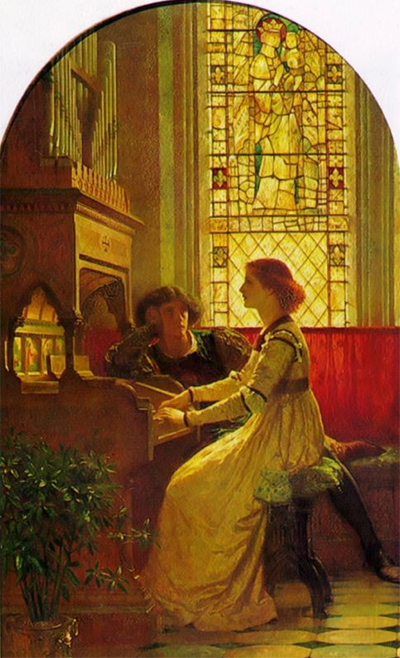
 by Tom Gurney
Tom Gurney BSc (Hons) is an art history expert with over 20 years experience
Published on June 19, 2020 / Updated on November 25, 2026
Email: tomgurney1@gmail.com / Phone: +44 7429 011000
Frank Dicksee Quotes: Introduction
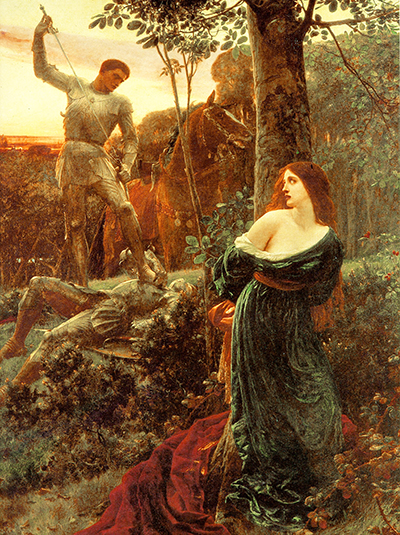
Frank Dicksee once tried to study breaking waves from a boat steadied by two men and a rope. Nearly thirty years after Mary Angela Dickens published that story, a newspaper quoted him on a different problem: what makes a painting worth looking at? His answer put human feeling at the centre. The studio profile, the presidential interview and the reviews written between them show how much could depend on who was speaking and what they wanted a picture to do. [1] [2]
At a Glance
- 1896–97 · In the studio.Mary Angela Dickens reports how Dicksee studied colour, light and passing expressions. [1]
- December 1924 · On the Academy presidency.In an interview reported the following January, Dicksee discusses women’s training, new painting and the Academy’s duty to the public. [2]
- 1895 and 1928 · Other voices.Two critics disagree about what a painting can convey, and a letter recalled by a friend’s daughter records a small act of artistic care. [3] [4] [5]
Contents
- Frank Dicksee on painting from life
- Dicksee on what makes a good picture
- Two critics look at Dicksee’s pictures
- Dicksee writing about another artist’s work
Frank Dicksee on painting from life
On a winter afternoon in Peel Street, the approach to Dicksee’s studio offered Mary Angela Dickens a grey sky and a row of ordinary London houses. Inside, she found subdued furnishings and a suit of armour that caught the light. Dickens calls the room “essentially a background and a workshop”. The phrase is hers. It sets the terms of her visit: the armour could be beautiful to look at and still be there because it gave a painter something to study. [1]
Dickens describes a working sequence that began with an imaginative sketch. If a model could settle naturally into a pose, the sketch stood a chance of surviving. If successive models failed to make a pose convincing, Dicksee reconsidered it. Studies of drapery, tone and other details followed. The sitting was therefore a means of testing the composition. In Dickens’s account, the painter could decide what he wanted a figure to express before he knew whether a real person could turn or lean in quite that way. [1]
A face glimpsed at Chatsworth
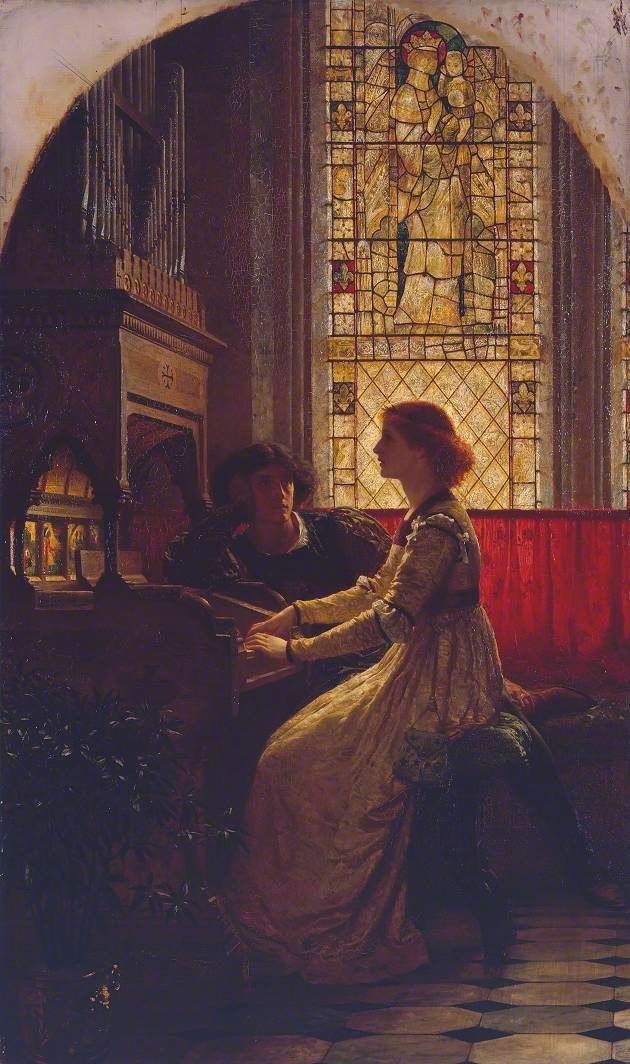
In the story Dickens tells about Harmony, the young Dicksee was visiting Chatsworth when a guide drew his attention to a woman in a passing party. At the junction of two corridors he caught a glimpse “of a cheek and a bit of nose beyond”. According to Dickens, years later, when he was looking for a model for the painting, he recognised the face as soon as a woman recommended to him came to the studio. Her account gives the guide a part in the encounter and leaves the model unnamed. [1]
That fleeting view is worth looking for in the painting. The organist turns away from her companion, exposing a narrow contour of cheek and nose while he watches her intently. The coloured light and the carved organ invite a leisurely look. The glimpse Dicksee remembered could have registered in an instant. The anecdote accounts for the interest of that particular angle while leaving the rest of the scene to the painter’s invention. [1] [6]
A boat that would not hold still
“One could only make little studies.” [1]
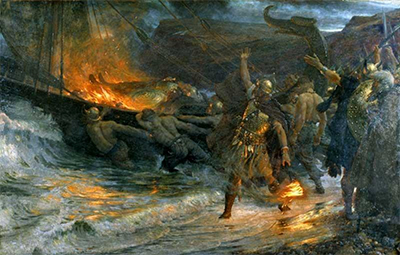
Dicksee was talking about the sea off Seaton, which he studied for The Funeral of a Viking. To get the point of view he wanted, he needed to be among the waves. Dickens describes his experiments with a bathing machine, a plank and finally a boat. Even with help securing it, the boat rolled. There was a different constraint when he studied for Evangeline at Lynmouth. From land he had a view of the coast and sea, but the afterglow he wanted lasted only briefly. He returned evening after evening to study the light in the interval before darkness. [1]
The sea at Seaton kept changing his position as well as the thing he was looking at. Each study could catch part of an effect that a large studio painting had to make continuous. In The Funeral of a Viking, the light over the procession and the near water have to feel as though they belong to the same moment, even though the artist reached it by stages. [1] [7]
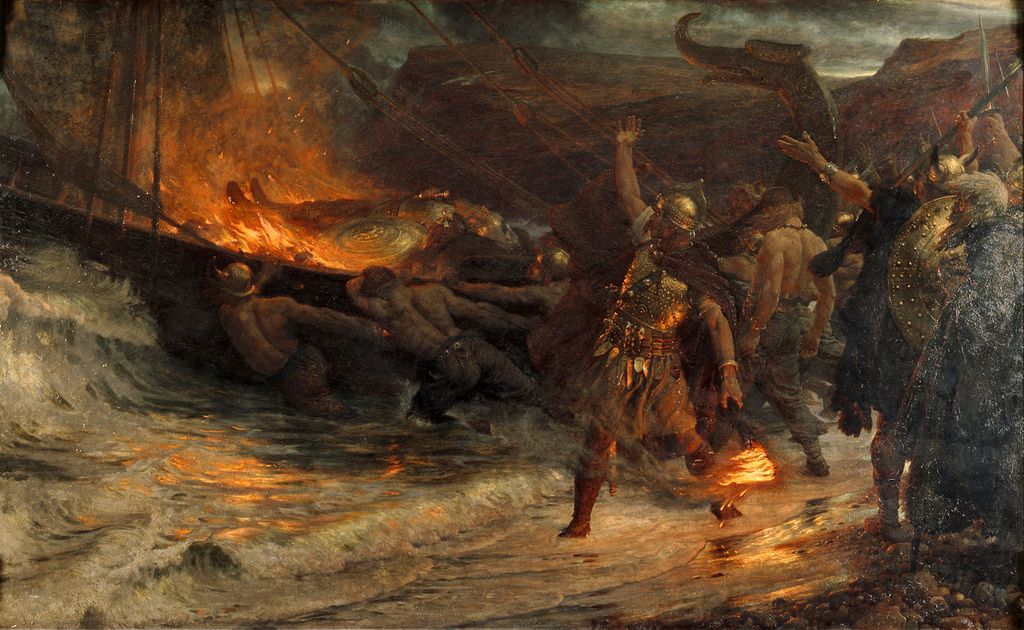
The Funeral of a Viking, Manchester Art Gallery. Dicksee described the difficulty of making the sea studies off Seaton. Image source. Public domain.
Dicksee on what makes a good picture
In its issue of 27 January 1925, New Zealand’s Otago Daily Times ran a dispatch from London dated 16 December. The Royal Academy had elected Dicksee its president in December 1924. Under the heading A Good Picture, the report has him describe “a picture that appeals to the emotions”. His idea was quite specific. He wanted viewers to recognise an incident or an idea of human interest, and thought the arrangement of forms and the handling of paint could only carry the viewer so far. He also expected the Academy to guide public taste. A judgement about what made pictures good therefore had consequences for the work that an institution might encourage. [2] [8]
In the same interview, Dicksee used the phrase “a rather dangerous revolutionary” to recall how his younger self had been regarded. He claimed that he had helped secure facilities for women students to study from life and the nude. The Academy’s own history shows a campaign lasting years. Its archive preserves a petition from women students dated 4 December 1883, and the earliest provision for a women’s life class came in 1893, more than twenty years after Dicksee formally entered the Schools. The dates make his remark revealing as a defence of his record. The petition records the women themselves pressing for that change. [2] [8] [9] [10]
Dicksee urged the Academy “not to reject anything simply because it is new”. He thought new work deserved serious attention when it was sincere and showed sufficient skill. He praised the Victorians Millais, Leighton and Watts, while finding that Leighton could be overly ornamental. In December 1925, speaking to Academy students after the distribution of prizes, he recommended studying the Old Masters and pointed out how much students could see without travelling far. In the published address, as quoted by historian Vassil Yordanov, Dicksee insisted on white standards of beauty and invoked the language of empire. Two years later, at the same annual ceremony, he disparaged modern painting he associated with Black influence and drew a parallel with Black American music. Tim Barringer traces those remarks to the contemporary report in The Times. The two speeches show how Dicksee used the authority of the presidency to define what students should look at and what they were encouraged to dismiss. [2] [11] [12] [13]
The audience changed again when Dicksee spoke on the radio about the 1927 exhibition of Flemish and Belgian art. From the surviving Academy typescript, historian Ilaria Scaglia records his appeal to the shared wartime experience of Britain and Belgium. Here the Royal Academy’s public voice lent a diplomatic purpose to the display of Old Master paintings. A prize-giving address might direct the student’s eye, while a broadcast could ask the whole audience to remember why two countries had fought together. [14]
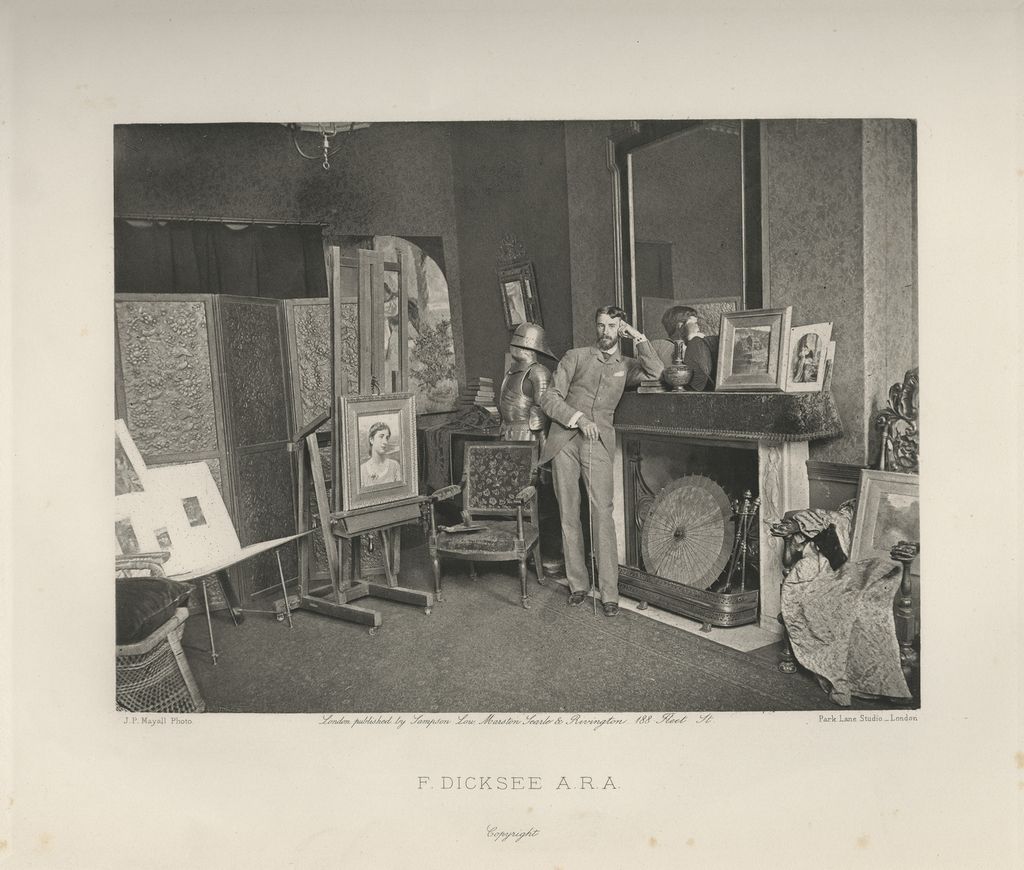
Frank Dicksee in his studio, photographed by Joseph Parkin Mayall. Image source. Public domain.
Two critics look at Dicksee’s pictures
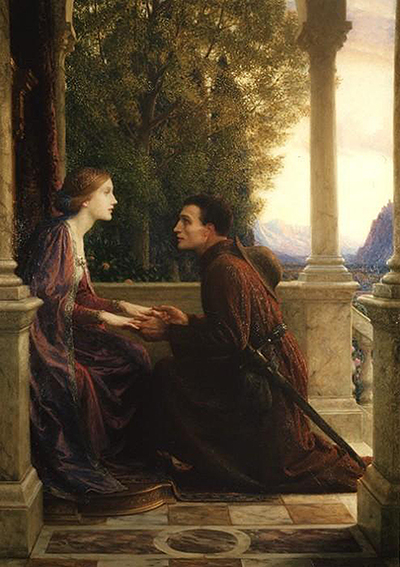
In June 1895, Robert Jope Slade recalled seeing A Reverie beside Paolo and Francesca in Dicksee’s studio. He found it striking that “such different pictures had been painted by the same man in the same year”. He called A Reverie “an expression of extreme modernity”. Both works appeared at the Academy in 1895. The date on Paolo and Francesca is 1894. [3] [15]
Slade meant the choice of lamplight and a contemporary drawing room as well as the loose handling of the paint. In the Dante picture, the open book and the lovers leaning towards one another suggested an affinity with the Pre-Raphaelites. For Slade, the surprise lay in finding both manners at work in the same studio. [3]
The critic who signed the Spectator review D. S. M. asked what happened when a visitor tried to read A Reverie without help. The bright lamp caught the eye first. Then a second, warmer light competed for attention, and the people in the room offered several possible centres of interest. A woman at a piano, a listening man and an apparition had to convey that a song was bringing a dead woman back to the man’s mind. The reviewer doubted that this could be made clear by painting an apparition and argued that the look of the listener could suggest the feeling of the music more convincingly. The disagreement reaches into Dicksee’s later definition of a good picture. Both he and the critic wanted a picture to move its audience. They differed over how much of a story the painter needed to show to make that happen. [2] [4]
Dicksee writing about another artist’s work
In a remembrance published in The Times on 20 October 1928, Winifred Holiday quoted a letter Dicksee had written to her earlier that year. After her father Henry Holiday died, his life-size statue Sleep was among the last works left at the studio. Dicksee found room for it in one of his own studios. Cleaning had lifted some of the colour Henry had applied to the sculpture, and Dicksee wrote that he had gone over the figure himself to restore it. Winifred remembered the pleasure he took in unveiling the result for her. The care over a painted surface is familiar from the earlier studio profile. Here the judgement was more intimate. He wanted the artist’s daughter to see what remained of a work her father had valued. [5]
Frank Dicksee artworks directory
Browse documented paintings, studies, illustration designs and prints. Where an article is available, the title opens it. Simon Toll’s catalogue
| Name | Date | Medium |
|---|---|---|
| A Love Story | 1882 | Painting |
| A Reverie | 1895 | Painting |
| An Offering | 1898 | Painting |
| Chivalry | 1885 | Painting |
| Dawn | 1897 | Painting |
| Elijah Confronting Ahab and Jezebel in Naboth’s Vineyard | By 1875 | Painting |
| Harmony | 1877 | Painting |
| Harmony, etching by Charles-Albert Waltner after Dicksee | 1880 | |
| Harmony, the smaller Towneley version | Late 1870s | Painting |
| Hesperia | 1887 | Painting |
| Hesperia, watercolour version | Late 1880s | Painting |
| Italian Coast from La Mortola | 1925 | Painting |
| La Belle Dame sans Merci | c. 1901 | Painting |
| Memories | 1886 | Painting |
| Paolo and Francesca | 1894 | Painting |
| Portrait of Camille Sutton Palmer | 1914 | Painting |
| Portrait of Elsa | 1927 | Painting |
| Portrait of the Duchess of Buckingham and Chandos | 1901 | Painting |
| Romeo and Juliet | 1884 | Painting |
| Romeo and Juliet, monochrome design on joined wood | c. 1880s | Painting |
| Sir Edmund William Gosse, collotype after Dicksee | 1912 | |
| Startled | 1892 | Painting |
| Study for Startled | Early 1890s | Drawing |
| The Confession | 1896 | Painting |
| The Crisis | 1891 | Painting |
| The Daughters of Eve | 1925 | Painting |
| The Embarkation | 1879 | Painting |
| The End of the Quest | 1921 | Painting |
| The Funeral of a Viking | 1893 | Painting |
| The House Builders | 1880 | Painting |
| The Magic Crystal | 1894 | Painting |
| The Passing of Arthur | 1889 | Painting |
| The Redemption of Tannhäuser | 1890 | Painting |
| The Symbol | 1881 | Painting |
| The Two Crowns | 1900 | Painting |
| Yseult | 1901 | Painting |
Discussion
Look again at the images and ideas explored in Frank Dicksee Quotes. These editorial prompts invite your observations.
Reader Insights
Look at the organist’s profile in Harmony. How much of her absorption in the music comes through in that small area of the picture?
In A Reverie, would the listener’s expression carry the story for you if the apparition were absent?
Join the Conversation
Choose a remark from the studio profile, the reviews or the presidential interview and share which painting it changes for you.
References
- Mary Angela Dickens, “A Popular Painter: Mr. Frank Dicksee, R.A.”, The Windsor Magazine, vol. 5 (December 1896–May 1897), pp. 385–391. Studio pp. 385–386, Chatsworth pp. 386 and 388, field studies pp. 389–390 and working method p. 391. View source.
- Otago Daily Times, “The Royal Academy”, London dispatch dated 16 December 1924, published 27 January 1925, issue 19389, p. 4, sections “New Phases of Work” and “A Good Picture”. View source.
- Robert Jope Slade, “The Royal Academy of Arts, 1895”, The Art Journal, new series, vol. 57, June 1895, p. 171. View source.
- D. S. M., “Art”, The Spectator, 18 May 1895, p. 15. View source.
- Winifred Holiday, remembrance in The Times, 20 October 1928, excerpted as “The Death of Sir Frank Dicksee” in Paul Ripley’s compilation for the Art Renewal Center. Includes the extract from Dicksee’s letter. View source.
- Tate, Harmony, 1877, collection record N01587. View source.
- Nancy Rose Marshall, “Victorian Imag(in)ing of the Pagan Pyre: Frank Dicksee’s Funeral of a Viking”, 19: Interdisciplinary Studies in the Long Nineteenth Century, no. 25, 2017, pp. 32–34. View source.
- Royal Academy of Arts, Sir Frank Dicksee PRA (1853–1928), artist register. View source.
- Royal Academy of Arts, “Women and the Royal Academy of Arts”, including its archive’s petition of women students to the President and Council, 4 December 1883. View source.
- University of Reading Art Collections, “Learning to Draw”, on women’s admission to life drawing and the schools’ contrasting policies. View source.
- Tim Barringer, “1927 Dod Procter’s Morning”, The Royal Academy of Arts Summer Exhibition: A Chronicle, 1769–2018, Paul Mellon Centre, 2018. The “1927 in Context” section cites “Sinister Tendencies in Art”, The Times, 12 December 1927, p. 19. View source.
- J. Mason, “Royal Academy Schools Prize Distribution”, The Architects’ Journal, 23 December 1925, p. 937, on the address given on 10 December. View source.
- Vassil Yordanov, MPhil thesis, University of East Anglia, 2019, pp. 69–70 and note 142. Quotes Frank Dicksee, Discourse to the Students of the Royal Academy on the Distribution of the Prizes, London, 1925, p. 13. View source.
- Ilaria Scaglia, “‘Beauty Has Ever a Healing Touch’: Visible Internationalism at the 1927 Exhibition of Flemish and Belgian Art in London”, Contemporary European History, vol. 33, 2024, note 61. Quotes Royal Academy archive RAA/PRA/5/1, Dicksee broadcast typescript, pp. 1–2. View source.
- Christie’s, Paolo and Francesca, lot 5161181, signed and dated 1894, Royal Academy exhibition history and signature. View source.